Organ Pipes and Burnt Mountain
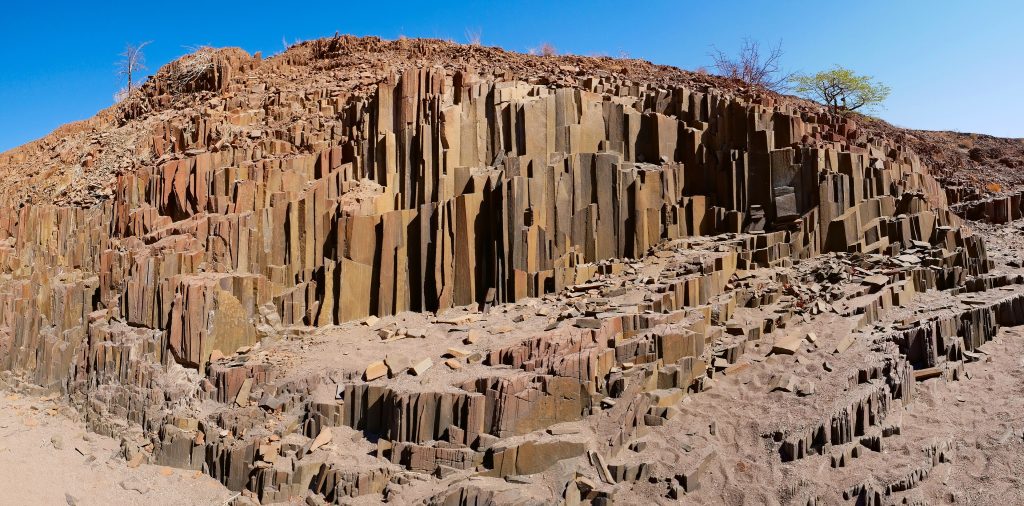
Two geological oddities sit within sight of each other about six kilometres east of Twyfelfontein. The Organ Pipes are a 100 metre stretch of four metre dolerite columns in a small gorge. Burnt Mountain is a ridge of shale that was literally baked black by molten rock. Both take twenty minutes and both are frequently skipped.
The Organ Pipes
The formation is small, easy to reach and genuinely unusual.
A gorge holds a stretch of around 100 metres of vertical dolerite columns reaching about four metres high, some sources giving up to five. They are hexagonal and pentagonal in cross section, packed together in a wall.
The rust colouring comes from weathering over an enormous span, and it is what makes them photograph well.
An obvious path leads into the gorge from a parking area beside the gravel road, and a walking loop of one to two kilometres takes in the riverbed and the formations.
There are no facilities on site beyond parking. No toilets, no shop, no permanent structures.
The comparison people reach for is the Giant’s Causeway in Northern Ireland, which shares the same columnar jointing process.
Do these two on the way to or from Twyfelfontein rather than as a separate outing. They sit around six kilometres east of the rock engravings on the same road, take twenty minutes each, and need no permit or guide. Travellers who plan them as a destination find them underwhelming; travellers who stop on the way through find them a good addition to a Damaraland morning.
How the Columns Formed
The process is called columnar jointing and it explains the shape.
Molten dolerite intruded into cracks within underlying slate and shale formations of the Karoo Supergroup. As it cooled it contracted, and contraction in a cooling sheet of rock produces a regular fracture pattern from the surface inward.
That pattern is hexagonal because hexagons are the most efficient way to divide a plane, which is why the same shape appears in basalt formations worldwide.
Dating estimates cluster around 120 to 132 million years ago, in the Early Cretaceous, associated with the Etendeka volcanic event.
That event was part of the breakup of the supercontinent Gondwana, when molten rock pushed to the surface as the landmass split.
The same volcanic province produced the basalt of the Etendeka Plateau in the Palmwag Concession, so the geology here connects directly to the country further northwest.
Scientists have modelled the hexagonal structure in laboratories using cornstarch and water, which produces the same pattern on a small scale.
Burnt Mountain
The neighbouring ridge is stranger than the columns and less photogenic.
Burnt Mountain, known in Afrikaans as the Verbrandeberg, is a barren ridge where almost nothing grows, black and clinker like across its slopes.
It was proclaimed a national monument in 1956, with 15 September given as the date in some sources.
Its appearance is the product of contact metamorphism. A sheet of dolerite at around 1,000 degrees intruded into black carbonaceous shale of the Permian Prince Albert Formation, part of the Karoo sequence.
The heat baked the shale and drove off volatile organic components, leaving a charred black burnt mass, which is exactly what the name describes.
The mountain was literally burned, which makes it one of the few Namibian place names that is a precise geological description rather than a metaphor.
Climbing on Burnt Mountain is not permitted, so it is viewed from the ground.
A Correction Worth Knowing
One factual error circulates widely about the Organ Pipes and it is worth flagging.
Several sources describe the columns as dolomite. They are dolerite, which is a completely different rock: a medium grained intrusive igneous rock, equivalent to basalt in composition and intermediate between basalt and gabbro.
Dolomite is a sedimentary carbonate rock and would not form columns by this process at all.
The confusion between the two words is common and it changes the explanation entirely, since the columns exist because igneous rock cooled and contracted.
Guides at the site mostly get it right, and printed material and websites frequently do not.
The same distinction matters at Burnt Mountain, where a dolerite sheet baked sedimentary shale, and calling either rock dolomite makes the whole account incoherent.
When to See Them
Timing matters far more at Burnt Mountain than at the Organ Pipes.
Burnt Mountain works at sunrise and sunset, when low sun brings out deep shades of red, purple and black across the slopes and the mountain appears to be ablaze, which is where the name gained its second meaning.
Through the middle of the day it flattens into a uniform dark ridge and photographs poorly, which is when most visitors see it and why many find it disappointing.
The Organ Pipes are in a gorge and less dependent on the sun angle, though early or late light in the gorge brings out the rust colouring.
Damaraland heat builds fast, and the walk into the gorge is exposed with no shade.
May to September gives comfortable conditions. Summer means going at first light or not at all.
Fitting Them Into a Day
These are components of a Damaraland circuit rather than destinations in themselves.
Twyfelfontein. Six kilometres west, with over 2,500 rock engravings and Namibia’s first UNESCO World Heritage Site. Compulsory guides, around ninety minutes.
The Petrified Forest. North towards Khorixas, with fossilised trunks up to 34 metres long, around 280 million years old. Guided visits, roughly forty minutes.
The Damara Living Museum. In the same area, an open cultural site with a stated set up format rather than a working village, which is the honest arrangement.
Vingerklip. East towards Outjo, a 35 metre sedimentary pillar above the Ugab Terraces. A longer drive and a bigger sight.
Twyfelfontein, the Organ Pipes, Burnt Mountain and the Petrified Forest make a comfortable single day from a base near Twyfelfontein or Khorixas.
Etendeka and the Wider Geology
These two sites are the accessible edge of a volcanic event that made a large part of northwestern Namibia what it is.
The Etendeka volcanism of around 132 million years ago accompanied the breakup of Gondwana, when the landmass that became South America began separating from the one that became Africa.
Enormous quantities of magma reached the surface, laying down basalt across the region. What remains is the Etendeka Plateau: flat topped hills, rubble slopes and dark rock terraces stretching to the horizon through Damaraland and the Palmwag Concession.
The same event produced matching formations in Brazil, in what geologists call the Parana-Etendeka province, since the two continents were joined when it happened.
Standing at the Organ Pipes puts you at a small, legible piece of that: molten rock forced into a crack, cooled, contracted and fractured into columns, then exposed by erosion.
Namibia offers several places where continental drift is visible on the ground, including the Petrified Forest nearby and the Mesosaurus fossils near Keetmanshoop, whose distribution across Africa and South America formed part of the original evidence for the theory.
Practical Details
The arrangements are simple, which is part of the appeal.
Both sites sit around six kilometres east of Twyfelfontein and west of Khorixas, in the Kunene Region, reached on gravel from the same road.
Access is via a short path from a parking area, with no permit and no guide required at either.
Modest entry fees may be charged locally, so carry cash.
Roads are gravel and manageable in an ordinary car in dry conditions, with higher clearance more comfortable.
Accommodation is at Twyfelfontein Country Lodge, Camp Kipwe, Mowani Mountain Camp and other properties in the Twyfelfontein area, or at Khorixas.
Bring water, closed shoes and a hat. The gorge walk is short and entirely exposed.
Photographing Them
Both sites reward a little planning and punish arriving at noon.
Burnt Mountain needs low sun. Sunrise and sunset bring out reds, purples and blacks across the slopes; midday flattens it into a uniform dark ridge and produces the disappointing photographs most visitors come away with.
The Organ Pipes sit in a gorge, so the light works differently. Early or late sun reaches down into the gorge and picks up the rust colouring on the columns, while overhead midday light produces flat grey.
Close work on the columns is the stronger option than a wide shot, since the hexagonal cross sections and the packing pattern are what make the formation unusual.
A wide lens helps in the gorge, which is narrow enough that stepping back is not always possible.
Dust is constant on Damaraland gravel, so keep gear sealed between shots and change lenses inside the vehicle.
Organ Pipes and Burnt Mountain Questions
What are the Organ Pipes?
A stretch of around 100 metres of vertical dolerite columns reaching about four metres high in a small gorge east of Twyfelfontein, hexagonal and pentagonal in cross section and rust coloured from weathering. They formed through columnar jointing when molten dolerite cooled and contracted, roughly 120 to 132 million years ago during the Etendeka volcanic event associated with the breakup of Gondwana.
Are the columns dolomite or dolerite?
Dolerite, and the distinction matters. Several sources say dolomite, which is a sedimentary carbonate rock that would not form columns by this process at all. Dolerite is a medium grained intrusive igneous rock equivalent to basalt in composition. The columns exist because igneous rock cooled and contracted, so calling it dolomite makes the explanation incoherent.
Why is Burnt Mountain black?
Because it was baked. A sheet of dolerite at around 1,000 degrees intruded into black carbonaceous shale of the Permian Prince Albert Formation, and the heat drove off volatile organic components, leaving a charred black clinker like mass. The name is a precise geological description rather than a metaphor. It was proclaimed a national monument in 1956.
When should I visit?
Sunrise or sunset for Burnt Mountain, when low sun brings out deep reds, purples and blacks and the mountain appears ablaze. Through the middle of the day it flattens into a uniform dark ridge and photographs poorly, which is when most visitors see it. The Organ Pipes sit in a gorge and are less dependent on sun angle, though early or late light brings out the rust colouring.
Do I need a permit or a guide?
No to both. An obvious path leads into the gorge from a parking area, with a walking loop of one to two kilometres through the riverbed and formations. There are no facilities beyond parking, meaning no toilets or shop. Modest entry fees may be charged locally, so carry cash. Climbing on Burnt Mountain is not permitted.
Are they worth the stop?
As part of a Damaraland circuit, yes. They sit around six kilometres east of Twyfelfontein on the same road and take twenty minutes each. Travellers who plan them as a destination find them underwhelming; those who stop on the way to or from the rock engravings find them a good addition. Combine with the Petrified Forest for a full day.
How do the columns compare to the Giant’s Causeway?
They share the same geological process of columnar jointing, where cooling igneous rock contracts and fractures into a regular hexagonal pattern from the surface inward. The Namibian site is smaller and considerably less visited. The pattern has been reproduced in laboratories using cornstarch and water, which produces the same shapes on a small scale.
Booking Your Namibia Trip
The safari companies and tour operators listed on this website put trips like this together for a living and know which camps, guides and routes actually deliver. We are an independent guide to Namibia; we do not book or sell tours ourselves.
When you are ready, arrange your safari, tour or holiday with one of the recognised operators listed here. Tell them your dates and what matters most, and a real person, not a form, will handle the itinerary, park bookings and logistics for you.