Damaraland
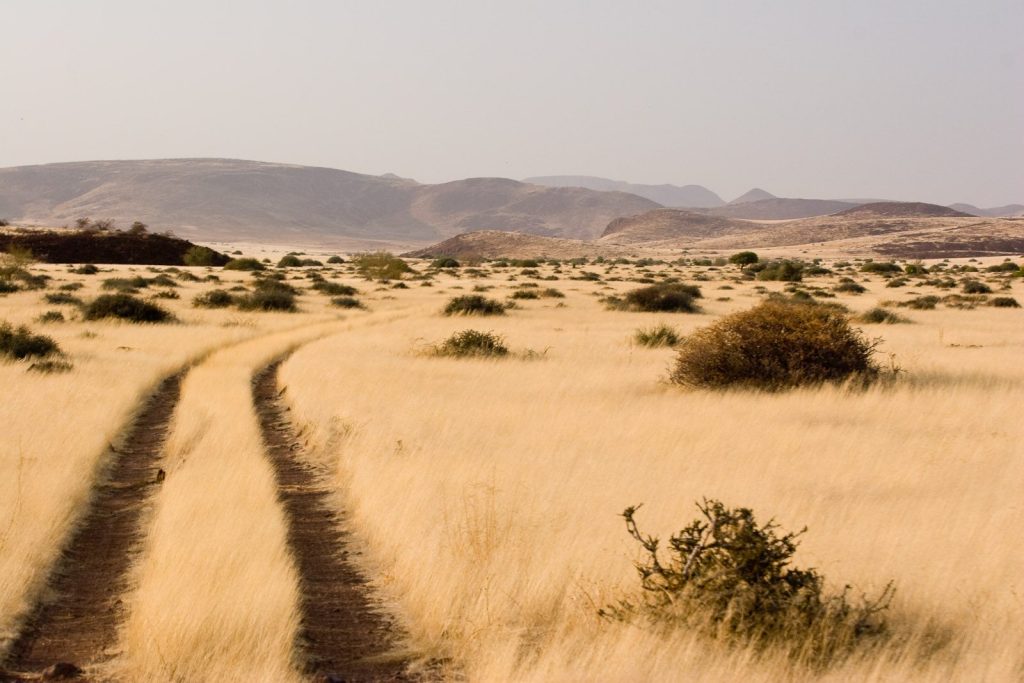
Damaraland is a region of red rock, flat topped mountains and dry riverbeds in northwestern Namibia, holding the largest free roaming black rhino population on earth and the country’s first UNESCO World Heritage site at Twyfelfontein. It sits between the Skeleton Coast and Etosha, and it is unfenced communal land rather than a national park. Most visitors give it two to three nights.
Twyfelfontein Rock Art Tours and the Engraving Valley
Twyfelfontein holds over 2,500 rock engravings cut into sandstone slabs in a single valley, made across several thousand years, and it became Namibia’s first UNESCO World Heritage site. The name means doubtful fountain, after a spring that ran unreliably.
Guided visits are compulsory and the guides are local, which is part of the point. The engravings depict giraffe, rhino, lion, elephant and antelope, along with animal spoor carved as tracking lessons and geometric forms whose meaning remains argued over. The famous Lion Man panel shows a lion with a curiously extended tail ending in a paw print.
Go early. The valley heats up quickly, the walk involves rock steps and loose ground, and the low light in the first hours picks out the engravings far better than midday sun.
Note that some sources describe this as Namibia’s only World Heritage site, which is no longer accurate since the Namib Sand Sea was subsequently listed. Twyfelfontein was the first.
Desert Adapted Elephant Tracking in the Riverbeds
The elephant of the Huab, Aba Huab and Hoanib riverbeds are ordinary African elephant whose behaviour has changed under extreme aridity. They range home territories of several hundred kilometres, go days between drinking, dig water out of apparently dry sand, and move with a quietness that other populations do not show.
Researchers working directly on these animals put the desert dwelling population at around 150 across the five ephemeral rivers of the northwest, recovered from a remnant a few decades ago. Higher figures of six or seven hundred that circulate in travel writing count all elephants across the wider region, including non desert populations further inland, so they overstate how many desert elephants there are.
The Aba Huab near Twyfelfontein offers self drive access and elephant do turn up there. The main Huab corridor is reached through conservancy partnered lodges. Sightings are genuinely uncertain and depend on where the herds have moved that week, so ask your camp what has passed through recently rather than driving the riverbed hopefully all day.
Black Rhino Tracking Safaris in the Palmwag Concession
The Palmwag Concession covers around 550,000 hectares of the northwest and holds the largest free roaming population of desert adapted black rhino anywhere, roughly two hundred animals in unfenced country monitored daily by Save the Rhino Trust trackers drawn from local communities.
Tracking starts before dawn. Trackers find fresh spoor and you follow it on foot across rocky ground, sometimes for several hours, with guides maintaining careful distance throughout. Sightings are consistent rather than guaranteed, and the tracking itself is much of the experience.
Numbers here have grown from under thirty animals to around two hundred, with poaching driven down sharply over two decades through the partnership between the trust, community conservancies and tourism operators. Desert Rhino Camp is built around this activity. Palmwag Lodge is the more affordable base for self drivers wanting the same thing.
Damaraland splits into two separate areas that need separate bases. The central circuit of Twyfelfontein, the Organ Pipes, Burnt Mountain, the Petrified Forest and Vingerklip works from Khorixas over two to three days. The western wildlife areas of Palmwag, the Huab and Etendeka need their own two to three day base further out. Trying to do both from one lodge means long daily drives.
Organ Pipes, Burnt Mountain and the Petrified Forest
The geology here is the quiet reason to stay longer than one night. The Organ Pipes are a cluster of tall dolerite columns standing in a small gorge close to Twyfelfontein, formed as molten rock cooled and cracked into hexagonal shafts. Burnt Mountain beside it is a slope of shale scorched black and purple by contact with that same intrusion.
Both sit within a short drive of Twyfelfontein and combine into a half day circuit with the engravings. Neither takes long on its own.
The Petrified Forest lies about 50 kilometres west of Khorixas and is a national monument. Fossilised tree trunks lie scattered in the gravel, some substantial, with the wood grain and bark still clearly visible in stone. They are around 260 to 300 million years old and did not grow here, having arrived by flood from far away long before this became desert. Guided visits are required and the guides are worth listening to.
Vingerklip and the Ugab Terraces
Vingerklip stands about 50 kilometres east of Khorixas among the Ugab Terraces, a 35 metre pillar of sedimentary conglomerate and sandstone left standing after the rest of the terrace eroded away. It is signposted from the C39 and reachable in an ordinary car, with a modest entry fee paid at the gate.
The base is a twenty minute walk from the lodge, and the whole stop takes about ninety minutes including the walk. Sunset facing west gives the silhouette shot, sunrise lights the east face.
The surrounding Ugab Terraces are flat topped hills stacked in layers across a wide valley, and the drive through them between Outjo and Khorixas is one of the better transfers in the region.
Brandberg Mountain and the White Lady Painting
Brandberg is Namibia’s highest massif and it holds the White Lady, one of the most discussed rock paintings in southern Africa. Reaching it involves a guided walk of about three kilometres each way up the Tsisab Gorge over rocky ground, which takes two to three hours in total and is warm work.
The painting itself is smaller than most visitors expect and the figure is now widely read as a male shaman rather than the European woman early interpreters imagined. That reinterpretation is part of what makes the site interesting.
Uis, the small town south of Brandberg, is worth a stop in its own right. Artisans there make sculptures from recycled tin cans and wire in a tradition grown out of the town’s tin mining past, with workshops visible from the main road and prices well below lodge shop rates.

Community Conservancies and the Damaraland Conservation Model
Damaraland is not a national park. It is communal land held under a network of conservancies, and knowing that changes how the region reads.
The community conservancy model developed here is the most successful community led wildlife recovery in Africa. Black rhino have grown from under thirty animals to around two hundred, and elephant numbers across the wider northwest recovering substantially from their low point. Torra Conservancy, #Khoadi//Hoas and their neighbours run tourism partnerships that return income directly to residents, and the Namibian government adopted the model as the national template.
Practically, this means the lodges you stay at are usually joint ventures with the conservancy, and your bed night funds the trackers and game guards. It also means wildlife here is genuinely wild and unfenced rather than managed inside a boundary.
Wildlife and Birding Across Damaraland
Density is low and quality is high, which is the trade Damaraland makes. Beyond rhino and elephant, Hartmann’s mountain zebra work the Etendeka Plateau and rocky ground, along with oryx, springbok, kudu and giraffe in the riverbeds.
Predators are present and difficult. Desert lion range across the northwest with home territories among the largest recorded for the species. Cheetah and leopard occur around Grootberg. Brown hyena and aardwolf are nocturnal and rarely seen.
Birding is better than the terrain suggests, with more than 240 species recorded across the conservancies. Martial eagle and lappet faced vulture hunt the plains, Rüppell’s korhaan calls from the gravel, and the Benguela long billed lark, a Namibian endemic, works the craggy slopes. Namaqua sandgrouse turn up in camp.
Central circuit. Twyfelfontein, Organ Pipes, Burnt Mountain, Petrified Forest, Vingerklip. Two to three days from a Khorixas or Twyfelfontein base. Mostly self drive friendly.
Western wildlife area. Palmwag, the Huab corridor, Etendeka. Rhino tracking and desert elephant. Needs its own base and mostly guided rather than self drive.
Brandberg and Uis. The White Lady gorge walk and the tin craft workshops. Fits between Swakopmund and the central circuit rather than as a detour from either.
Grootberg. Community owned lodge on the escarpment with elephant and predator tracking, plus the drive up the pass. Sits between Damaraland and Kaokoland.
Where to Stay in Damaraland
Accommodation runs the full range and clusters by area. Around Twyfelfontein sit Mowani Mountain Camp, Camp Kipwe, Doro Nawas and Twyfelfontein Country Lodge, with the Aba Huab campsite for self drivers. Damara Mopane Lodge near Khorixas serves the central circuit.
Out west, Damaraland Camp sits in the Torra Conservancy, Desert Rhino Camp in Palmwag, and Etendeka Mountain Camp in Meru tents at the foot of the Grootberg. Grootberg Lodge is community owned on the escarpment edge. Palmwag Lodge is the practical self drive base.
Camping is well provided for, with Madisa Camp and the Aba Huab site along the riverbeds and Hoada on the #Khoadi//Hoas Conservancy among granite boulders. Several are community run and basic in the best way.
Best Time to Visit Damaraland
May to October is the dry season and the strongest window. Wildlife concentrates along the riverbeds and springs, tracking is easier without vegetation, and daytime temperatures are workable for the gorge walks at Brandberg and Twyfelfontein.
Nights get cold from June through August, which catches out visitors who packed for a desert. Summer from November to March brings serious heat, with rock sites becoming early morning activities only, and occasional flash flooding in the riverbeds after storms.
Rhino tracking runs year round and is easier in the dry months when animals are tied to fewer water points.
Getting to Damaraland
Most travellers arrive from Swakopmund, heading north up the coast past Cape Cross then inland, roughly 350 to 450 kilometres depending on the lodge. From Etosha the drive west via Kamanjab takes three to five hours. From Windhoek direct it is a long day via Otjiwarongo and Outjo.
Roads are gravel throughout and vary in quality. A higher clearance vehicle is worth having, and some lodge access tracks want genuine four wheel drive, so check the final access track when booking. Fuel is available at Khorixas, Uis, Kamanjab and Palmwag, with long gaps between them.
Charter flights serve airstrips at several of the western camps from Windhoek, Swakopmund and the Etosha area, which is how most guests reach the Palmwag and Hoanib properties.
Damaraland Travel Questions
What does a Damaraland trip cost?
Self driving with mid range lodges runs roughly 250 to 400 US dollars per night for two including meals. The premium camps in the western conservancies, including Desert Rhino Camp and the Hoanib properties, sit from around 600 US dollars per person per night into four figures, fully inclusive with activities. Campsites are far cheaper at a few hundred Namibian dollars. Twyfelfontein and the Petrified Forest charge modest guided entry fees, and Vingerklip around 20 Namibian dollars per person.
How many nights do I need in Damaraland?
Two to three at minimum, and four to five if you want both halves of the region. The central circuit of Twyfelfontein, the Organ Pipes, Burnt Mountain and the Petrified Forest takes two to three days from one base. The western wildlife areas around Palmwag and the Huab need a separate base and another two to three days. Most standard itineraries allocate two nights, which covers the rock art and one elephant drive.
Will I see desert elephants in Damaraland?
Possibly rather than probably, and it depends entirely on where the herds have moved. The desert dwelling population runs to roughly 150 animals spread across five ephemeral rivers, and they cover enormous distances between water points. Lodges along the Huab and Aba Huab know what has passed recently, so ask on arrival. Any operator promising a sighting is overselling.
Do I need a 4×4 for Damaraland?
Strongly advisable. The main gravel roads are manageable in a two wheel drive in dry conditions, but many lodge access tracks and the riverbed routes need genuine four wheel drive with clearance. The western conservancy areas are rougher again. Check the final access road with your specific accommodation before booking a vehicle, since several run twenty kilometres or more off the main road.
Is rhino tracking on foot suitable for everyone?
It requires reasonable fitness, since it involves several hours of walking on rough rocky ground, often starting before dawn and continuing into rising heat. Camps set minimum ages, commonly around eight to twelve. Guides from Save the Rhino Trust monitor these animals daily and keep careful distance, and the safety briefing takes black rhino unpredictability seriously, which is appropriate rather than alarming.
Is Damaraland a national park?
No, and this is worth knowing. It is communal land held under a network of community conservancies rather than a state protected area, which is why the conservation story here is different from Etosha’s. Wildlife is unfenced and free ranging across conservancy land, lodges are usually joint ventures with the community, and tourism income goes directly to residents and to the trackers and game guards.
Can I visit Twyfelfontein without a guide?
No. Guided visits are compulsory at Twyfelfontein and the guides are local and included in the entry fee. The same applies at the Petrified Forest. This is both a conservation measure for sites that have suffered damage and a source of local employment, and the guides add a great deal that the sites do not explain on their own.
Booking Your Namibia Trip
The safari companies and tour operators listed on this website put trips like this together for a living and know which camps, guides and routes actually deliver. We are an independent guide to Namibia; we do not book or sell tours ourselves.
When you are ready, arrange your safari, tour or holiday with one of the recognised operators listed here. Tell them your dates and what matters most, and a real person, not a form, will handle the itinerary, park bookings and logistics for you.