10-Day Namibia Itinerary
A 10-day Namibia itinerary covers the classic circuit of Sossusvlei, Swakopmund, Damaraland and Etosha as a loop from Windhoek, running roughly 2,000 to 2,400 kilometres. Most travellers hire a 4×4 and drive it themselves, with fly in options for those wanting to skip the long transfers. Ten days is enough for the highlights without moving accommodation every night.
Namibia 10 Day Safari Route at a Glance
The loop runs anticlockwise: southwest from Windhoek into the dunes, northwest to the coast, inland through Damaraland, north to Etosha, then back south to the capital. Going this direction keeps backtracking to a minimum and puts the wildlife at the end, which is the right emotional shape for the trip.
Ten days sounds generous and is not. Namibia is larger than most people picture and the gravel makes every leg slower than a map suggests, so the plan below deliberately holds two nights in three places rather than chasing an extra destination. Fish River Canyon, Lüderitz, Kolmanskop and the Zambezi Region are all worth seeing and none of them fit in ten days alongside this route. Save them for a longer trip.
Days 1 to 3. Windhoek and the Namib. Collect the vehicle, drive to Sesriem, one full day on the dunes at Sossusvlei and Deadvlei.
Days 4 and 5. The Atlantic coast. Desert drive to Swakopmund through the Kuiseb and Gaub passes, then a coastal day around Walvis Bay.
Days 6 and 7. Damaraland. Cape Cross seals on the way north, rock art at Twyfelfontein, desert adapted elephant in the Aba Huab riverbed.
Days 8 to 10. Etosha and the return. Two nights in the park working the waterholes, then the drive south to Windhoek and departure.
Day 1: Windhoek Arrival and Vehicle Collection
Most international flights land at Hosea Kutako International Airport in the morning after an overnight leg, about 40 kilometres east of the city. Collect the vehicle here rather than in town if you can, and take the handover briefing seriously: tyre changing, pressure adjustment and where the recovery gear lives all matter later.
Windhoek does not need a day. Christuskirche, the Independence Memorial Museum and a walk through the craft market at Post Street Mall fill an afternoon comfortably. The city sits at around 1,700 metres, so a slow first evening is sensible after a long flight.
Use the afternoon to shop. Supermarkets here are well stocked and cheaper than anything you will find on the road, and if you are camping this is the moment to load up.
Days 2 and 3: Sossusvlei Dune Safari from Sesriem
Day two is the drive southwest, roughly 370 to 380 kilometres and about five hours to the Sesriem area. The Spreetshoogte Pass route is slower and far more scenic than the alternatives. Stop at Solitaire for fuel and the bakery that has become an institution on this road.
Arrive with daylight to spare, since the last stretch is gravel. If your accommodation sits inside the park fence at Sesriem Campsite, Sossus Dune Lodge or Dead Valley Lodge, you get access through the inner gate an hour before everyone else, which decides whether day three works properly.
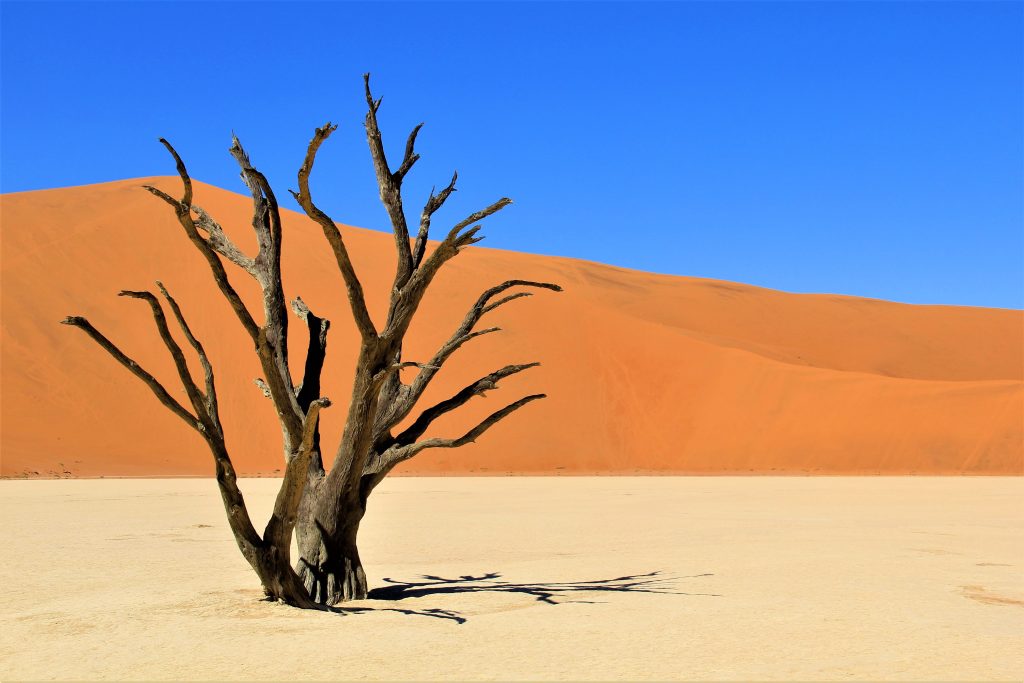
Day three starts before dawn. A Sossusvlei dune safari runs 60 kilometres of tar to the car parks, then the sandy section to the pans. Do Deadvlei in the first light while the dune behind it is still shadowed, climb Big Daddy if you have the legs for it, and be off the sand by mid morning. Dune 45 works on the way back out, and Sesriem Canyon fills a late afternoon once the heat has gone out of the day.
The single biggest upgrade to this itinerary is booking accommodation inside the Sesriem gate for night two. It costs more and books out months ahead, and it is the difference between photographing Deadvlei in shadow and photographing it in flat mid morning glare.
Day 4: Desert Drive to Swakopmund Through the Kuiseb and Gaub Passes
The run from Sesriem to Swakopmund is only 340 to 350 kilometres but takes five to six and a half hours, because almost all of it is gravel. Do not treat this as a transfer day to be rushed. The C14 crosses the Kuiseb and Gaub canyons and runs through the gravel plains of the Namib section, and the emptiness of it is one of the memorable stretches of the whole loop.
Tropic of Capricorn has a signpost worth a photograph. Solitaire again if you need fuel. As you drop towards the coast the temperature falls sharply and the fog often rolls in, which is disconcerting after three days in the desert.
Swakopmund arrives as a genuine surprise: German colonial architecture, cafes, a promenade and cold Atlantic air. After the Namib it feels like a different country.
Day 5: Swakopmund and Walvis Bay Coastal Tours
Give the coast a full day. Walvis Bay is 30 kilometres south and holds the lagoon, where flamingos gather in large numbers through the summer months, and Pelican Point with its Cape fur seal colony.
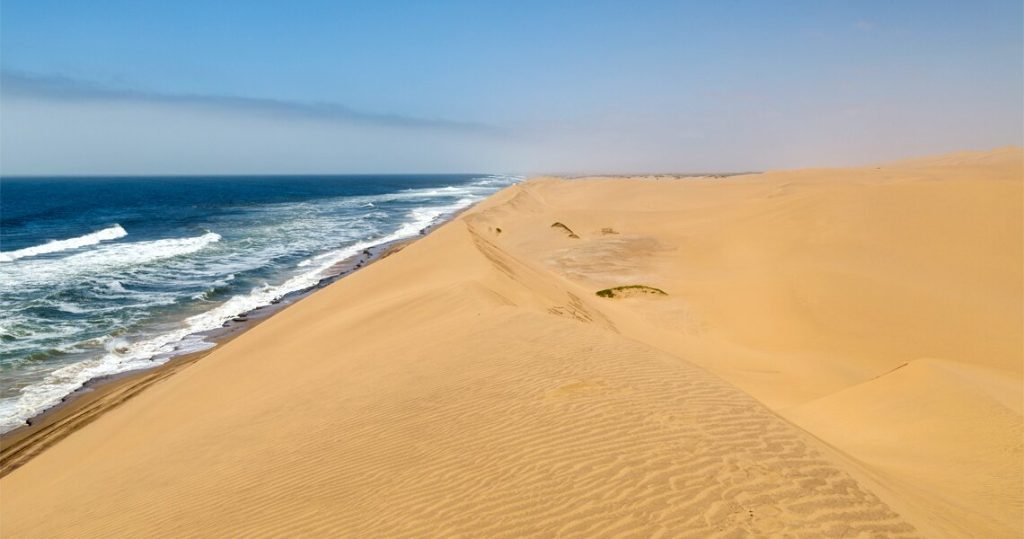
The two coastal tours worth booking are a catamaran cruise out to Pelican Point, where seals and pelicans come aboard and dolphins are common, and a 4×4 trip south to Sandwich Harbour, run along the beach on the tide and over the dune faces where the sand sea meets the sea. Sandwich Harbour needs an operator rather than your own vehicle.
Swakopmund itself is the adventure town: sandboarding, quad biking, skydiving and scenic flights all leave from here. If the driving has been tiring, this is also the sensible place to do nothing at all for a day, which is a legitimate use of it.
Day 6: Cape Cross Seal Reserve and the Drive into Damaraland
Head north up the coast road. Cape Cross Seal Reserve sits about 120 kilometres from Swakopmund and holds one of the largest Cape fur seal colonies anywhere, tens of thousands of animals depending on the season. The smell is genuinely overwhelming and nobody warns you adequately about it.
From there the route turns inland towards Damaraland, and the country changes into red rock, flat topped mountains and dry riverbeds lined with camel thorn. It is a long day, roughly 350 to 450 kilometres depending on where you are staying, so leave Swakopmund early.
Accommodation options cluster around Twyfelfontein and the Aba Huab and Huab riverbeds. Book ahead, since there is not much of it.
Day 7: Twyfelfontein Rock Art Tours and Desert Elephant Tracking
Twyfelfontein holds one of the largest concentrations of rock engravings in Africa, thousands of them cut into sandstone slabs over several thousand years, and it carries UNESCO World Heritage status. Guided visits are compulsory and the guides are local and worth listening to. Go early before the rock heats up.
The Organ Pipes, a cluster of dolerite columns in a small gorge, and the Burnt Mountain sit close by and take under an hour combined.
The afternoon is for desert elephant tracking in the Aba Huab or Huab riverbeds, usually as a guided drive from your lodge. These are not a separate species but ordinary African elephant that have adapted to arid country, moving in small family groups across enormous ranges. Sightings are genuinely uncertain, and any operator promising them is overselling. When it works it is one of the better wildlife experiences in the country.

Days 8 and 9: Etosha Safari at the Waterholes
Day eight is the drive north to Etosha, three to five hours from Damaraland depending on your gate. Galton in the west suits travellers coming from this direction, though it restricts you to guided drives and requires a booking at Dolomite. Most people continue round to Andersson Gate in the south and base at Okaukuejo.
An Etosha safari is a waterhole operation rather than a searching one. The park has no rivers, so in the dry season every animal has to come to a spring within a day or two. Park at Okondeka, Nebrownii, Goas or Kalkheuwel, switch off and wait an hour rather than driving hard between sightings.
Nights are the thing that sets Etosha apart. Okaukuejo, Halali and Namutoni have floodlit waterholes just inside the fence, viewable on foot, lit all night. Black rhino come in to drink at Okaukuejo most nights, usually late. Bring a warm jacket, because people give up on good sightings purely from cold.
Two nights lets you split between camps, typically Okaukuejo and Halali or Namutoni, and work a different section each day.
Day 10: Etosha to Windhoek and Departure
The drive south runs 415 to 500 kilometres and takes five hours or more, mostly on good tar through Otjiwarongo. A final early morning game drive before leaving the park is worth the alarm, since first light is when the waterholes are busiest.
Build in a large buffer if you are flying out the same day. Rental returns take time, the airport sits 40 kilometres east of the city, and a puncture on the last morning is not a rare event. Many travellers prefer a final night at a lodge near Windhoek or at Okonjima and fly out the following morning, which removes the pressure entirely.
Adapting a 10 Day Namibia Trip: Camping, Lodges and Fly In Options
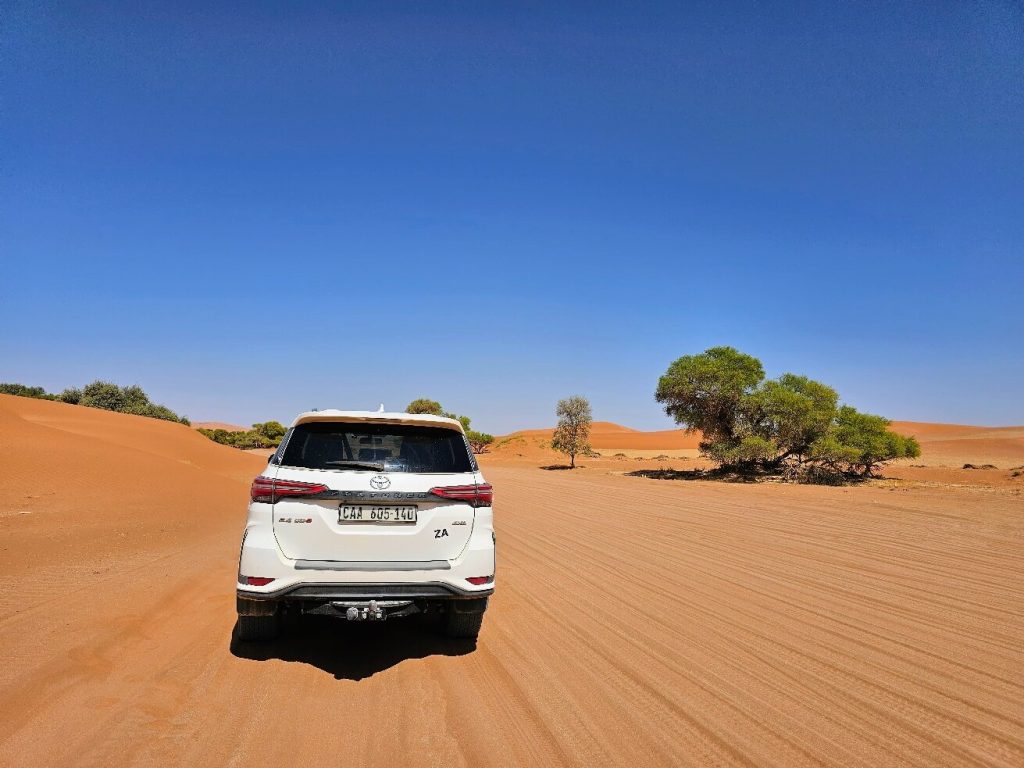
The same route works at very different budgets. Camping with a rooftop tent cuts accommodation costs to almost nothing and gets you into the park campsites, which occupy better positions than most lodges. Lodge based travel on the identical route costs several times more and removes the daily setup.
Flying changes the shape rather than the content. Light aircraft link Windhoek, Sesriem, Swakopmund, Damaraland and Etosha, and a fly in version of this itinerary removes four long driving days and replaces them with an hour in the air each time. It costs considerably more and you lose the passes, the Solitaire stop and the sense of scale that comes from driving it.
If you would rather not drive at all, guided small group versions of this loop run regularly, with a driver and guide handling the logistics.
Best Time for a 10 Day Namibia Safari
May to October is the dry season and the reliable window, with July through September strongest for Etosha and most comfortable for dune climbing. Nights in the desert in June and July drop close to freezing, so pack for a 25 degree swing across a single day.
April and May are underrated for this route: the rain has finished, the country still carries some green, the roads are dry and peak season prices have not landed. Between November and February the interior regularly passes 40 degrees, which makes the desert legs hard work, though the coast stays cool and rates fall away.
Entry Requirements for a Namibia Trip
Entry rules were revised recently and much of the published advice is out of date. Namibia withdrew visa free entry for many European, North American and Australasian passports, and travellers from those countries now need either a visa on arrival or a holiday visa arranged online beforehand. Passports need six months of validity and three blank pages, and a return ticket is checked.
A driving licence in English carrying a photograph is accepted for car hire. Confirm your own nationality against the current official position rather than working from an older article, since the tiers have changed.
10 Day Namibia Itinerary Questions
What does a 10 day Namibia trip cost?
Self driving with camping, two people can run at roughly 200 to 250 US dollars a day all in, covering vehicle, fuel, campsites, park fees and food. A lodge based version of the same route lands closer to 400 to 450 US dollars a day for two. Vehicle hire is the largest single line, roughly 1,400 to 2,200 US dollars for the ten days depending on specification and season. Add the visa fee at around 1,600 Namibian dollars per adult for most non African Union passports, plus park fees, which were revised upward recently and now likely sit in the 200 to 280 Namibian dollar range per international adult per day at the major parks.
Is 10 days enough for Namibia?
For the classic circuit, yes, with the discipline to leave things out. Ten days covers Sossusvlei, the coast, Damaraland and Etosha at a reasonable pace. It does not stretch to Fish River Canyon, Lüderitz and Kolmanskop, or the Zambezi Region, and trying to add them turns the trip into a driving marathon. Fourteen days is the point at which the south becomes realistic.
Should I do this itinerary clockwise or anticlockwise?
Anticlockwise, as laid out here, taking the desert first and Etosha last. It minimises backtracking, puts the long gravel stretches early while you are fresh, and finishes on the wildlife, which most people find the stronger note to end on. The reverse works but leaves you driving the Sesriem to Windhoek leg at the end of a tiring trip.
Can I do this itinerary without a 4×4?
Most of it, yes. The tar and graded gravel on this route is manageable in a two wheel drive car during the dry months. The exceptions are the final five kilometres to the Sossusvlei pans, where you would use the shuttle instead, and some Damaraland tracks. A 4×4 gives clearance and traction that make the whole trip more comfortable, which is why most travellers take one.
How much driving is there each day?
Between 340 and 500 kilometres on the four transfer days, which works out at four to six and a half hours once gravel speeds are accounted for. The other days involve short local driving only. Mapping estimates run optimistic here, so add one to two hours to anything off the tar and avoid scheduling two long days back to back.
Where should I stay in Etosha on a 10 day trip?
Inside the park if you can get it. Okaukuejo has the most dependable floodlit waterhole and the best odds on black rhino after dark, and it is also the busiest. Halali is quieter with a better setting. Splitting two nights between two camps cuts the daily driving and covers more of the park. The rest camps book out months ahead for July to September, so private lodges outside the gates are the fallback.
What should I add if I have two extra days?
Spitzkoppe on the way between Swakopmund and Damaraland is the easiest addition, a granite massif with rock art and exceptional stargazing. A third night at Etosha is the other strong option, since two full days in the park is not many. If the interest is southern, use the extra days for Fish River Canyon and Kolmanskop instead, though that really wants a fourteen day frame.
Booking Your Namibia Trip
The safari companies and tour operators listed on this website put trips like this together for a living and know which camps, guides and routes actually deliver. We are an independent guide to Namibia; we do not book or sell tours ourselves.
When you are ready, arrange your safari, tour or holiday with one of the recognised operators listed here. Tell them your dates and what matters most, and a real person, not a form, will handle the itinerary, park bookings and logistics for you.