14-Day Namibia Itinerary
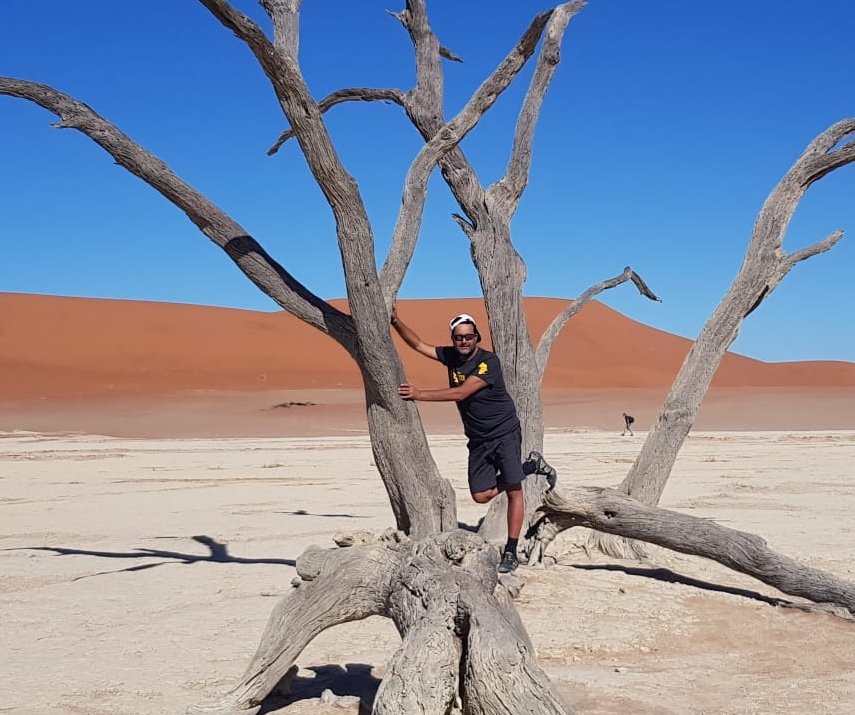
A 14-day Namibia itinerary is the shortest trip that reaches the south, adding Fish River Canyon, Lüderitz and Kolmanskop to the standard circuit of Sossusvlei, the coast, Damaraland and Etosha. The full loop runs roughly 3,500 kilometres from Windhoek. Two weeks also allows three nights at Etosha rather than the usual two.
The 14 Day Namibia Route at a Glance
Two weeks is where Namibia stops being a compromise. The ten day circuit covers the headline regions but skips the entire southern half of the country, and fourteen days is the point at which Fish River Canyon and the diamond coast become realistic rather than punishing.
The route below runs clockwise: south first through the Kalahari to the canyon, west to Lüderitz, north through the Namib to Sossusvlei, on to the coast, inland to Damaraland and finally north to Etosha before returning to Windhoek. Going this way puts the longest driving early and finishes on the wildlife.
Days 1 to 3. Windhoek, the Kalahari and Keetmanshoop, then Fish River Canyon. The longest driving of the trip and the emptiest country.
Days 4 and 5. Aus and the wild horses at Garub, then Lüderitz with Kolmanskop at first light.
Days 6 to 9. North to Sesriem for the dunes, then the gravel crossing to Swakopmund and a coastal day at Walvis Bay.
Days 10 to 14. Spitzkoppe and Damaraland, then three nights at Etosha before the run south to Windhoek.
Days 1 to 3: Windhoek, the Kalahari and Fish River Canyon
Collect the vehicle at the airport and head south. Most travellers break the first leg with a night in the Kalahari near Mariental or Keetmanshoop rather than driving straight through, since Windhoek to the canyon is around 760 kilometres.
Keetmanshoop is the southern hub and holds the Quiver Tree Forest just outside town, a stand of several hundred aloes on dolerite, along with the Giant’s Playground rock formations nearby. Both work well in late afternoon light.
Day three brings you to Fish River Canyon, a gorge around 160 kilometres long and 550 metres deep that appears without warning out of a flat plateau. Hobas is the gate and the main viewpoint sits ten kilometres further on. Descending into the canyon is limited to permit holding hikers, so day visitors work the rim. Arrive for sunset rather than midday, when the whole thing flattens into grey rock.
Days 4 and 5: Aus, the Wild Horses and Lüderitz
Head west on the B4, which is tarred the whole way and crosses the restricted diamond zone. Around 20 kilometres west of Aus a gravel turning leads to the Garub waterhole and a viewing hide, where Namibia’s feral desert horses come to drink. They descend from stud farm and cavalry animals abandoned during the First World War and have lived unmanaged since.
Lüderitz is a small German colonial port at the end of the road, pastel Art Nouveau buildings on bare granite with the Atlantic on one side and desert on the other. Two nights covers it: an afternoon on the peninsula out to Diaz Point, a morning catamaran cruise to the African penguin colony at Halifax Island, and the seafood, which is excellent and cheap.
Kolmanskop is the reason most people come this far. Buy the permit the day before if you want the photography pass, since it cannot be issued at the gate on the morning, and be there at first light before the tour groups start moving through.
The southern leg is the part travellers most often cut when the plan gets tight, and it is worth protecting. Cut a night from the coast instead. Swakopmund is pleasant and it is not unlike coastal towns elsewhere, while Kolmanskop and the canyon exist nowhere else.
Days 6 and 7: North to Sesriem and the Sossusvlei Dunes
The run north from Lüderitz to Sesriem is the longest single leg of the trip at around 700 to 800 kilometres, so most people break it with a night at Aus or in the Tiras Mountains. That stretch through the Namib south of Sesriem is quietly one of the most striking drives in the country and almost nobody writes about it.
Reach the Sesriem area with daylight to spare. Stay inside the gate if anything is available, because guests within the fence pass through the inner gate an hour before everyone else, which decides the quality of the following morning.
Day seven starts before dawn: 60 kilometres of tar, five kilometres of soft sand, then Deadvlei in the first light with the dune behind it still in shadow. Climb Big Daddy if you have the legs. Dune 45 on the way out, Sesriem Canyon in the late afternoon once the heat has gone.
Days 8 and 9: Swakopmund and Walvis Bay Coastal Tours
Sesriem to Swakopmund is 340 to 350 kilometres of mostly gravel, five to six and a half hours through the Kuiseb and Gaub passes. The temperature drops sharply on the descent and fog usually meets you at the coast.
Give the coast a full day. Walvis Bay is 30 kilometres south, holding a Ramsar listed lagoon with tens of thousands of flamingos and the Pelican Point seal colony reached by catamaran or kayak. Sandwich Harbour, where the dune sea runs into the Atlantic, is a guided 4×4 trip timed around the tide.
Swakopmund itself has the adventure activities, sandboarding, quad biking and skydiving over the dune belt, plus the best restaurants on the route. It is also the last place to restock properly before the north.
Days 10 and 11: Spitzkoppe and Damaraland Rock Art
Head north up the salt road past Cape Cross Seal Reserve, where tens of thousands of Cape fur seals occupy a stretch of shoreline and the smell is genuinely overwhelming. Then turn inland.
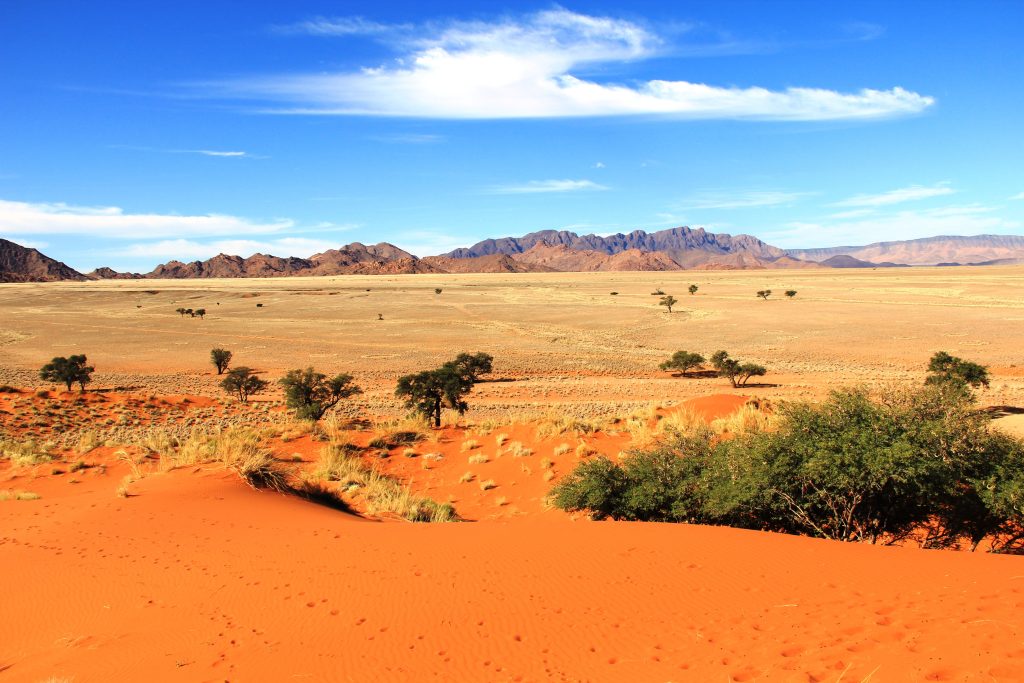
Spitzkoppe is a cluster of granite peaks rising out of flat gravel, often called the Matterhorn of Namibia, with rock art, short scrambles and some of the darkest skies in the country. A night camping among the boulders is one of the trip’s better ones.
Damaraland follows: red rock, flat topped mountains and dry riverbeds. Twyfelfontein holds one of the largest concentrations of rock engravings in Africa and carries UNESCO World Heritage status, with guided visits compulsory and worth taking. The afternoon is for tracking desert adapted elephant in the Aba Huab or Huab riverbeds, which are ordinary African elephant that range enormous distances between water. Sightings are uncertain and any operator promising them is overselling.
Days 12 to 14: Etosha Safari and the Return South
Three nights at Etosha is what two weeks buys you and it changes the park entirely. Two full days lets you split between camps, typically Okaukuejo and Halali or Namutoni, and work a different section each day rather than seeing one circuit once.
The park has no rivers, so through the dry season every animal comes to a spring within a day or two. Park at Okondeka, Goas, Nebrownii or Kalkheuwel, switch off and wait an hour. The floodlit waterholes at the rest camps run all night and black rhino come in to drink at Okaukuejo most evenings.
The final day is the drive south, 415 to 500 kilometres on good tar through Otjiwarongo. Many travellers break it with a night at Okonjima, home of the AfriCat Foundation and its big cat tracking, which turns a transfer day into a final wildlife day and removes the airport pressure entirely.
Alternative 14 Day Route: North Instead of South
If the south does not appeal, two weeks buys depth in the north instead. The alternative runs Windhoek, Sossusvlei, Swakopmund, Damaraland, Palmwag, Kaokoland and Etosha, with the extra days going into rhino tracking in the Palmwag Concession and Himba communities in the Kunene.
That version reaches the free roaming black rhino tracked on foot with Save the Rhino Trust, which is among the strongest wildlife experiences in Africa and impossible on a ten day trip. Epupa Falls on the Kunene River is the far northern anchor.
A third option pushes east to the Zambezi Region for rivers, elephant, buffalo and the country’s best birding, which feels more like Botswana than Namibia. That one really wants three weeks rather than two.
Camping and Lodge Versions of a Two Week Trip
The same route works at very different budgets. A 4×4 with a rooftop tent and full kit gets you into the park campsites at Sesriem, Etosha and Spitzkoppe, several of which occupy better positions than the lodges nearby, and cuts accommodation costs to a fraction.
Over fourteen days the effort adds up though, since you pitch and pack most mornings. Many travellers mix the two, camping most nights and booking a lodge every third or fourth to reset, which works well on a trip this long.
Fly in versions remove the driving entirely and cost several times more. On a two week trip the driving is a large part of what you came for, so flying makes less sense here than it does on a short trip.
Best Time for a 14 Day Namibia Safari
May to October is the dry season and the reliable window, with July through September strongest for Etosha and most comfortable for the dunes and the canyon rim. Nights in the desert and the south drop close to freezing in June and July.
The southern leg is the part most affected by season. Fish River Canyon becomes severe in summer, with temperatures towards fifty degrees, and the hiking trail closes entirely outside May to mid September. April, May and September give good conditions throughout with fewer people and lower rates.
Getting to Namibia and Entry Requirements
Nearly all international flights land at Hosea Kutako International Airport outside Windhoek, with common routings through Johannesburg, Frankfurt and Addis Ababa. Vehicles are collected at the airport or in the city.
Entry rules changed recently and much published advice is out of date. Namibia withdrew visa free entry for many European, North American and Australasian passports, so travellers from those countries now need a visa on arrival or a holiday visa arranged online in advance. Six months of passport validity, three blank pages and a return ticket are required. Confirm your own nationality against the current official position.
14 Day Namibia Itinerary Questions
What does a 14 day Namibia trip cost?
Self driving with camping, two people can run at roughly 200 to 250 US dollars a day, so around 2,800 to 3,500 for the fortnight. Lodge based self driving lands closer to 400 to 450 a day for two, meaning 5,600 to 6,300. Guided private trips run considerably higher. Vehicle hire over two weeks typically falls between 1,800 and 2,800 US dollars depending on specification and season. Add the visa at around 1,600 Namibian dollars per adult and park fees, revised upward recently to roughly 200 to 280 Namibian dollars per international adult per day at the major parks.
Is 14 days enough to see Namibia?
It covers the country properly for a first visit, including the south that shorter trips miss. What it still leaves out is the Zambezi Region in the far northeast and the remote parts of Kaokoland, both of which want a three week frame. You also cannot do the full southern loop and deep northwest in the same fortnight, so you are choosing between Fish River Canyon and Palmwag rather than getting both.
How much driving is in a 14 day route?
Around 3,500 kilometres on the southern loop version, with the longest legs being Windhoek to the canyon at roughly 760 kilometres and Lüderitz to Sesriem at 700 to 800. Most days involve three to six hours of driving, with three or four genuine rest days built in. Adding one to two hours to any mapping estimate is the rule off the tar.
Should I go clockwise or anticlockwise?
Clockwise for the southern loop, taking the canyon and Lüderitz first and finishing at Etosha. That puts the longest and emptiest driving early while you are fresh and ends on the wildlife. For the northern alternative without the south, anticlockwise works better, taking the desert first and Etosha last.
Is the southern loop worth the extra driving?
For most travellers who do it, yes, and Kolmanskop in particular is frequently named the highlight of the whole trip. The counterargument is real though: it adds well over a thousand kilometres and three or four days to reach two attractions and a canyon viewpoint. If wildlife is your priority rather than scenery and history, the northern alternative with rhino tracking at Palmwag delivers more.
How many nights should I give Etosha on a two week trip?
Three, which is the main gain over a ten day itinerary. That means two full game days rather than one, three floodlit waterhole evenings, and the ability to base at two different camps and work separate sections of the park. Splitting between Okaukuejo and either Halali or Namutoni also cuts the daily driving considerably.
Can I combine Namibia with Botswana or Victoria Falls in 14 days?
You can, and it means cutting Namibia back to the northern regions and crossing east through the Zambezi Region. Two weeks split across two countries gives neither the time it deserves, and the Namibian half would lose the desert or the wildlife. If a combined trip is the aim, three weeks is the honest minimum. Cross border travel also needs declaring in advance with rental vehicles.
Booking Your Namibia Trip
The safari companies and tour operators listed on this website put trips like this together for a living and know which camps, guides and routes actually deliver. We are an independent guide to Namibia; we do not book or sell tours ourselves.
When you are ready, arrange your safari, tour or holiday with one of the recognised operators listed here. Tell them your dates and what matters most, and a real person, not a form, will handle the itinerary, park bookings and logistics for you.