Etosha National Park
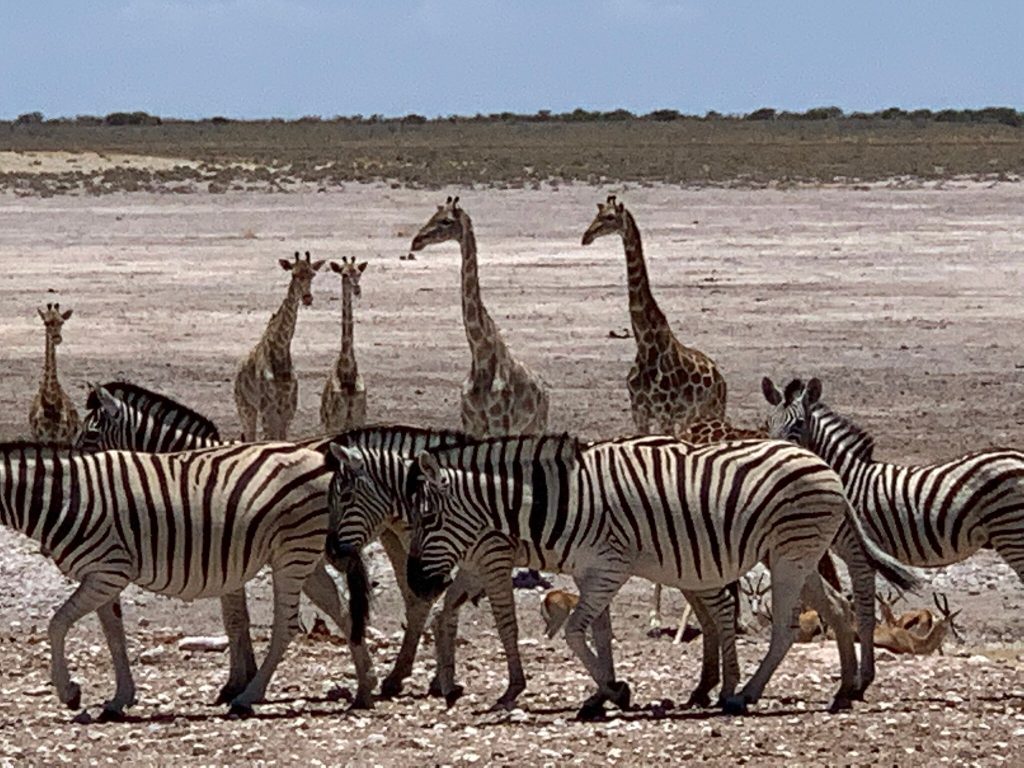
Etosha National Park is Namibia’s flagship safari destination, built around a salt pan so vast that game viewing works in reverse here: you sit still at a waterhole and the animals come to you, because there is nowhere else to drink. Most visitors either self drive or book guided game drive safaris from the six rest camps inside the park. Etosha covers 22,270 square kilometres in northwestern Namibia and holds four of the Big Five.
Etosha Safari Highlights at the Great White Place
The pan is the reason everything else works. Roughly 4,760 square kilometres of cracked white clay sits at the centre of Etosha National Park, taking up close to a quarter of the total area and stretching about 120 kilometres from end to end. It is the bed of an ancient inland lake, fed long ago by the Kunene River before that river turned west and ran to the Atlantic instead. What was left behind holds no surface water for most of the year.
That single fact shapes every safari here. No rivers cross the park. There are no permanent streams. Water comes from a network of more than forty springs and boreholes scattered along the pan’s southern edge and out across the plains, and in the dry months every elephant, lion, giraffe and zebra in the park has to visit one of them within a day or two. You are not searching for wildlife across thousands of square kilometres. You are choosing which waterhole to park at.
The Oshindonga name for the pan was Etotha, usually translated as the place where no plants grow. Early European traders could not manage the pronunciation and the spelling drifted to Etosha. Proclaimed a game reserve in 1907, it was for a time the largest protected area on earth, running to something like 80,000 square kilometres before the boundaries were cut back repeatedly over the following decades.
Etosha rewards patience over mileage. Guides who work the park daily will tell you the same thing: pick two or three waterholes, arrive early, switch the engine off and wait an hour. Visitors who spend the day driving hard between sightings usually see less than the ones parked in the shade at Chudop.
Waterhole Game Drive Safaris in Etosha National Park
A game drive safari in Etosha is mostly a waterhole circuit, and knowing which ones are producing changes the day entirely. The southern edge of the pan carries the densest concentration, and the stretch between Okaukuejo and Halali is the most consistently productive ground in the park for big herds and the predators that follow them.
Certain names come up again and again. Okondeka, a natural fountain on the western pan edge north of Okaukuejo, has a long reputation for lions and is often where a pride is found sitting over a kill. Goas, roughly midway between the southern and eastern gates, is a spring surrounded by greenery that pulls in elephant, black faced impala and heavy numbers of zebra and wildebeest. Kalkheuwel, southwest of Namutoni, is the sort of place where seven or eight mammal species drink at once if you sit long enough. Nebrownii and Olifantsbad draw elephant herds through the dry months, and Rietfontein and Gemsbokvlakte hold resident lion prides.
Sightings are never guaranteed at any of them. Waterholes dry up, shift and go quiet for weeks. The sightings boards at each camp are genuinely useful and worth five minutes before you set out.
Okondeka. Natural spring on the western pan edge. Best known for lion, often with large zebra herds nearby. Morning is the stronger window.
Goas. Oasis style spring between Halali and the eastern section. Elephant, black faced impala, wildebeest and heavy birdlife. One of the better leopard bets in the park.
Kalkheuwel. About 20 kilometres southwest of Namutoni. Breeding elephant herds, lion, kudu, warthog and red hartebeest, frequently several species together.
Klein Namutoni. Two to three kilometres from Namutoni camp, so you can stay late and still beat the sunset curfew. The bush along the access road is good for Damara dik dik.
Floodlit Waterhole Watching at Okaukuejo, Halali and Namutoni
This is the thing Etosha does that almost nowhere else does. Three camps have floodlit waterholes just inside the fence, viewable on foot from fixed platforms, and they stay lit all night. Your safari does not stop at sunset. You walk from dinner to a low stone wall, sit down, and watch whatever arrives.
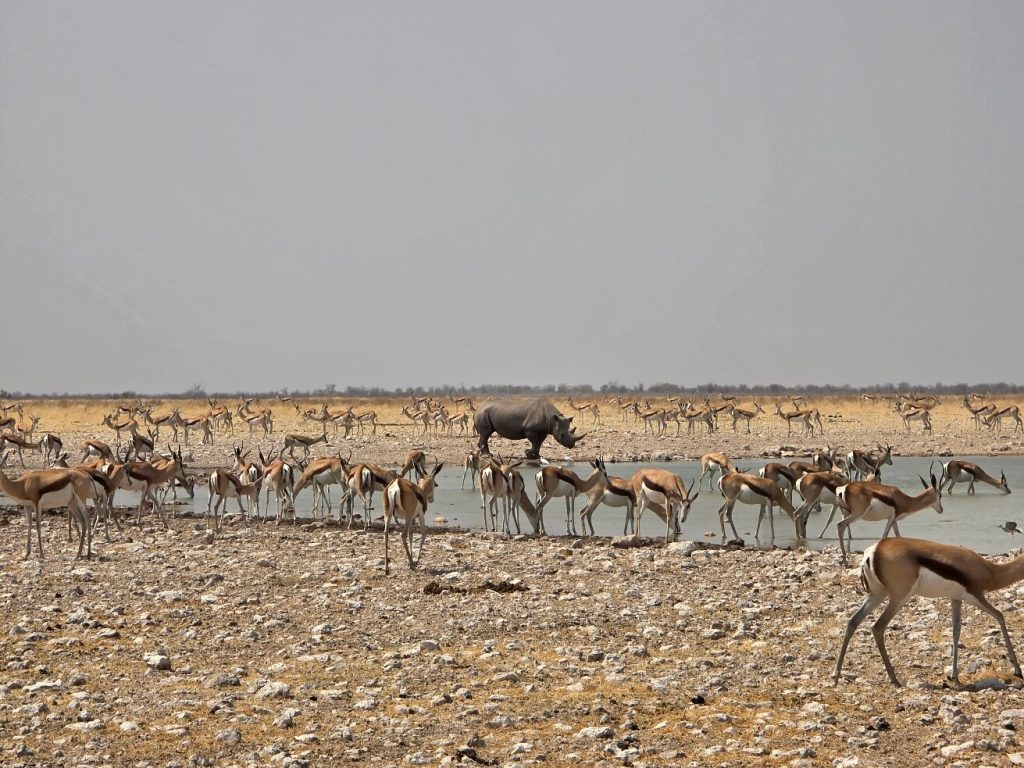
Okaukuejo is the famous one. Black rhino are the headline act, and they appear on most nights, usually somewhere between nine in the evening and the small hours. Elephant, lion and spotted hyena come through too, and standoffs over drinking rights are common. Halali’s waterhole is called Moringa, set below a rocky koppie with an amphitheatre view down to the water, and it has a better reputation than Okaukuejo for leopard and for close elephant viewing, though overall numbers are lower. Namutoni is the quietest of the three, looking east across open plains from beside the old fort.
Sitting at Okaukuejo after dark is not like being on a game drive. You are stationary, the light is constant, the rhino sets its own pace, and it drinks close enough that you can pick out individual scars.
Bring a warm jacket. Between June and August the temperature at those platforms drops to single figures once the sun goes down, and people regularly give up on a good sighting because they came out in a shirt.
Wildlife to Look For on an Etosha Safari
An Etosha safari puts you among 114 recorded mammal species and well over three hundred bird species. Four of the traditional Big Five are resident. Buffalo are the exception, and their absence is deliberate rather than accidental: they are kept out under veterinary policy to protect Namibia’s foot and mouth disease free status for livestock export.
Black rhino are the species that draws serious wildlife travellers. Etosha holds the largest population of the southwestern subspecies anywhere, running past five hundred free ranging animals, which is a recovery story worth knowing about given the population was estimated in the dozens six decades ago. They browse at night, so the floodlit waterholes are the reliable way to see them.
Lion numbers sit somewhere between three and four hundred across roughly twenty five prides, and they have been studied continuously from the Etosha Ecological Institute at Okaukuejo since the 1960s, one of the longest running lion research programmes on the continent. Elephant here run to a couple of thousand and often look ghostly pale, because they dust bathe in the calcrete sediment of the pan and it coats them white.
Two species are close to being Etosha specialities. The black faced impala, marked by a dark blaze running from the nostrils over the head, is endemic to northwestern Namibia and southwestern Angola. A translocation operation moved 226 of them into the park during a Kaokoland drought, they took to it, and the park population now runs past fifteen hundred. The Damara dik dik, Namibia’s smallest antelope, works the thicker bush in pairs and is easy to miss. Out west in the dolomite hills you also get Hartmann’s mountain zebra, which you will not find in the eastern section.
Cheetah favour the open plains west of Okaukuejo. Leopard are present throughout but genuinely difficult, and anyone who tells you a sighting is likely is selling something. Beyond the headliners there are brown and spotted hyena, black backed jackal, bat eared fox, caracal, African wildcat, honey badger and the ground squirrels that run the camps.
Black Rhino Tracking and Night Game Drive Safaris
Self driving after dark is prohibited inside the park and the fines are steep, so night game drive safaris have to be booked through the rest camps. Vehicles go out from Okaukuejo, Halali and Namutoni after the gates close, which is the only legal way to be on the park roads at night.
Guides work with filtered spotlights and cover ground the day drives cannot. Porcupine, spotted hyena, owls, genet, aardwolf and the occasional leopard turn up. Some nights deliver very little beyond nocturnal birds and frogs. That is the honest picture, and the camps will say as much if you ask them.
Rest camps also run morning and afternoon guided drives in open sided vehicles. These are worth doing even if you have your own car, mainly because the guide sits higher, knows what moved through yesterday, and can legally be out before the public gate opens.
Self Drive Safaris on the Etosha Road Network
Etosha is one of the easier parks in Africa to drive yourself. The road network linking the camps and waterholes is gravel but well graded, and in the dry months a standard two wheel drive car handles the main routes without trouble. Plan on averaging about 30 kilometres an hour once you are inside, which catches out people working off a map and a calculator.
Gates open at sunrise and shut at sunset, and the times move week to week with the light. You need photo identification at entry, so keep a passport or driving licence within reach rather than buried in a bag. At some gates you are directed to pay at the nearest camp rather than at the barrier itself.
Getting caught out by sunset is the classic mistake on a self drive safari in Etosha. Work backwards from the closing time, add a buffer of at least half an hour, and remember that a good sighting forty kilometres from camp will eat that buffer without you noticing. Fuel is available at Okaukuejo, Halali and Namutoni, though running down to fumes before you reach one is not advisable.
Position matters more than distance at a waterhole. Park with the sun behind you or off to one side, leave the animals’ walking route clear, and pull to the edge rather than the centre of the viewing area. Everyone in the queue behind you gets a better view, and so do you.

Western Etosha Safaris at Dolomite and Olifantsrus
The western section was closed to general visitors for years and reserved for researchers and permit holding operators. Galton Gate opened it up, and it is now the quietest part of the park by a wide margin. Traffic is low, the terrain is more broken, and rhino sightings out here are strong.
Dolomite Camp sits on a ridge with about twenty elevated tented chalets scattered through the rock. The nearest other camp is Okaukuejo, roughly 180 kilometres away, which tells you how much space you have. Guests entering at Galton are restricted to guided drives rather than self driving the western zone. Olifantsrus is the only camping exclusive site in the park, ten pitches, no chalets, and a double storey hide over its waterhole that photographers rate highly.
Neither is convenient if you are on a tight schedule. Both are worth it if you have already done the eastern circuit and want the version of Etosha with fewer vehicles at every sighting.
Birding Safaris Around Fischer’s Pan and the Andoni Plain
Birding here changes completely with the season, which is why some people come in the months everyone else avoids. During good rains the main pan holds water and turns into a shallow lake, and flamingos arrive in enormous numbers to breed on it. Fischer’s Pan in the east and the Andoni Plain to the north flood as well and pull in waders, storks and raptors.
Resident species worth looking for on a birding safari in Etosha include Hartlaub’s spurfowl, Carp’s tit, the white tailed shrike, Ruppell’s parrot and Meyer’s parrot, several of which are birds you have to come to this corner of Africa to find. Lappet faced vulture and woolly necked stork are both recorded here. Migrants from the northern hemisphere push the species count up sharply between about November and March.
The trade off is straightforward. Green season birding is exceptional and the mammal viewing gets harder, because water is everywhere and the herds spread out instead of queueing at boreholes.

Where to Stay Inside Etosha National Park for a Multi Night Safari
Namibia Wildlife Resorts runs six camps inside the fence, and staying in the park rather than outside it is the single biggest upgrade to an Etosha safari. Being inside means you are at the waterhole at first light instead of queueing at a gate, and it means the floodlit waterholes are available to you all night.
Okaukuejo. South, near Andersson Gate, the oldest and busiest camp. Famous floodlit waterhole, premier chalets facing the water, restaurant, pool, shop and fuel. Book far ahead.
Halali. Central, between the other two main camps. Moringa waterhole set below a koppie, thicker bush nearby, better odds on leopard and rhino, and a calmer feel than Okaukuejo.
Namutoni. East, built around a German colonial fort that is now a national monument. Open plains, good elephant viewing, close to Fischer’s Pan and the eastern waterhole circuit.
Onkoshi. Fifteen chalets on raised decks right on the pan rim, reached only with camp transfer. The most secluded option NWR runs and the one with the strongest pan views.
Dolomite. Western section, twenty tented chalets on a dolomite ridge. Guided drives only. Very low visitor numbers and consistently good rhino and mountain zebra sightings.
Olifantsrus. Camping only, ten pitches with shared power stands, remote western position between Okaukuejo and Dolomite. Double storey photographic hide over the waterhole.
Camps fill months in advance for the dry season, particularly Okaukuejo. Plenty of private lodges and reserves sit just outside the gates, including Ongava and Onguma, and those tend to have availability when the park camps do not. They also offer guided drives on their own land, which the park camps cannot.
Best Time for an Etosha Safari
The dry season from May to October is when the park does what it is known for. Water disappears from the veld, the grass thins out, and animals concentrate at a handful of reliable springs. July through September is the strongest window for game viewing and also the busiest, with cold mornings around eight degrees and comfortable days in the high twenties or low thirties.
May to June. Some green still hanging on from the rains, wildlife starting to concentrate, cool nights and thinner crowds. A good compromise if you want both the scenery and the sightings.
July to September. Peak game viewing at the waterholes and peak visitor numbers with it. Clear skies, dusty conditions, very cold before dawn. Book camps early.
October to November. Hot, sometimes over forty degrees, with the first storms building. Wildlife still tied to water and the park noticeably emptier of people.
December to April. Green season. Heaviest rain from January to March, birdlife at its peak, flamingos on the flooded pan, calving underway. Mammals harder to find and some routes impassable.
A large wildfire swept through roughly a third of the park during one recent dry season, driven by heavy grass growth after a strong rainy year. The camps stayed open throughout and the main tourist routes were largely unaffected, though a few eastern loops closed temporarily while containment work went on. Grass systems here have burned and regrown for millennia. If you are planning a trip, it is still worth checking current road status with your camp or operator, since a separate road upgrade programme has also closed sections of the Okaukuejo to Halali route at times.
Getting to Etosha National Park and Choosing a Gate
Most trips start at Hosea Kutako International Airport outside Windhoek and run north by road. Andersson Gate in the south sits around 440 kilometres from the capital, about five hours on tar via Otjiwarongo and Outjo, and it puts you 17 kilometres from Okaukuejo. Outjo is the last decent supermarket and fuel stop before the barrier.
Von Lindequist Gate in the east is the natural entry if you are coming from Tsumeb, Grootfontein or the Caprivi, and it drops you within about ten kilometres of Namutoni. That route from Windhoek runs closer to 580 kilometres. Galton Gate in the west is reached via Kamanjab and is the only access to Dolomite Camp. King Nehale Lya Mpingana Gate in the north is the least used, sitting some 48 kilometres off the main Ondangwa road.
Fly in safaris are common too, with charter flights linking Etosha to Sossusvlei, the Skeleton Coast and Damaraland for travellers who would rather not spend days behind the wheel. Coming from Swakopmund by road, allow the better part of a day for the 520 kilometres to Andersson Gate.
Etosha National Park Safari Questions
How much does it cost to enter Etosha National Park?
Park fees were revised upward in a recent adjustment and international adults now pay in the region of 280 Namibian dollars per person per day, made up of an entrance portion and a conservation levy of roughly equal size. Visitors from SADC countries pay around 180 Namibian dollars and Namibian nationals around 60. Vehicles with ten seats or fewer are charged about 60 Namibian dollars per day, with larger vehicles scaling up from there. Younger children enter free, though the exact age cut off has shifted with the new schedule, so check at the gate. Fees run for a 24 hour period from the moment you enter, and older figures of 150 Namibian dollars still circulating online predate the increase.
What does accommodation cost inside Etosha?
Rooms and chalets at the NWR rest camps run somewhere between 900 and 2,500 Namibian dollars per night depending on the camp and whether the unit faces the waterhole. Camping pitches tend to sit in the 300 to 600 Namibian dollar range per person. Private lodges outside the gates cover a much wider spread, with the upper tier of properties near Ongava and Onguma charging from roughly 3,000 to 7,000 Namibian dollars per person per night, usually with meals and guided drives included. Rates move with season and are highest between July and September.
How many days should I spend on an Etosha safari?
Two nights is the practical minimum and three or four is better. A single night gives you one evening at a floodlit waterhole and one morning drive, which is thin given how far you have travelled to get there. Three nights lets you base at two different camps, usually Okaukuejo and either Halali or Namutoni, and work a different section of the park each day. Anyone adding the western section at Dolomite or Olifantsrus should budget five nights or more.
Can I do a self drive safari in Etosha without a 4×4?
Yes, for the main circuit in the dry months. The roads linking the camps and the principal waterholes are graded gravel and a standard two wheel drive car copes fine. A higher clearance vehicle helps after rain and on the rougher western tracks, and it also gives you a better sightline over the grass. Whatever you drive, keep to the marked roads, stay in the vehicle except at the designated points, and get to camp before the gates shut.
Which is better, Okaukuejo or Halali?
Okaukuejo has the more dependable floodlit waterhole and is the better bet for black rhino after dark, but it is also the busiest camp in the park and it feels it. Halali is smaller and calmer, its Moringa waterhole sits below a rocky rise that makes for a more interesting outlook, and the thicker bush around it improves the odds on leopard. Many people book both and move between them, which also cuts the driving on each day.
Is Etosha good for a family safari?
It works well for families. The floodlit waterholes give children something to watch without a long drive, the camps are fenced with pools and restaurants, and self driving means you set your own pace and can turn back when attention runs out. Reduced or free entry for younger children keeps the cost down. The main constraints are the heat between October and December and the ban on leaving your vehicle outside designated areas.
Will I see the Big Five in Etosha?
Four of them are present, since buffalo are excluded on veterinary grounds. Elephant, lion and black rhino are seen regularly during the dry season, with rhino most dependable at the Okaukuejo waterhole at night. Leopard are resident but shy, and sightings are uncommon rather than expected. Nobody can promise you a particular animal, and any operator who does is worth treating with caution.
Booking Your Namibia Trip
The safari companies and tour operators listed on this website put trips like this together for a living and know which camps, guides and routes actually deliver. We are an independent guide to Namibia; we do not book or sell tours ourselves.
When you are ready, arrange your safari, tour or holiday with one of the recognised operators listed here. Tell them your dates and what matters most, and a real person, not a form, will handle the itinerary, park bookings and logistics for you.