Red Hartebeest in Namibia
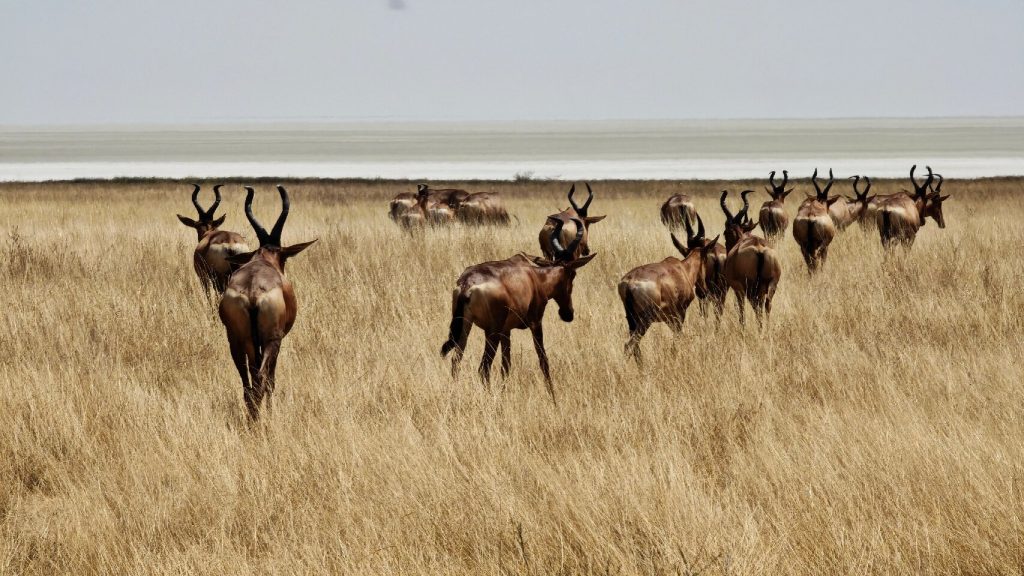
The red hartebeest is the most awkward looking antelope in Namibia and one of the fastest. High shoulders, a steeply sloping back and a long narrow face give it a build that appears wrong until it runs. It occurs in smaller numbers than the other plains game at Etosha and does well in arid country where competitors struggle.
Built Wrong and Working Perfectly
The hartebeest is readily identified by a combination of features that do not obviously go together.
Alcelaphus buselaphus stands around 125 centimetres at the shoulder and weighs roughly 120 to 150 kilograms. The shoulders are large, the back slopes steeply down to the hindquarters, and the coat is a glossy red brown that catches light.
The face is the distinctive part: unusually long and narrow, carrying smallish horns in both sexes that rise from a common base, curve outward and then hook sharply back.
That horn shape is the reliable identifier. No other Namibian antelope has the double curve rising from a shared pedicel.
The overall impression is ungainly, and it stops being funny once the animal moves. Hartebeest are among the fastest antelope in Africa and can sustain speed over long distances, with the high shoulders and sloping back giving an efficient loping stride.
The long face has a practical function, letting the animal graze with its eyes still above the grass line, watching for predators.
Look for the sentinel. Hartebeest herds almost always post one animal on a termite mound or rise, standing still and watching while the others graze with heads down. Spotting that motionless silhouette on a mound is frequently how you find the herd rather than the other way round, and it is a habit worth training your eye to.
Where They Occur
Red hartebeest are widely distributed in Namibia and nowhere abundant.
In Etosha they occur in smaller numbers than springbok, Burchell’s zebra, oryx and blue wildebeest, which is the standard description across sources. They are present rather than plentiful.
They do well in arid and semi arid country including the Kalahari, the central highlands and the grasslands of the interior.
They are widely held on Namibian game farms and private reserves, where numbers are frequently higher than in the national parks.
They tolerate dry conditions better than wildebeest, taking much of their water from the plants they eat, though they drink where water is available.
Grasslands and open savanna are the preferred habitat, and they avoid thick bush where their speed counts for nothing.
Behaviour
Hartebeest are social and their herd behaviour is worth watching.
They form herds of varying size, typically a dozen or two, though larger aggregations occur where grazing is good.
Bulls hold territories and mark them, standing on elevated points such as termite mounds to advertise their presence and watch for rivals.
The sentinel behaviour is the characteristic one, with at least one animal usually standing alert on high ground while the rest graze.
They mix with other plains game including wildebeest, zebra and springbok, benefiting from the additional vigilance the same way everything else does.
When alarmed they run in a loping stride that covers ground efficiently, and the herd tends to follow a single leader rather than scattering.
The Tsessebe Comparison
Namibia holds a relative that is easily confused and considerably rarer.
The tsessebe shares the hartebeest’s build, with high shoulders, a sloping back and a long face, and belongs to the same broad group.
Tsessebe are darker, with a purplish sheen to the coat and dark patches on the upper legs, and their horns are shorter and less dramatically curved.
Tsessebe are among the rare species Waterberg Plateau Park was proclaimed to breed and maintain, alongside roan and sable antelope, and they occur in the northeast.
Red hartebeest are widespread and unthreatened; tsessebe are scarce and localised.
If you are looking at a hartebeest type antelope in Etosha or the Kalahari, it is almost certainly a red hartebeest. In the Zambezi Region or at Waterberg, tsessebe becomes a real possibility.
Predators and Speed
Speed is the hartebeest’s defence and it is a good one.
They are among the fastest antelope in Africa and, more usefully, among the most enduring, able to sustain speed over distances that exhaust a pursuing predator.
Cheetah, which rely on a short explosive chase, frequently fail against an adult hartebeest that gets a start.
Lion take them, particularly at waterholes and through ambush rather than pursuit. Spotted hyena, which hunt by exhaustion over distance, are better matched to a hartebeest than a cheetah is.
Calves are vulnerable to a much wider range of predators including jackal and caracal.
The sentinel system exists to prevent the ambush that speed cannot answer, which is why a herd with a watching animal on a mound is doing something functional rather than decorative.

The Wider Hartebeest Family
The hartebeest group is more complicated than the Namibian picture suggests, and it is worth a note.
Alcelaphus buselaphus occurs across Africa in several subspecies, of which the red hartebeest of the southwest is one. Others include Coke’s hartebeest of East Africa and Lichtenstein’s hartebeest further north and east.
The red hartebeest is the southern form and the one found in Namibia, South Africa and Botswana. It is the most richly coloured of the group, which is where the name comes from.
The broader family, the Alcelaphinae, also contains wildebeest, tsessebe, topi and blesbok, all of which share the sloping back and elongated face to varying degrees.
That shared build reflects a shared strategy: open country grazing animals that rely on speed and endurance rather than concealment or fighting.
Seeing a hartebeest, a wildebeest and a tsessebe together, which is possible in parts of the northeast, makes the family resemblance obvious in a way photographs do not.
Where to See Red Hartebeest
Etosha. Present throughout in smaller numbers than the commoner plains game. Open plains and grassland areas, and around waterholes with mixed herds.
The Kalahari. Eastern and southeastern red dune country, where they handle the arid conditions well and occur on private reserves in numbers.
Game farms. Widely held across the central highlands, frequently in higher densities than the national parks and more approachable.
Waterberg. Present alongside the rarer species the park was proclaimed to protect, including tsessebe, roan and sable.
Hartebeest on Farmland
A substantial share of Namibia’s red hartebeest live on private land, which is worth knowing because it changes where you should look.
Wildlife based land use has expanded considerably across the Namibian central highlands over recent decades, with many commercial farms converting wholly or partly from cattle to game.
Red hartebeest have benefited from that shift alongside springbok, oryx, kudu and eland. They handle arid conditions, they graze rather than browse, and they hold value both for tourism and for hunting, which gives landowners reasons to keep them.
The consequence is that densities on game farms are frequently higher than in the national parks, and the animals are more used to vehicles, which makes them easier to watch and photograph.
That pattern repeats across Namibian wildlife. Around 90 percent of the country’s cheetah live on farmland, leopard densities are higher outside protected areas than inside them, and more than half the giraffe are on private land.
For a visitor, it means a guest farm in the central highlands can deliver better hartebeest viewing than a day in Etosha, at considerably lower cost.
Best Time to See Them
Red hartebeest are resident year round and no season misses them.
The dry season from May to October concentrates game near water and thins the grass, which improves visibility on open plains considerably.
Early morning and late afternoon are when they graze and move. Through the middle of the day they rest, though the sentinel usually stays standing.
After good rains the grass grows tall enough to hide a grazing herd, and the standing sentinel becomes the way you find them.
Private reserves and game farms give better odds than the open parks, since densities are higher and the animals are more used to vehicles.
Red Hartebeest Questions
How do I recognise a red hartebeest?
By the combination of large shoulders, a steeply sloping back, a glossy red brown coat and an unusually long narrow face. The horns are the reliable identifier: smallish in both sexes, rising from a common base, curving outward then hooking sharply back. No other Namibian antelope has that double curve from a shared pedicel.
Why does it look so awkward?
The high shoulders and sloping back appear wrong standing still and work perfectly in motion, giving an efficient loping stride. Hartebeest are among the fastest antelope in Africa and among the most enduring over distance. The long face lets the animal graze with its eyes still above the grass line, watching for predators while feeding.
Are they common in Etosha?
Present rather than plentiful. They occur in smaller numbers than springbok, Burchell’s zebra, oryx and blue wildebeest, which is how sources consistently describe them. They are widely distributed across Namibia and nowhere abundant, and densities on private game farms are frequently higher than in the national parks.
What is the animal standing on the termite mound?
Frequently a hartebeest sentinel. Herds almost always post one animal on a mound or rise, standing motionless and watching while the others graze with heads down. Spotting that silhouette is often how you find the herd rather than the other way round, and it is a functional system rather than a habit.
How do I tell a hartebeest from a tsessebe?
Tsessebe are darker with a purplish sheen to the coat and dark patches on the upper legs, and their horns are shorter and less dramatically curved. Red hartebeest are widespread and unthreatened; tsessebe are scarce, occurring in the northeast and at Waterberg, which was proclaimed partly to breed them alongside roan and sable.
What hunts them?
Lion, mostly by ambush at waterholes rather than pursuit, and spotted hyena, whose exhaustion hunting is better matched to a hartebeest than a cheetah’s short explosive chase. Cheetah frequently fail against an adult that gets a start. Calves are vulnerable to a much wider range including jackal and caracal, which is why the sentinel system exists.
Do they need to drink?
They drink where water is available and tolerate dry conditions better than wildebeest, taking much of their moisture from the plants they eat. That is why they do well in the Kalahari and arid central Namibia where wildebeest struggle, though they do not match the true desert independence of oryx and springbok.
Booking Your Namibia Trip
The safari companies and tour operators listed on this website put trips like this together for a living and know which camps, guides and routes actually deliver. We are an independent guide to Namibia; we do not book or sell tours ourselves.
When you are ready, arrange your safari, tour or holiday with one of the recognised operators listed here. Tell them your dates and what matters most, and a real person, not a form, will handle the itinerary, park bookings and logistics for you.