Deadvlei

Deadvlei is a white clay pan in the Namib Desert holding the blackened skeletons of camel thorn trees that died centuries ago and never decayed, ringed by orange dunes rising more than 300 metres. Visitors reach it on foot, about a kilometre from the 4×4 car park inside Namib-Naukluft National Park. The name comes from the Afrikaans for dead marsh, and it is among the most photographed places in Africa.
Deadvlei Walking Tours and What the Pan Actually Is
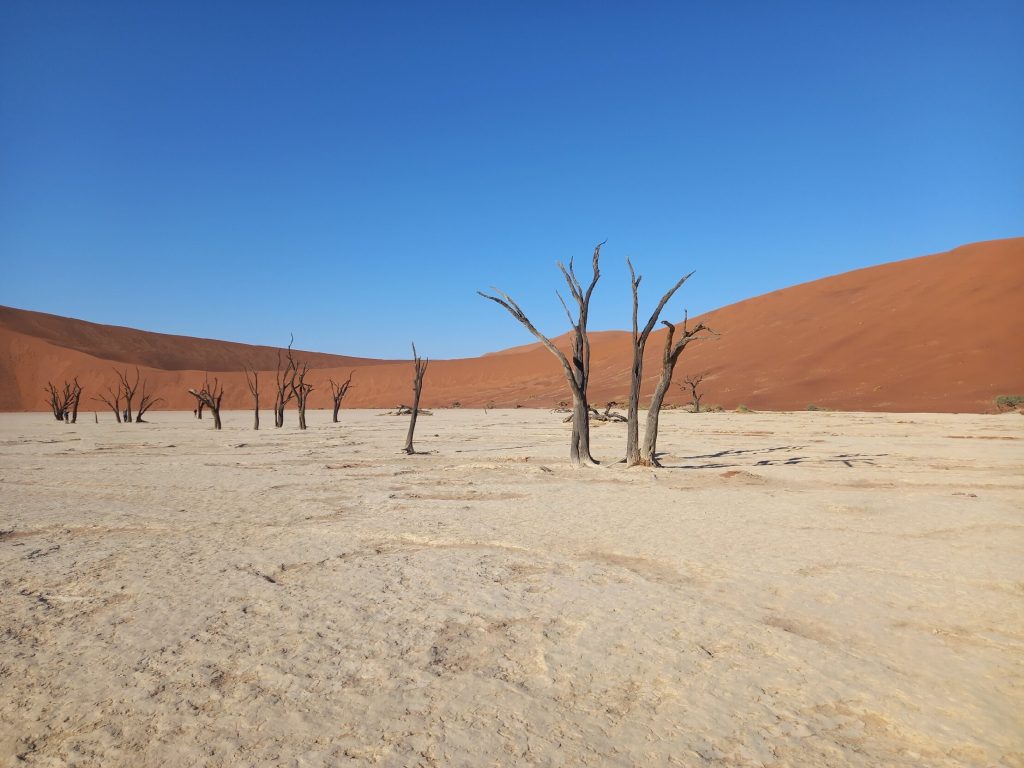
A Deadvlei walking tour delivers something quite specific: a flat, cracked, bone white floor about the size of a few football pitches, perhaps three dozen dead trees standing on it, and a wall of red sand behind. Three colours and nothing else. No shade, no water, no vegetation beyond a few salt tolerant clumps clinging on at the edges.
The pan sits directly beneath Big Daddy, the tallest dune in this part of the sand sea, and roughly two kilometres from Sossusvlei pan itself. People routinely confuse the two. Sossusvlei still receives water in exceptional years when the Tsauchab River runs far enough. Deadvlei receives none at all, ever, and has not for a very long time.
What surprises most visitors is the quiet. The dunes block the wind on three sides, so on a still morning the pan is silent in a way that feels physical, and the clay is cool underfoot before the sun gets to it even when the air is already warm.
The Camel Thorn Trees of Deadvlei
The trees are Vachellia erioloba, camel thorn, the same hardy species you see alive across much of southern Africa. These ones have been dead for centuries. Their age is usually given as around 900 years, though the figure is not settled, and some assessments put their death closer to 600 or 700 years ago instead. Either way, they have been standing dead for longer than most of the buildings anyone reading this has been inside.
They have not fossilised, which is a common mix up. They are simply desiccated. The air here is so dry that the fungi and bacteria that would normally break down wood cannot function, so the trunks have stayed intact while the sun has scorched their surfaces black. Get close and you can still see the grain and the old thorn scars.
They look like they died violently, twisting and reaching. They did not. They simply stopped getting water and stayed exactly where they stood while everything around them dried out.
Do not climb on them or lean against them. They are more fragile than they look, they cannot be replaced, and pieces have already been broken off by visitors treating them as photo props.
How the Deadvlei Pan Formed
The sequence is straightforward once you lay it out. During a wetter period the Tsauchab River flooded far enough to reach this basin and left shallow standing pools behind. Camel thorn trees took root in the clay and grew, probably over a couple of centuries.
Then the climate turned dry and the dunes moved. Sand built up across the river’s path, including the mass that is now Big Daddy, and cut the pan off from any water at all. The trees held on for a while and then died. The clay floor bleached white, cracked into the pattern you see today, and stayed that way.
What makes the place unusual is not that trees died in a desert. It is that the desert then preserved them rather than erasing them. Almost anywhere else on earth this would be a bare pan.
Photography Tours and the Best Light at Deadvlei
Timing decides whether your pictures work. In the first ninety minutes after sunrise the big dune behind the pan is still in shadow while the trees take direct light, so you get black trunks against a dark backdrop against white clay, with sunlit dune crests above. That separation is what makes the famous images.
By mid morning the sun is high enough to light the dune face as well, the contrast collapses, and everything flattens into a uniform brightness. Heat haze builds off the clay. A Deadvlei photography tour that arrives at ten in the morning has largely missed the point.
Walk further in than you think you need to. Most visitors stop at the first cluster of trees near the entry point and photograph the same three subjects from the same angle. The far side of the pan holds fewer trees but far fewer people, and the shadows there run cleaner across the clay.
Late afternoon is the second option and a much quieter one. The light comes from the other side, the dune behind lights up rather than the trees, and you get a warmer, softer version that looks nothing like the standard shot. Gate closing times constrain how long you can stay, so work backwards from sunset.
Big Daddy Dune Hiking and the Descent into Deadvlei
The best arrival at Deadvlei is from above. Big Daddy hiking starts at the 4×4 car park and follows the ridge line up roughly 325 metres, taking most people between one and two hours depending on fitness and how often they stop. The ridge dips and climbs repeatedly rather than rising steadily, which is the part people find harder than expected.
From the crest you look straight down onto the pan, with the trees reduced to black pins on white. Then you come off the steep face directly into Deadvlei, sinking to your ankles at every stride, and the whole descent takes ten or fifteen minutes. The sand booms softly as it shifts under you.
Start at first light or do not start at all. There is no shade on that ridge, no water anywhere on the route, and the sand surface becomes genuinely dangerous to walk on once the sun has been on it for a few hours.
Deadvlei Hiking Routes from the Sossusvlei Car Parks
Two car parks matter. The 2WD parking area sits at the end of the tarred road, 60 kilometres from the inner gate. From there it is roughly five kilometres of soft sand to the pans, which most people cover by 4×4 or shuttle. Walking it takes about ninety minutes each way and is a serious undertaking in the heat.
The 4×4 car park is the closer one. From there the walk to Deadvlei is about a kilometre, over a low dune and down into the basin, taking fifteen to twenty minutes at an easy pace. It is soft going rather than steep. Follow the marker posts, since the route across the sand is not obvious and people do wander off it.
From the 4×4 car park. Around one kilometre, fifteen to twenty minutes over a low dune. The standard route and the one nearly everyone uses.
From the 2WD car park on foot. Roughly five kilometres of soft sand, about ninety minutes each way. Free, exhausting, and best attempted only in the first hours of daylight.
By shuttle. A 4×4 transfer across the sandy section, running hop on and hop off through the day. Around 180 to 200 Namibian dollars return per person.
Down from Big Daddy. One to two hours up the ridge, then ten to fifteen minutes straight down the face into the pan. The most rewarding arrival and the most demanding.

Wildlife and Plants Around the Deadvlei Pan
Life on the pan itself is close to nil, which is the point. Around its edges a few species hold on: salsola, and clumps of nara, a spiny melon plant with roots reaching deep into the sand that survives largely on the fog that rolls inland from the coast.
On the walk in and out you may see oryx crossing the sand, which they do apparently for no reason and at considerable cost. Springbok and ostrich work the flats nearer the road. The interesting residents are small: Namaqua chameleon, sidewinding adder, palmato gecko with translucent skin, and the darkling beetles that climb the dune crest before dawn and stand head down so fog condenses on their backs and runs to their mouths.
None of this is guaranteed on any given morning. Most people walk to Deadvlei and see nothing alive at all beyond other visitors, which is a fair description of the place.
Deadvlei Trip Rules and Looking After the Pan
This is a small site absorbing a very large number of visitors, and the damage is visible. A few things matter.
Stay off the trees entirely. Do not climb them, hang from them, or move fallen pieces around to improve a composition. Keep to the clay floor and the marked route rather than cutting fresh tracks across dune faces, since the crust takes years to re form. Take every scrap of rubbish out with you, including fruit peel, which does not break down here in any useful timeframe.
Drones are not permitted without authorisation, and the rules on this have tightened. Carry more water than you expect to drink, at least two litres per person for a short visit and more if you are climbing. There is no water, no shade and no shop at any point past the gate.
Best Time for a Deadvlei Trip
The pan does not change much through the year, so the season question is about heat and crowds rather than conditions.
May to June. Days around 20 to 25 degrees and predawn starts close to freezing. Clear air, good light, fewer people than midwinter. One of the better windows.
July to September. Comfortable walking temperatures and the busiest period, with the pan holding a lot of visitors by mid morning. Get in at first light or accept company in every frame.
October to November. Regularly above 40 degrees. Only workable before eight in the morning. Building storm clouds can give unusual skies behind the trees.
December to April. Hot with afternoon thunderstorms, lowest visitor numbers and lowest rates. In rare years the Tsauchab floods nearby Sossusvlei pan, which almost nobody times correctly.
Whatever the month, the first two hours after the gates open are the ones that matter.
Getting to Deadvlei from Sesriem
Everything starts at Sesriem, around 350 kilometres southwest of Windhoek and 345 kilometres southeast of Swakopmund. The outer gate opens at sunrise and the inner gate about an hour earlier, with early access reserved for guests staying inside the park fence at Sesriem Campsite, Sossus Dune Lodge or Dead Valley Lodge.
From the inner gate it is 60 kilometres of tar to the 2WD car park, an hour or so with a stop or two. Then the five kilometre sandy section, by 4×4, shuttle or on foot. Then the walk in. Allowing for all of it, plan on roughly two hours between passing the gate and standing on the clay.
Arrangements on the sandy stretch have shifted more than once recently, covering where the official shuttle departs and whether private 4×4 drivers may continue all the way. Ask at the Sesriem office on the morning rather than working from anything published in advance.
Deadvlei Trip Questions
How much does it cost to visit Deadvlei?
There is no separate charge for Deadvlei. You pay park fees for Namib-Naukluft National Park at the Ministry office at Sesriem, and those cover the whole area. The schedule was revised upward recently, so published figures vary a lot: older sources say 80 to 150 Namibian dollars per adult per day, while the current rate for major parks sits higher, likely in the 200 to 280 Namibian dollar range including the conservation levy, with a separate vehicle charge. The shuttle across the sandy section, if you need it, adds roughly 180 to 200 Namibian dollars per person return. Confirm all of it at the gate office.
How old are the trees at Deadvlei?
Commonly quoted as around 900 years old, though the estimates genuinely disagree and some put their death nearer 600 or 700 years ago. The uncertainty is honest rather than sloppy, since dating desiccated wood in this setting is difficult. What is not in dispute is that they died when the dunes cut the pan off from the Tsauchab River and that the dry air has stopped them rotting since.
How long is the walk to Deadvlei?
About one kilometre from the 4×4 car park, fifteen to twenty minutes over soft sand and a low dune rise. From the 2WD car park it is roughly five kilometres and around ninety minutes each way, which is a much bigger commitment in the heat. Coming down off Big Daddy drops you into the pan in ten to fifteen minutes, but that route needs one to two hours of climbing first.
Do I need a 4×4 to reach Deadvlei?
Not for the tar road, which any ordinary car handles for 60 kilometres from the gate. The final five kilometres is deep sand where a genuine 4×4 with reduced tyre pressure is needed, and this is where vehicles get bogged most days. If you are not confident, take the shuttle or walk. A soft roader or crossover is not a 4×4 for this purpose.
What time should I arrive at Deadvlei?
As early as the gates allow. The first ninety minutes after sunrise give you the shadowed dune behind sunlit trees, which is the contrast the place is known for, and the temperature is still manageable. Staying inside the park fence buys you the extra hour through the inner gate, which is a real advantage. Late afternoon is the quieter alternative with completely different light.
Can I climb the trees or take a piece of wood?
No to both. The trees are protected, they are centuries old, and they are more brittle than they appear. Removing wood or clay from the pan is prohibited and climbing has already caused visible damage to several trunks. Photograph them, walk among them, and leave everything where it stands.
Is Deadvlei worth it if I have already seen Sossusvlei?
They are two different places about two kilometres apart, and Deadvlei is the one most people actually picture when they think of this desert. Sossusvlei pan is larger and less dramatic. If you only have time for one, take Deadvlei. Most visitors do both in a single morning since they share a car park.
Booking Your Namibia Trip
The safari companies and tour operators listed on this website put trips like this together for a living and know which camps, guides and routes actually deliver. We are an independent guide to Namibia; we do not book or sell tours ourselves.
When you are ready, arrange your safari, tour or holiday with one of the recognised operators listed here. Tell them your dates and what matters most, and a real person, not a form, will handle the itinerary, park bookings and logistics for you.