Big Daddy Dune

Big Daddy is the tallest dune in the Sossusvlei area at roughly 325 metres, standing between Sossusvlei pan and Deadvlei. The climb follows a ridge and takes most people between forty five minutes and two hours, finishing with a descent straight down the face into Deadvlei that takes ten to fifteen minutes. It is the hardest walk in the dune field.
Climbing Big Daddy and What the Ridge Is Like
The route follows the spine of the dune rather than going straight up a face, which sounds easier than it is. The ridge dips and rises repeatedly, so you lose height you have already gained, and in soft sand every step gives back a portion of itself.
Times reported by people who have done it range from forty five minutes to two hours, and that spread is real rather than a matter of exaggeration. Fitness matters, how often you stop matters, and the time of day matters most of all.
There is a patch of soft sand partway up that catches nearly everyone. It is only twenty or thirty metres long and it is the section people describe as feeling like Everest, with each step sliding back. Some find the practical answer is to lean forward and use hands along with feet through it, which works and looks undignified.
Past that, the going eases into a long slow slog to the crest. The ridge narrows near the top, the sand is firm where the wind has packed it, and the drop on either side is considerable.
How Tall Big Daddy Actually Is
The usual figure is 325 metres, and it is worth knowing that this is an estimate rather than a survey.
Published heights range from 325 to 400 metres depending on the source, and one first hand account puts it at 380. The honest position is that dunes move. Wind reshapes the crest, seasonal sand movement changes the profile, and the height is measured from the Deadvlei clay pan below rather than from sea level, which adds another variable. Most sources settle on 325 metres and that is the figure to use.
Two related claims are worth correcting. Big Daddy is the tallest dune in the Sossusvlei area, not in Namibia. Dune 7 near Walvis Bay has been measured at around 388 metres and takes that title. And while the Namib holds some of the tallest dunes anywhere, claims that Big Daddy is the tallest in the world do not survive checking.
The height is not what makes this hard. It is the soft sand, the heat and the ridge that keeps dropping before it climbs again. People arrive fit, look at 325 metres, and reason that they walk further than that on a normal day. Sand is a different proposition entirely, and starting late is what turns a hard walk into a dangerous one.
Routes Up: The Ridge and the Shortcut
Big Daddy is a star dune with several arms, which means more than one line to the top.
The main route starts from the 4×4 car park and follows the long ridge, and it is the one most people take and most guides recommend. A shorter and steeper line exists, and visitors report the full route taking around two hours against roughly an hour by the shortcut. The shortcut is harder going per metre and gets you there sooner.
Neither needs a guide, a permit or any equipment. There are no markers either, so you follow the ridge and the tracks of everyone who went up before you, which on a normal morning is entirely obvious.
Whichever line you take, keep to the established ridge rather than cutting fresh tracks across the faces, which damages the surface and makes the climb harder for you as well.
The Descent into Deadvlei
This is the part everyone remembers and it is the reason to climb Big Daddy rather than Big Mama.
From the summit you look straight down onto the Deadvlei pan, with the dead camel thorns reduced to black pins on a white floor. Rather than retracing the ridge, you go off the steep face directly into the pan, sinking to your ankles at every stride, covering 325 metres of descent in ten or fifteen minutes.
The sand makes a low booming noise as it shifts under you, which is a genuine acoustic phenomenon rather than imagination. You land at the edge of the pan and walk out among the trees, which is a considerably better arrival than coming in flat from the car park.
Going barefoot makes the descent easier, and many people do. Shoes fill with sand within seconds either way.

Timing the Climb Around Heat and Light
Start at or before first light. This is not advice, it is the difference between a good morning and a serious problem.
Sand surface temperature rises quickly once the sun is on it. By mid morning in summer the surface is too hot to stand on barefoot, the air temperature is climbing towards 40 degrees, and there is no shade and no water anywhere on the route. People do give up partway, and some get into real difficulty.
The other reason for an early start is Deadvlei. If you climb at dawn you drop into the pan while the dune behind it is still shadowed and the trees are catching direct light, which is the window the whole place is famous for. Climb later and you arrive to flat mid morning glare.
Guests staying inside the Sesriem gate pass through the inner gate about an hour before everyone else, which on this particular climb is worth more than anywhere else in the park.
What to Carry and Who Should Not Attempt It
Water is the main thing and one litre per person is not enough. Two litres is a reasonable minimum and more in summer, since there is nothing to drink between the car park and the pan.
Beyond that: a hat, sunglasses for the glare, high factor sunscreen and either bare feet or shoes you do not mind filling with sand. Photographers should keep gear sealed between shots, since the sand blows constantly and gets into everything.
This climb is not for everyone and there is no shame in that. Anyone with heart or breathing conditions, knee problems, or who is not comfortable with sustained effort in heat should take Dune 45 or Big Mama instead. Children under about twelve mostly find it beyond them. Turning back partway is entirely reasonable and the views improve steadily rather than only at the summit.
Big Daddy Compared with Big Mama and Dune 45
Three climbs, three quite different propositions.
Big Daddy. Around 325 metres, one to two hours up from the 4×4 car park, descent into Deadvlei. The hardest and the most rewarding. Needs a 4×4 or the shuttle to reach.
Big Mama. Across the pan on the eastern edge of Sossusvlei, roughly 200 metres of climbing. Similar views, easier going, and far fewer people on it.
Dune 45. Around 170 metres beside the tarred road, forty minutes to an hour up. Reachable in any car. The busiest dune in Namibia at sunrise.
Elim Dune. About five kilometres from Sesriem in a two wheel drive. The quiet option for an arrival afternoon without driving the full dune road.
With one dune morning available, most people should take Dune 45 and walk in flat to Deadvlei. With two, Big Daddy on the first and Dune 45 on the second covers the whole range.
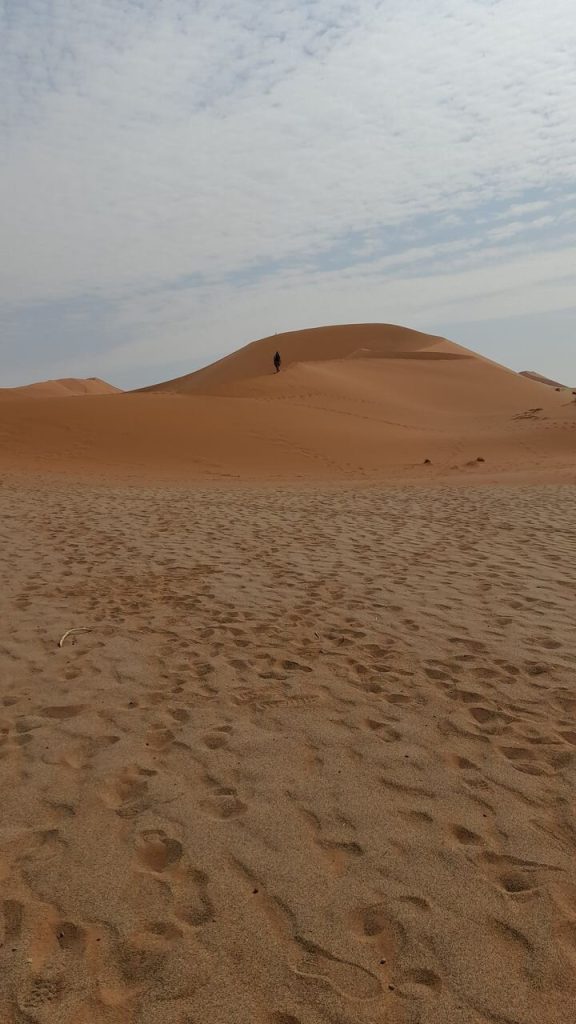
Where the Sand Came From
The sand you are climbing has travelled a very long way, and knowing that improves the view from the top.
The prevailing account is that it eroded from the interior, including the Kalahari, and was carried down the Orange River to the Atlantic. The cold Benguela current then pushed it north along the coast, where it was deposited back on land and blown inland by the wind over an extremely long period, piling into the dune field you are standing on.
The colour is iron oxide. Slow oxidation over time turns the grains progressively redder, so the older the sand, the deeper the colour, which is why dunes further inland run redder than those near the coast.
These are star dunes rather than the simpler crescent shapes found elsewhere, formed because wind arrives here from several directions across the year rather than one.
Best Time to Climb Big Daddy
May to September gives daytime temperatures around 20 to 25 degrees and predawn starts near freezing in June and July, which is the right combination for a hard climb. That is the season to plan around.
From October to February the interior passes 40 degrees and the climb becomes an early morning proposition only, realistically finished before eight. Attempting it later in those months is genuinely unwise.
Whatever the month, the first hour after the gate opens is the window. Everything about this climb works better in cool sand and low light.
Getting to Big Daddy
Big Daddy is reached from the 4×4 car park at the end of the dune road, which means the 60 kilometres of tar from the Sesriem inner gate followed by five kilometres of deep sand.
That final stretch needs a genuine 4×4 with reduced tyre pressure, or the shuttle that runs across it, or a walk of about ninety minutes each way. This is where more vehicles get bogged than anywhere else in Namibia, so anyone unsure should take the shuttle.
Sesriem itself sits roughly 350 to 360 kilometres from Windhoek and 340 to 350 from Swakopmund. Arrangements on the sandy section have changed more than once recently, so ask at the Sesriem office on the morning rather than relying on published information.
Big Daddy Dune Questions
How much does it cost to climb Big Daddy?
Nothing beyond park entry, since no permit or guide is required. Park fees are paid at the Sesriem office and were revised upward recently, with older sources quoting around 150 Namibian dollars per adult plus 50 per vehicle and the current figure likely in the 200 to 280 range once the conservation levy is counted. If you use the shuttle across the sandy section rather than driving it, add roughly 180 to 200 Namibian dollars per person return.
How hard is the Big Daddy climb?
Hard, and harder than the height suggests. Soft sand means every step gives back part of itself, the ridge dips and climbs repeatedly, and there is a steep soft section partway up that catches almost everyone. Reported times run from forty five minutes to two hours. Reasonable fitness is needed and starting before the heat builds matters more than fitness does.
How tall is Big Daddy?
Usually given as 325 metres, measured from the Deadvlei pan below. Published figures range from 325 to 400 metres, partly because dunes shift with wind and season. It is the tallest in the Sossusvlei area but not in Namibia, where Dune 7 near Walvis Bay is usually credited at around 388 metres.
Can I descend into Deadvlei from the summit?
Yes, and it is the best part. From the top you go straight down the steep face into the pan, sinking to your ankles, covering the whole descent in ten to fifteen minutes. Doing it that way means you arrive at Deadvlei from above rather than walking in flat from the car park, which is a far better introduction to the place.
Do I need a 4×4 to reach Big Daddy?
To reach the car park at its base, yes, or the shuttle, or a ninety minute walk each way from the 2WD parking. The last five kilometres of the dune road is deep sand where ordinary vehicles get bogged daily. The tar from the gate to the 2WD car park is fine in any car, and Dune 45 sits on that stretch if you would rather not deal with the sand.
Should I climb Big Daddy or Dune 45?
Dune 45 if you have one morning, want the classic sunrise and would rather not commit to a two hour ascent. Big Daddy if you are fit, want the harder climb and the run down into Deadvlei, and can be at the car park at first light. Big Mama across the pan is the middle option, similar views with easier going and far fewer people.
Can children climb Big Daddy?
Most under twelves will find it beyond them, and in rising heat it is genuinely unsuitable for young children. There is no shade, no water and no easy way off the ridge partway. Dune 45 is the family climb here, short enough for most children and with a run back down that they enjoy. Turning back partway on Big Daddy is always an option and no loss.
Booking Your Namibia Trip
The safari companies and tour operators listed on this website put trips like this together for a living and know which camps, guides and routes actually deliver. We are an independent guide to Namibia; we do not book or sell tours ourselves.
When you are ready, arrange your safari, tour or holiday with one of the recognised operators listed here. Tell them your dates and what matters most, and a real person, not a form, will handle the itinerary, park bookings and logistics for you.