Wildlife of Namibia

Namibia’s wildlife is defined by aridity rather than abundance. Game densities are lower than East Africa, and what the country holds instead are animals doing something difficult: desert adapted elephant and lion, free roaming black rhino, and the largest cheetah population on earth living mostly on farmland. Much of the best wildlife country here sits outside the national parks.
How Namibian Wildlife Is Arranged
The geography is unusually legible once you know it, and it decides where you go for what.
The north, meaning Etosha, is where the big game concentrates. The northwest, meaning Damaraland and Kaokoland, holds the desert specialists. The west coast holds the marine wildlife. The far northeast, the Zambezi Region, holds the wetland species and the animals that occur nowhere else in the country. The south and east hold arid country game and the meerkats.
No single route covers all of it. A ten day circuit reaches the first three. Adding the northeast wants a fortnight or more, which is why buffalo, hippo, sitatunga and red lechwe are missing from most Namibian trip reports.
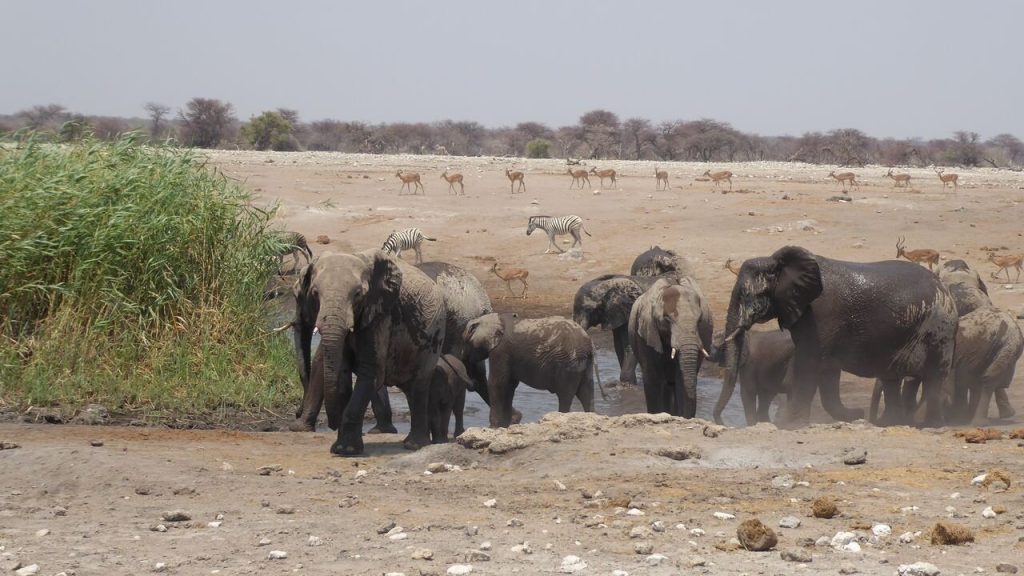
Etosha and the north. Lion, elephant, black rhino, leopard, giraffe, plains and mountain zebra, kudu, oryx, springbok, eland, black faced impala, spotted hyena and over 340 bird species.
Damaraland and Kaokoland. Desert adapted elephant and lion, free roaming black rhino, Hartmann’s mountain zebra. Low density, high quality, mostly conservancy land.
The Atlantic coast. Cape fur seals, brown hyena, Heaviside’s dolphins, flamingos, pelicans and the fog dependent invertebrates of the dune belt.
The Zambezi Region. Buffalo, hippo, crocodile, sitatunga, red lechwe, sable, roan and African wild dog. None of these occur in Etosha or the desert.
The Big Five and What Is Missing
Namibia holds four of the traditional Big Five and the fifth is the interesting one.
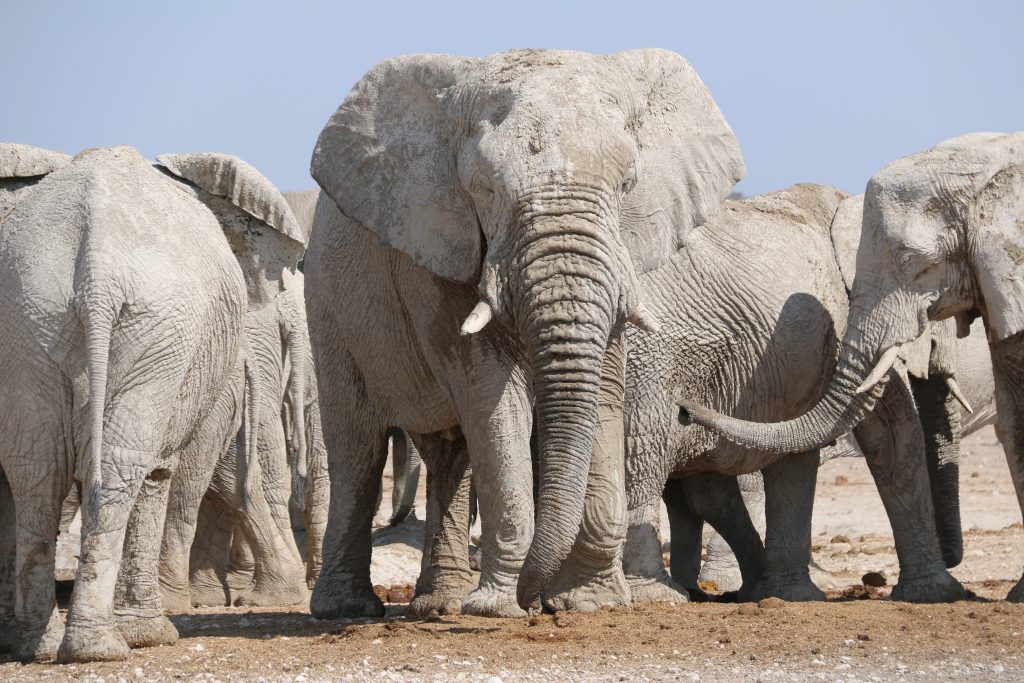
Elephant, lion, leopard and black rhino all occur, with Etosha the most dependable place for the first three and Damaraland the best for free roaming rhino. Namibia also holds the world’s largest black rhino population, over 2,000 animals, and the second largest white rhino population in Africa.
Buffalo are absent from Etosha entirely. They are excluded on veterinary grounds, kept out to protect Namibia’s foot and mouth disease free status for livestock export. They occur in the Zambezi Region parks in the far northeast, which means a complete Big Five list here requires a trip most itineraries do not include.
Anyone told they can see the Big Five at Etosha is being misled, and it is worth checking that claim before booking.
The Desert Specialists
This is what Namibia offers that nowhere else does, and it is the reason to choose this country over a higher density destination.
Desert adapted elephant work the dry riverbeds of the northwest, ranging enormous distances between water and digging for it in apparently dry sand. Around 150 remain across five ephemeral river systems. Genetic work shows they are not a separate subspecies: the adaptation is learned and passed down within family groups rather than inherited.
Desert lion in the Kunene occupy some of the largest home ranges recorded for the species, and some individuals hunt Cape fur seals on the Atlantic shoreline. Fewer than sixty adults survive across tens of thousands of square kilometres.
Free roaming black rhino in the Palmwag Concession are the last genuinely wild population on earth, unfenced across communal land and tracked on foot with community trackers. Numbers there have recovered from a remnant to around two hundred animals.
Brown hyena on the Namib coast feed almost entirely on seal pups, which is ecologically unique for the species. Hartmann’s mountain zebra, roughly 95 percent near-endemic to Namibia, work the rocky escarpment of the west.
Namibia rewards travellers who come for adaptation rather than abundance. If your measure of a good safari is animals per hour, East Africa or Botswana will beat this country every time. If it is standing on open ground with a critically endangered rhino nobody put there, or watching an elephant dig water out of sand, nothing else compares.
Wildlife Outside the National Parks
The single most useful fact about Namibian wildlife is that most of it lives outside protected areas, which reverses the assumption most visitors arrive with.
Around 90 percent of the country’s cheetah live on commercial and communal farmland, because lion and hyena in the parks kill cheetah cubs and steal their kills. Leopard densities are higher on freehold farmland and Kunene conservancies than inside national parks, for the same reason plus a better prey base. More than half of Namibia’s roughly 12,000 giraffe are on private land. Only about 20 percent of Hartmann’s mountain zebra sit inside protected areas.
That means the fate of these species rests with landowners and communal conservancies rather than with park management. It is also why Namibia’s conservation model, which gives communities rights over wildlife and tourism income on their own land, matters so much.
Between state parks, conservancies and private reserves, something close to 40 percent of Namibia is under some form of conservation management, which is among the highest proportions anywhere.
Conservation Successes Worth Knowing
Namibia’s record runs counter to the continental trend in several specific ways.
Black rhino in the northwest grew from a remnant of under fifty animals to around two hundred through the community conservancy model, which the government then adopted as the national template. Giraffe numbers and distribution have both increased over three decades, and Namibian animals were used to reintroduce the Angolan giraffe to Angola after it went locally extinct there.
The black faced impala was saved by a rescue operation that moved 226 animals from a failing Kaokoland population into Etosha, where the population now exceeds 1,500. Springbok are one of very few African antelope with an expanding population.
None of that means the picture is uniformly good. Desert lion numbers have fallen sharply after a decade of poor rainfall and conflict with livestock farmers. Rhino poaching runs at serious levels with Etosha identified as a hotspot. The secretary bird has been uplisted to Endangered. Leopard removal as problem animals runs into hundreds annually.
Wildlife You Can Only See Here
A short list of things Namibia offers that are genuinely hard or impossible elsewhere.
Free roaming black rhino tracked on foot in the Palmwag Concession. Desert adapted elephant in the Hoanib and Huab riverbeds. Brown hyena scavenging seal colonies on the Skeleton Coast. Black faced impala, a near-endemic subspecies whose entire world population is all but Namibian. Hartmann’s mountain zebra on the western escarpment. The dune lark, Namibia’s only true endemic bird, in the Namib sand sea.
Add to that the floodlit waterholes at the Etosha rest camps, where black rhino come to drink most nights and you watch on foot from a platform, which is available at no other park in Africa in this form.
Smaller Wildlife Most Visitors Miss
The large mammals get the attention and the small ones are frequently more interesting.
The Namib holds a set of animals running entirely on fog: darkling beetles that stand head down on dune crests collecting condensation, the Namaqua chameleon, palmato geckos with translucent skin, sidewinding adders, dancing white lady spiders and golden moles that live underground where temperatures stay stable.
None of this is visible without a guide, which is why living desert tours from Swakopmund consistently outrate activities costing three times as much.
Elsewhere, night drives produce aardwolf, bat eared fox, porcupine, genet, African wild cat and honey badger, none of which most self drive visitors ever see because driving after dark inside Etosha is prohibited.
Best Time for Namibian Wildlife
May to October is the dry season and the reliable window, with July through September strongest. Water disappears from the veld, grass thins out, and animals concentrate at permanent springs. In Etosha, where there are no rivers at all, that concentration is absolute.
The green season from November to April disperses game and hides it in high grass. What it gives instead is calving, predators working newborns, migrant birds, flamingos on flooded pans and far fewer people, at considerably lower rates.
Birders should reverse the standard advice. The best birding here runs opposite to the best game viewing, which is one of the more useful things to know when planning.
Wildlife of Namibia Questions
Is Namibia good for a safari?
Yes, with the right expectations. Game densities are lower than East Africa or Botswana and no route changes that. What Namibia offers instead is species and experiences found almost nowhere else: free roaming black rhino tracked on foot, desert adapted elephant and lion, and sightings you often have entirely to yourself. It is also by far the cheapest African country to self drive.
Can you see the Big Five in Namibia?
Four of them readily. Elephant, lion, leopard and black rhino all occur, with Etosha best for the first three and Damaraland for free roaming rhino. Buffalo are excluded from Etosha entirely on veterinary grounds to protect Namibia’s foot and mouth free status. They occur in the Zambezi Region in the far northeast, so a complete list needs a trip most itineraries do not include.
Where is the best wildlife in Namibia?
Etosha for volume and variety, since the absence of rivers forces every animal to a handful of waterholes through the dry season. Damaraland and the Palmwag Concession for quality, with free roaming black rhino and desert adapted elephant. The Zambezi Region for species that occur nowhere else in the country. Private reserves for guided activities the national parks do not permit.
Why does so much Namibian wildlife live outside parks?
Because the parks are not always the best habitat. Around 90 percent of cheetah live on farmland, where lion and hyena that kill their cubs are absent. Leopard densities are higher outside protected areas for the same reason plus a better prey base. Over half the giraffe and 80 percent of Hartmann’s mountain zebra are outside parks. Namibia’s conservancy model exists to give communities a stake in those animals.
What can I see in Namibia that I cannot see elsewhere?
Free roaming black rhino tracked on foot in unfenced country, which exists nowhere else. Desert adapted elephant in the northwestern riverbeds. Brown hyena feeding on seal colonies. Black faced impala, a near-endemic whose world population is all but Namibian. Hartmann’s mountain zebra. The dune lark, the country’s only true endemic bird. And the floodlit waterholes at Etosha’s rest camps.
When is the best time for wildlife in Namibia?
May to October, with July through September the peak. Water vanishes from the veld and animals concentrate at the remaining springs, which in Etosha is absolute because the park has no rivers. The green season from November to April disperses game but delivers calving, migrant birds, flamingos on flooded pans, dramatic skies and much lower rates. Birding peaks when game viewing is worst.
Is Namibia malaria free?
Much of it is in practice. The desert, the coast, the south and the central highlands carry little to no risk year round. Etosha sits in a low risk zone considered lowest in the winter months. Genuine risk concentrates in the Zambezi Region and along the northern rivers, particularly during and after the rains. Discuss your specific route and dates with a travel clinic rather than relying on a blanket answer.
Booking Your Namibia Trip
The safari companies and tour operators listed on this website put trips like this together for a living and know which camps, guides and routes actually deliver. We are an independent guide to Namibia; we do not book or sell tours ourselves.
When you are ready, arrange your safari, tour or holiday with one of the recognised operators listed here. Tell them your dates and what matters most, and a real person, not a form, will handle the itinerary, park bookings and logistics for you.