Black-Faced Impala

The black-faced impala is a vulnerable subspecies found only in northwestern Namibia and southwestern Angola, making it one of very few genuinely near-endemic large mammals in the country. Etosha National Park holds the largest population, established by a translocation operation that saved the subspecies from probable extinction. A dark blaze running from the nostrils over the head distinguishes it from the common impala.
Namibia’s Near-Endemic Antelope
Aepyceros melampus petersi evolved in geographic isolation in the northwest, separated for long enough from the common impala further east to become distinct in appearance, in ecology and, as later research confirmed, in its mitochondrial DNA.
Its natural range centres on the Kunene Region of Namibia and extends into southwestern Angola, where recent reports suggest it is close to extinct. That leaves Namibia holding almost the whole world population.
It is listed as vulnerable by the IUCN and is classified as specially protected under Namibian law. For anyone keeping a list, it is one of the more satisfying things to find here, precisely because most visitors walk past it assuming it is the same impala they saw in Kruger or the Serengeti.
The distinction is not academic. Namibia has very few endemic or near-endemic large mammals, and this is the most accessible of them.
Telling Black-Faced from Common Impala
The differences are clear once you know to look, and invisible if you do not.
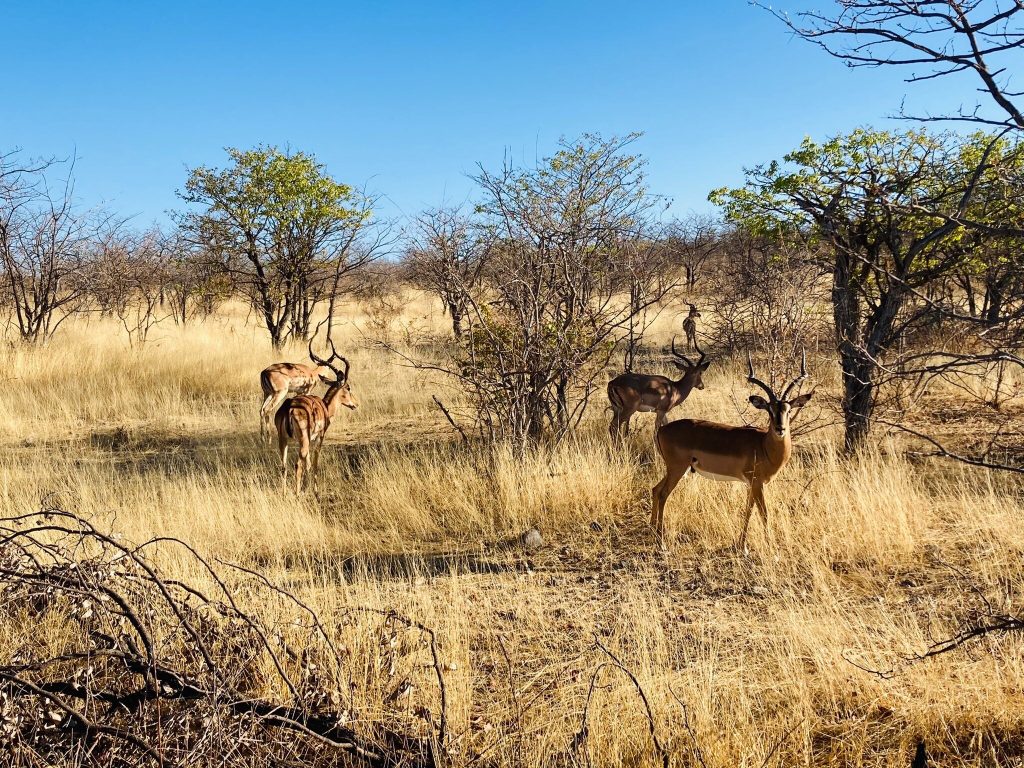
The face is the giveaway. A dark purplish black blaze runs from the nostrils up over the bridge of the nose to the top of the head, which the common impala lacks entirely. Once you have seen it the two are not confusable.
Beyond the face, black-faced impala are slightly larger and more heavily built, with a darker and shinier reddish coat, and a noticeably bushier tail. Black tufts on the rear ankles are more pronounced.
Common impala do occur in Namibia, in the Zambezi Region in the far northeast where they are native, and on farms and reserves further south where they were introduced from South Africa. So the rule of thumb is geographic: an impala in Etosha or the northwest is black-faced, and an impala in the Caprivi is common.
Most visitors to Etosha see black-faced impala within an hour of entering and never register what they are looking at. If you enter at Andersson or Von Lindequist gate, the first antelope you meet is likely to be one. Look at the face rather than the body, and once you have the blaze fixed in your eye you will pick them out at distance for the rest of the trip.
The Etosha Translocation
The reason this subspecies still exists is a rescue operation carried out in Kaokoland when its future there looked hopeless.
Prolonged drought, competition with livestock, poaching and illegal hunting had reduced the Kaokoland population severely, and conservation authorities concluded it was likely to be lost. The decision was taken to move a founder population to Etosha National Park, into an area on the edge of the subspecies’ historic range where a small native population already occurred.
The logistics were substantial. Vehicles involved covered more than 40,000 kilometres during the round up, the transport of fodder to feed animals held in quarantine, and the translocation itself. By the early nineteen seventies a total of 226 black-faced impala had been moved into the park.
They took to it. The population established, grew steadily, and by the nineteen eighties the authorities were selling small groups to game farmers. Even after those sales and subsequent translocations to communal conservancies, the Etosha population now exceeds 1,500 animals.
It is one of the clearer conservation successes in Namibian history and it is largely unknown to the visitors driving past the results.
How Many Are Left
Published figures disagree considerably and it is worth knowing the range rather than trusting one number.
The Etosha population is consistently given as more than 1,500 animals. Beyond that, some assessments put the total surviving population at around 1,000, which cannot be right if Etosha alone holds 1,500, while others put it at approximately 4,000 including animals on private reserves and farmland.
The discrepancy probably reflects what is being counted. Figures around 1,000 may refer to mature individuals or to a particular assessment date; higher figures include farm and conservancy populations that have grown since the sales began.
What is not in dispute is the shape of the situation: Etosha holds the largest single population, animals occur on private reserves and communal conservancies, the Angolan population is close to gone, and the subspecies remains listed as vulnerable.
Hybridisation: The Main Threat
The most serious risk to this subspecies is not poaching or habitat loss. It is interbreeding with the common impala.
Where black-faced impala on farms or reserves come into contact with introduced common impala, the two interbreed freely, and the genetic distinctness that makes the subspecies worth conserving is diluted. Since common impala have been introduced widely onto Namibian farms and reserves from South Africa, the risk of contact is considerable.
Etosha’s population is the critical asset here because it shows no signs of hybridisation with common impala on land bordering the park. That makes it usable as a pure source population for translocations elsewhere, which is why its management matters beyond the animals inside the park.
Alongside hybridisation, the recognised threats are habitat loss and hunting outside protected areas.
Breeding Programmes and the Management Plan
The national plan for this subspecies is more interesting than most species management and worth knowing.
Research over three decades has established what makes translocations succeed. Releases of at least sixteen animals appear to be necessary for a founder population to establish, and populations can persist alongside cheetah provided the initial release was large enough. Habitat preference work has identified where reintroductions are likely to work.
The draft national management strategy proposes that the Ministry loans farmers and conservancies a founder population of thirty animals from Etosha at no cost, on condition that the property qualifies as a pure black-faced impala farm. Qualifying requires the complete absence of common impala on the property and on neighbouring land, plus a commitment to annual counts.
After a set period, or once the population exceeds sixty animals, the farmer returns thirty animals to the Ministry for translocation elsewhere. Farms within a buffer zone around Etosha, particularly those holding common impala, are priority targets for conversion.
The subspecies also carries real commercial value as a game animal, which is part of what makes the scheme workable.
Where to See Black-Faced Impala
Etosha, and the eastern section in particular, is where you should look.
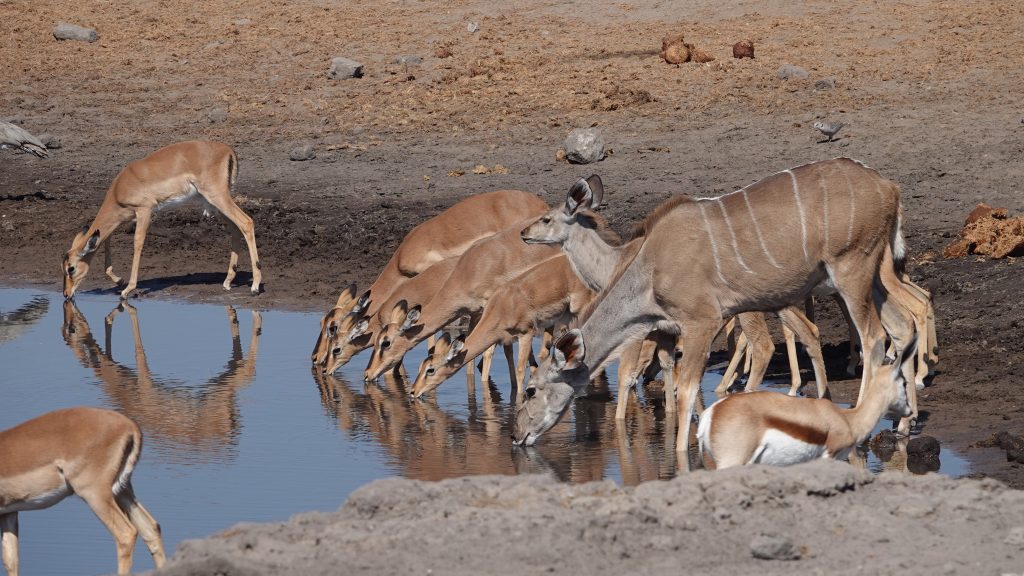
Klein Namutoni. Two to three kilometres from Namutoni camp and the most dependable waterhole in the park for them. Small herds visit regularly and the access roads give close viewing.
Namutoni camp area. The roads immediately around the camp are consistent habitat, suiting the subspecies’ preference for the edge between open plain and thicker bush.
Eastern circuit roads. Between Namutoni and the eastern waterholes. Morning drives here produce them regularly alongside kudu and giraffe.
Goas and central waterholes. The oasis style spring at Goas draws them along with elephant, and they occur through the central section of the park.
Ongava on Etosha’s southern boundary also holds a population that has been the subject of considerable research, and private reserves elsewhere hold animals descended from the Etosha sales.
Behaviour and Habitat
Black-faced impala favour the edge between open plain and thicker bush rather than either extreme, and they stay closer to water than most Namibian antelope.
Social structure follows the standard impala pattern: breeding herds of females and young attended by a dominant male, with bachelor herds of young males excluded from the breeding groups. Rams hold territory during the rut and are noisy about it.
They pronk when alarmed, the same stiff legged leap springbok are known for, and impala add a scattering manoeuvre in which a startled herd explodes in several directions at once, which confuses a pursuing predator.
They are browsers and grazers both, taking grass after rain and leaves through the dry season, which is part of why they cope with Namibian conditions where a pure grazer would struggle.
Best Time and Viewing Tips
The dry season from May to October concentrates them at waterholes in Etosha, which is when they are easiest to find and photograph.
Morning drives on the eastern circuit are the strongest bet. They are active in the cooler hours and use the wooded edges where the light is better early.
The single most useful tip is simply to look. Visitors driving past a herd of impala in Etosha are almost certainly looking at a vulnerable near-endemic subspecies rather than the commonest antelope in Africa, and knowing that changes the sighting entirely.
Black-Faced Impala Questions
How do I tell a black-faced impala from a common impala?
The face. A dark purplish black blaze runs from the nostrils up over the nose to the top of the head, which the common impala does not have. Black-faced impala are also slightly larger and more heavily built, with a darker shinier coat and a bushier tail. Geography helps too: impala in Etosha and the northwest are black-faced, while impala in the Zambezi Region in the far northeast are common impala.
How many black-faced impala are there?
Figures disagree. The Etosha population is consistently given as over 1,500. Total estimates range from around 1,000 in some assessments to approximately 4,000 in others including private reserves and farmland, and the lower figure sits awkwardly against the Etosha count. The subspecies is listed as vulnerable, the Angolan population is close to extinct, and Namibia holds virtually the whole world population.
Why were they moved to Etosha?
Because their Kaokoland population was failing. Prolonged drought, competition with livestock, poaching and illegal hunting had reduced it to the point where authorities expected local extinction. A rescue operation moved 226 animals into western Etosha by the early nineteen seventies, onto the edge of the subspecies’ historic range where a small native population already existed. They established successfully and the park population now exceeds 1,500.
What is the biggest threat to black-faced impala?
Hybridisation with common impala. Where the two come into contact on farms and reserves they interbreed freely, diluting the genetic distinctness that makes the subspecies worth conserving. Common impala have been widely introduced onto Namibian properties from South Africa, so the risk of contact is real. Habitat loss and hunting outside protected areas are the other recognised pressures.
Where is the best place to see them?
The eastern section of Etosha. Klein Namutoni waterhole, two to three kilometres from Namutoni camp, is the most dependable spot, with small herds visiting regularly and good close viewing from the access roads. The roads around Namutoni camp and the eastern circuit towards the outer waterholes are consistent habitat, and morning drives there produce them alongside kudu and giraffe.
Are black-faced impala endemic to Namibia?
Near-endemic rather than strictly endemic, since the natural range also covers southwestern Angola. In practice the Angolan population is reported as close to extinct, so Namibia holds virtually the entire world population. It is one of very few near-endemic large mammals in the country and the most accessible of them, which makes it a specific target worth having on a Namibian wildlife list.
Can farmers keep black-faced impala?
Yes, and the national management strategy actively encourages it. The proposal is that the Ministry loans a founder population of thirty animals from Etosha at no cost, provided the property has no common impala on it or on neighbouring land and commits to annual counts. After a set period or once numbers exceed sixty, the farmer returns thirty animals for translocation elsewhere. The subspecies carries real commercial value, which makes the scheme viable.
Booking Your Namibia Trip
The safari companies and tour operators listed on this website put trips like this together for a living and know which camps, guides and routes actually deliver. We are an independent guide to Namibia; we do not book or sell tours ourselves.
When you are ready, arrange your safari, tour or holiday with one of the recognised operators listed here. Tell them your dates and what matters most, and a real person, not a form, will handle the itinerary, park bookings and logistics for you.