Namibia in the Green Season

The green season is Namibia’s contrarian window, running roughly November to April with heat, storm cloud, dispersed wildlife, the best birding of the year and rates that fall considerably. Photographers gain skies the dry season cannot produce. Wildlife watchers lose the waterhole concentration that makes Etosha work. It suits some travellers precisely and others not at all.
What the Green Season Actually Is
Namibia’s wet season is drier than most countries’ dry one, which is worth establishing first.
Rain arrives as afternoon thunderstorms rather than persistent downpours, building inland from around midday and breaking in the late afternoon. It is dramatic and short lived rather than a washout.
Total rainfall is modest almost everywhere. The Namib coast receives under 100 millimetres a year and sometimes nothing at all. The interior plateau gets modest and variable rain. Only the northeast approaches what most visitors would call a wet season, at 600 to 700 millimetres.
The country greens within days of good rain. Bushman grass sprouts and matures within weeks, which is how empty plains turn green so fast.
Rainfall varies enormously year to year. Some years the rains fail entirely and some produce enough for the Tsauchab to reach Sossusvlei and fill the pan, which almost nobody witnesses.
Weight a green season trip towards the coast and the desert rather than the north. Swakopmund stays between 15 and 25 degrees year round and is where Namibian families themselves holiday in midsummer. The northeast, by contrast, is where the rains actually bite: roads flood, some lodges close and malaria risk peaks. The same season is comfortable in one half of the country and difficult in the other.
What You Gain
The case for green season travel is specific rather than a consolation.
Dramatic skies. Storm cloud is the one thing the dry season cannot offer, and it transforms a dune photograph from a study in colour into something with structure. Photographers who have shot Sossusvlei under empty blue skies frequently come back for this.
Calving. Springbok, zebra, wildebeest and other plains game drop young in the wet months, which brings predators onto newborns and produces the most dramatic action of the year.
Birding. Palearctic migrants arrive from around November and stay through April, pushing counts to their annual peak. Resident species breed, which makes them more visible and vocal.
Flamingos. When the Etosha Pan floods, greater and lesser flamingos arrive to breed in numbers reaching tens of thousands of pairs, which is among the great wildlife spectacles in Namibia and entirely unpredictable.
Space and price. Rates fall, availability improves and the country is quiet, including at places that queue in July.
What You Lose
Being direct about this prevents the wrong booking.
Wildlife concentration. Etosha works because the park has no rivers, so in the dry season every animal must come to a handful of springs. In the wet season water lies everywhere, animals disperse across the whole park and high grass hides what remains. You may drive for an hour seeing little.
Heat. Interior daytime temperatures regularly exceed 40 degrees and Fish River Canyon can pass 48, which is why the multi day hiking trails close entirely from mid September to May.
Access. The northeast floods, with roads in the Zambezi Region becoming impassable and sections of Nkasa Rupara cut off. Kaokoland tracks become unreliable and dry riverbeds flash flood. Van Zyl’s Pass closes.
Malaria. Risk peaks during and after the rains in the northern regions, roughly November to May.
Haze. The air is less clear than in winter, which affects both photography and the night sky.
Where It Works Best
The green season is not uniform and the regional differences decide the itinerary.
The coast. Excellent. Swakopmund and Walvis Bay stay at 15 to 25 degrees, activities run, and this is where Namibians holiday in December and January.
Sossusvlei and the desert. Good with adjustments. Storm cloud transforms the photography and the heat means early starts and afternoons at the pool.
The Kalahari. At its best. Thunderstorms green the grass across the red dunes, which is the defining Kalahari image and a summer one.
The northeast. Difficult. Roads flood, some lodges close, malaria peaks. Excellent birding, which is the trade birders make and most visitors should not.
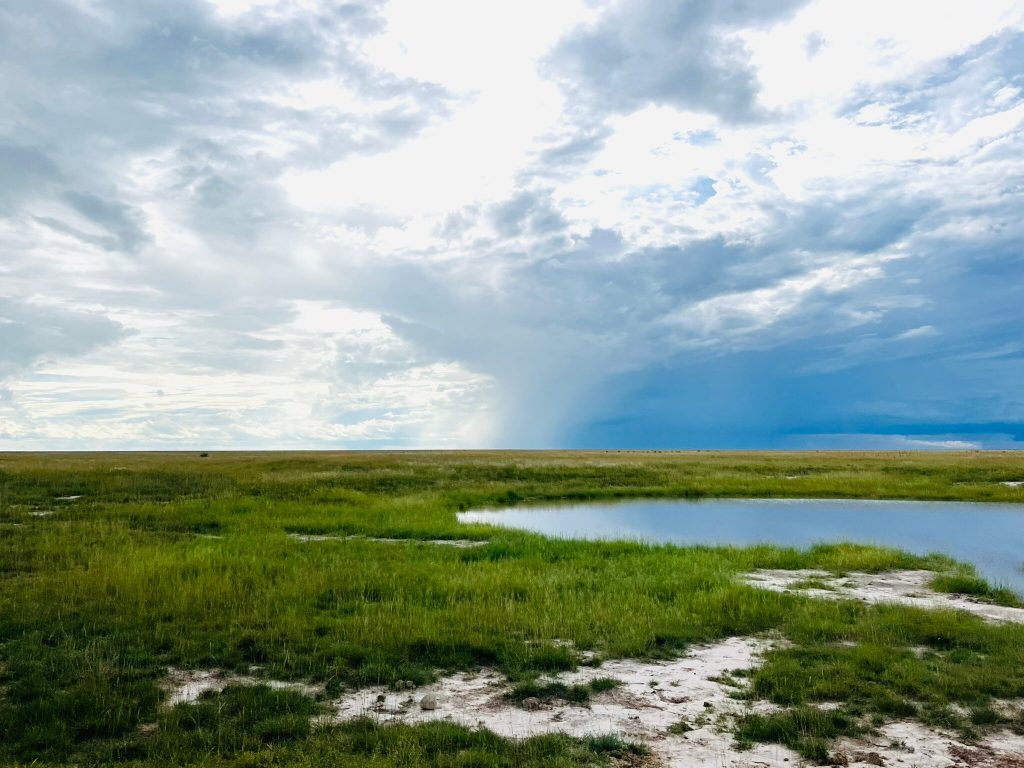
Etosha in the Green Season
The flagship park changes character completely and it is worth knowing how.
Water appears across the park and the waterhole technique stops working, since animals no longer need to come to you. Grass grows high enough to hide what remains.
The floodlit waterholes at the rest camps continue to work, since they are pumped rather than seasonal, and they remain the strongest reason to stay inside the park in any month.
Calving brings predators onto newborns, which produces genuinely dramatic sightings for anyone who finds them.
If the pan floods, flamingos arrive to breed far out in the eastern section, along with waders at Fischer’s Pan near Namutoni.
Rest camps that book out six months ahead in July are straightforwardly available, which is a real advantage for anyone who could not plan far ahead.
The honest summary is that Etosha in February is a worse wildlife park and a more interesting one.
Photography in the Green Season
This is where the season has its strongest case and photographers are its main constituency.
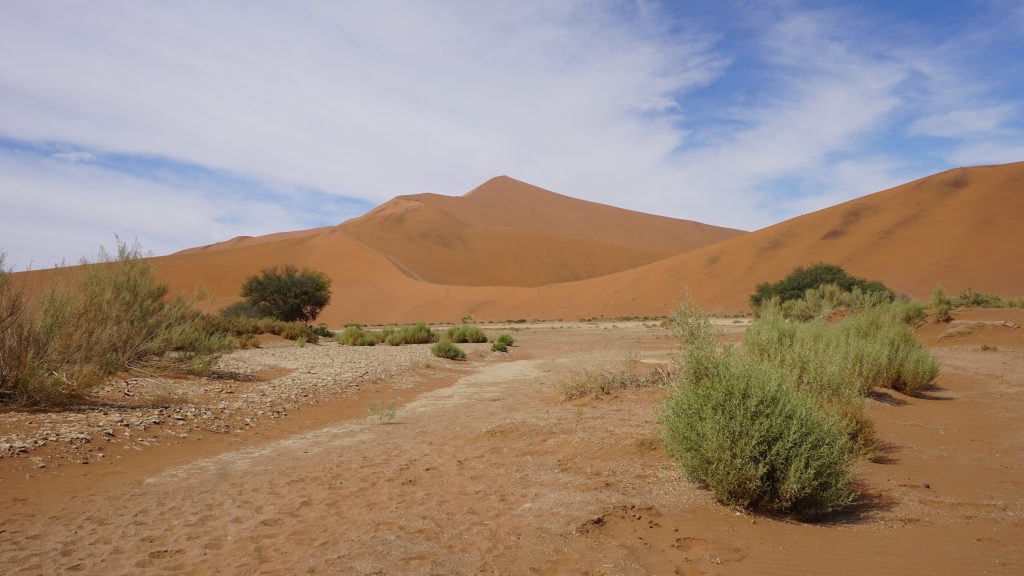
Storm cloud over the dunes is the reason to come. A red dune under an empty blue sky is a study in colour and texture; the same dune under building thunderheads is a different photograph entirely.
The rare possibility of water at Sossusvlei, when the Tsauchab reaches the pan, produces images almost nobody has.
Green grass against red Kalahari sand is the defining image of that region and only available now.
Lightning over the interior at dusk is a subject the dry season does not offer.
The costs are haze reducing clarity, a compromised night sky and dispersed wildlife.
Within any season, time of day still beats month. A dune at sunrise in January outperforms the same dune at noon in July.
The Rare Events Worth Chasing
Three green season events are unpredictable enough that nobody plans around them and striking enough to know about.
Water at Sossusvlei. In years of exceptional rain the Tsauchab River reaches the pan and fills it, producing a sheet of water at the foot of the dunes that almost nobody has photographed. It happens rarely and cannot be forecast.
Flamingos breeding on the Etosha Pan. When the pan floods, greater and lesser flamingos arrive to nest on mud mounds in the eastern section, with counts of up to 27,000 breeding pairs recorded. They nest far out beyond the reach of visitors, deliberately isolated from predators, so this is something you may hear about rather than see.
Ephemeral rivers running. The dry riverbeds of the west carry water for a handful of days a year at most, and seeing the Huab, Hoanib or Ugab come down in flood is described by travellers who happen to be there as among the strangest things they have witnessed in the country.
None of these is a reason to book. All of them are reasons to ask your camp what has happened recently, since a good rainfall year changes what is available considerably.
The corollary is that green season trips reward flexibility. A fixed itinerary cannot respond to a flooded pan or a river running, and one with slack in it can.
Practical Adjustments
A green season trip needs building differently rather than simply booking the same itinerary cheaper.
Structure activity around early morning and late afternoon, with the middle of the day at a pool. This is what Namibians do and why lodges have them.
Book accommodation with a pool at every desert and Etosha stop, which matters more in summer than at any other time.
Weight the itinerary towards the coast and the Kalahari and away from the northeast.
Allow slack for weather. Roads can wash out, riverbeds flood without warning and a route may need changing.
Never camp in a dry riverbed, since the rain filling it may fall a hundred kilometres upstream in country you cannot see.
Take malaria advice for your specific route rather than assuming the desert rules apply, since the northern picture changes considerably in these months.
Who Should Come in the Green Season
The season suits some travellers precisely.
Photographers wanting skies with structure, particularly repeat visitors who have already shot the country under blue.
Birders, for whom counts peak with the arrival of Palearctic migrants and resident breeding.
Travellers on a budget, since rates fall considerably and availability improves at properties that book out months ahead in winter.
Anyone who could not plan six months ahead and finds the rest camps and the Sesriem gate properties available.
Travellers who have seen high density game viewing elsewhere and are coming for country rather than animals.
It suits first time safari travellers least, since the thing they came for is the thing the season removes.
Green Season Questions
When is Namibia’s green season?
Roughly November to April. Rain arrives as afternoon thunderstorms building inland from midday and breaking in the late afternoon, dramatic and short lived rather than persistent. Total rainfall is modest almost everywhere: the Namib coast receives under 100 millimetres a year and only the northeast approaches what most visitors would call a wet season, at 600 to 700 millimetres.
Is it worth visiting in the green season?
For photographers, birders and budget travellers, yes. You gain storm cloud that transforms desert photography, calving with predators working newborns, migrant birds pushing counts to their annual peak, possible flamingo breeding if the Etosha Pan floods, and considerably lower rates. You lose the waterhole concentration that makes Etosha work, and you get heat above 40 degrees inland.
How bad is Etosha in the wet season?
Worse as a wildlife park and more interesting as a place. Water appears across the park so animals no longer come to you, and high grass hides what remains. The floodlit waterholes keep working since they are pumped. Calving brings predators onto newborns, flamingos may breed if the pan floods, and rest camps that book out six months ahead in July are straightforwardly available.
Where should I go in the green season?
The coast and the Kalahari. Swakopmund and Walvis Bay stay at 15 to 25 degrees year round and are where Namibians holiday in midsummer. The Kalahari is at its best, with thunderstorms greening the grass across the red dunes. Avoid weighting the trip towards the northeast, where roads flood, some lodges close and malaria risk peaks.
Will roads be a problem?
In the northeast, yes, with roads in the Zambezi Region becoming impassable and sections of Nkasa Rupara cut off. Kaokoland tracks become unreliable and dry riverbeds flash flood without warning, with Van Zyl’s Pass closing entirely. On the main circuit the tar holds and gravel roads are mostly passable, though allow slack for weather and never camp in a riverbed.
How hot does it get?
Interior daytime temperatures regularly exceed 40 degrees and Fish River Canyon can pass 48, which is why the multi day hiking trails close from mid September to May. Structure activity around early morning and late afternoon with the middle of the day at a pool, and book accommodation with one at every desert and Etosha stop.
Who should avoid the green season?
First time safari travellers, since the waterhole concentration that makes Namibian wildlife viewing work is exactly what the season removes. Anyone whose priority is seeing animals rather than country. Hikers, since the Fish River Canyon and Naukluft trails are closed. And anyone planning a northeastern route, where the rains genuinely disrupt access.
Booking Your Namibia Trip
The safari companies and tour operators listed on this website put trips like this together for a living and know which camps, guides and routes actually deliver. We are an independent guide to Namibia; we do not book or sell tours ourselves.
When you are ready, arrange your safari, tour or holiday with one of the recognised operators listed here. Tell them your dates and what matters most, and a real person, not a form, will handle the itinerary, park bookings and logistics for you.