Black Rhino in Namibia
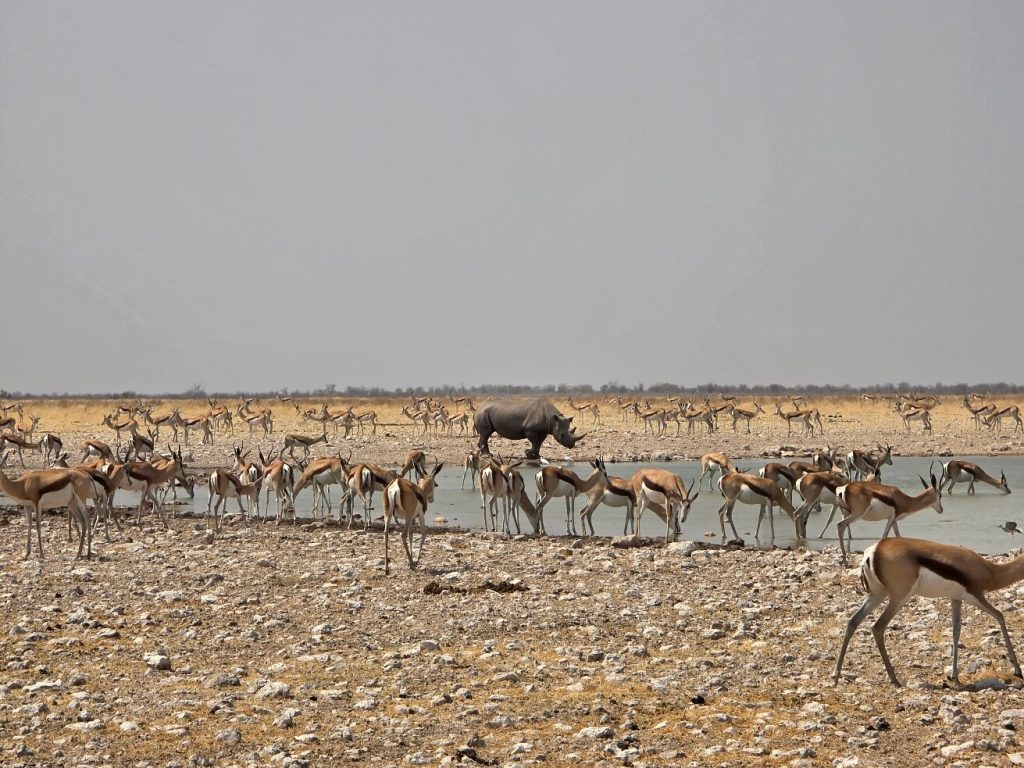
Namibia holds more black rhino than any country on earth, with over 2,000 animals representing roughly a third of Africa’s total and the great majority of the south-western subspecies. Etosha contains the world’s largest single population, while the Kunene Region holds the only genuinely free roaming black rhino left anywhere, living unfenced across communal land. Both are under active poaching pressure.
Namibia’s Black Rhino Population
The scale is worth stating plainly because it is not widely understood. Black rhino numbers across Africa collapsed from something over 100,000 in the middle of the last century to a low point of a few thousand, and the species remains critically endangered with somewhere over 6,000 animals in the wild.
Namibia holds more than 2,000 of them, over a third of the continental total and the largest national population anywhere. It also holds around 84 percent of the south-western subspecies. Alongside that sits the second largest white rhino population in Africa at roughly 1,000 animals.
Those animals are concentrated in three areas. Etosha National Park holds the world’s largest single black rhino population. Waterberg Plateau Park holds a further protected population, and the Kunene Region in the northwest holds the desert adapted animals. Between them these account for most of the country’s rhino.
The South-Western Black Rhino and Its Adaptations
The animals in the northwest are Diceros bicornis bicornis, the south-western black rhino, and they are the largest of the black rhino subspecies.
They have adapted to arid country in ways that let them persist where the species otherwise could not. They can go several days without drinking. They browse plants that would poison most animals, including the Damara milk bush, a highly toxic euphorbia that grows across the Kunene gravel plains and forms a substantial part of their diet.
Home ranges are large by black rhino standards, reflecting how thinly browse is spread. They are largely nocturnal, feeding through the night and resting in whatever shade the terrain offers by day.
These animals have been in this country a very long time. Rock engravings across the Kunene, including at Twyfelfontein, depict rhino among the animals the region’s earlier inhabitants knew.
The Kunene Recovery Story
What happened in the northwest is one of the more substantial conservation recoveries in Africa and it is worth knowing before you go looking for these animals.
Through the drought and heavy poaching of the nineteen seventies and eighties the Kunene population was reduced to a remnant. By the early eighties fewer than 40 black rhino survived in Damaraland and fewer than ten in Kaokoland to the north. There was no anti poaching capacity and very little information about the habitat.
Save the Rhino Trust was formed in response, and its method was simple: give local people a secure livelihood as wildlife guards, so that the men who knew the country best had a reason to protect the animals rather than help poachers find them.
Over three decades, working with the Namibian government and with communal conservancies, that population grew steadily. The Palmwag Concession now holds something in the region of two hundred animals, and the wider Kunene population is the last truly wild black rhino population on the planet, living in open country with no fence around it.
The distinction between free roaming and protected matters more than it sounds. Nearly every other black rhino on earth lives inside a fenced reserve or a heavily managed park. The Kunene animals do not. They range across communal land where people live and farm, which is why the conservancy model here is the whole basis of their survival.
Tracking Black Rhino on Foot in the Kunene
The experience most travellers come for starts before dawn with trackers finding fresh spoor, then following it on foot across rocky ground, sometimes for several hours.
Save the Rhino Trust trackers, drawn from local communities and monitoring these animals daily, lead the tracking. They maintain an extensive database built from photographic and life history records of individual rhino across the region, so the person walking ahead of you usually knows which animal you are following.
Sightings are consistent rather than guaranteed, and guides keep careful distance, since black rhino are unpredictable and the briefing takes that seriously. Reasonable fitness is required for several hours of walking on rough ground, and camps set minimum ages.
Desert Rhino Camp in the Palmwag Concession is the property built around this activity, operating as a partnership with the trust and neighbouring conservancies. Palmwag Lodge offers a more affordable base for the same experience.
Black Rhino in Etosha
Etosha is the other half of the Namibian rhino story and it works completely differently.
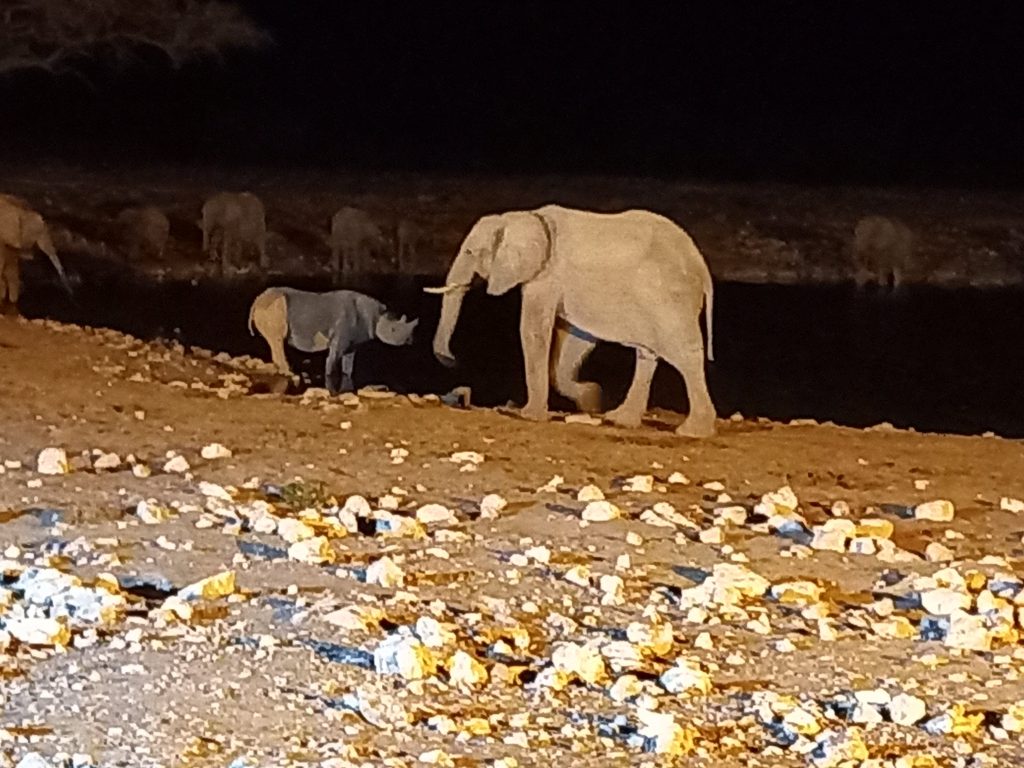
The park holds the largest single black rhino population in the world, in fenced and actively managed country where the animals concentrate at waterholes through the dry season. That makes them far easier to see than the Kunene animals.
The floodlit waterhole at Okaukuejo is the most dependable black rhino viewing anywhere. Animals come in to drink most nights, usually between about nine in the evening and the small hours, and you watch from a fixed platform just inside the perimeter fence. Moringa at Halali produces them too, and Chudop in the east is the best of the daytime waterholes for rhino, with two to four individuals visiting most afternoons.
The trade off is that this is managed viewing in a fenced park rather than tracking wild animals on open ground. Most travellers who care about rhino do both.
Poaching Pressure and Current Threats
The recovery is real and so is the ongoing threat, and it would be misleading to present one without the other.
Namibian rhino poaching losses have run at serious levels in recent years, with annual figures reaching into the high dozens across both species and black rhino accounting for the majority in the worst years. Etosha has been identified as a poaching hotspot, which is the uncomfortable flip side of holding the largest population.
Poaching levels in the Kunene have remained comparatively low, partly because the conservation programmes there are strong and partly because the remoteness helps, though remoteness alone protects nothing.
Mining is the other pressure. Approval of mining activity in rhino range in the northwest has prompted local conservancies to object, on the grounds that it displaces animals, damages the tourism income conservancies depend on, and pushes rhino into areas where they are harder to protect.

Dehorning and What the Research Shows
Dehorning is now standard practice for rhino in high risk areas of Namibia, and the obvious question is whether removing an animal’s horn harms it.
A study using historical data from the Ministry and Save the Rhino Trust examined four Namibian black rhino populations that had undergone differing levels of dehorning, looking at age at first reproduction, interval between calves, birth sex ratios, calf survival, cause of death and lifespan.
It found no measurable difference in any of those measures between dehorned and horned animals. That is a useful finding, because it removes the main welfare objection to a technique that demonstrably reduces poaching incentive.
Dehorning is temporary, since horn regrows, so it has to be repeated. It is used alongside translocation of animals out of high risk areas, satellite units fitted in horns, foot bracelets for monitoring, and a dedicated investigation unit handling rhino, elephant and pangolin crime in cooperation with police and defence forces.
Drought and the Western Kunene Decline
The threat that gets least attention is rainfall, and in the northwest it has been the dominant factor recently.
Western Kunene has endured more than ten years of below average rainfall, and the rhino population there has declined as a result. Browse becomes scarce, animals move further and in worse condition, and calf survival falls. This is not a poaching problem and cannot be solved by anti poaching work.
Exceptional rain recorded recently, described as the heaviest in a decade, has brought some optimism that breeding may improve in the years ahead. Whether that holds depends on whether the rain continues.
Elsewhere, rangers now live permanently in camp in the Nyae Nyae Conservancy in the northeast, where poaching risk is high, supported by mules brought across from the Kunene to improve mobility across a monitoring area of over 9,000 hectares.
Where to See Black Rhino in Namibia
Three quite different options, and they suit different travellers.
Okaukuejo, Etosha. Floodlit waterhole viewing on foot from a platform, most nights. The most dependable black rhino sighting in Africa and by far the cheapest.
Chudop, eastern Etosha. Daytime waterhole about four kilometres west of Namutoni, with two to four animals visiting most afternoons. Not floodlit, so arrive by late afternoon.
Palmwag Concession. Tracking free roaming animals on foot with Save the Rhino Trust trackers. The only place to do this with genuinely wild, unfenced rhino. Expensive and worth it.
Private reserves. Ongava on the Etosha boundary holds both black and white rhino with guided tracking and walking, including walking up to white rhino on foot.
Responsible Rhino Tourism
A few things matter more with this species than with others.
Do not post photographs with location data attached, and be careful about naming precise sighting locations publicly. Poachers use social media, and this is a standard request from conservation organisations rather than an abstract concern.
Follow your guide’s instructions exactly on foot. Black rhino are unpredictable, they have poor eyesight and excellent hearing, and the distances guides maintain exist for good reason.
Choose operators that partner with conservancies and with Save the Rhino Trust, since your bed night then funds the trackers directly. In the Kunene the link between tourism revenue and rhino survival is unusually direct, because the model depends on communities having a reason to protect animals that bring them no other benefit.
Black Rhino Questions
How many black rhino are there in Namibia?
More than 2,000, which is the largest national population in the world and roughly a third of Africa’s total. Namibia also holds around 84 percent of the south-western black rhino subspecies. Etosha National Park contains the largest single population anywhere, with Waterberg Plateau Park and the Kunene Region accounting for most of the rest. The country also holds around 1,000 white rhino.
Where is the best place to see black rhino in Namibia?
For reliability and cost, the floodlit waterhole at Okaukuejo in Etosha, where animals come in to drink most nights and you watch on foot from a platform. For the experience, tracking on foot in the Palmwag Concession with Save the Rhino Trust, which is the only place in the world to follow genuinely free roaming, unfenced black rhino. Chudop in eastern Etosha is the best daytime waterhole for them.
Why are the Kunene rhino called the last truly wild population?
Because they live unfenced on open communal land rather than inside a reserve boundary or a managed park. Almost every other black rhino on earth is behind a fence somewhere. The Kunene animals range across country where people live and farm, which is why the community conservancy model matters so much: their survival depends on residents having a reason to protect them.
Does dehorning hurt rhino?
Research using Namibian data across four black rhino populations found no measurable difference between dehorned and horned animals in age at first reproduction, interval between calves, birth sex ratios, calf survival, cause of death or lifespan. Horn regrows, so the procedure has to be repeated. It is used alongside translocation, satellite tracking units and intelligence led anti poaching work in high risk areas.
Is rhino poaching still a problem in Namibia?
Yes. Losses have run into the high dozens annually in recent years across both species, with black rhino accounting for the majority in the worst years, and Etosha identified as a hotspot. Kunene poaching has stayed comparatively low thanks to strong community conservation programmes. Mining approvals in rhino range in the northwest are a further pressure, displacing animals and undermining conservancy tourism income.
Is rhino tracking on foot safe?
It is run by trackers who monitor these animals daily and know individual temperaments, and guides maintain careful distance throughout. Black rhino are genuinely unpredictable and the safety briefing reflects that, which is appropriate rather than alarming. It requires reasonable fitness for several hours of walking on rocky ground, often starting before dawn, and camps set minimum ages, commonly around eight to twelve.
What do desert black rhino eat?
Browse rather than grass, and some of it is startling. They feed on the Damara milk bush, a highly toxic euphorbia growing across the Kunene gravel plains that would poison most animals, and it forms a substantial part of their diet. They can also go several days without drinking. Those two adaptations together are what allow the species to persist in country this dry.
Booking Your Namibia Trip
The safari companies and tour operators listed on this website put trips like this together for a living and know which camps, guides and routes actually deliver. We are an independent guide to Namibia; we do not book or sell tours ourselves.
When you are ready, arrange your safari, tour or holiday with one of the recognised operators listed here. Tell them your dates and what matters most, and a real person, not a form, will handle the itinerary, park bookings and logistics for you.