Twyfelfontein Rock Engravings
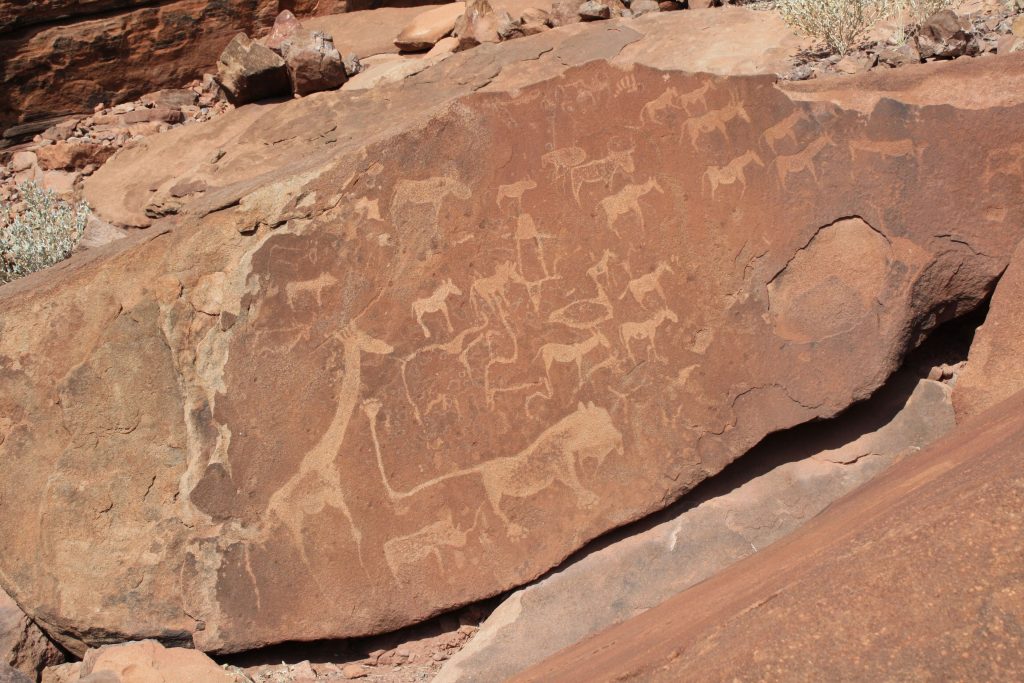
Twyfelfontein holds one of the largest concentrations of rock engravings in Africa, with over two thousand images pecked into sandstone in a single Damaraland valley, and it became Namibia’s first UNESCO World Heritage site. Guided visits are compulsory and take about an hour on one of two circular routes. The visitor centre opens daily and takes cash only.
Twyfelfontein Rock Art Tours and What You Actually See
The engravings sit on slabs of red sandstone scattered across a slope at the head of a dry valley, and the setting does as much work as the art. A raised stone path and viewing platforms run between the main panels so visitors see them without touching the rock.
Guided tours run on two circular routes that do not overlap, the Lion Man route and the Dancing Kudu route, each taking roughly 60 to 80 minutes. Guides assign one or the other depending on the group, so you see one on any given visit rather than both.
What strikes most people is the precision. The animals are rendered in accurate profile with species characteristics you can identify at a glance: the ear shape of a rhinoceros, the neck pattern of a giraffe, the paws of a lion. Over two hundred giraffe and around a hundred rhino appear, along with elephant, ostrich, zebra, oryx and antelope, plus human footprints, animal spoor and geometric forms.
The Lion Man and the Dancing Kudu Panels
Two engravings carry the reputation of the site and they sit on separate routes.
The Lion Man is the more famous. A lion is shown with five toes on each paw rather than four, and the tail extends implausibly far before ending in what looks like a human hand or footprint. The usual reading is a shaman transformed into a lion in the spirit world, which fits the wider interpretation of the site.
The Dancing Kudu on the other route is a polished engraving combining a female kudu with geometric forms, viewed from a purpose built platform that makes it one of the better photographic subjects here. The same route passes the Zwei Schneider site, which holds rock paintings rather than engravings and an unusual natural stone formation.
Ask your guide which route you are being taken on before you start. The two circuits do not intersect and each holds different headline panels, so if the Lion Man is what you came for, say so at the visitor centre rather than discovering at the end that you walked the other loop.
How Old the Engravings Are and Who Made Them
The images were made by San hunter gatherers who used this valley over an extremely long period, with the oldest commonly dated to around 6,000 years and some estimates pushing considerably further back.
The technique matters. These are not scratched but pecked, formed by repeated small strikes with a sharp quartzite point that cut through the dark weathered surface of the sandstone to expose the lighter rock beneath. That takes patience and control, and the consistency of the results across thousands of images is what gives the site its standing rather than merely its size.
Interpretation has shifted. The older reading treated the engravings as a record of animals in the area or a hunting map. Current thinking leans towards ritual and trance, with the images representing what shamans experienced in altered states, which is supported by their placement beside cracks and crevasses in the rock understood as openings to the spirit world.
One detail keeps coming up on tours and it is worth knowing. Seals and penguins appear among the engravings, which is unexpected 100 kilometres inland and suggests either that the artists travelled to the coast or that knowledge moved across long distances.
The Name, the Spring and the Farm Ruins
Twyfelfontein is Afrikaans for doubtful fountain, and the name is recent rather than ancient. A farmer settled here after the Second World War to run sheep and named the place after the spring, which delivered water unreliably and made the venture marginal.
The ruins of his homestead stand at the start of the guided walk, and the spring itself can still be seen under a shelter against the rock. It was he who showed the engravings to an archaeologist, and the site gained monument protection within a few years.
The older name is /Ui-//aes in the local Damara language, where the slashes represent two different click sounds. Signage uses both.
The Guide Requirement and the Uibasen Conservancy
You cannot walk the engraving site alone. Entry is only permitted with a guide from the Uibasen Twyfelfontein Conservancy, and this is a condition of the UNESCO management plan rather than a local preference.
The guide fee is included in the entrance price, so there is nothing extra to pay beyond a tip. Guides are available from opening and tours depart regularly through the day, so arriving without a booking is normal.
They are worth having for reasons beyond the rules. The site is a confusing spread of sandstone boulders and the panels are not signposted with explanation, so a visitor left alone would walk past most of what matters. Guides also explain the click languages, the geology and the conservancy structure that funds the site.
Nearby Sites: Organ Pipes, Burnt Mountain and the Damara Living Museum
Three stops sit within a short drive and combine with the engravings into a comfortable half day.
The Organ Pipes are a cluster of tall dolerite columns standing in a small gorge, formed as molten rock cooled and cracked into shafts. Burnt Mountain beside them is a slope of shale scorched black and purple where that same intrusion made contact, and it is at its most striking in low light.
The Damara Living Museum sits on the exit road from Twyfelfontein, a traditional village where community members demonstrate fire lighting, foraging, medicinal plants, games and crafts. Proceeds go to the community. It is a set up rather than a working settlement and it says so, which is more honest than several similar operations elsewhere.
Twyfelfontein engravings. Guided circuit of about an hour. Compulsory guide included in entry. Open daily from early morning, cash only, and best done as early as possible.
Organ Pipes. Dolerite columns in a short gorge, a few kilometres away. Under half an hour. Self guided and free or nominal.
Burnt Mountain. Scorched shale slope beside the Organ Pipes. Best in early or late light when the colours show. A brief roadside stop.
Damara Living Museum. On the exit road. Demonstrations of traditional skills, crafts for sale, community owned. Around an hour.
Photographing the Engravings
Morning is the answer. Low sun rakes across the sandstone and lifts the pecked outlines out of the surface, while overhead light flattens them into the rock and makes them very hard to photograph at all.
The site opens early and going straight in gives you both the light and a gap ahead of the tour groups. Late afternoon works too and gives warmer colour on the sandstone, though closing time constrains it.
Bring a polarising filter if you have one, since glare off the rock is a real problem. There is no shade on the circuits and the sandstone reflects heat, so a hat and water matter as much as the camera.
The Animals and the Marine Engravings
What is depicted tells you a good deal about the people who made it.
Giraffe, rhinoceros, elephant, lion, oryx, kudu, zebra, ostrich and various antelope appear, along with numerous human and animal footprints. Many of these animals no longer occur in the area, which is evidence of how the country has changed.
The genuinely startling images are the marine ones. Engravings of seals, sea lions and flamingos appear at a site more than 100 kilometres from the ocean, with penguins reported among them. Those artists either travelled to the coast or had detailed accounts from people who did.
That single detail reframes the site. These were not people confined to one valley but part of a network reaching to the Atlantic.
Animals are frequently rendered with elongated limbs or necks, and figures like the Lion Man combine human and animal elements, which researchers read as depicting the merging of physical and spiritual worlds in shamanic practice.
One reading holds that shamans chose rock faces that served as suitable surfaces and may also have been understood as portals into another world, with the act of engraving itself a means of focusing energy to enter trance.
Protection and the Decades of Damage
The site’s protection history includes a gap that cost it.
Sources differ on the initial designation, with 1948 and 1952 both appearing, though the substance is the same: recognition as a national monument came in the late forties or early fifties.
Formal protection as a nature reserve did not follow until 1986. In the interim many petroglyphs were damaged by vandals and some were removed altogether.
Concerted government protection came only after independence in 1990, culminating in World Heritage designation in 2007. Substantial restoration work has taken place in recent years.
Twyfelfontein was Namibia’s first World Heritage Site rather than its only one, since the Namib Sand Sea was inscribed later. Sources describing it as the country’s only such site are out of date.
The viewing platforms, compulsory guiding and marked paths all exist because of what happened during those unprotected decades, which is worth knowing when the rules feel restrictive.
Best Time to Visit Twyfelfontein
May to September gives comfortable walking temperatures on an exposed site with no shade. The valley heats up fast and the middle of the day is unpleasant in any season.
From October to March temperatures climb sharply and a visit becomes an early morning activity only. Rain is occasional and can make the access roads harder, though the site itself stays open.
Time of day matters more than month. Be at the visitor centre when it opens, take the tour, and be back in the vehicle before the heat builds.
Getting to Twyfelfontein
Twyfelfontein lies about 70 kilometres west of Khorixas in Damaraland, signposted off the D3254 and D2612 roads. From Khorixas allow around an hour. From Swakopmund it is a long half day, and from Etosha via Kamanjab a similar run.
The roads are gravel and manageable in an ordinary car in dry conditions, with higher clearance more comfortable on the rougher sections. Several lodges sit within ten to twenty minutes of the visitor centre, which is the sensible way to be there at opening.
Fuel is available at Khorixas and Uis, both with long gaps beyond them, so fill up before heading into the area.
Twyfelfontein Questions
What does it cost to visit Twyfelfontein?
Recent sources put the entrance fee at roughly 250 to 270 Namibian dollars per person with the compulsory guide included, though older figures circulating online are far lower and predate several increases. Children pay a reduced rate. Cash only is accepted, and the nearest ATMs are in Khorixas or considerably further at Swakopmund, so withdraw before you arrive. Confirm the current figure at the visitor centre rather than budgeting from anything published.
Do I need a guide at Twyfelfontein?
Yes, and it is enforced as a condition of the UNESCO site management plan. Entry to the engravings is only permitted with a guide from the Uibasen Twyfelfontein Conservancy, and the fee is included in your entrance ticket. Guides are available from opening and tours leave regularly, so no advance booking is needed. Beyond the rule, the site is a maze of boulders with unexplained panels and you would miss most of it alone.
How long does a visit take?
The guided circuit runs about 60 to 80 minutes depending on the route and the pace of your group. Allow two hours in total once you count buying tickets, waiting for a tour to depart and walking up to the site. Adding the Organ Pipes, Burnt Mountain and the Damara Living Museum turns it into a comfortable half day.
How old are the engravings?
The oldest are commonly dated to around 6,000 years, with some estimates pushing further back again. They were made by San hunter gatherers over a very long period, with generations returning to the same rocks, which is why images are sometimes layered over one another. The engraving technique used quartzite points to peck through the weathered surface of the sandstone, exposing the lighter rock beneath.
What is the Lion Man?
The best known engraving at the site, showing a lion with five toes on each paw instead of four and a tail that extends far behind the body before ending in what appears to be a human hand or footprint. It is usually read as a shaman transformed into a lion in the spirit world. It sits on one of the two guided circuits, so ask which route you are taking if you particularly want to see it.
Are there paintings here or only engravings?
Mostly engravings, which are pecked into the rock, and a small number of painted panels. The Zwei Schneider site on the Dancing Kudu route holds rock paintings. If it is paintings you are after, Brandberg Mountain to the south is the site for those, including the White Lady, and the two make a natural pair rather than a repetition.
Is Twyfelfontein suitable for children?
The shorter route near the visitor centre needs little climbing and works for children. The longer circuits involve steeper sections over rock and about an hour in full sun with no shade, which is harder going. Reduced rates apply for children. Whatever the age, go early, carry water and wear proper shoes rather than sandals.
Booking Your Namibia Trip
The safari companies and tour operators listed on this website put trips like this together for a living and know which camps, guides and routes actually deliver. We are an independent guide to Namibia; we do not book or sell tours ourselves.
When you are ready, arrange your safari, tour or holiday with one of the recognised operators listed here. Tell them your dates and what matters most, and a real person, not a form, will handle the itinerary, park bookings and logistics for you.