Brandberg Mountain
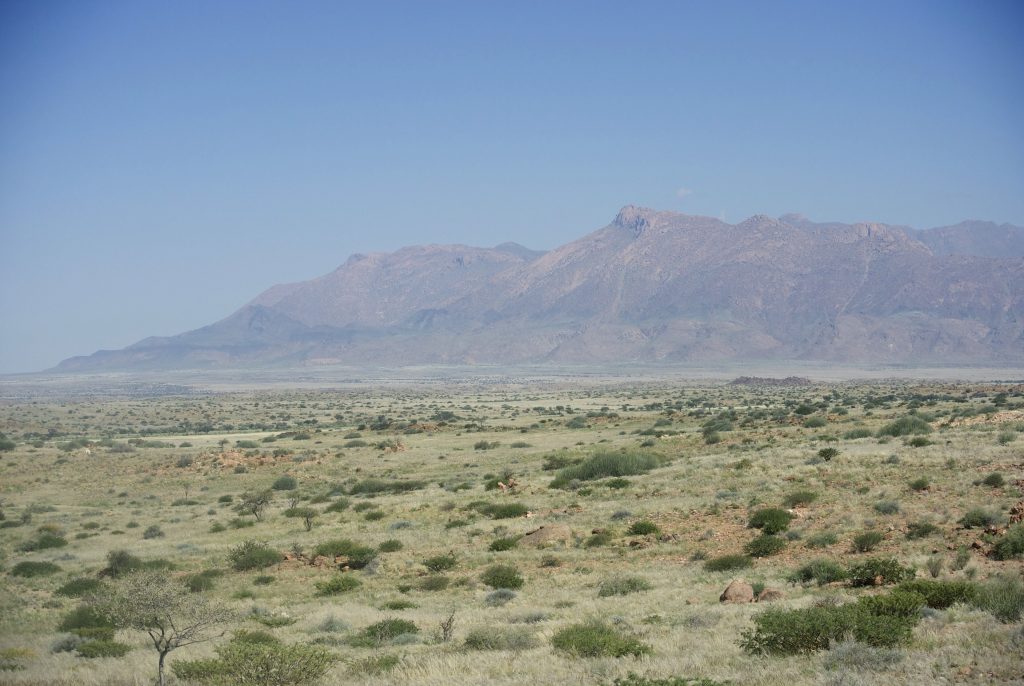
Brandberg Mountain is Namibia’s highest massif, a granite dome rising some 2,000 metres above the surrounding plains to the Königstein summit at 2,573 metres. It holds tens of thousands of San rock paintings including the famous White Lady in the Tsisab Gorge, reached on a guided walk of about five kilometres. The town of Uis lies roughly 30 kilometres away.
The White Lady Rock Painting and the Tsisab Gorge Walk
The White Lady is the reason most visitors come, and it is worth knowing what you are walking to before you set out. The painting is about 45 centimetres tall, one figure among a larger panel in a rock shelter, and visitors who expect something monumental are often taken aback by the scale.
Reaching it means a guided walk of roughly five kilometres return through the Tsisab Gorge, taking two to three hours in total over uneven rocky ground with river crossings after rain. Guides are stationed at the park office at the eastern foot of the mountain where the trail starts, and going with one is compulsory rather than optional. The panel is now protected behind bars following vandalism.
The walk itself is much of the experience. The gorge cuts into the massif with granite walls rising on either side, and guides point out endemic plants, birds and the occasional dassie along the way. Go early morning or late afternoon, because there is little shade and the gorge holds heat.
The Story Behind the White Lady Name
The name is a mistake that stuck, and the correction is more interesting than the original.
The painting was recorded in 1917 by Reinhard Maack, a German explorer and surveyor who was also the first European to climb the Königstein. He read the figure as a warrior. Decades later, in 1955, the French priest and prehistorian Henri Breuil compared it to depictions of women in Cretan Greek art and named it the White Lady, and that name entered general use and never left.
Modern scholarship reads the figure quite differently, most commonly as a male shaman or hunter with body paint, part of a hunting or trance scene rather than a Mediterranean visitor. The original interpretation says more about European assumptions of the period than about the San who made it.
Guides at the site tell this story well, and it is one of the better examples in Namibia of a famous attraction being more interesting once you know it has been misread.
Manage expectations before you walk in. The White Lady is a small figure in a wider panel, viewed from behind protective bars, at the end of a hot two to three hour round trip. Visitors who come for the painting alone are frequently disappointed. Visitors who come for the gorge, the guiding and the sense of a 4,000 year old site rarely are.
Rock Art Across the Brandberg Massif
The White Lady is one panel among an enormous body of work. Estimates put the number of paintings across the massif in the tens of thousands, with figures around 50,000 commonly quoted, spread across gorges and shelters over a mountain covering roughly 750 square kilometres.
Most are between about 2,000 and 4,000 years old, made by San hunter gatherers who used the mountain over thousands of years. Excavations suggest people were living here around 5,000 years ago, with the streams and caves drawing dispersed groups together, and the concentration of people is thought to have fed the ritual activity that produced the art.
The subjects are mostly animals and human figures: giraffe, oryx, rhino, ostrich, along with hunters, dancers and processions. The density of wildlife depicted tells you something about how different this country was when the paintings were made.
Many sites are fragile, remote or both, and are not open to casual visitors. The multi day hikes reach some of them with a guide.
Hiking to Königstein and the Summit Routes
Climbing to Königstein is a serious undertaking rather than a day walk, and it is one of the harder mountain trips in southern Africa.
A permit and a guide are both mandatory, arranged through the National Heritage Council in Windhoek or through the rest camp at Uis. Published costs vary widely between sources, with figures from around 225 Namibian dollars per person up to 1,500 plus a reservation fee, so confirm directly rather than budgeting from anything you read online.
Very fit and experienced hikers manage it in one to two days. Most take three to five, which also allows time at rock art sites along the way. There is no water on the mountain much of the year, and it may have to be hauled up at considerable cost, so the trip depends on what is available at the time.
Water is the whole problem. Four to five litres per person per day is the working figure, and carrying that weight over granite slabs is what makes this hard. Sturdy boots, poles for the descent, salty snacks and serious sun protection are all needed. Because of heat and water, the hike is realistically a winter activity from about April to September.
Uis and the Tin Mining Town Below the Mountain
Uis is the settlement most visitors use as a base, roughly 30 to 35 kilometres from the mountain, with a hotel, guesthouses, campsites, a supermarket, fuel and restaurants. It exists because of tin, and the old mine workings are still visible from a viewpoint above town.
The tin left something unexpected behind. Artisans in Uis make sculptures and ornaments from recycled tin cans and wire in a tradition grown out of the mining years, and the workshops are visible from the main road. Prices are considerably lower than at lodge gift shops and the money goes straight to the makers.
Uis is also the practical fuel and supply stop between the coast and Damaraland, and the gaps in either direction are long enough to make that worth planning around.
The 4×4 Tracks and Craters Around Brandberg
The country around the massif is laced with rough tracks reaching some genuinely remote places, and this is expedition driving rather than sightseeing.
The D2303 runs from the old Brandberg West mine towards Twyfelfontein, about 75 kilometres, and it is not passable in a saloon. There are sandy patches, the Aba Huab riverbed to cross, and steep rocky sections nearer the mine. Signage is close to nonexistent and GPS is required rather than advisable.
Other tracks lead to the Messum Crater, an eroded volcanic ring complex 18 to 25 kilometres across dating back around 130 million years, holding welwitschia and San rock paintings. Doros Crater sits north of the mountain. Stretches with names like Desolation Valley and the Divorce Pass give a fair sense of what the driving is like.
None of this should be attempted in a single vehicle without recovery gear, and lichen fields on the plains here are damaged permanently by tracks cut across them.
Wildlife Around the Brandberg
Desert adapted elephant move through the Ugab riverbed south of the mountain and are seen from time to time by visitors staying at the camps along it, though sightings are uncertain and depend on where the herds are.
On the massif itself the residents are rock specialists: klipspringer on the steep faces, dassies, baboon troops, and Hartmann’s mountain zebra on the lower slopes. Leopard are present and almost never seen.
Birding is good for near endemics, with Herero chat, Rüppell’s korhaan, Monteiro’s hornbill and Rüppell’s parrot among the species recorded in the area. Black eagle hunt the cliffs.
Where to Stay Near Brandberg Mountain
Uis carries most of the accommodation, with a hotel, self catering cottages, guesthouses and a caravan park, and several properties have views straight to the mountain.
Brandberg Rest Camp in Uis is the usual base for hikers and handles Königstein permits. Brandberg White Lady Lodge sits closer to the mountain on the Ugab River, which puts you in desert elephant country and gives a shorter run to the trailhead in the morning.
Campsites in the area range from organised sites with facilities to basic pitches. There is no accommodation at the trailhead itself, so plan to drive in.
Best Time to Visit Brandberg
April to September is the window for anything involving walking. Daytime temperatures are manageable, water demands are lower and the Königstein hike is realistic, which it is not in summer.
From October to March the mountain lives up to its name, which means fire mountain and refers to the red glow it takes on at sunset and in the summer heat. Temperatures make the Tsisab walk an early morning activity only and rule out the summit entirely. Rain can also flood the gorge and make crossings difficult.
Whatever the month, start the White Lady walk early. Guides begin operating from the park office in the morning and the gorge becomes unpleasant by the middle of the day.
Getting to Brandberg Mountain
Brandberg sits in the Erongo Region about 90 kilometres inland from the Atlantic. From Swakopmund the route runs north and inland via Henties Bay or Usakos to Uis, roughly three hours. From Twyfelfontein and central Damaraland it is a shorter run south.
The road to Uis is gravel and manageable in an ordinary car in dry conditions. The final stretch to the Tsisab Gorge trailhead is rougher, and a higher clearance vehicle is worth having, with a 4×4 preferable after rain.
It fits naturally between Spitzkoppe or the coast and Twyfelfontein, which is how most itineraries reach it, rather than as a destination visited on its own.
Brandberg Mountain Questions
What does it cost to visit the White Lady?
Entry to the Tsisab Gorge trail has historically been modest, with older sources quoting around 60 Namibian dollars per person plus about 20 for parking, though fees have been revised since so confirm at the park office. Guides are compulsory and the guide fee may be separate from entry. The Königstein summit permit is a different matter entirely, with published figures ranging from roughly 225 Namibian dollars per person up to 1,500 plus a reservation fee, so contact the National Heritage Council or the rest camp at Uis directly.
How long is the walk to the White Lady?
Around five kilometres return through the Tsisab Gorge, taking two to three hours at a normal pace. The ground is uneven and rocky with some scrambling, and after rain there are water crossings. It is manageable for reasonably fit walkers of most ages, though there is very little shade and it becomes hard work in the middle of the day.
Is the White Lady worth the walk?
That depends on what you expect. The painting itself is small, about 45 centimetres, and viewed from behind protective bars at the end of a hot walk. Visitors who come for the painting alone often feel underwhelmed. The gorge, the guiding, the wider panel and the sense of standing at a site used for thousands of years are what make the trip worthwhile, and going in with that framing changes the experience considerably.
Can I climb to the top of Brandberg?
Yes, with a permit and a guide, both mandatory and arranged through the National Heritage Council or the rest camp at Uis. Very fit hikers manage Königstein in one to two days and most take three to five. Water is the limiting factor, since there is often none on the mountain and four to five litres per person per day is needed. It is a winter activity only, realistically April to September.
Do I need a guide at Brandberg?
Yes for both the White Lady walk and any summit attempt. Guides are stationed at the park office where the Tsisab trail begins and going without one is not permitted. The requirement followed damage to the paintings, and the guides are local, well informed and the reason the site is still in reasonable condition.
Do I need a 4×4 for Brandberg?
Not for the road to Uis or the main run in, which are gravel and fine in an ordinary car when dry. Higher clearance helps on the final stretch to the trailhead and becomes necessary after rain. The tracks beyond, including the D2303 towards Twyfelfontein and the routes to the Messum and Doros craters, need a genuine 4×4, GPS and preferably a second vehicle.
How does Brandberg compare to Twyfelfontein?
They hold different things. Twyfelfontein has engravings, cut into sandstone, thousands of them concentrated in one valley with a visitor centre and short guided circuits. Brandberg has paintings, applied to rock in shelters, spread across an enormous massif with the White Lady reached on a two to three hour walk. Most travellers visiting Damaraland do both, and they complement each other rather than repeating.
Booking Your Namibia Trip
The safari companies and tour operators listed on this website put trips like this together for a living and know which camps, guides and routes actually deliver. We are an independent guide to Namibia; we do not book or sell tours ourselves.
When you are ready, arrange your safari, tour or holiday with one of the recognised operators listed here. Tell them your dates and what matters most, and a real person, not a form, will handle the itinerary, park bookings and logistics for you.