Fish River Canyon
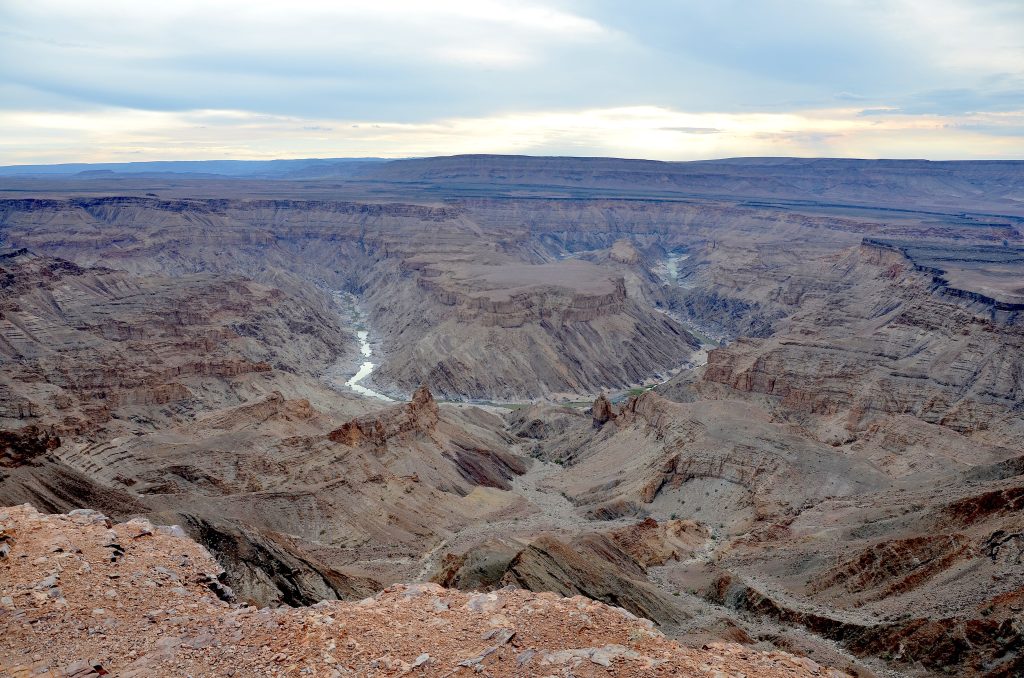
Fish River Canyon is a gorge roughly 160 kilometres long, up to 27 kilometres wide and around 550 metres deep in southern Namibia, widely described as the largest canyon in Africa. Day visitors see it from rim viewpoints near Hobas, while descending into it is restricted to permit holding hikers on the multi day trail. It sits inside the Ai-Ais Richtersveld Transfrontier Park shared with South Africa.
Fish River Canyon Viewpoint Tours from Hobas
What makes the first sight of it work is that there is no warning. You drive across a flat, dry, featureless plateau with nothing on the horizon, and then the ground simply falls away half a kilometre in front of you. Visitors regularly describe walking to the rim expecting a gradual reveal and getting none.
Hobas is the park gate and rest camp, and the main viewpoint sits ten kilometres further on a gravel access road. That lookout, often called Hell’s Bend, faces the sharpest meander in the gorge and is where nearly every photograph of the canyon is taken. Picnic tables sit under shade on the rim.
Other viewpoints run along the rim road and most people skip them, which is exactly why they are worth the extra half hour. Sunrise and sunset are when the walls take on colour and the shadows give the gorge depth, and in the middle of the day the whole thing flattens out into grey rock.
Do not treat this as a two hour stop on the way somewhere else. The canyon is a long way from anything, the access roads are rough enough to want higher clearance, and the light only works early or late. Give it a night at Hobas or a nearby lodge rather than arriving at noon and wondering what the fuss is about.
Hiking the Fish River Canyon Trail
The trail is among the hardest multi day walks in Africa and it has a reputation to match. Somewhere between 85 and 90 kilometres depending on which shortcuts you take, it runs from the main viewpoint near Hobas along the canyon floor south to Ai-Ais, and most groups take four to five days.
The descent on the first morning is the part people remember: a steep scramble down chain assisted rock to the riverbed, with a full pack. After that it is boulder fields, deep sand, river crossings and long days of 20 to 30 kilometres with no path, no facilities and no way out. There are no fixed campsites. You sleep on sandbanks.
You carry everything, including all food. Water comes from the river and needs treating. There is no phone signal, no resupply and no realistic evacuation for most of the route, which is why the medical certificate is not a formality.
Permits and Booking for the Fish River Canyon Hike
Access is tightly controlled and the rules catch out people who arrive hoping to sort it on the day. Permits come from Namibia Wildlife Resorts and must be arranged well in advance, with popular dates going many months out.
The trail opens only from the start of May to mid September, closed the rest of the year because summer temperatures reach into the high forties and flash flooding is a real risk. Minimum group size is three, minimum age is twelve, and a doctor signed medical certificate of fitness is required from every hiker. Around thirty hikers are permitted to start each day.
You also need to arrange your own transport logistics. The trail ends at Ai-Ais, 68 kilometres by road from Hobas where you left the vehicle, so a shuttle back has to be booked separately with the Ai-Ais office.
Day visitors. Rim viewpoints only. Entry permit at the Hobas gate. Descending into the canyon is prohibited without a hiking permit, and this is enforced.
Multi day hikers. Permit, medical certificate, minimum party of three, May to mid September only. Fully self supported over four to five days.
Rim walks. Shorter guided and unguided walks along the top of the canyon, available year round, no descent involved. The realistic option for most travellers.
Private reserve trails. The northern canyon runs through Gondwana Canyon Park and neighbouring private land, where lodges run their own shorter hikes and drives.
Ai-Ais Hot Springs at the Southern End of the Canyon
Ai-Ais sits at the southern end of the park where the trail finishes, built around thermal springs that come out of the ground hot enough to need cooling before use. The name means burning water in Khoekhoegowab.
For hikers it is the reward, and the sight of people who have just walked ninety kilometres lowering themselves into a hot pool is a fixture of the season. For everyone else it is a resort with chalets, camping, a restaurant and an indoor and outdoor spa complex, reachable by ordinary road without any hiking involved.
It also works as a base for the southern end of the canyon and for onward travel to the Orange River and the South African border, which is 125 kilometres away at Noordoewer.

Day Visitor Rim Walks and Guided Tours
Descending is off limits to day visitors, but the rim itself gives more than most people use. Walks along the top run between viewpoints with the gorge falling away beside you, and they need no permit beyond park entry.
Lodges in the area run guided drives, sundowner trips to private viewpoints and short walks, which is how most non hiking visitors see the canyon beyond the main lookout. Scenic flights operate too and give the only view that makes the scale of the thing legible.
Canyon Roadhouse, about 16 kilometres north of Hobas, has become a fixture on this route: a bar and restaurant built around a collection of rusting vintage cars under quiver trees. It is the only reliable food and cold drink for a long way in any direction.
Wildlife and Plants Around Fish River Canyon
This is dwarf shrub savanna on rock and it holds less than most Namibian parks, which is not the reason anyone comes. Hartmann’s mountain zebra move on the plateau and the upper slopes. Klipspringer work the rock faces, and kudu, oryx and springbok occur across the area.
Baboon troops live in the gorge and hikers deal with them regularly, since they are bold around food. Leopard are present and almost never seen. Rock hyrax, ground squirrel and a good range of reptiles round it out.
The plants are the more interesting story. Quiver trees stand across the rocky ground, along with euphorbias and the shepherd’s tree, and after the rare rains the plateau flowers briefly. The Fish River itself is Namibia’s longest at around 800 kilometres, rising in the Naukluft mountains and dry for most of the year, reduced in the gorge to a chain of still green pools.
Orange River Canoeing Tours Near the Canyon
The Orange River marks the South African border about 110 kilometres south of Ai-Ais and it is the natural add on for anyone already this far down the country. Several operators run canoe and kayak trips from half a day to four or five days, drifting between rock walls with easy rapids and camping on sandbanks.
The water is warm, which after the Atlantic coast comes as a genuine relief, and the trips suit families and first time paddlers rather than needing whitewater experience. It also pairs naturally with a canyon visit for travellers heading on to South Africa.
Where to Stay Near Fish River Canyon
Options fall into three groups. Namibia Wildlife Resorts runs Hobas at the northern end, mostly campsites with a few bush chalets, a kiosk and a pool, and Ai-Ais at the southern end with chalets, camping and the spa. Both are inside the park.
Private lodges sit 20 to 60 kilometres out, including the Gondwana properties on Canyon Park land with their own rim access and activities. These are more comfortable than the park camps and give you private viewpoints.
The third option is basing in Keetmanshoop and driving down for the day, which some travellers do to save a night. It works logistically and it means missing sunrise and sunset at the rim, which are the two hours that matter.
Best Time to Visit Fish River Canyon
Winter, roughly May to September, is the practical season and the only one in which the hiking trail operates. Days are comfortable and nights on the canyon floor drop to five degrees or below in July, which surprises hikers who packed for a desert.
Summer here is severe. Temperatures on the plateau and in the gorge climb towards fifty degrees, which is why the trail closes entirely, and even rim viewing becomes an early morning activity. The rains from January to April can turn the normally dry river into a torrent.
For hikers wanting a balance of warm enough to swim in the pools and cool enough to walk, the second half of June is the window most experienced walkers point to. September gets hot again and the river often shrinks to muddy remnants.
Getting to Fish River Canyon
The canyon is a long way from the rest of the Namibian circuit and that is the main planning constraint. Windhoek is around 760 kilometres north, Sesriem about 620, Lüderitz roughly 465 and the Noordoewer border post 125 kilometres south of Ai-Ais.
Coming from the north, take the B1 south then the B4 towards Lüderitz, turning onto the C12 and following signs to Hobas. The final gravel sections are rough enough that a higher clearance vehicle is worth having, though a true 4×4 is not required in dry conditions.
Because of the distances, most itineraries fold the canyon into a southern loop taking in Keetmanshoop, the Quiver Tree Forest, Aus and Lüderitz rather than treating it as a detour from the main circuit. That works well and needs about fourteen days for the country as a whole.
Fish River Canyon Questions
What does it cost to visit Fish River Canyon?
Day entry is paid at the Hobas gate. Older sources quote around 60 Namibian dollars per person plus 10 per vehicle, though the national park schedule was revised upward recently and the current figure sits higher, so confirm at the gate. For the hiking trail, recent figures put the permit at roughly 500 Namibian dollars per person, park entry at about 160, and the shuttle from Ai-Ais back to Hobas near 300, giving a total in the region of 960 Namibian dollars or about 67 US dollars per hiker. That is cheap by international standards for a five day wilderness trail.
Can I hike into the canyon as a day visitor?
No. Descending into the gorge is limited to hikers holding a permit for the multi day trail, and the rule is enforced. Day visitors are restricted to the rim viewpoints and rim walks. There is no short in and out hike to the canyon floor, which disappoints a lot of people who arrive expecting one.
How hard is the Fish River Canyon hike?
Genuinely hard, and harder than its distance suggests. Between 85 and 90 kilometres over four to five days, carrying all your food, over boulder fields and deep sand with no path. Most groups end up walking 25 to 30 kilometres on the longer days. The first morning starts with a steep chain assisted descent with a full pack. A doctor signed medical certificate is required precisely because evacuation from most of the route is not straightforward.
When can I hike the Fish River Canyon trail?
From the start of May to the middle of September only. The trail closes for the rest of the year because of summer temperatures reaching towards fifty degrees and the risk of flash flooding. Permits should be booked many months ahead, since only around thirty hikers are allowed to start each day and popular dates go early.
Is Fish River Canyon really the second largest in the world?
That claim appears everywhere and it depends on how you measure. It is comfortably the largest canyon in Africa at around 160 kilometres long, 27 wide and 550 deep. Whether it ranks second globally after the Grand Canyon depends on whether you rank by depth, length, volume or area, and other contenders have stronger claims on some of those. The scale is not in question even if the ranking is.
How long do I need at Fish River Canyon?
One night is enough for a non hiker, arriving in the afternoon for sunset at the rim and leaving after sunrise the following morning. Two nights lets you add Ai-Ais and the quieter viewpoints without rushing. Hikers need five to six days for the trail plus travel either side. Given the driving distances, most people build it into a wider southern loop rather than visiting alone.
Do I need a 4×4 for Fish River Canyon?
Not strictly, though higher clearance helps. The tar route in is fine in any car, and the gravel access roads to the viewpoints have deteriorated in places, so a saloon can manage in dry conditions but will be slow and uncomfortable. Most travellers reaching the far south are in a 4×4 anyway for the rest of the route.
Booking Your Namibia Trip
The safari companies and tour operators listed on this website put trips like this together for a living and know which camps, guides and routes actually deliver. We are an independent guide to Namibia; we do not book or sell tours ourselves.
When you are ready, arrange your safari, tour or holiday with one of the recognised operators listed here. Tell them your dates and what matters most, and a real person, not a form, will handle the itinerary, park bookings and logistics for you.