Zebra in Namibia: Hartmann’s Mountain and Burchell’s
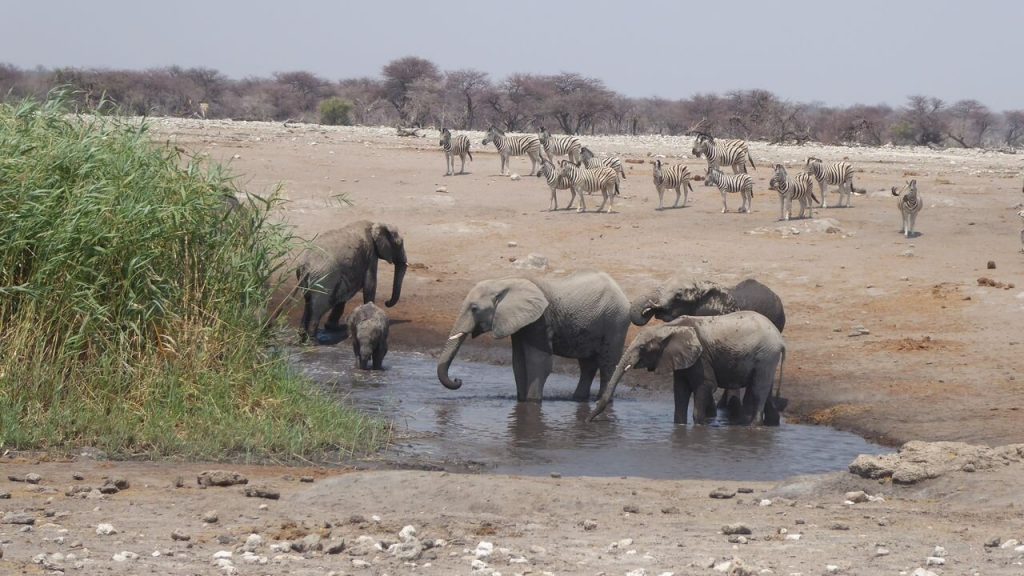
Namibia holds two of the world’s three zebra species, and one of them is close to being a Namibian animal. Hartmann’s mountain zebra is around 95 percent near-endemic to Namibia, living on the rocky escarpment of the west. Burchell’s plains zebra occupies the flatter savanna, and Etosha holds both. Telling them apart takes about ten seconds once you know what to look at.
Two Zebras, Two Habitats
The split is geographic and it is fairly clean, which makes identification easier than the stripes suggest.
Hartmann’s mountain zebra, Equus zebra hartmannae, lives on the rugged terrain of the western escarpment and the flats beside it, from the Kunene Region south through the Erongo mountains and into central and southern Namibia. It is an agile climber and it belongs on rock.
Burchell’s zebra, a subspecies of the plains zebra, prefers arid savanna with access to water and occupies the open grassland from Etosha northwards and eastwards. It is the one you will see in large numbers on the pan edge.
Their ranges historically barely overlapped. That has changed, with consequences covered further down this page.
How to Tell Hartmann’s from Burchell’s
Four features do the work and any one of them settles it.
The belly is the quickest. Hartmann’s has a plain white belly with the stripes stopping short, while Burchell’s stripes carry across the underside and join.
The legs are next. Hartmann’s is striped distinctly all the way down to the hooves. Burchell’s stripes reach roughly the knee and then fade out.
The rump carries a giveaway pattern. Hartmann’s has a grid iron arrangement of narrow horizontal stripes across the top of the rump, which Burchell’s lacks entirely.
And the throat. Hartmann’s has a pronounced dewlap, a fold of skin hanging beneath the neck, particularly in older males. Burchell’s has none.
One more helps at distance: Burchell’s carries faint grey shadow stripes superimposed on the white bands, while Hartmann’s stripes are stark black and white with no shadowing. Hartmann’s also has noticeably larger ears and golden brown nostrils against Burchell’s black.
Start with the belly and the legs, since both are visible from a vehicle at reasonable range and neither depends on light. If the stripes stop before the underside and run all the way to the hooves, you are looking at Hartmann’s. Most visitors photograph both species on one trip without realising they are different animals.
Hartmann’s Mountain Zebra: Namibia’s Own
This is the one worth caring about. Around 95 percent of the world population lives in Namibia, with a small remnant in southwestern Angola whose status is unclear, which makes it near-endemic in practical terms.
Population estimates for Namibia run from around 24,000 to 33,000 animals, and the trend is described as stable or increasing over recent decades. Globally the mountain zebra as a species is listed as vulnerable, with Hartmann’s making up the great majority of that total and the Cape mountain zebra of South Africa accounting for only a couple of thousand.
Its distribution here is discontinuous, concentrated in several main areas: from the Kunene south to around the Ugab River and east towards Outjo, the Erongo mountains, and the escarpment country running south. Historically its range was continuous from Angola down past the Orange River into the Cape.
The animal is named after Georg Hartmann, a German geographer who worked on the exploration of this country with the Otavi Mining and Railway Company.
One conservation concern deserves attention: only about 20 percent of the national population sits inside protected areas. The rest is on freehold and communal land, so the species depends on landowners rather than parks, which is a pattern repeated across Namibian wildlife.
Life on the Escarpment
Hartmann’s behaviour follows its terrain and it is worth watching for.
They spend the day on rocky slopes in small family units of roughly three to thirteen animals, typically five to eight, with a single breeding stallion tolerated per group. Bachelor groups of young males form separately.
Late in the afternoon they start moving downhill to drink and feed in the valleys through the night, then climb back at first light. Mountain zebra country is recognisable by deeply worn game paths on the slopes and well used dust bowls where the animals roll.
They are agile climbers and they behave differently from plains zebra when disturbed, adopting a confrontational stance and moving in an arc to keep facing whatever concerns them rather than simply running.
Adults are large, with mares averaging around 276 kilograms and mature stallions around 343, standing 116 to 150 centimetres at the shoulder.

Burchell’s Zebra in Etosha
Burchell’s is the zebra of the plains and the one that produces the mass gatherings visitors remember.
Etosha holds them in numbers, and herds at pan edge waterholes such as Salvadora can run into four figures. They mix freely with springbok, oryx and wildebeest, and the churn of a large zebra herd coming to drink is one of the better spectacles in the park.
Historically they moved seasonally within Etosha, confining themselves to the southern and eastern pan edges in the dry season and moving to the open plains west of the pan when the rains came. That movement has been constrained by fencing.
Burchell’s are the main prey species for Etosha’s lions, so a large zebra herd at a waterhole is worth sitting with for reasons beyond the zebra.
The Hybridisation Problem in Etosha
This is the most interesting and least reported thing about Namibian zebra, and it is a genuine conservation issue.
The two species historically had limited range overlap because they used different country and different water. Two human interventions changed that. Park boundary fences covering more than 850 kilometres were erected around Etosha, blocking dispersal beyond the boundary and preventing dry season movement to external water. And new artificial waterpoints were created inside the park.
The result is that two previously separated species now overlap, and they are hybridising. Within Etosha, mountain zebra are restricted to the dolomite ridges in the far western section while plains zebra occur throughout, and the contact zone between them is where the problem sits.
Ongoing research is assessing the mechanisms and extent of it using combined genetic and ecological work across Etosha and the connected country to its west. The concern is straightforward: hybridisation dilutes the distinctness of a near-endemic subspecies that Namibia is very nearly the sole custodian of.

Where to See Each Species
Hartmann’s, western Etosha. Restricted to the dolomite ridges in the far western section around Dolomite Camp and the Galton Gate area. Rocky ground, small groups.
Hartmann’s, Damaraland and Erongo. The core habitat. Escarpment slopes, the Etendeka plateau, the Erongo mountains and the Naukluft. Look on rocky slopes in the afternoon.
Burchell’s, Etosha. Throughout the park and in large numbers at pan edge waterholes. Salvadora, Okondeka and Rietfontein produce big herds through the dry season.
Burchell’s, the north and east. Common from Etosha northwards and eastwards through the Kavango and Zambezi regions on open savanna with water.
Why Zebras Have Stripes
The question has been argued over for more than a century and the answer has shifted considerably in recent years.
Camouflage was the old explanation, on the theory that stripes break up the outline in long grass or confuse a predator in a running herd. It has fallen out of favour, partly because zebra are conspicuous to the eye and partly because lion take them readily.
Temperature regulation has been proposed, with black and white bands heating at different rates and generating small air currents over the skin. Evidence for it is mixed.
The explanation with the strongest recent support is biting flies. Experimental work has shown that horseflies and tsetse struggle to land on striped surfaces, apparently because the pattern disrupts their flight path in the final moment before contact. Since those flies carry disease, the benefit would be substantial.
Namibia offers a natural test of sorts. Hartmann’s mountain zebra live in dry, rocky country where biting flies are scarce, while Burchell’s occupy wetter savanna where they are not, and both are heavily striped. Whatever the pressure was, it appears to have applied before the two diverged.
Best Time to See Zebra in Namibia
Both species are present year round and neither requires seasonal planning to find.
The dry season from May to October concentrates Burchell’s at Etosha waterholes in the largest numbers, which is when the big herds and the predator activity around them are at their best.
For Hartmann’s, late afternoon is the productive window in any season, since that is when they leave the rocky slopes and move down towards water and valley feeding. Early morning catches them heading back up.
Zebra in Namibia Questions
How do I tell Namibia’s two zebras apart?
Look at the belly and legs. Hartmann’s mountain zebra has a plain white belly with stripes stopping short of the underside, and striping that runs all the way down to the hooves. Burchell’s stripes cross the belly and fade around the knee. Hartmann’s also has a grid iron pattern across the rump, a pronounced dewlap on the throat, larger ears and no grey shadow stripes.
How many Hartmann’s mountain zebra are there?
Estimates for Namibia run from around 24,000 to 33,000, with the population described as stable or increasing over recent decades. Roughly 95 percent of the world total lives in Namibia, which makes it near-endemic, with a small remnant in southwestern Angola of unknown status. The mountain zebra as a species is listed as vulnerable by the IUCN.
Where can I see Hartmann’s mountain zebra?
On rocky escarpment country in the west. Damaraland, the Etendeka plateau, the Erongo mountains and the Naukluft all hold good numbers. Inside Etosha they are confined to the dolomite ridges in the far western section around Dolomite Camp, so a standard southern circuit trip will not produce them. Late afternoon is the best time, as they move downhill towards water.
Are the two zebra species interbreeding?
Yes, and it is a recognised conservation concern. The two historically had little range overlap. Park boundary fencing at Etosha covering over 850 kilometres, combined with artificial waterpoints created inside the park, brought them into contact. Research is under way using genetics and ecology to assess how extensive the hybridisation is, since it dilutes a near-endemic subspecies that Namibia is very nearly sole custodian of.
Why is it called Hartmann’s zebra?
After Georg Hartmann, a German geographer who contributed to the exploration of this country while working with the Otavi Mining and Railway Company. The scientific name Equus zebra hartmannae carries the same reference. It is one of a number of Namibian species and places named after German figures from the colonial period.
Are mountain zebra bigger than plains zebra?
Slightly, yes. Hartmann’s mares average around 276 kilograms and mature stallions around 343, standing 116 to 150 centimetres at the shoulder. They also carry a heavier build suited to climbing. Hunters and guides who know both consistently describe the mountain zebra as the larger and more striking of the two, with starker black and white striping and no grey shadowing.
Do zebras live in the desert in Namibia?
Hartmann’s mountain zebra lives in genuinely arid country on the western escarpment and the flats beside it, including areas bordering the Namib. They cope with heat and limited water by climbing to feed on higher ground and descending to drink in the evening. They are not found in the true dune fields, which offer no grazing at all, but they occur far closer to the desert than most large mammals.
Booking Your Namibia Trip
The safari companies and tour operators listed on this website put trips like this together for a living and know which camps, guides and routes actually deliver. We are an independent guide to Namibia; we do not book or sell tours ourselves.
When you are ready, arrange your safari, tour or holiday with one of the recognised operators listed here. Tell them your dates and what matters most, and a real person, not a form, will handle the itinerary, park bookings and logistics for you.