Etosha Waterholes and Where to Find Wildlife

Etosha’s waterholes are the whole basis of game viewing here, because the park has no rivers and every animal has to drink at one of roughly forty springs and boreholes within a day or two. Knowing which ones produce what, and at which time of day, changes a safari here more than any other decision. The southern circuit between Okaukuejo and Halali is the most consistently productive.
How Etosha Waterholes Work and Why Sitting Beats Driving
Three kinds of water exist in the park and they behave differently. Contact springs occur naturally where the pan edge meets underlying rock and push water to the surface. Artesian springs rise under pressure. Boreholes are pumped and man made, and they are the ones that stay reliable when everything else dries.
The practical consequence is that in the dry months water is scarce, predictable and mapped. You do not search for animals across 22,000 square kilometres. You choose which waterhole to sit at.
That word sit is the one most visitors ignore. Park, switch the engine off and wait a minimum of thirty to sixty minutes. Predators frequently appear only after the wait, and Etosha differs from riverine parks in that the open terrain and heat force lions and cheetah to drink in daylight rather than at night. Visitors who drive hard between waterholes covering distance see consistently less than those parked in the shade at one good hole.
Alternate between two well known waterholes and one small satellite hole each day. The named ones have vehicles at them; the satellites often have nobody at all. Charitsaub, Batia, Gemsbokwater and Kapupuhedi are the kind of places where you can spend an hour entirely alone and still have animals arriving.
Waterholes on the Southern Circuit Around Okaukuejo
The area around Okaukuejo is the densest concentration of productive water in the park and the natural place to start.
Okondeka is the one people name first. A natural fountain on the western pan edge about twenty minutes north of Okaukuejo, it has a long reputation for lion, often found over a kill under the scattered trees nearby. The drive out has almost no vegetation, which makes the whole area feel open and remote, and afternoon light is best both for photography and for the wider view across the pan.
Nebrownii sits close to camp and pulls large elephant herds through the dry season, often arriving in waves. Olifantsbad translates as elephant’s bath and earns it, with elephant, zebra, black faced impala, red hartebeest and kudu. Gemsbokvlakte and Aus fill out the loop, and Ombika near Andersson Gate is one of the better general drinking places with regular lion.
Ozonjuitji m’Bari lies a long way west of Okaukuejo and is the only place in the park where roan antelope are reliably found. Allow proper time to get back before the sunset curfew, and take the route through the Fairytale Forest of moringa trees on the way.
The Central Pan Edge Waterholes
Between Okaukuejo and Halali the road runs close to the pan and a cluster of waterholes sit along it with the white expanse behind them, which makes this the most photogenic stretch in the park.
Salvadora, named after the Salvadora persica bush, is the standout. Lions are a regular sighting and it is one of the more dependable places for cheetah, which hunt the wide calcrete flats around it in the early morning. Enormous zebra herds drink here, with counts running into four figures. Morning light works best.
Sueda and Charitsaub sit alongside it, and Charitsaub in particular concentrates large elephant herds in the late dry season with a wide clearing that improves visibility. Rietfontein is one of the biggest waterholes in the park, ringed by open plain so you see animals coming from a distance, and it is a regular lion haunt with afternoon light favouring photography. Two graves from the Dorsland Trek survive nearby.
Homob and Ngobib are the quieter options in this stretch, both wooded enough to give leopard a chance, with morning light suiting Homob.
Halali, Goas and the Central Woodland
Halali sits centrally among mopane woodland, and the thicker cover here changes what you see. Moringa, the camp’s own floodlit waterhole, is set below a rocky rise and draws rhino, elephant and leopard, viewable on foot at any hour.
Goas is the outstanding one nearby. An oasis style natural spring surrounded by greenery, it pulls in elephant, black faced impala, heavy numbers of wildebeest and zebra, and strong birdlife. Along with Halali it is among the better leopard bets in the park, which is saying something in a place where leopard sightings are uncommon.
Rietfontein and Goas both reward long stays. It is not unusual to see close to ten species drinking at the same hole here, sometimes peacefully and sometimes not.

Eastern Waterholes Around Namutoni
The east is flatter and more open, with wide pans and long visibility, and it comes into its own in the late dry season when plains game gathers along the pan edges.
Chudop is the pick of them and rates as the best dedicated black rhino waterhole in the eastern sector, with two to four animals visiting most afternoons and evenings. It sits about four kilometres west of Namutoni on a quiet loop road with less traffic than the main route. It is not floodlit, so arrive by late afternoon for the light. Lion, spotted hyena, giraffe, large elephant bulls and the occasional leopard at dusk all use it.
Klein Namutoni is two to three kilometres from camp, which lets you stay late and still beat the gate curfew, and the bush along the access road is good for Damara dik dik. Kalkheuwel, southwest of Namutoni, is one of those places where seven or eight species drink at once if you sit long enough.
Tsumcor lies between Namutoni and the Andoni Plain to the north. Zwei Palmen is easy to spot by its landmark trees and is a good raptor stop. Batia, Gemsbokwater, Charitsaub and Kapupuhedi extend the circuit and see very few vehicles.
For lion. Okondeka, Salvadora, Rietfontein, Kalkheuwel, Chudop and Ombika. Early morning and late afternoon are strongest, though Etosha’s heat brings predators to water in daylight.
For black rhino. Okaukuejo and Moringa after dark from the camp platforms, and Chudop in the east in the late afternoon. The western section around Olifantsrus and Dolomite also holds strong numbers.
For elephant. Nebrownii, Okaukuejo, Chudop, Olifantsbad and Charitsaub. Herds tend to arrive in waves at the pumped holes rather than trickling in.
For leopard. Goas, Moringa at Halali and Ngobib, all of which have enough surrounding cover. Sightings remain uncommon and anyone promising one is overselling.
Western Etosha and the Dolomite Waterholes
The western section beyond Okaukuejo towards Galton Gate is the quietest part of the park by a wide margin. Traffic is minimal, the terrain is more broken, and rhino sightings out here are among the best available.
Klippan and the holes around Dolomite Camp hold water well and give open viewing from the parking areas. Olifantsrus has a double storey photographic hide over its waterhole, which is a different way of watching entirely and one that photographers rate highly.
Access is the constraint. Guests entering at Galton are restricted to guided drives rather than self driving the western zone, and Dolomite is 180 kilometres from Okaukuejo, so this is a section you commit to rather than dip into.
Fischer’s Pan, Andoni and Seasonal Water
The green season changes the map completely, and travellers who come between about December and April need to think differently.
Water lies everywhere, herds disperse, and the reliable boreholes become less important. What appears instead is seasonal water. Fischer’s Pan near Namutoni floods in good rain years and can hold flamingo flocks running past ten thousand birds, roughly four kilometres from the camp. The Andoni Plain in the north floods too, drawing waders, storks and raptors.
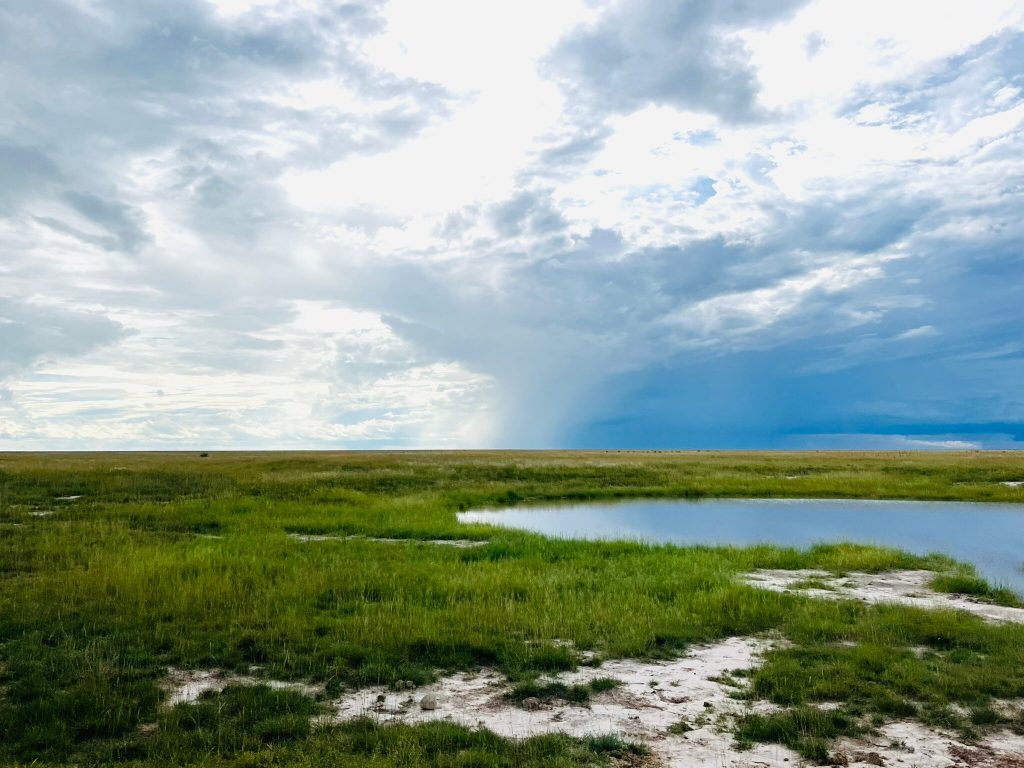
Zebra and wildebeest move in long columns during the wet season transition, which is its own spectacle. Mammal viewing is harder and the photography can be far better, with dramatic cloud and green foreground.
Reading the Sightings Boards and Timing Your Day
Each rest camp keeps a sightings board where visitors record what they saw, where and when. Spending five minutes there before setting out is the single cheapest improvement you can make to a day in Etosha, since waterholes go quiet for weeks and shift with the pumping schedule.
Structure the day around the gates. Be through at opening for the first two hours, come back to camp through the worst of the midday heat, and go out again from mid afternoon until you need to return before sunset. Work backwards from closing time and add a buffer of at least half an hour, because a good sighting forty kilometres from camp will eat it.
Position matters at the hole itself. Park with the sun behind you or to one side, keep the animals’ walking route clear, and pull to the edge of the viewing area rather than the middle so the vehicles behind you can see too.
Best Time of Year for Etosha Waterholes
May to October is when the system works as described, with July through September the peak. Water disappears from the veld, grass thins out, and animals have no alternative to the springs. October is the most intense month of all, with animals under real pressure at drying holes, though the heat is punishing.
The green season from November to April disperses everything. Herds spread out across new grazing, high grass hides them, and the waterholes go quiet. Birding improves sharply and the pans can flood. It is a different park rather than a worse one, but for waterhole watching it is the wrong window.
Getting Around the Etosha Road Network
Roads between the waterholes are graded gravel and a standard two wheel drive handles the main circuit in the dry season. Plan on averaging around 30 kilometres an hour, which catches out anyone working from a map and a calculator.
Gates open at sunrise and close at sunset with times shifting week to week. Driving after dark is prohibited and carries heavy fines. Fuel is available at Okaukuejo, Halali and Namutoni, though running low before you reach one is unwise.
Stay in the vehicle except at designated points, keep to the marked roads, and remember that photo identification is required at the entry gate.
Etosha Waterhole Questions
Which is the best waterhole in Etosha?
There is no single answer because it depends on what you want and when you come. Okaukuejo is the most dependable overall thanks to the floodlit viewing after dark and its black rhino. Okondeka is the pick for lion, Goas for leopard and general variety, Salvadora for cheetah and pan views, and Chudop for rhino in the east. Waterholes also go quiet for weeks at a time, which is why the camp sightings boards matter.
How long should I sit at a waterhole?
A minimum of thirty to sixty minutes, and longer at the productive ones. Predators regularly appear only after a substantial wait, and animals arrive in waves rather than continuously. Visitors who drive hard between waterholes consistently see less than those who park at two or three good ones and wait. Patience produces more here than mileage does.
What does it cost to enter Etosha?
Park fees were revised upward recently and now likely sit in the region of 200 to 280 Namibian dollars per international adult per day once the conservation levy is counted, with reduced rates for SADC and Namibian residents and a separate vehicle charge of around 60 Namibian dollars for cars with ten seats or fewer. Older sources quoting 150 Namibian dollars predate the increase. Fees run for a 24 hour period from entry, and confirmation at the gate is worth doing.
Can I see rhino at Etosha waterholes?
Yes, and Etosha is among the best places in the world for black rhino. The most dependable viewing is after dark from the floodlit platform at Okaukuejo, where animals come in most nights, usually between about nine in the evening and the small hours. Moringa at Halali also produces them. In the east, Chudop is the standout, with two to four individuals visiting most afternoons and evenings.
Are there waterholes you can visit on foot?
Only the three floodlit camp waterholes at Okaukuejo, Halali and Namutoni, which are viewed from fixed platforms just inside the perimeter fence and lit all night. Olifantsrus has a double storey hide over its waterhole. Everywhere else in the park you must stay in your vehicle, and leaving it outside designated points is prohibited.
Do waterholes dry up during the year?
Natural springs and contact springs can and do, particularly late in the dry season, which is one reason the sightings boards are useful. The pumped boreholes are the reliable ones and are what concentrate animals through the driest months. In the green season the position reverses entirely, with water everywhere and the named holes far less important.
Which waterholes are best for photography?
Okondeka and Salvadora for wide pan backdrops, with Okondeka favouring afternoon light and Salvadora the morning. Rietfontein has open plains around it and works better in the afternoon. Homob is a morning hole. Olifantsrus offers the low angle from its hide. As a rule, position the vehicle so the sun is behind you, and be at the gate at opening for the first useful hour of light.
Booking Your Namibia Trip
The safari companies and tour operators listed on this website put trips like this together for a living and know which camps, guides and routes actually deliver. We are an independent guide to Namibia; we do not book or sell tours ourselves.
When you are ready, arrange your safari, tour or holiday with one of the recognised operators listed here. Tell them your dates and what matters most, and a real person, not a form, will handle the itinerary, park bookings and logistics for you.