Small Antelope of Namibia
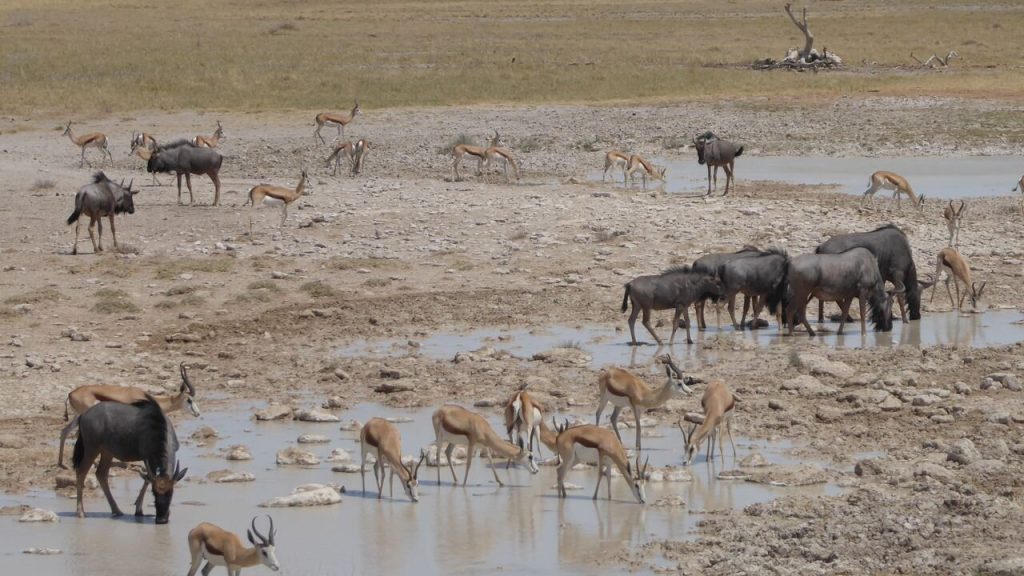
Namibia’s four small antelope are the ones everyone drives past. The Damara dik dik stands 35 centimetres and weighs five kilograms. The klipspringer walks on the tips of hooves that work like rubber grips and can stand with all four feet on a rock the size of a saucer. Steenbok and duiker fill out the group, and all four reward stopping.
Why They Get Missed
Namibia holds over twenty antelope species and visitors photograph perhaps six.
The small ones are missed for structural reasons rather than rarity. They are the colour of the ground, they freeze rather than run, they work thick bush and rocky slopes where a vehicle cannot follow, and they occur in pairs rather than herds.
A herd of springbok on an open plain announces itself. A steenbok standing motionless in dry grass fifteen metres from the road does not.
They are also small enough that visitors scanning for elephant simply do not register them, which is why guides point them out and self drivers frequently do not see them at all.
The reward for slowing down is that these are among the more interesting animals in the country biologically, with adaptations that the large mammals do not need.
Scan the verges rather than the middle distance. Small antelope stand within metres of Namibian roads and their instinct is to freeze rather than flee, which means they are frequently still there after you have passed. Drive slower through mopane and thick bush, look for a horizontal line in vertical grass, and stop when something does not fit. The dik dik in particular is almost always closer than you would expect.
The Damara Dik Dik
Namibia’s smallest antelope and a near-endemic worth travelling for.
It stands around 35 centimetres at the shoulder and weighs about five kilograms, which is roughly the size of a hare with legs. Only males carry horns, short and often hidden by a tuft of hair on the forehead.
The nose is the distinguishing feature: an elongated, mobile snout used for cooling. Blood passing through it loses heat by evaporation, which lets the animal manage without shade in country that gets very hot.
Damara dik dik occur in northern and central Namibia, through the mopane woodland of Etosha, Damaraland and the Erongo. Etosha’s Halali area is reliable, and they are frequently seen along the roads through thick bush.
They live in monogamous pairs holding small territories, marked with dung middens and with secretions from a gland below the eye, which you can see them wiping onto twigs.
They are browsers, taking leaves, shoots, fruit and flowers, and they get most of their water from what they eat.
The Klipspringer
The rock specialist, and the one with the most striking adaptations.
Klipspringer means rock jumper in Afrikaans and it is accurate. They live on rocky slopes, koppies and escarpments, and they move across terrain nothing else attempts.
The hooves are the reason. Klipspringer walk on the tips of cylindrical hooves with a rubbery core, which grip rock the way a climbing shoe does, and the animal can stand with all four feet together on a surface the size of a saucer.
The coat is unusual too: thick, coarse, hollow hair that stands away from the body rather than lying flat. It insulates against both heat and cold on exposed rock, and it cushions impact against stone.
They stand around 50 centimetres and weigh 10 to 15 kilograms, and they pair for life, with the male keeping watch on a high point while the female feeds.
Look for them at Spitzkoppe, the Erongo, the Naukluft, Waterberg and the Fish River Canyon rim, typically standing motionless on a skyline rock.
The Steenbok
The one most likely to be seen and least likely to be identified.
Steenbok stand around 50 centimetres and weigh 10 to 11 kilograms, with a bright rufous coat, large ears and a white belly. Only males carry horns, short and straight.
They occur across most of Namibia in open country, and they are among the most widespread antelope in the region.
Their behaviour is what identifies them. A steenbok freezes flat to the ground when threatened, relying on camouflage, then explodes into a zigzag sprint at the last moment. That freeze is why visitors drive past them constantly.
They are solitary or in pairs rather than herds, which reinforces the impression that there are few of them when there are many.
Unusually, steenbok bury their dung and urine, scraping a hole and covering it afterwards, which is thought to reduce scent available to predators.
They are independent of drinking water, taking what they need from their food.
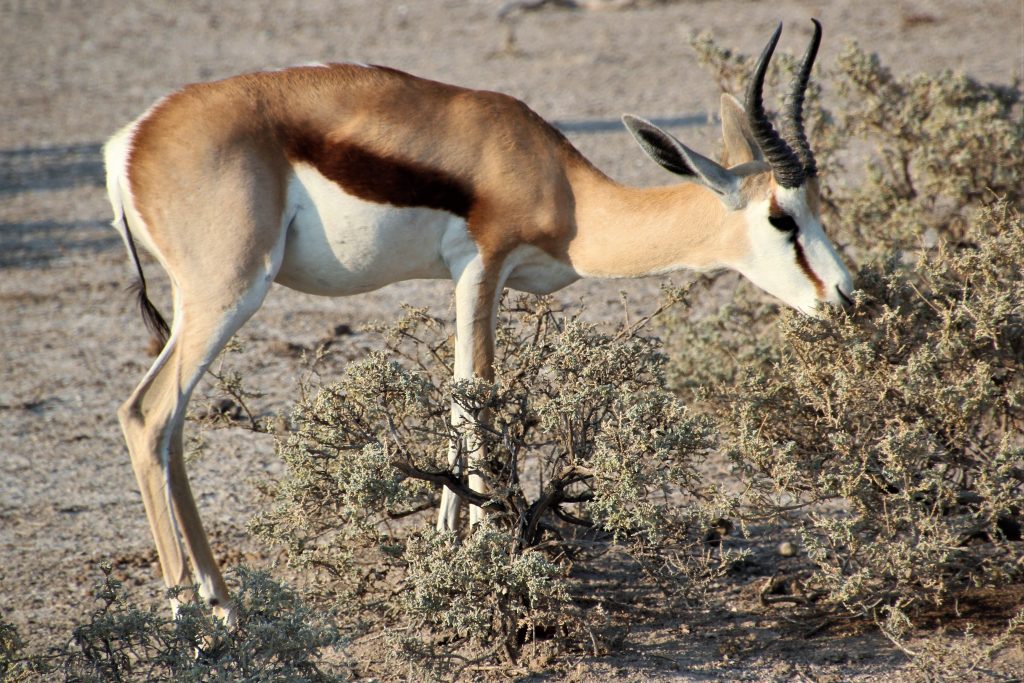
The Duikers
The bush dwellers, and the hardest of the four to see.
The common duiker, also called the grey duiker or bush duiker, is the species across most of Namibia. It stands around 50 centimetres and weighs 15 to 21 kilograms, greyish brown with a dark blaze down the nose.
The name comes from the Afrikaans for diver, describing the way the animal plunges into cover when disturbed rather than running in the open.
They are the most widely distributed antelope in Africa and they work thick bush, which is exactly where you cannot see them.
They are also the least strictly vegetarian of the group. Common duiker take fruit, leaves, flowers and seeds and will also eat insects, birds, eggs and small mammals, which is unusual among antelope.
They are mainly nocturnal and crepuscular in areas with human pressure, which makes night drives on private reserves the reliable way to see them.
How to Tell Them Apart
Four small brown antelope in the same country is a genuine identification problem and habitat solves most of it.
On rock. Klipspringer. Standing on a skyline boulder on stiff, tip-toe hooves with coarse hair that stands away from the body. Nothing else works that terrain.
In thick mopane, in a pair. Damara dik dik. Tiny, with an elongated mobile snout and a tuft of hair on the forehead. Northern and central Namibia only.
In open grass, frozen flat. Steenbok. Bright rufous with large ears and a white belly, alone or in a pair, exploding into a zigzag at the last moment.
Diving into cover. Common duiker. Greyish brown with a dark blaze down the nose, plunging into bush rather than running across open ground.
Size also separates them. Dik dik is unmistakably the smallest at around five kilograms; the other three run 10 to 21.
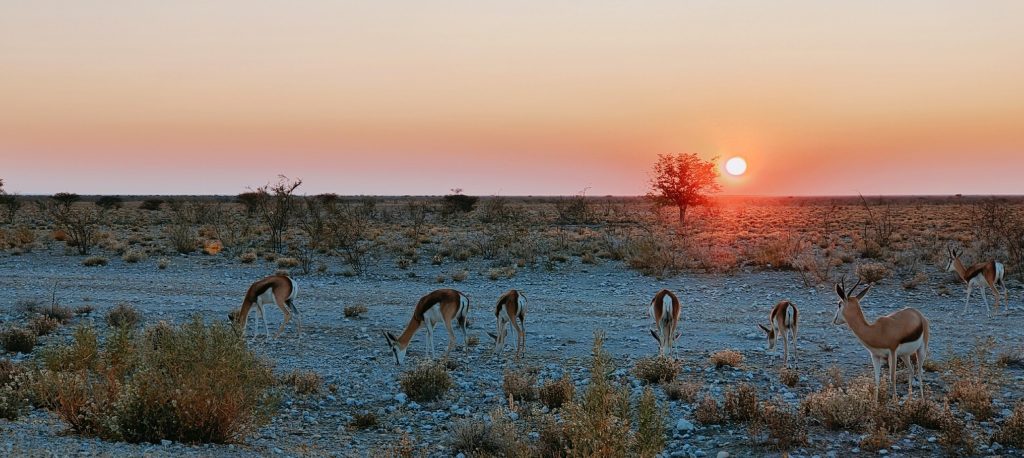
Why Small Antelope Manage in Namibia
Being small in a hot dry country requires solutions that large animals do not need.
Water independence is the common one. Dik dik, steenbok and klipspringer all get most or all of their water from their food, which is what lets them occupy country with no surface water.
Selective feeding is the mechanism. A small browser can afford to eat only the most nutritious leaves, shoots and fruit, which are also the parts with the highest moisture content. A large grazer cannot be that selective and needs volume.
Body size works against them on heat, since a small animal has more surface area relative to volume. The dik dik’s elongated snout is a direct response, cooling blood by evaporation.
Territoriality rather than migration is the other pattern. All four hold small permanent territories rather than moving with the rains, which suits animals that can meet their needs in a limited area.
The trade off is predation. Small antelope are prey for everything from leopard and caracal to jackal, eagle and python, which is why the behavioural repertoire runs to freezing, zigzagging and diving into cover.
Where to See Them
Each has a reliable place, which makes a full set achievable on a standard itinerary.
Damara dik dik in Etosha, particularly the mopane around Halali, and through Damaraland and the Erongo. They are frequently right beside the road.
Klipspringer at Spitzkoppe, the Erongo, the Naukluft, Waterberg and the Fish River Canyon rim, on rock and usually skylined.
Steenbok across most of the country in open country, including Etosha’s plains and the Kalahari, alone or in pairs.
Common duiker in thicker bush across the north and centre, most often on night drives at private reserves such as Okonjima, Erindi and the Etosha boundary properties.
All four occur in Etosha, which makes a patient few days there the best single opportunity.
Best Time to See Small Antelope
Early morning and late afternoon, as with most Namibian wildlife, when they move and feed rather than lying up in shade.
The dry season from May to October thins the grass and bush considerably, which makes small antelope far easier to spot. In the green season high grass hides them completely.
Night drives on private reserves are the answer for duiker in particular, and produce the others alongside aardwolf, bat eared fox, porcupine and genet.
Klipspringer show through the day, since they stand on exposed rock and their habit of skylining themselves works in your favour.
Slow driving matters more than season. These are animals found by scanning verges at 40 kilometres an hour rather than covering ground at 80.
Small Antelope Questions
What is Namibia’s smallest antelope?
The Damara dik dik, standing around 35 centimetres at the shoulder and weighing about five kilograms. Only males carry horns, short and often hidden by a tuft of hair on the forehead. Its elongated mobile snout is used for cooling, with blood losing heat by evaporation as it passes through, which lets the animal manage without shade in very hot country.
How does a klipspringer stand on rock?
It walks on the tips of cylindrical hooves with a rubbery core, which grip stone the way a climbing shoe does, and it can stand with all four feet together on a surface the size of a saucer. Its coat is thick, coarse and hollow, standing away from the body to insulate against heat and cold and to cushion impact against rock.
Why do I keep missing small antelope?
Because they freeze rather than run, they are the colour of the ground, they occur in pairs rather than herds, and they work thick bush and rocky slopes. A steenbok flattens itself and relies on camouflage before exploding into a zigzag at the last moment. Scan the verges rather than the middle distance and drive slower through thick bush.
How do I tell them apart?
Habitat solves most of it. On rock, skylined, it is a klipspringer. Tiny and in a pair in thick mopane, a Damara dik dik. Bright rufous and frozen flat in open grass, a steenbok. Diving into cover rather than running across open ground, a common duiker. Size helps too, since dik dik at five kilograms is unmistakably smaller than the other three at 10 to 21.
Do they need to drink?
Mostly not. Dik dik, steenbok and klipspringer all get most or all of their water from their food, which is what allows them to occupy country with no surface water. Being small lets them feed selectively on the most nutritious leaves, shoots and fruit, which are also the parts with the highest moisture content. A large grazer cannot be that selective.
Where can I see all four?
Etosha holds all four, which makes a patient few days there the best single opportunity. Dik dik are frequently beside the road in the mopane around Halali. Steenbok work the open plains. Klipspringer need rock, so Spitzkoppe, the Erongo, the Naukluft and Waterberg are better for them. Duiker are most reliably seen on night drives at private reserves.
Do duikers really eat meat?
Common duiker are the least strictly vegetarian antelope in the group, taking fruit, leaves, flowers and seeds and also eating insects, birds, eggs and small mammals, which is unusual among antelope. The name comes from the Afrikaans for diver, describing how they plunge into cover when disturbed rather than running in the open.
Booking Your Namibia Trip
The safari companies and tour operators listed on this website put trips like this together for a living and know which camps, guides and routes actually deliver. We are an independent guide to Namibia; we do not book or sell tours ourselves.
When you are ready, arrange your safari, tour or holiday with one of the recognised operators listed here. Tell them your dates and what matters most, and a real person, not a form, will handle the itinerary, park bookings and logistics for you.