African Elephant in Namibia

Namibia holds around 24,000 African elephants and the population has grown at roughly 5 percent a year for three decades, which runs directly counter to the continental trend. The great majority live in the northeast rather than in Etosha or the desert. Namibia is one of very few African countries where elephant numbers and range are both expanding.
How Many Elephants Namibia Has
The national estimate sits at around 24,000 animals, derived from a series of aerial surveys using methods standardised since the mid nineteen nineties.
The distribution is lopsided and worth knowing before planning a trip. Roughly 12,000 elephants occupy the Zambezi Region in the far northeast, taking in Bwabwata, Mudumu and Nkasa Rupara alongside fifteen communal conservancies. Around 8,000 more sit in Khaudum National Park and the Nyae Nyae Conservancy to the southwest of that.
Etosha, which most visitors take to be the elephant destination, holds somewhere near 2,900. The entire northwest, including Damaraland and Kaokoland, holds roughly 1,200 to 1,700.
Six main range areas are recognised: the northwest, Etosha, Mangetti National Park, northern Kavango, Khaudum and Nyae Nyae, and the Zambezi Region.
Claims that Namibia holds only around 5,600 elephants circulate periodically and do not survive contact with the survey data. Observers on one set of flights physically counted over 10,000 animals within a fraction of the total area being estimated.
A Population That Is Growing
Namibia’s elephant trend is unusual enough that it is worth stating precisely.
Since the mid nineties the national population has increased at an estimated 5.36 percent a year, a trend the surveys treat as very strongly established. Distribution has expanded across the country at the same time, so elephants now occur in areas they had been absent from for decades.
Not all populations grow equally. The Zambezi has increased at around 4.76 percent annually and Khaudum and Nyae Nyae at 4.85 percent, both firmly established in the data. Etosha is the slowest growing population in the country at roughly 1.75 percent, and the northwest trend at 3.86 percent does not hold up statistically given the wide error margins.
A separate measure supports the picture. The ratio of elephant carcasses to live elephants recorded during aerial surveys sits at around 3.57 percent in Namibia, where anything over 8 percent is considered a warning sign.
Densities in the arid northwest and in Etosha remain very low, and those populations recovered from historical over hunting that came close to eliminating them.
If elephants are what you have come for, the arithmetic points northeast rather than to Etosha. Roughly 20,000 of Namibia’s 24,000 elephants live in the Zambezi and Khaudum areas. Etosha delivers reliable sightings at waterholes and holds barely a tenth of the national population, which catches most visitors out.
Elephants in Etosha
Etosha remains where most visitors see elephants, and the way the park works makes it dependable even at low density.
With no rivers at all, every animal has to drink at a spring or borehole through the dry season, so elephants come to a small number of known points rather than dispersing. Nebrownii, Okaukuejo, Olifantsbad, Chudop and Charitsaub all pull herds in, often arriving in waves rather than trickling.
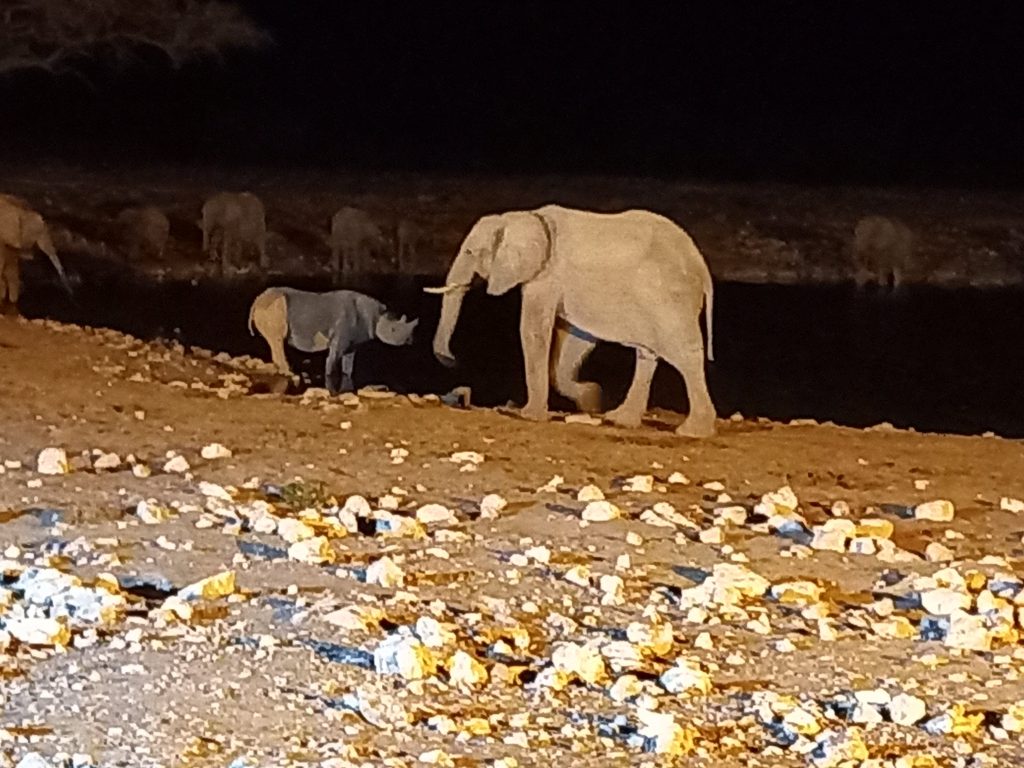
Etosha elephants frequently look ghostly pale, almost white. That is calcrete dust from the pan sediment, which they throw over themselves when dust bathing, and it washes off at the waterhole.
The population has been described as fluctuating considerably because animals move between the Kaokoveld, Etosha and areas further north and east, so a count in one season does not necessarily hold in another.
Bulls in musth are seen regularly at the floodlit waterholes after dark, and a large bull displacing everything else at Okaukuejo is one of the sights people remember from the park.
The Northeast and the Transfrontier Population
The Zambezi and Khaudum populations belong to something much larger than Namibia.
Around 21,000 Namibian elephants fall within the country’s portion of the Kavango Zambezi Transfrontier Conservation Area, which links protected land across five countries and supports the largest elephant population in Africa. Animals move freely across borders that are largely unfenced, particularly between Namibia and Botswana.
That mobility means national figures are a snapshot rather than a fixed stock. A transfrontier survey put the Namibian portion at roughly 21,000, closely matching the country’s own estimates, and found the Zambezi and Kavango numbers stable while Khaudum and Nyae Nyae increased slightly.
The eastern Zambezi is also among the more densely settled parts of the survey area, with high human population close to the rivers where most elephants occur. That overlap is the source of the country’s most serious conflict problem.
Human Elephant Conflict
A growing elephant population expanding its range through a country where people farm is not a straightforward good news story, and Namibian officials have been direct about it.
Conflict comes down to two things: water and food. Elephants break water infrastructure, destroy boreholes, raid crops and damage fences, all of which land hard on households with little margin. In the northeast, high human density along the rivers where elephants concentrate makes run ins routine.
Ministry officials have stated plainly that Namibia is not managing elephants to increase their numbers and is satisfied with the population it has, which is a policy position worth knowing when reading about Namibian wildlife management.
Communal conservancies carry much of the mitigation work. Elephant guard units run night watches at homesteads, GPS satellite collars feed early alert systems that warn communities when animals come close, and protective walls are built around water points with alternative drinking points provided away from settlements.
Illegal killing was a substantial problem for a period and has since reduced considerably.
The Northwest and the Desert Elephants
The northwestern population is small, at roughly 1,200 to 1,700 across the whole region, and it contains within it the animals most visitors have heard of.
Only around 150 of those are genuinely desert dwelling elephants living in the five ephemeral riverbeds that run west towards the Skeleton Coast. The remainder occupy the northern highlands inland, where conditions are less extreme.
That distinction matters because the two groups get conflated constantly in travel writing, producing figures for desert elephants that are five or ten times too high. The desert dwelling animals are covered in depth on our desert adapted elephants page.
Genetic work has established that Namibian elephants are in effect one population, with the Caprivi animals the exception. Desert elephants are not a separate subspecies and their survival skills are learned rather than inherited.
Ivory, Trade and Namibia’s Position
Namibia’s stance on elephant policy differs from much of the conservation world and it is worth knowing why.
The country’s argument runs that its elephant population has grown consistently for three decades while numbers decline almost everywhere else, that this is the product of a system giving communities a direct stake in wildlife, and that policy should follow the evidence on the ground rather than a continental rule.
From that position Namibia has argued at international level for the ability to trade in ivory stockpiles, on the grounds that revenue would fund conservation and conflict mitigation in the communities that carry the cost of living with elephants. Opponents argue that any legal trade stimulates demand and provides cover for illegal ivory, undermining protection in countries with weaker populations.
Both positions are held seriously by people who work in conservation, and neither is a fringe view. A visitor reading about Namibian wildlife will meet the argument sooner or later and it helps to know the shape of it.
What is not disputed is that illegal killing of elephants in Namibia was a substantial problem for a period and has since reduced considerably, and that the ratio of carcasses to live animals recorded in surveys remains well below the level considered a warning sign.
Where to See Elephants in Namibia
Etosha. The most dependable sightings, for all that it holds barely a tenth of the national population, because the waterholes concentrate everything. Nebrownii and Olifantsbad are the names to aim for.
Zambezi Region. Around 12,000 animals across Bwabwata, Mudumu, Nkasa Rupara and the conservancies. River based viewing from boats is the strength here.
Khaudum and Nyae Nyae. Roughly 8,000 elephants in deep sand country with no facilities. Two vehicles in convoy required. Very few visitors.
Damaraland riverbeds. The desert dwelling animals in the Huab and Aba Huab. Uncertain sightings and a completely different experience from a waterhole.
Best Time to See Elephants
May to October across the country, with July through September strongest. Water disappears and animals concentrate at the remaining points, which in Etosha is absolute.
In the northeast the same logic applies with flooding as an added factor. From June to October the floodwaters recede, elephants concentrate along the rivers, roads are passable and malaria risk drops. January to March floods the roads and disperses the game.
In Damaraland, sightings depend on where the herds have moved that week rather than on season, so ask your camp rather than assuming.
African Elephant in Namibia Questions
How many elephants are there in Namibia?
Around 24,000 based on aerial surveys using methods standardised since the mid nineties. Roughly 12,000 are in the Zambezi Region, 8,000 in Khaudum and Nyae Nyae, around 2,900 in Etosha and 1,200 to 1,700 in the whole northwest. Claims of only 5,600 nationally circulate periodically and are contradicted by the survey data, where observers counted over 10,000 animals within a fraction of the estimated area.
Are Namibia’s elephant numbers increasing?
Yes, at roughly 5.36 percent a year since the mid nineties, a trend the surveys treat as very strongly established, with distribution expanding across the country at the same time. That runs counter to the continental picture. Growth is uneven: the Zambezi and Khaudum populations increase strongly while Etosha grows at only about 1.75 percent, the slowest in the country.
Where are most of Namibia’s elephants?
The northeast, which surprises most visitors. Around 20,000 of the national total of 24,000 live in the Zambezi Region and the Khaudum and Nyae Nyae area. Etosha holds barely a tenth of the country’s elephants while being where nearly everyone sees them, and the entire northwest including Damaraland holds only 1,200 to 1,700.
Why do Etosha elephants look white?
Calcrete dust. They dust bathe in the pale sediment of the Etosha Pan, which coats the skin and gives them a ghostly, almost white appearance quite unlike elephants elsewhere. It washes off when they drink and get wet, so the same animal can look grey at the waterhole and white an hour later.
Is there human elephant conflict in Namibia?
Yes, and it is the central management issue. Elephants break water infrastructure, destroy boreholes and raid crops, which lands hard on rural households. In the northeast, human settlement concentrates along the same rivers as the elephants. Ministry officials have stated that Namibia is not managing elephants to increase numbers and is satisfied with the population it has, which is worth knowing when reading about policy here.
How many desert elephants are there?
Around 150 genuinely desert dwelling animals across the five ephemeral riverbeds of the northwest. The whole northwestern region holds 1,200 to 1,700 elephants, but most of those occupy the northern highlands inland rather than the desert riverbeds. Travel writing conflates the two constantly, producing desert elephant figures five or ten times too high.
Can I see elephants in the Zambezi Region?
Yes, and in the greatest numbers in the country, with around 12,000 across Bwabwata, Mudumu, Nkasa Rupara and the surrounding conservancies. River based viewing from boats is the strength there. The trade off is distance, since the region sits well over 1,200 kilometres from Windhoek, and seasonality, since the rains flood the roads between January and March.
Booking Your Namibia Trip
The safari companies and tour operators listed on this website put trips like this together for a living and know which camps, guides and routes actually deliver. We are an independent guide to Namibia; we do not book or sell tours ourselves.
When you are ready, arrange your safari, tour or holiday with one of the recognised operators listed here. Tell them your dates and what matters most, and a real person, not a form, will handle the itinerary, park bookings and logistics for you.