Sossusvlei
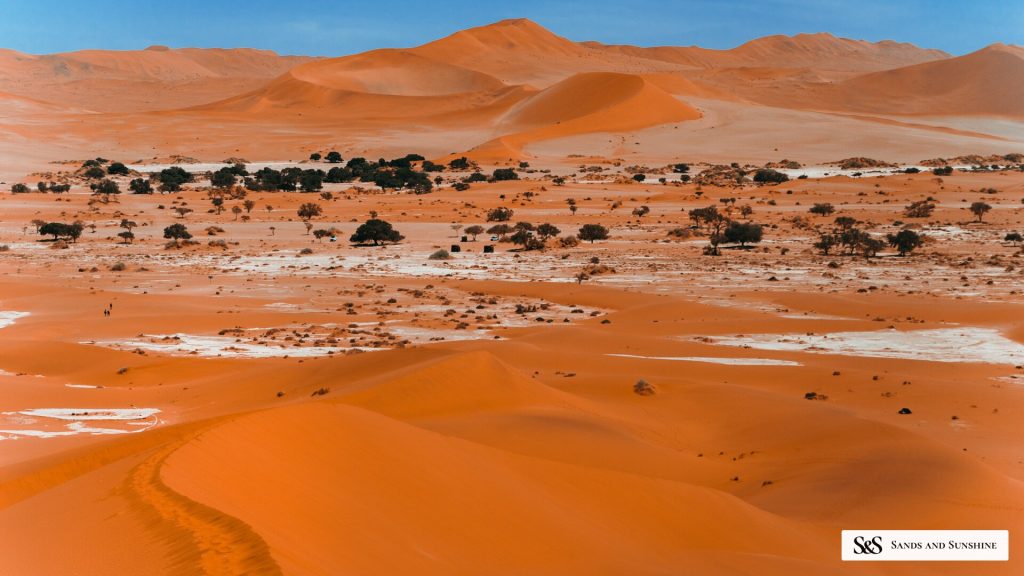
Sossusvlei is a clay and salt pan ringed by red dunes in southern Namibia, and it is the country’s most visited desert destination. Visitors reach it through Sesriem gate, drive 60 kilometres of tarred road into the dune sea, then walk or take a 4×4 across a final stretch of soft sand. Sossusvlei sits inside Namib-Naukluft National Park, within the Namib Sand Sea, a UNESCO World Heritage site.
Sossusvlei Dune Safaris and the Tsauchab Pan
The name causes confusion, so it helps to sort it out early. Sossusvlei proper is a single pan, the dead end where the Tsauchab River runs into the dunes and stops, roughly 60 kilometres short of the Atlantic. In everyday use the name has stretched to cover the whole area: Deadvlei, Dune 45, Big Daddy, Hiddenvlei, Sesriem Canyon and the road that links them. When someone books a Sossusvlei safari, that wider area is what they mean.
Roughly translated the word means dead end marsh, vlei being the Afrikaans term for a shallow seasonal pan. Water reaches it only in exceptional rainfall years, and when it does the pan holds a turquoise sheet of water for a few weeks that draws birds and oryx from a long way off. Most visitors see it dry.
The dunes here are among the tallest anywhere, rising past 300 metres from the valley floors, and they are star dunes rather than the simpler crescent shapes you get closer to the coast. Wind arrives from several directions across the year, which is why the ridges curve the way they do rather than running in parallel lines. The colour comes from iron oxide in the sand, and the older the sand, the deeper the red.
Nearly everyone underestimates the distances inside the park. It is 60 kilometres of tar from the inner gate to the 2WD car park, then a further five kilometres of deep sand to the pans. Allow an hour to reach the parking area even without stopping, and more if you are pulling over for photographs on the way.
Deadvlei Walking Tours from the Sossusvlei Car Park
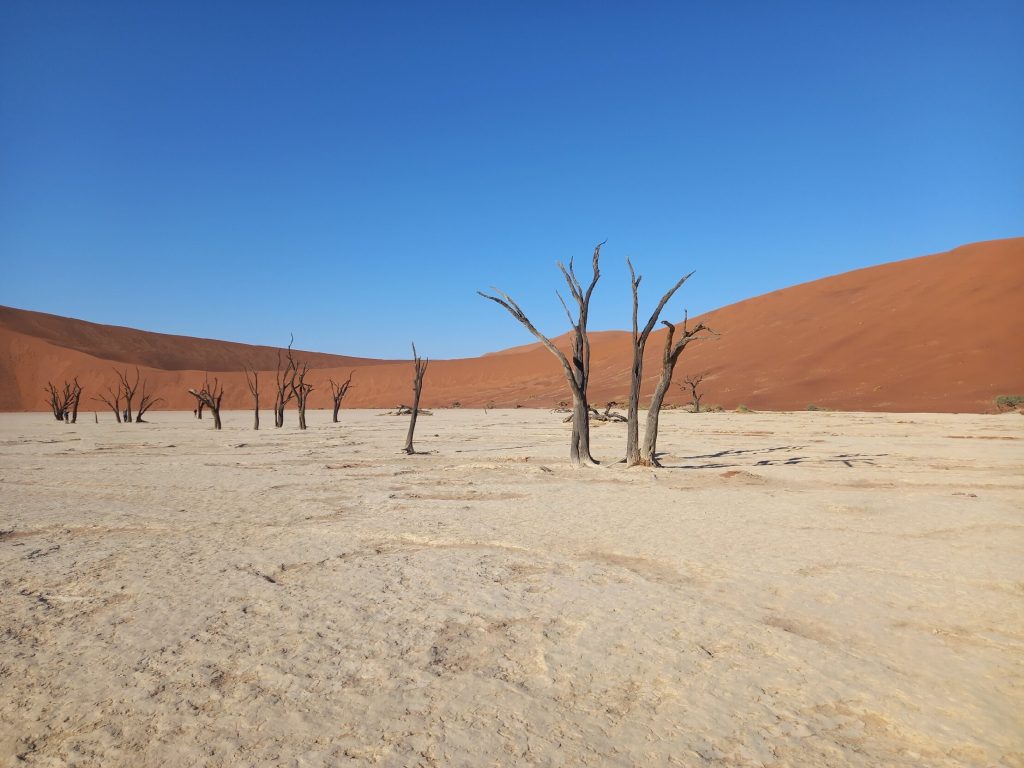
Deadvlei is the reason most people come, whatever the itinerary says. It is a white clay pan a short walk from the 4×4 parking area, studded with the blackened skeletons of camel thorn trees that died when the dunes cut off the river and never rotted afterwards because the air is too dry for decay.
A Deadvlei walking tour is short but not trivial. From the 4×4 car park it is about a kilometre over a low dune, and there is no shade at any point. From the 2WD car park it is closer to five kilometres and takes most people around ninety minutes each way. People do walk it, and people also get into trouble doing it in the middle of the day without enough water.
Light matters more here than anywhere else in the park. In the first hour or so after sunrise the dune behind the pan still sits in shadow while the trees catch direct sun, which gives you the black on white on orange separation the place is known for. By mid morning the contrast flattens out and the heat rises off the clay.
Dune 45 Sunrise Climbing on the Sossusvlei Road
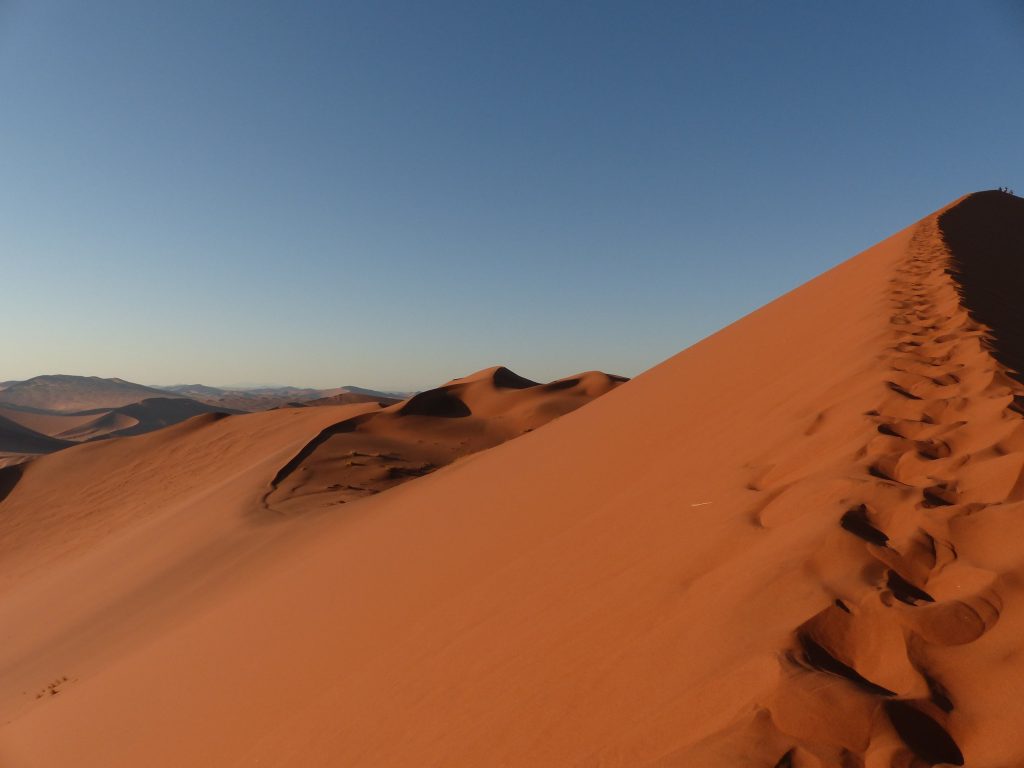
Dune 45 gets its name from its position, 45 kilometres along the road from the gate. At roughly 170 metres it is the accessible one, close to the tar, with a car park at its foot and a ridge line that most reasonably fit people can walk in forty minutes to an hour. Coming down takes a couple of minutes and is the part everyone remembers.
It is the classic sunrise stop on a Sossusvlei tour, which also means it is crowded. Vehicles queue at the inner gate before dawn just to get here. If you would rather not share the ridge with fifty other people, some visitors climb it in late afternoon instead and use the morning for Deadvlei, which is the better trade in most conditions.
Dune 45. About 170 metres, 45 kilometres from the gate, right beside the tar road. Forty minutes to an hour up. The easiest of the big climbs and the busiest at sunrise.
Big Daddy. Around 325 metres, reached from the 4×4 car park. Roughly an hour to ninety minutes up along the ridge. Ends with a run straight down into Deadvlei.
Elim Dune. Around five kilometres from Sesriem, reachable in a 2WD. A quiet option for people who arrive late in the day and want a climb without driving into the park.
Big Mama. Sits across the pan from Big Daddy, above Sossusvlei itself. Reached through a second short sandy section past the first 4×4 car park. Far fewer climbers.
Big Daddy Dune Hiking Above Deadvlei
Big Daddy is the tallest dune in the immediate area at something like 325 metres, though the exact figure shifts with the wind. Big Daddy hiking follows a ridge rather than going straight up a face, which sounds easier than it is: the ridge dips and rises repeatedly, so you lose height you have already gained, and every step gives back some ground in the soft sand.
Reckon on an hour for a fit walker and closer to two if you stop often. Start at first light. People do attempt it later in the morning and a few of them get into real difficulty, because there is no water, no shade and nowhere to sit down once you commit to the ridge.
The payoff is the descent. From the summit you drop straight down the steep face into Deadvlei in ten or fifteen minutes, sinking to your ankles with every stride, and the sand makes a low booming noise as the air moves through it. You land at the edge of the pan and walk out among the trees, which is a far better arrival than coming in flat from the car park.
Nobody warns you that the hardest part of Big Daddy is not the height. It is the ridge dipping down again just when you thought you had the summit, three times over.
Sesriem Canyon Walking Tours Near the Gate
Sesriem Canyon sits close to the main gate and is worth thirty to forty-five minutes rather than half a day. The Tsauchab has cut a narrow slot about a kilometre long and up to thirty metres deep into the conglomerate rock, and parts of it are only a couple of metres wide. One section holds water through most of the year, which is unusual enough in this country to be interesting on its own.
The name comes from the Afrikaans for six thongs, a reference to the number of joined ox wagon straps early settlers needed to lower a bucket to the water. A Sesriem Canyon walking tour works well in the late afternoon when the dunes have become too hot, since the canyon walls give the only real shade in the area.
Self Drive Tours Through the Sossusvlei Dune Road
The gate system is the thing to understand before a self drive Sossusvlei trip, because it decides whether you get the good light. There are two barriers. The outer gate at Sesriem opens at sunrise and closes at sunset. The inner gate, a couple of kilometres further in, opens about an hour before sunrise and shuts around an hour after sunset, and it is available only to guests staying inside the fence.
That difference is the whole argument for staying in the park. Guests at Sesriem Campsite, Sossus Dune Lodge and Dead Valley Lodge are on the dune road while everyone else is still queueing outside in the dark. Lodges on private land bordering the park, including the Kulala properties, have their own access arrangements that work much the same way.
The tar road runs 60 kilometres from the inner gate to a 2WD car park and any ordinary car handles it. After that comes five kilometres of soft sand where a real 4×4 with lowered tyre pressure is needed. This section catches out more visitors than any other part of the park, and vehicles get bogged here most days.
Access rules on that sandy stretch have been adjusted more than once in recent times, including changes to where the official shuttle departs from and the arrival of a private shuttle operator, with the current position allowing capable 4×4 drivers to continue to the pans themselves. Because it has moved around, confirm the arrangement at the Sesriem office on the day rather than relying on anything written online, including this.

Hot Air Balloon Safaris and Scenic Flights Over the Namib
A hot air balloon safari lifts off before dawn and drifts over the dune sea for about an hour, usually finishing with a champagne breakfast set up in the desert. It is expensive and it is weather dependent, and flights get cancelled for wind with little notice. Those who go rarely regret it, because the scale of the dune field only makes sense from above.
Light aircraft flights are the cheaper way to get the same perspective and cover far more ground, running north over the sand sea towards the coast and the shipwrecks. Several lodges arrange them, and charter flights also connect Sossusvlei directly to Swakopmund, Damaraland and Etosha for travellers skipping the long drives.
Stargazing Tours in the Sossusvlei Desert
There is almost no artificial light for a very long way in any direction, and the air is dry. The NamibRand Nature Reserve on the eastern boundary holds International Dark Sky Reserve status, the only one on the African continent, and several lodges in the area run stargazing tours with telescopes and a guide.
You do not need a booked activity for it to work. Walking out from a campsite at Sesriem after the moon has set is enough. Winter nights give the clearest air, and they are also cold enough that people give up early, so take more layers than the daytime temperature suggests.
Where to Stay for a Sossusvlei Safari
Where you sleep changes what you see, more than at most destinations, because of the inner gate.
Inside the park. Sesriem Campsite, Sossus Dune Lodge and Dead Valley Lodge. Early access through the inner gate, so you reach Deadvlei and Dune 45 in the first light. Books out months ahead.
Private reserve lodges. Kulala Desert Lodge, Little Kulala, Kwessi Dunes and the andBeyond property. Own access routes to the dunes, guided drives, plunge pools, high nightly rates.
Just outside the gate. Sossusvlei Lodge, Sossus Oasis and Desert Quiver Camp. A short drive to the barrier but no early entry, so you join the sunrise queue with everyone else.
Solitaire and further out. Cheaper lodges and campsites an hour or more away. Fine on a budget, though it means leaving in full darkness to be at the gate on time.
Two nights is the sensible booking. One gives you a single morning in the park and a long drive on either side. Two lets you do Deadvlei and Big Daddy on the first morning and something quieter, Hiddenvlei or the canyon, on the second.
Best Time for a Sossusvlei Trip
The dunes are photogenic year round, so the season question is really about heat and crowds.
May to June. Cool days around 20 to 25 degrees, cold predawn starts near freezing, clear air and a faint green flush left on the gravel plains. One of the better windows and quieter than midwinter.
July to September. Peak. Comfortable daytime walking temperatures and the strongest light for photography, matched by the largest crowds at Dune 45 and the highest lodge rates. Book early.
October to November. Hot, often reaching or passing 40 degrees, with climbing sensible only before eight in the morning. Storm clouds start building and the skies can be dramatic.
December to April. Rainy season, afternoon thunderstorms, lower prices and fewer visitors. In exceptional years the Tsauchab reaches the pan and floods it, which almost nobody gets to see.
Getting to Sossusvlei and Sesriem
Sesriem sits roughly 350 to 360 kilometres southwest of Windhoek and about 345 kilometres southeast of Swakopmund. From Windhoek allow four and a half to six hours depending on the route and how hard you push the gravel sections. Most of the drive is on unsealed roads that a two wheel drive car handles without difficulty, though corrugations and loose gravel cause more accidents in Namibia than anything else, so keep the speed down.
Solitaire is the usual stop coming from the north, an hour or so from Sesriem, with fuel, a petrol station graveyard of rusting cars and a bakery whose apple pie has become a small institution. Fill up there. Fuel at Sesriem itself is available but the queue at dawn can be long.
Flying in is the alternative. Light aircraft serve airstrips near several of the lodges from Windhoek and Swakopmund, and a fly in trip removes two long driving days from a short itinerary.
Sossusvlei Safari Questions
How much are the park fees for Sossusvlei?
Fees are paid at the Ministry office at Sesriem and cover entry to Namib-Naukluft National Park. The schedule was revised upward recently and published figures vary widely as a result, with older sources quoting around 80 to 150 Namibian dollars per adult per day and the current rate sitting materially higher, likely in the region of 200 to 280 Namibian dollars once the conservation levy is counted. A separate vehicle charge applies, historically modest at around 10 to 80 Namibian dollars depending on size. Given how much the published numbers disagree, treat any figure you read online as indicative and confirm at the park office. Fees run for 24 hours from entry.
What does the 4×4 shuttle to Deadvlei cost?
The shuttle across the final sandy stretch has run at roughly 180 to 200 Namibian dollars per person for a return trip, hop on and hop off through the day. Both the operator and the departure point have changed in recent times, so check on arrival. If you have a genuine 4×4 and know how to drop tyre pressure, you can drive it yourself and skip the charge entirely.
What does accommodation cost at Sossusvlei?
Camping at Sesriem or Sossus Oasis has run around 780 to 980 Namibian dollars per pitch per night. Mid range lodges near the gate typically sit somewhere between 200 and 300 US dollars per room per night. The luxury properties on the private reserves are in a different bracket, from roughly 600 US dollars per person per night at Little Kulala up to well past 1,500 at the top end, usually all inclusive with activities and meals. Rates climb sharply between July and September.
Do I need a 4×4 to visit Sossusvlei?
Not to reach Sesriem, and not for the 60 kilometre tar road inside the park. You need one only for the last five kilometres of deep sand to the pans, and even then there is a shuttle and the option of walking. Plenty of visitors do the whole trip in an ordinary car. What matters more is not attempting that sandy section in a soft roader or a low clearance vehicle, because getting bogged there is common and recovery is slow.
How long do I need at Sossusvlei?
Two nights and one full day inside the park covers Deadvlei, Big Daddy or Dune 45, and Sesriem Canyon without rushing. A single night works if you are staying inside the fence and can be on the dune road at first light, though it makes for a tight day. Photographers usually want three.
Can I climb the dunes at Sossusvlei?
Yes, and it is one of the main reasons people come. Dune 45, Big Daddy, Big Mama and Elim Dune are all open to climbers with no permit or guide needed. Start early, carry far more water than feels necessary, and turn back if the heat becomes uncomfortable rather than pushing on. Keep to the ridge lines that others have used instead of cutting fresh tracks across the faces.
Is Sossusvlei suitable for children?
The shorter walks work well and rolling down a dune face keeps most children happy for a long time. Big Daddy is too much for younger legs in the heat. The bigger constraints are the pre dawn starts needed for decent light and the complete absence of shade once you leave the vehicle, so plan on being back at the lodge pool by late morning.
Booking Your Namibia Trip
The safari companies and tour operators listed on this website put trips like this together for a living and know which camps, guides and routes actually deliver. We are an independent guide to Namibia; we do not book or sell tours ourselves.
When you are ready, arrange your safari, tour or holiday with one of the recognised operators listed here. Tell them your dates and what matters most, and a real person, not a form, will handle the itinerary, park bookings and logistics for you.