Hot Air Ballooning in Namibia

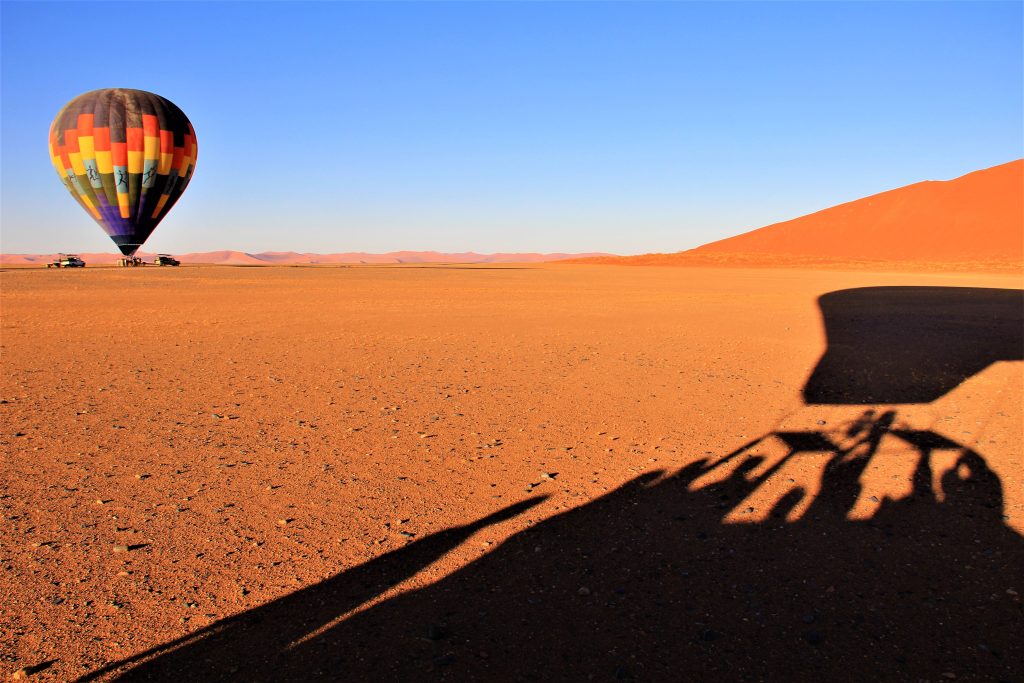
Hot air ballooning over the Namib lifts off before sunrise, drifts for about an hour over the dune sea in complete silence and finishes with a sparkling wine breakfast laid out in the desert. One operator has run it at Sossusvlei since the early nineties. The whole thing takes three and a half to four hours and costs around N$10,000 per person.
How the Morning Works
The timings are early and the sequence is worth knowing before you commit.
Pickup is around five in the morning from allocated points, or you drive yourself to the ballooning base at least half an hour before sunrise if you are staying nearby. There is then a wait of roughly forty five minutes with tea and coffee and a safety briefing.
The last chance for a lavatory is before the transfer, which matters given what follows. From the meeting point it is about twenty minutes to the launch site, where you watch the balloon inflate in the half dark, which is a spectacle in itself.
You are usually airborne shortly after seven, and the balloon rises as the sun does. The flight runs about an hour at varying heights.
After landing, the recovery vehicle takes you ten minutes or so to a breakfast site in the desert. You are back at your accommodation between roughly half past nine and eleven depending on the season.
Book the balloon for early in your Sossusvlei stay rather than the final morning. Flights are cancelled for wind at short notice and the operator will not fly if conditions are marginal, which is exactly what you want from a balloon company and exactly what ruins a trip if you have no spare morning. Two nights at Sesriem gives you a second chance.
What the Flight Is Like
The thing people describe afterwards is the silence.
A balloon moves with the air rather than through it, so there is no wind noise and no engine. The burner fires intermittently and between bursts there is nothing at all, which over a desert at dawn is genuinely unusual.
Below you the dune sea opens out, with the crests catching the first light while the valleys stay in shadow, and the line between the two moves as the sun climbs. Big Daddy and Dune 45 are visible on the Sossusvlei flights.
You go where the air goes. Neither the route nor the landing site is fixed, which is why a recovery vehicle follows and why the launch point is chosen the night before based on the forecast.
Baskets are divided into four compartments carrying up to four people each, so sixteen passengers plus the pilot. Passengers regularly note that the Namibian arrangement is less crowded than European flights, which often put six in a compartment.
You stand for the whole flight, which is worth knowing if that is difficult for you.
Where You Can Fly
Two launch areas serve the Sossusvlei flights and the choice is made by the pilot the night before according to conditions.
One sits between Sesriem and Sossusvlei, putting you over the dune corridor and within sight of the famous dunes. The other is in the northern part of the NamibRand Nature Reserve, which gives a different character: private reserve, inselbergs and gravel plains alongside the sand.
The Solitaire area to the north offers quieter flights over desert plains and ochre mountains, less frequented than the Sossusvlei operation.
Ballooning has also been offered at Swakopmund on the coast, though the Namib flights from Sesriem are the ones the country is known for and the ones almost all visitors take.
Sossusvlei ballooning is operated by a single company, which has been flying here since the early nineties and employs around 25 people. That means no shopping around on price and, more usefully, no ambiguity about who is flying you.
What It Costs
This is an expensive activity and it is worth seeing the numbers plainly.
Published rates put it at roughly N$9,920 per person for the 2025 to 2026 season, rising to around N$10,720 for 2026 to 2027. In hard currency that is somewhere around 550 to 600 US dollars, or about 450 euros, depending on the exchange rate and the season.
Some agents quote higher figures, up to around N$11,610, depending on what is bundled into the package.
What is included is return transfers from the base to the launch site, the hour long flight, the champagne breakfast at the landing point, park fees and a flight certificate.
Booking through a lodge or a Namibian booking agent usually costs the same as booking direct, since public rates are charged, so there is no advantage in going around your lodge.
Spaces are limited and it books out, particularly in peak season, so reserve well in advance rather than on arrival.
When It Runs and When It Does Not
Ballooning operates almost year round at Sossusvlei with specific closures worth planning around.
The operation closes from 15 January to 15 February, which is the hottest part of the year and unsuitable for flying. It also closes on 25 December and 1 January.
The best months are the cooler ones from about April to October, when the weather is more predictable and cancellations are less frequent.
Flights are morning only. Desert temperatures rule out afternoon flying entirely, so there is no alternative slot if the morning is cancelled.
Weather cancellations happen and safety is not negotiable for the operator. If the wind is wrong, you do not fly, and this is why building a spare morning into the itinerary matters more here than for most bookings.
What to Wear and Bring
There is no dress code beyond common sense, and the temperature swing is the thing to plan for.
Layered clothing. Predawn in the desert is genuinely cold, particularly in winter, and it warms quickly once the sun is up and the burner is going. What is comfortable at five in the morning is too much by eight.
A hat and sunglasses for the bright desert sun after sunrise and at the breakfast site.
No high heels, which the operator states explicitly, since you are climbing into and out of a basket on uneven ground.
A camera, obviously, and binoculars if you have them for spotting wildlife from the air. There is space in the compartments to stow equipment, which is one advantage of the four person arrangement.
Nothing you cannot hold onto or secure, since a basket in the air is not the place to be juggling loose items.
Is It Worth the Money
It is a large sum for an hour and it is worth setting the case out honestly.
Against it: the cost is roughly what two nights at a good lodge would run, the flight is weather dependent and can be cancelled, and you can see the dunes perfectly well from the ground.
For it: the aerial perspective on the dune sea is genuinely different from anything available at ground level, the silence is unlike any other way of moving, and the breakfast in the desert afterwards is well done rather than a token gesture.
Guests consistently rate the operation highly on professionalism, safety and organisation, and reviewers describe the whole morning as tightly run.
Practically, the travellers who regret it are those who booked it as an isolated luxury without adjusting the rest of the budget. The travellers who rate it highest are those who treated it as one of the two or three defining things they would spend on.
Scenic Flights as an Alternative
If the balloon is beyond budget or cancelled, fixed wing scenic flights cover similar ground differently.
Light aircraft flights from Swakopmund or Walvis Bay run over the dune sea and the coast, taking in the shipwrecks at Conception Bay including the Eduard Bohlen, which no balloon reaches.
A transfer leg between Swakopmund and Sossusvlei routed via Conception Bay does the same job as part of a flight you may be making anyway, which is the cheapest aerial view of the Namib available.
Helicopter flights operate from some lodges and cover less ground at greater cost with more manoeuvrability.
The difference in experience is real. A scenic flight shows you more country; a balloon shows you less of it in a way you will remember longer.
Hot Air Ballooning Questions
How much does hot air ballooning in Namibia cost?
Around N$9,920 per person for the 2025 to 2026 season, rising to roughly N$10,720 for 2026 to 2027, which works out at approximately 550 to 600 US dollars or around 450 euros. Some agents quote up to N$11,610 depending on the package. Transfers, the hour long flight, champagne breakfast, park fees and a flight certificate are included.
How long does the whole thing take?
Three and a half to four hours. Pickup is around five in the morning, followed by roughly forty five minutes of waiting with tea and coffee and a safety briefing, then a twenty minute transfer to the launch site. The flight itself is about an hour, then ten minutes to the breakfast site. You are back at your accommodation between about half past nine and eleven.
When does ballooning not operate?
The Sossusvlei operation closes from 15 January to 15 February, the hottest part of the year, and also on 25 December and 1 January. Flights run in the morning only because desert temperatures rule out afternoon flying. The best months are April to October, when weather is more predictable and cancellations less frequent.
Can the flight be cancelled?
Yes, and regularly, for wind. The operator will not fly in marginal conditions, which is what you want from a balloon company and what ruins a trip if you have no spare morning. Because flights are morning only there is no alternative slot the same day. Book the balloon early in your Sossusvlei stay rather than on the final morning.
How many people are in the basket?
Up to sixteen plus the pilot, in a basket divided into four compartments carrying four each. Passengers regularly note that this is less crowded than European flights, which often put six in a compartment, and that there is room to move and stow camera equipment. You stand for the whole flight, which is worth knowing if that is difficult.
What should I wear?
Layers. Predawn in the desert is genuinely cold, especially in winter, and it warms fast once the sun is up. A hat and sunglasses for after sunrise. No high heels, which the operator states explicitly, since you climb into and out of a basket on uneven ground. Bring a camera and binoculars, and nothing loose you cannot secure.
Is it worth the money?
It costs roughly what two good lodge nights would, for an hour in the air, and that is the honest framing. What you get is an aerial perspective on the dune sea unavailable from the ground, complete silence, and a well executed breakfast in the desert. Travellers who budget for it as one of two or three defining splurges rate it highly; those who add it without adjusting elsewhere sometimes do not.
Booking Your Namibia Trip
The safari companies and tour operators listed on this website put trips like this together for a living and know which camps, guides and routes actually deliver. We are an independent guide to Namibia; we do not book or sell tours ourselves.
When you are ready, arrange your safari, tour or holiday with one of the recognised operators listed here. Tell them your dates and what matters most, and a real person, not a form, will handle the itinerary, park bookings and logistics for you.