Springbok
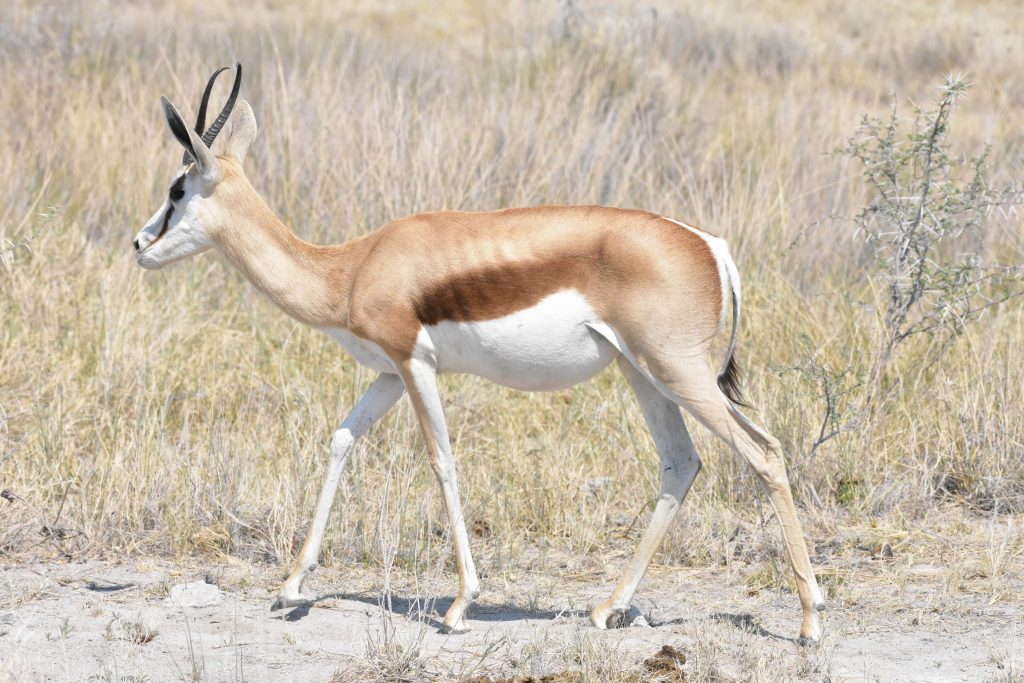
Springbok are the most numerous antelope in Namibia and one of very few African mammals whose population is growing rather than shrinking, with somewhere between 1.4 and 2.5 million across southern Africa. They are named for pronking, the stiff legged vertical leap that carries them up to three metres. Like the oryx they can survive for long periods without drinking.
Springbok in Namibia
Antidorcas marsupialis is native to southern and southwestern Africa and Namibia is one of its strongholds. They occur mainly in the south and west of the country, in the open plains and semi desert where they are most at home, and also across the savanna country of the east and north.
They prefer dry open habitat with firm footing, which is much of Namibia, and they are sharp sighted and alert, using long sightlines to spot predators well before those predators close in.
One point worth clearing up: the springbok is the national animal of South Africa and the nickname of its rugby team. Namibia’s national animal is the oryx, which appears on the coat of arms. Both animals are abundant here and visitors regularly attribute the wrong one to the wrong country.
They are medium sized and lightly built, standing around 70 to 85 centimetres at the shoulder and weighing between roughly 27 and 55 kilograms, with rams noticeably heavier and thicker in the neck than ewes.
Pronking and What It Is For
The behaviour that gives the animal its name is one of the more entertaining things you will see on a Namibian trip, and nobody is entirely sure why they do it.
Pronking, sometimes called stotting, is a stiff legged vertical leap with the back arched and all four feet leaving the ground together. Springbok reach heights of two to three and a half metres and can cover ten metres forward during a pronking run. The word is Afrikaans and means, roughly, to show off.
The scientific name marsupialis refers to the mechanism. A fold of skin runs down the animal’s back, normally visible only as a narrow white line, and when the animal pronks the fold opens into a wide crest of long white hair. That crest is lined with scent glands, so a pronking springbok is broadcasting both a visual signal seen from a long way off and a chemical one.
Explanations for the behaviour compete. It may signal fitness to a predator, in effect telling a stalking cheetah not to bother because this animal is too fast to catch. It may warn other springbok. It may confuse a predator’s targeting. And it is also observed in animals that are not alarmed at all, particularly young ones, which has led to the suggestion that some of it is simply done because it feels good.
Watch a springbok herd in the first hour after sunrise, particularly on a cool morning. Pronking is far more common then than in the heat of the day, and young animals will often set the whole herd off. It is one of the few wildlife behaviours in Namibia you can reasonably plan to see rather than hope for.
The Trekbokke Migrations
The springbok was once part of one of the largest mammal migrations on earth and almost nobody realises it.
Early travellers into the interior recorded treks, called trekbokke or trekbokken in Afrikaans, in which hundreds of thousands and by some accounts more than a million springbok moved together across the dry country in search of grazing. Accounts describe herds taking days to pass a single point. It was a phenomenon comparable in scale to the wildebeest migration in East Africa.
Fencing, farming and the subdivision of the great open plains ended it. Modern agricultural development broke the grasslands into farms and ranches, and the routes that made the treks possible no longer exist.
The instinct remains. Periodic movements of thousands of springbok still occur in remote parts of northwestern Namibia, in the Namib and in the NamibRand and Kalahari regions, and occasionally in Botswana and Angola. They are a fraction of what they were and they are still worth seeing.
Desert Adaptations
Springbok manage in country with very little water through a combination of diet and behaviour.
They are mixed feeders, grazing grass during and after the rains and switching to browsing herbs and foliage through the dry season, which gives them a food source year round rather than only when grass is available. Much of their moisture comes from what they eat, and they can survive long periods without drinking, though they will use water where it exists.
They favour open country with firm ground rather than soft sand, and they rely on sight and speed rather than cover. Springbok have been recorded at speeds around 88 kilometres an hour, which puts them among the faster antelope in Africa and close to what a cheetah reaches in full pursuit.
Their colouring works as heat management and as camouflage, with a reddish brown upper body, a dark side stripe and white underparts that reflect heat radiating up from the ground.
Herds, Breeding and Territory
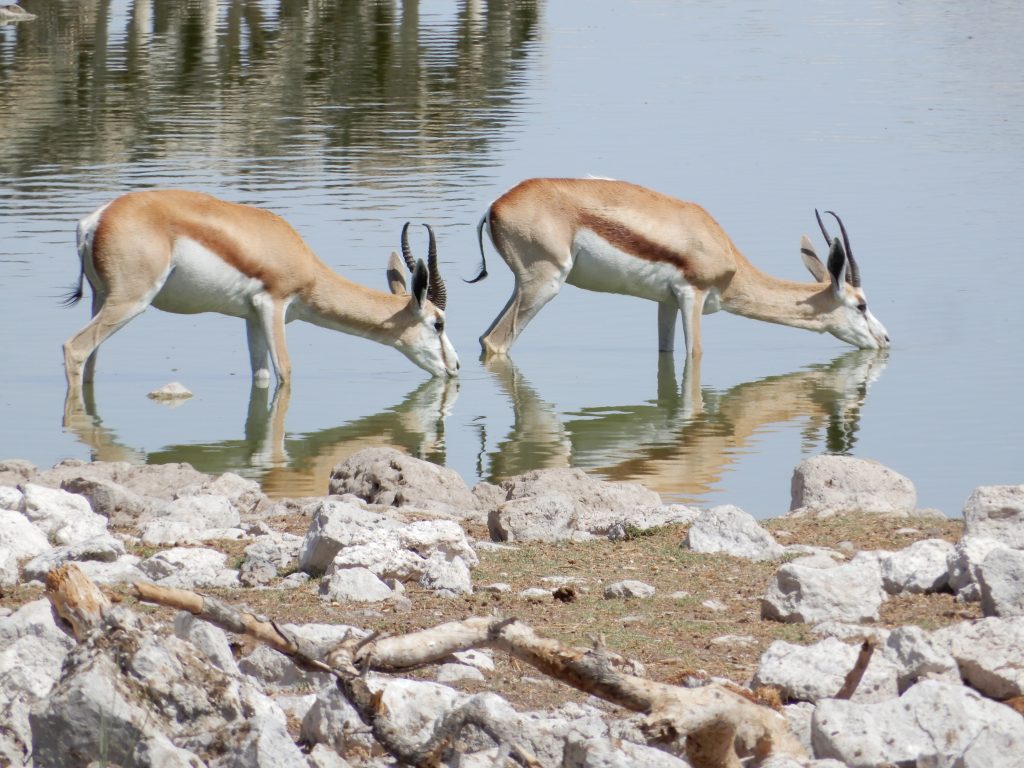
Springbok are social and form herds that can number in the thousands where conditions allow, which provides safety through collective vigilance rather than through hiding.
During the mating season, rams establish and defend territories on ground that ewes pass through in their daily feeding. A territorial ram tries to hold ewes within his ground for as long as he can, and produces a loud roar ending in a short bleat while doing it, which is a startling sound from an animal this size.
Mating runs through roughly April to June in Namibia, with a gestation of about five and a half months and a single lamb. Lambs are able to move with the herd very quickly, which matters in open country where hiding is not an option.
Outside the breeding season herds mix more freely, and bachelor groups of young rams form separately from the breeding herds.
Where to See Springbok in Namibia
Almost everywhere in the open country, and in large numbers.
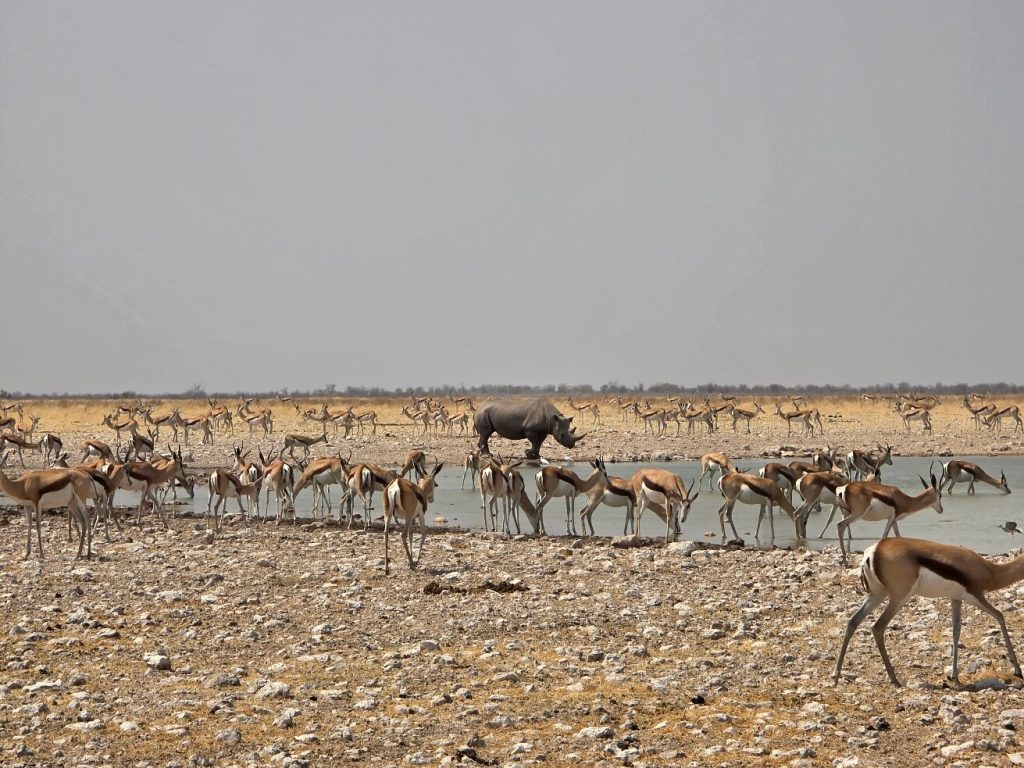
Etosha. Thousands of springbok across the plains and at every waterhole, often in mixed groups with zebra and oryx. The pan edge holds the largest concentrations.
The Namib and NamibRand. Herds on the gravel plains, and this is where the periodic movements of thousands still occur. Good for pronking against open ground.
The Kalahari. Red dune country in the east and southeast, with springbok on the grassy dune slopes and interdune valleys.
Roadsides throughout. Springbok are the animal you will see most often from the car anywhere in southern and western Namibia, on both farmland and open range.
Because they are so common, springbok are the animal visitors stop photographing on day two and then regret not photographing properly. A herd pronking across open plain in low light is one of the better images available in this country.
Springbok Numbers and Conservation Status
Springbok are listed as least concern by the IUCN and are one of the very few African antelope with an expanding population.
Estimates put the southern African total at somewhere between 1.4 and 1.75 million animals, with the IUCN acknowledging this is probably an underestimate and the true figure possibly above two million. Other assessments put it between two and two and a half million.
The reason for that success is partly the same reason the great migrations ended. Springbok do well on farmland, they are widely stocked on game farms across Namibia and South Africa, and they are commercially valuable as both a hunting and a meat species. Wildlife based land use has expanded across Namibian farmland substantially, and springbok have benefited more than almost any other species.
That is a genuine conservation success and it comes with a caveat: a fenced farmland population of two million is not the same thing ecologically as the free ranging migratory population that preceded it.
Best Time to See Springbok
Any month. Springbok are present year round throughout their range and require no seasonal planning.
The green season from about December to April brings lambing, which means young animals in the herds and considerably more pronking, since lambs pronk more readily than adults. Grazing is better and herds concentrate where the rain has fallen.
The dry season brings them to waterholes more predictably, which suits photography in Etosha. Early morning is the best time of day for both light and behaviour.
Springbok as Game and Food
Springbok is one of the three game meats you will meet constantly on Namibian menus, alongside oryx and kudu.
The meat is lean, fine grained and milder than oryx, and it appears as steak, fillet, carpaccio and in biltong, the dried meat sold at every filling station in the country. It is inexpensive and good, and most of it comes from game farms.
Springbok are also a major hunting species in Namibia, and hunters rate them as demanding because they live in open country, see extremely well and are difficult to get near. That commercial value is a substantial part of why the population has grown.
Springbok Questions
What is pronking?
A stiff legged vertical leap with the back arched and all four feet leaving the ground together, reaching two to three and a half metres in height. A fold of skin along the back opens into a crest of white hair lined with scent glands as the animal jumps. Explanations include signalling fitness to predators, warning other springbok and confusing a predator’s targeting. Young animals also do it when not alarmed at all.
Is the springbok Namibia’s national animal?
No, that is the oryx, which appears on the Namibian coat of arms. The springbok is the national animal of South Africa and the nickname of its national rugby team. Both species are abundant in Namibia and visitors frequently attribute the wrong animal to the wrong country. Oryx are larger with long straight horns and black and white face markings; springbok are smaller with curved horns and a dark side stripe.
How many springbok are there?
Estimates for southern Africa run from around 1.4 to 1.75 million, with the IUCN noting this is likely an underestimate and the true total possibly above two million. Some assessments put it at two to two and a half million. The species is listed as least concern and is one of very few African antelope whose population is increasing, largely because they do well on game farms and have real commercial value.
What are the trekbokke migrations?
Historic mass migrations in which hundreds of thousands and by some accounts more than a million springbok moved together across the dry interior in search of grazing, with herds reportedly taking days to pass a single point. Fencing and farmland subdivision ended them. Movements of thousands still occur periodically in remote parts of northwestern Namibia, the Namib, the NamibRand and the Kalahari.
Do springbok need to drink?
Not regularly. They take most of their moisture from food, grazing grass after rain and switching to browsing herbs and foliage through the dry season, which gives them a year round food supply. They can go long periods without drinking, though they will use water where it exists and gather at waterholes in Etosha and elsewhere during the dry months.
Where can I see springbok in Namibia?
Almost anywhere in open country. Etosha holds thousands across the plains and at every waterhole. The Namib and NamibRand give herds on gravel plains and the best chance of seeing the periodic mass movements. The Kalahari in the east holds strong populations. You will also see them constantly from the car on roadsides across southern and western Namibia.
How fast can a springbok run?
Recorded at around 88 kilometres an hour, which places them among the faster antelope in Africa and roughly in the range a cheetah reaches in pursuit. They combine that with excellent eyesight and a preference for open ground with firm footing, so they usually see a predator coming long before it arrives. That is also why hunters rate them as hard to get near.
Booking Your Namibia Trip
The safari companies and tour operators listed on this website put trips like this together for a living and know which camps, guides and routes actually deliver. We are an independent guide to Namibia; we do not book or sell tours ourselves.
When you are ready, arrange your safari, tour or holiday with one of the recognised operators listed here. Tell them your dates and what matters most, and a real person, not a form, will handle the itinerary, park bookings and logistics for you.