Oryx (Gemsbok)
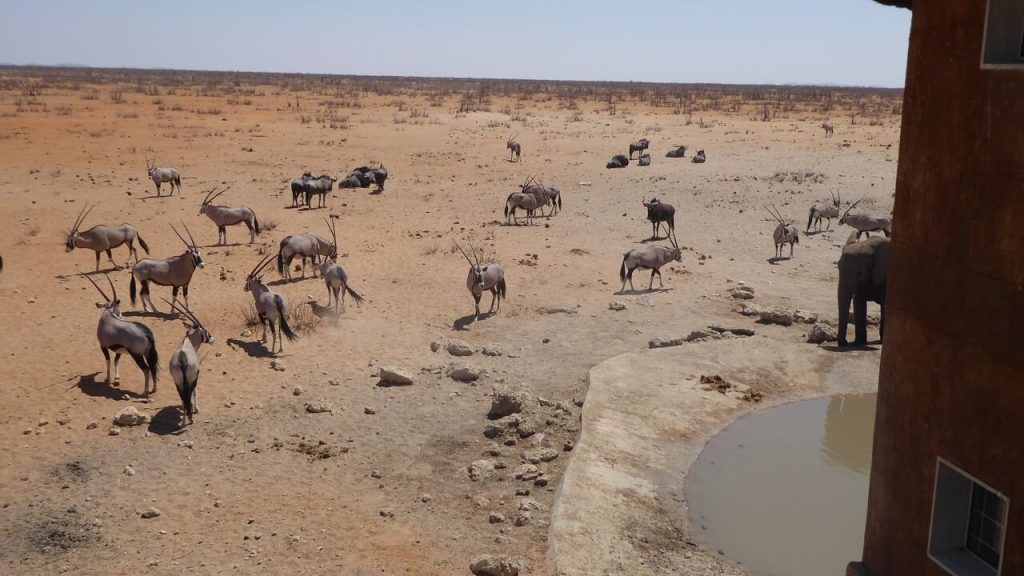
The oryx, known in Namibia by its Afrikaans name gemsbok, is the country’s national animal and appears on the coat of arms. It is the large antelope you will see standing in full sun on open gravel where nothing else will go, surviving on the moisture in its food and able to let its body temperature rise to levels that would kill most mammals. Both sexes carry horns over a metre long.
Namibia’s National Animal
Two oryx support the shield on the Namibian coat of arms, and the choice says something about how the country sees itself. It was selected for courage, elegance and pride, and more practically because it is the large mammal that thrives where the country is hardest.
Oryx gazella occurs across the arid and semi arid country of southern Africa, in Namibia, Botswana, South Africa, southwestern Angola and dry parts of Zimbabwe. In Namibia it is found almost everywhere, from the Kalahari in the east through the central highlands to the Namib in the west.
The Afrikaans name gemsbok comes from the German for chamois, applied by early settlers to an animal that resembles it not at all, and the origin of the transfer is unclear. Both names are used interchangeably here, with oryx more common in tourism and gemsbok in everyday Namibian speech.
It is a large animal, standing around 1.2 metres at the shoulder with a horse like body and a heavy build, which makes seeing one on a bare dune face all the more improbable.
How Oryx Survive Without Drinking
The headline adaptation is that they do not need to drink. Oryx extract most of their moisture from what they eat and can go weeks or months without water where necessary.
Diet is the mechanism. They graze coarse grasses when available and browse shrubs when not, and they dig up roots, bulbs and tubers with their hooves. Wild melons and tsamma cucumbers are a substantial water source in the Kalahari. Crucially, they feed at night and in the early morning, when condensation has gathered on the plants, so the food itself carries more water than it would at midday.
They also do not sweat. Sweating costs water, so oryx avoid it, which is the opposite strategy from most large mammals in heat.
Large flat hooves let them cross soft sand without sinking, which is why you see them on dune faces rather than only on the gravel plains. It is one of the more improbable sights in Namibia and it is entirely routine for the animal.
The Nasal Cooling System
The adaptation that gets biologists interested is how an oryx keeps its brain from cooking while the rest of it heats up.
Rather than sweating to shed heat, an oryx simply lets its core body temperature rise, reportedly as high as 45 degrees Celsius, a level that would cause brain damage in most mammals. Allowing the body to heat up means it does not need to lose water cooling itself.
The brain is protected separately. A dense network of fine blood vessels sits in the nasal passages, an arrangement known as a carotid rete mirabile. The animal breathes rapidly through the nose, which cools the air and the blood passing through those vessels, and that cooled blood is then routed to the brain rather than to the body.
The result is an animal that can stay active in ambient temperatures lethal to other species, without spending water on sweating or panting in the ordinary sense. Their black and white belly and leg markings are also thought to help reflect heat away from the body.
Watch an oryx in the middle of the day and you will notice it standing rather than lying, often facing away from the sun with its flanks presented as narrowly as possible. That posture minimises the surface exposed to direct sun. It is not resting so much as thermoregulating, and once you see it you notice it everywhere.
Horns, Markings and Telling the Sexes Apart
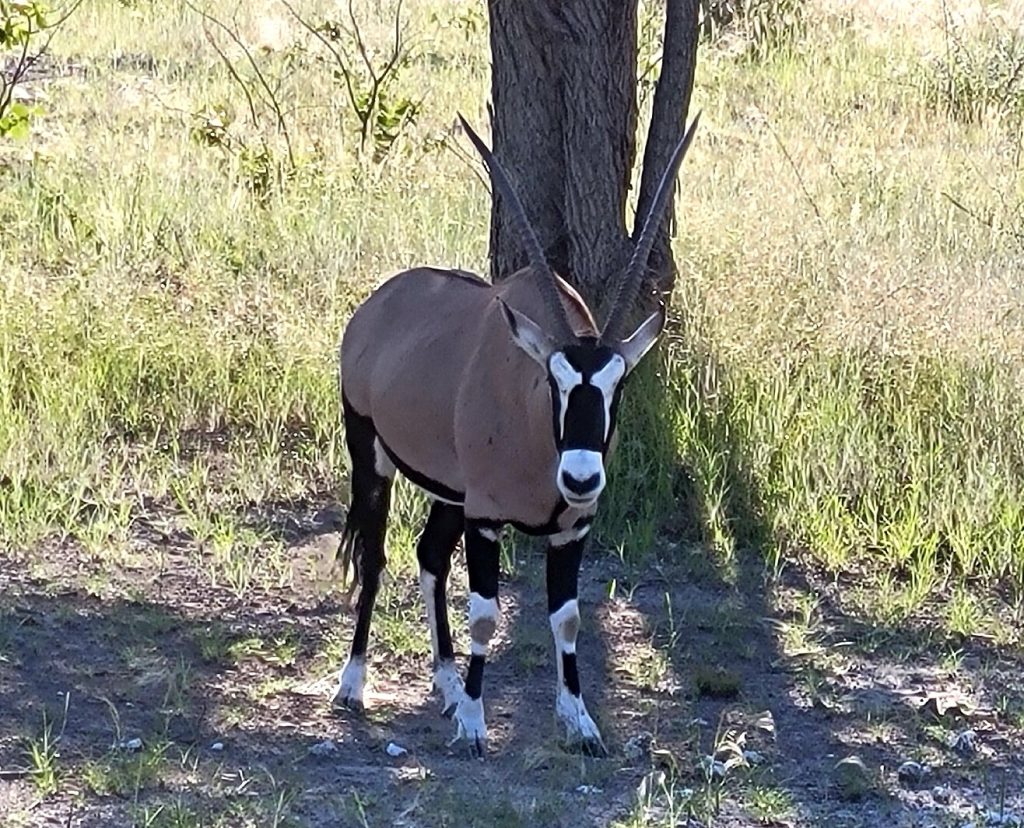
Both males and females carry the long, nearly straight horns, which is unusual among antelope and makes sexing them harder than most species.
The rule of thumb is that female horns are longer and thinner with a slight curve, while male horns are shorter, thicker and straighter. Males are also heavier through the neck and shoulders. Horns reach around 1.2 metres in length.
Those horns are genuinely dangerous weapons. Oryx have killed lions with them when cornered, and the animal will back into cover and face outwards rather than run when it cannot escape. Guides treat wounded or cornered oryx with real caution.
The black and white facial mask is thought to draw attention to the horns during mate selection, since size matters to females who carry horns of their own. Seen from the side, with the two horns aligned into one, the oryx has been suggested as a possible origin for the unicorn myth.
Oryx Herds and Social Structure
Herds typically run between about five and forty animals, though aggregations of several hundred occur where grazing is good after rain.
Female herds move through the territories of dominant bulls, and non territorial bulls travel with them, behaving submissively towards territorial males to avoid conflict. Territorial bulls attempt to hold females within their ground for as long as possible.
Solitary bulls are common, and a single oryx standing alone on a gravel plain is one of the defining images of this country. Calves are born with a plain sandy coat that lacks the adult markings, which camouflages them in dry grass, and they develop the black and white pattern as they mature.
Where to See Oryx in Namibia
Nearly everywhere, which is part of what makes them the national animal.
Sossusvlei and the Namib. Oryx crossing red dunes is the classic Namibian image. They cross open sand for no obvious reason and at considerable cost, and the photographs are worth the wait.
Etosha. Common at waterholes throughout the park, often in numbers alongside zebra and springbok. Gemsbokvlakte is named for them.
The Kalahari. Red dune country in the east and southeast holds strong populations, and this is where the tsamma melons that sustain them through drought grow.
The coast and gravel plains. Seen on the Namib gravel plains inland of Swakopmund and on the drive to Sandwich Harbour, standing in country that looks empty of everything.
For photography, the dune country around Sossusvlei and the NamibRand gives the strongest images, with a single animal against red sand or a bare crest. Early morning light and a long lens are what the shot needs.
Oryx and Predators
Adult oryx are formidable and few predators take them willingly.
Lion do, particularly in the Kunene where oryx form a major part of the desert adapted lions‘ diet, and in Etosha. Cheetah and leopard take calves and occasionally sub adults. Spotted hyena will take weakened animals.
The oryx defence is the horns and it works. An animal that stands its ground with head lowered presents two metre long spikes to anything approaching, and lions have been killed doing it. Predators mostly prefer to take calves or animals in poor condition.
Their real advantage is habitat. Few predators can operate for long in the country where oryx are most at home, which is why an animal with no camouflage to speak of survives perfectly well standing in the open.
Oryx in Namibian Life
Beyond the coat of arms, the oryx has a substantial place in Namibian life that visitors notice quickly.
Oryx meat appears on menus across the country and is excellent: lean, dark and gamey without being strong. It is cheap by international standards and turns up as steak, carpaccio and in stews. Much of it comes from game farms rather than wild populations.
The animal appears constantly in Namibian branding, on beer labels, in logos and in craft work. It is also a valued trophy species and a substantial part of the game farming economy, which is one of the reasons wildlife based land use has expanded across Namibian farmland.
Best Time to See Oryx
Any month, in any part of the country. They are one of very few large animals in Namibia that require no seasonal planning at all.
The dry season from May to October brings them to waterholes more often, which improves photography at Etosha and elsewhere. In the green season they disperse widely and become less concentrated, though no harder to find.
Time of day matters for the images rather than the sighting. Early morning and late afternoon give the low light that separates a pale animal from pale sand, and the middle of the day flattens everything.
Oryx and Gemsbok Questions
Is the oryx the same as the gemsbok?
Yes. Oryx gazella is called gemsbok in Afrikaans and both names are used in Namibia, with oryx more common in tourism and gemsbok in everyday speech. The Afrikaans name derives from the German for chamois, an animal it does not resemble, and how the transfer happened is not clear. There are several other oryx species elsewhere in Africa and Arabia, but in Namibia the two words mean the same animal.
How do oryx survive without water?
They take almost all their moisture from food, feeding at night and early morning when condensation has gathered on plants, and eating roots, bulbs, tubers and wild melons alongside grass. They do not sweat, which saves water. They also let their body temperature rise rather than cooling themselves, using a network of blood vessels in the nose to cool blood going to the brain separately. Together this lets them go weeks or months without drinking.
Can you tell male and female oryx apart?
With practice. Both sexes carry horns, which is unusual. Female horns tend to be longer, thinner and slightly curved, while male horns are shorter, thicker and straighter. Males are also heavier through the neck and shoulders. It is one of the harder antelope to sex at a glance, and many visitors assume every horned animal is male.
Are oryx dangerous?
To predators, yes. Their horns reach around 1.2 metres and oryx have killed lions with them when cornered, backing into cover and facing outwards rather than fleeing. They are not a threat to visitors in vehicles and will move away from people. Guides treat wounded or cornered animals with genuine caution, and you should never get close to one on foot.
Where is the best place to see oryx in Namibia?
Everywhere, which makes them unusual. For the classic image of an animal crossing red dunes, the Sossusvlei area and the NamibRand. For numbers at waterholes, Etosha, where Gemsbokvlakte is named after them. The Kalahari in the east holds strong populations, and they turn up on the gravel plains inland of Swakopmund where the country looks empty of everything.
Why is the oryx on Namibia’s coat of arms?
Two oryx support the shield, chosen for courage, elegance and pride, and because the animal survives where the country is hardest. It occurs across almost the whole of Namibia, from the Kalahari to the Namib, and thrives in conditions that exclude most large mammals. As a national symbol it works better than most, since it genuinely represents something about the place rather than being merely decorative.
Can you eat oryx?
Yes, and you will find it on menus throughout Namibia. The meat is lean, dark and gamey without being strong, and it is inexpensive by international standards. It appears as steak, carpaccio and in stews, and much of it comes from game farms rather than wild populations. Along with kudu and springbok it is one of the three game meats you will meet most often here.
Booking Your Namibia Trip
The safari companies and tour operators listed on this website put trips like this together for a living and know which camps, guides and routes actually deliver. We are an independent guide to Namibia; we do not book or sell tours ourselves.
When you are ready, arrange your safari, tour or holiday with one of the recognised operators listed here. Tell them your dates and what matters most, and a real person, not a form, will handle the itinerary, park bookings and logistics for you.