Namibia vs Botswana: Which Safari

Botswana delivers more animals; Namibia delivers more country. That is the honest summary and everything else follows from it. Botswana costs considerably more and concentrates on wildlife. Namibia costs a fraction as much, can be self driven, and offers desert, dunes, canyons and a coastline alongside game viewing that is genuinely thinner.
The Core Difference
These two countries share a border and almost nothing else about how they work as destinations.
Botswana built its tourism around low volume, high value. The Okavango Delta and the Chobe and Linyanti systems hold some of the highest game densities in Africa, access is largely restricted to fly in camps on private concessions, and prices reflect deliberate limits on visitor numbers.
Namibia built its around access. The country is self drivable on tar and graded gravel, accommodation runs from national park campsites to premium camps, and the attractions are as much geological as biological.
The consequence is that a Botswana trip is a wildlife trip and a Namibia trip is a country trip that includes wildlife.
Travellers who want to see a great many animals in a short time should go to Botswana. Travellers who want to drive somewhere astonishing and see some animals should come to Namibia.
Do not choose between them if you can combine them. The Zambezi Region at Namibia’s eastern tip sits about 100 kilometres from Chobe, and a self drive through Namibia finishing with a few nights in Botswana gives you both at a fraction of a full Botswana itinerary. Flying home from Kasane or Livingstone avoids driving back.
Wildlife: Botswana Wins
There is no useful argument here and pretending otherwise does travellers a disservice.
The Okavango Delta, Chobe, Linyanti, Savuti and the Kalahari reserves hold densities Namibia cannot match. Chobe has one of the densest elephant populations in Africa. Predator sightings are more frequent and more reliable.
Namibia’s Etosha is a genuinely good park with 114 recorded mammal species, and the absence of rivers concentrates animals at waterholes through the dry season, which produces excellent viewing. It is still a lower density system than the Delta.
Buffalo are absent from Etosha entirely, excluded on veterinary grounds to protect Namibia’s foot and mouth free status for livestock export. A full Big Five list here requires the Zambezi Region, which most itineraries skip.
Botswana also delivers water based game viewing, with mokoro and boat activities in the Delta, which Namibia offers only in the far northeast.
If your measure is animals per hour, Botswana wins comfortably.
Scenery and Variety: Namibia Wins
Here the position reverses just as firmly.
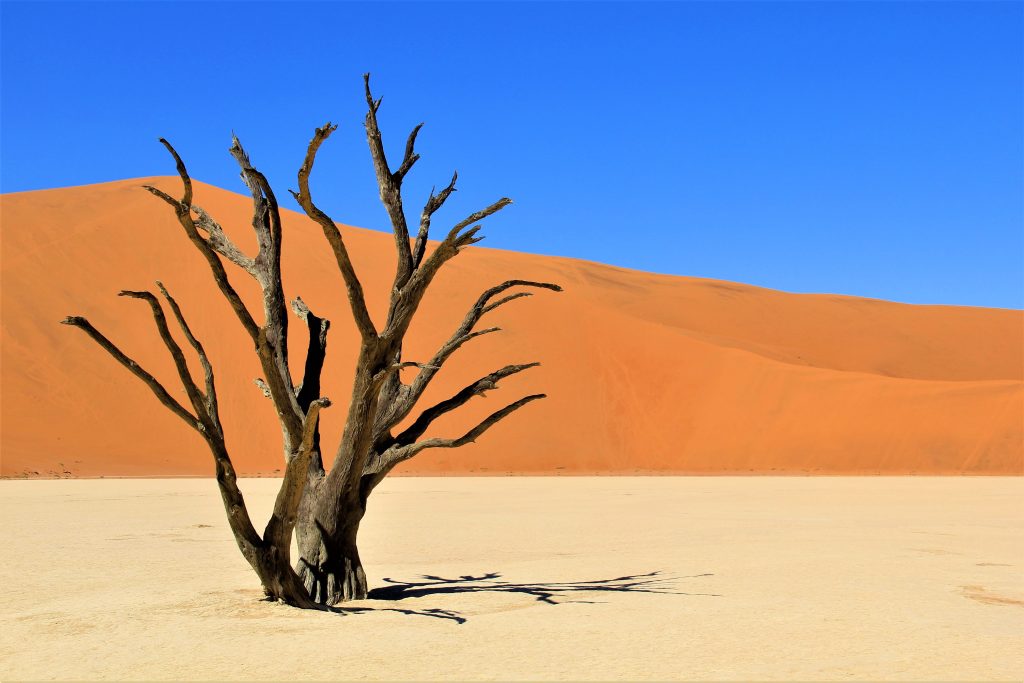
Namibia offers the oldest desert on earth, the highest dunes in the world at Sossusvlei, a fog bound Atlantic coastline with shipwrecks and seal colonies, Fish River Canyon, granite massifs, rock art sites tens of thousands of years old, and a dark sky reserve.
Botswana is largely flat. The Delta is beautiful and the Makgadikgadi pans are striking, and the range of terrain is narrow by comparison.
A Namibian itinerary changes character every two days: dune, coast, mountain, savanna. A Botswana itinerary is water, bush and pan.
Namibia also holds things found almost nowhere else: free roaming black rhino tracked on foot, desert adapted elephant and lion, brown hyena feeding on seal colonies, and the world’s largest cheetah population living on farmland.
If your measure is what you will photograph and remember, Namibia has more range.
Cost
The difference here is substantial and it is the deciding factor for many travellers.
Botswana’s premium camps run from several hundred to well over a thousand US dollars per person per night, with charter transfers frequently quoted separately. A ten night Botswana fly in itinerary runs into five figures per person without difficulty.
Namibia self driving with mid range lodges costs roughly 400 to 450 US dollars a day for two people. Camping brings that to 200 to 300 a day for two. Premium Namibian camps do reach Botswana prices, but they are an option rather than the only route in.
Botswana does have self drive camping options in Chobe, Moremi and the Central Kalahari, which are considerably cheaper than the camps, though they require serious 4×4 capability and advance campsite bookings that are notoriously hard to secure.
Broadly, a Namibian trip costs a quarter of a comparable Botswana one and is still excellent.
Self Drive
This is the practical divide and it decides the trip for a lot of people.
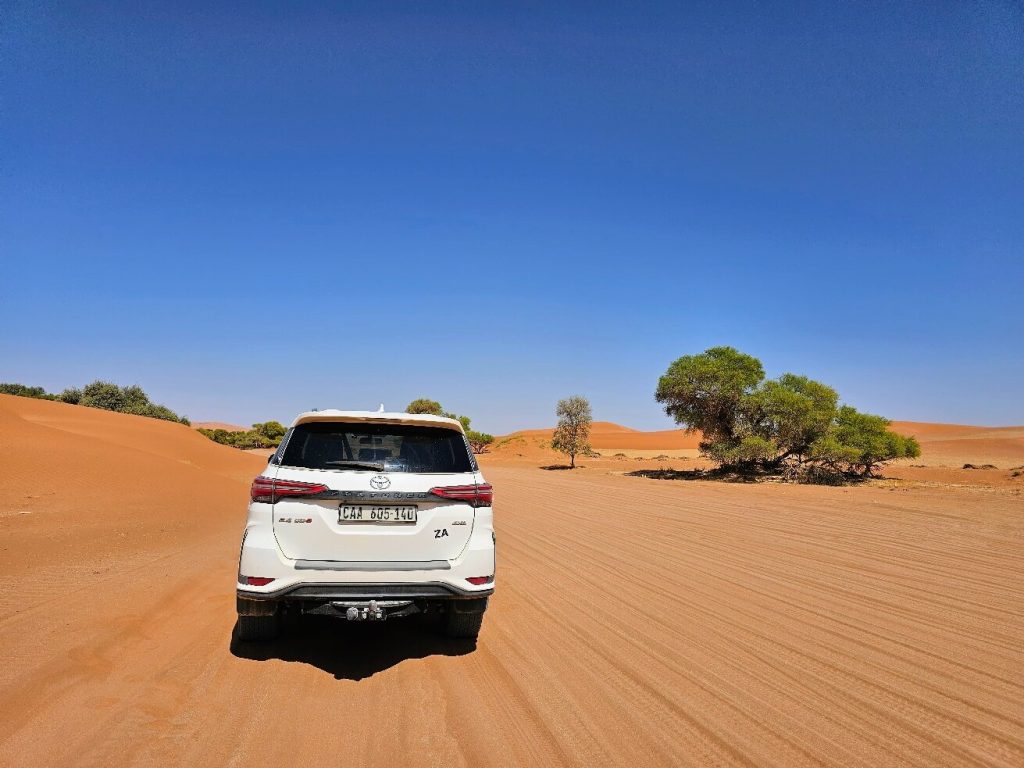
Namibia is among the best self drive countries in Africa. Tar roads connect the main centres, gravel roads are graded and mostly in reasonable condition, distances are long but the driving is straightforward, and the rental infrastructure for fully equipped 4×4 camping vehicles is excellent.
Botswana self driving is a different proposition. The main routes are fine, but reaching Moremi, Savuti and the Central Kalahari means deep sand, water crossings and genuine 4×4 experience, often with a requirement to travel in convoy. Campsite bookings inside the parks are limited and sell out far in advance.
Most Botswana visitors fly between camps because that is how the country is set up.
Namibia rewards independence; Botswana rewards being looked after.
Which Suits Which Traveller
First safari, limited time. Botswana, if the budget allows. Higher density means you see more in fewer days, and everything is arranged for you.
Photographers and self drivers. Namibia. The range of terrain, the light, the freedom to be somewhere at dawn and the cost of staying longer all favour it.
Families. Namibia, mostly. Much of it is malaria free, self driving lets you set the pace around children, and the coast offers activities that are not game drives.
Repeat safari travellers. Namibia. If you have already done high density game viewing elsewhere, desert adapted species and tracking rhino on foot offer something genuinely different.
Malaria and Health
A practical difference that matters for families in particular.
Much of Namibia carries little to no malaria risk. The desert, the coast, the south and the central highlands are close to risk free year round, and Etosha sits in a low risk zone considered lowest in winter. Genuine risk concentrates in the Zambezi Region and along the northern rivers.
Botswana’s prime safari areas, meaning the Delta, Chobe and the Linyanti, all carry malaria risk, with the highest levels during and after the rains.
That makes a Namibian itinerary avoiding the northeast one of the few genuinely low risk safari options in Africa, which is a real consideration for travellers with young children or medical concerns.
Both countries have good medical facilities in their capitals and thin coverage elsewhere, and comprehensive insurance with evacuation cover is necessary in either.
Seasons
The calendars broadly match, with some useful differences.
Both countries are at their best for wildlife in the dry season from roughly May to October, when water disappears and animals concentrate.
Botswana’s Delta floods counterintuitively during the dry season, since the water arrives from Angolan rains months earlier, which means the peak water levels and the best mokoro conditions fall between roughly June and August.
Namibia’s dry season concentrates game at waterholes with no such complication, and the desert is at its most comfortable in the same months.
Green season in both brings lower prices, dispersed game, better birding and dramatic skies. Botswana’s green season is genuinely difficult in places, with roads closing. Namibia’s is workable throughout except the northeast.
Combining the Two
The strongest answer for many travellers is not to choose.
Namibia’s Zambezi Region reaches to within about 100 kilometres of Chobe, with the Ngoma border crossing linking them. Katima Mulilo sits at the eastern end of the Caprivi Strip and Kasane is a short run beyond.
A common structure is two weeks self driving Namibia, ending in the Zambezi Region, then crossing to Chobe for three or four nights and flying home from Kasane or Livingstone. That gives desert, coast, Etosha and high density game viewing on one trip.
Victoria Falls is within reach from the same corner, which adds a third country.
Rental vehicles need cross border authorisation arranged at booking, and one way drops are handled by several Namibian companies for a fee.
The alternative structure is flying: a Namibian fly in circuit connecting to a Botswana one, which is expensive and removes all the driving.
Namibia vs Botswana Questions
Which has better wildlife, Namibia or Botswana?
Botswana, and it is not close. The Okavango Delta, Chobe, Linyanti and Savuti hold densities Namibia cannot match, with Chobe having one of the densest elephant populations in Africa. Namibia’s Etosha is genuinely good, with 114 mammal species concentrated at waterholes in the dry season, but it is a lower density system and buffalo are absent from it entirely.
Which is cheaper?
Namibia, substantially. Self driving with mid range lodges costs roughly 400 to 450 US dollars a day for two, and camping brings that to 200 to 300. Botswana’s premium camps run from several hundred to well over a thousand US dollars per person per night with transfers often extra, so a ten night fly in itinerary reaches five figures per person without difficulty.
Can I self drive in both?
Namibia easily, Botswana with difficulty. Namibia has tar roads between main centres, graded gravel elsewhere and excellent rental infrastructure for equipped 4×4 camping vehicles. Botswana’s prime areas mean deep sand, water crossings, genuine 4×4 experience, often convoy requirements, and park campsite bookings that sell out far in advance. Most Botswana visitors fly between camps.
Which is better for families?
Namibia, mostly. Much of it carries little to no malaria risk, which is a real consideration with young children, while Botswana’s prime safari areas all carry risk. Self driving lets you set the pace around children rather than a group schedule, and the coast offers sandboarding, seal cruises and dune climbing that are not game drives.
Can I combine Namibia and Botswana?
Yes, and it is often the best answer. Namibia’s Zambezi Region reaches within about 100 kilometres of Chobe via the Ngoma crossing. A common structure is two weeks self driving Namibia, crossing to Chobe for three or four nights, then flying home from Kasane or Livingstone. Rental vehicles need cross border authorisation arranged at booking.
Which should I choose for a first safari?
Botswana if the budget allows and time is short, since higher density means seeing more in fewer days with everything arranged. Namibia if cost matters, if you want to drive yourself, or if you want scenery alongside wildlife. Repeat safari travellers who have already done high density game viewing usually get more from Namibia’s desert adapted species and rhino tracking on foot.
Can I see the Big Five in Namibia?
Four of them readily: elephant, lion, leopard and black rhino, with Etosha best for the first three and Damaraland for free roaming rhino. Buffalo are excluded from Etosha entirely on veterinary grounds protecting the country’s foot and mouth free status. They occur in the Zambezi Region, so a complete list needs a trip most itineraries skip. Botswana delivers all five more easily.
Booking Your Namibia Trip
The safari companies and tour operators listed on this website put trips like this together for a living and know which camps, guides and routes actually deliver. We are an independent guide to Namibia; we do not book or sell tours ourselves.
When you are ready, arrange your safari, tour or holiday with one of the recognised operators listed here. Tell them your dates and what matters most, and a real person, not a form, will handle the itinerary, park bookings and logistics for you.