Blue Wildebeest in Namibia
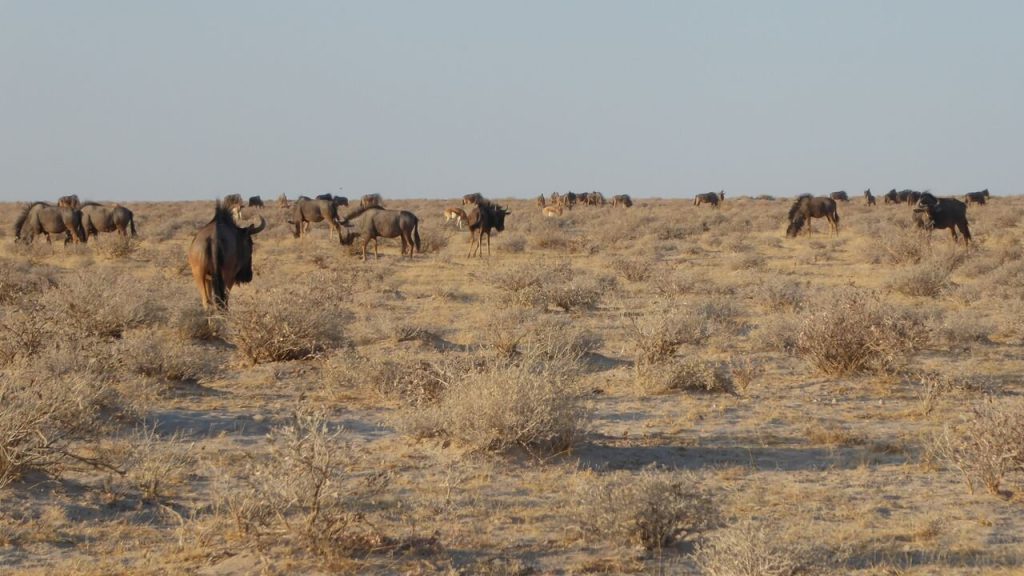
Blue wildebeest form sizeable herds in Etosha and the surrounding conservancies, and they are visible all year because Namibia sits outside the Great Migration entirely. That spectacle belongs to the Serengeti and Mara system. Namibian wildebeest stay put, which means no seasonal gamble on timing and no chance of the crossing footage people arrive expecting.
No Migration Here
This is the first thing to clear up because visitors arrive with the wrong picture.
The Great Migration, with its river crossings and columns of animals hundreds of thousands strong, is a Serengeti and Masai Mara phenomenon. Namibia is not part of that route and never has been.
The practical consequence is good and bad. You can see wildebeest here in any month, which removes the timing gamble that shapes an East African trip. You will not see the crossings.
Namibian wildebeest move locally in response to rainfall and grazing rather than undertaking long distance migration, and in Etosha they concentrate at waterholes through the dry season like everything else.
Travellers who came for herds on the move should understand that Namibia offers desert adaptation and low density wilderness instead, which is a different proposition rather than a lesser one.
Watch wildebeest at an Etosha waterhole rather than driving past a grazing herd. They come to water nervously, in a pattern of advancing and retreating that can go on for twenty minutes, because they know predators wait there. Watching a herd talk itself into drinking is one of the more interesting things to observe at a Namibian waterhole and it costs nothing but patience.
What They Look Like
The blue wildebeest is an ungainly animal built from parts that appear borrowed.
Connochaetes taurinus stands around 1.15 to 1.4 metres at the shoulder and weighs roughly 180 to 250 kilograms, with bulls heavier than cows.
The body is slate grey with darker vertical stripes on the neck and shoulders, which is the blue of the name, and the coat can look silver in certain light.
Both sexes carry curved horns that sweep outward then upward, heavier and more massively based in bulls.
A dark beard hangs from the throat, a mane runs along the neck, and the head is disproportionately large with a broad muzzle built for grazing short grass.
The overall impression is of high shoulders sloping down to lower hindquarters, which gives them their characteristic rocking gait.
The Other Wildebeest
A second species occurs in Namibia and it is not native.
The black wildebeest, Connochaetes gnou, is endemic to South Africa’s central highveld and numbers only around 4,000 animals. It has been introduced to several private game areas in Namibia.
Telling them apart is straightforward once you know. The black wildebeest has a white tail rather than dark, a defined black on white mane, and horns that slope sharply down before rising to form a U shape when seen from the side.
The blue wildebeest has a dark tail, a darker mane and horns that sweep outward then up without the pronounced downward first curve.
Black wildebeest on a Namibian game farm are introduced stock rather than a natural population, which is worth knowing when a lodge presents them as local wildlife.
Blue wildebeest were themselves successfully reintroduced to parts of Namibia, having declined in places, and now occur widely.
Where They Live
Distribution follows grass and water, and blue wildebeest need both.
They occur naturally north of Etosha and east into the Caprivi Strip, and are found in the Kalahari, Khaudum and along Namibia’s far eastern borders.
Etosha is where most visitors see them, in sizeable herds across the open plains and at waterholes, alongside springbok, Burchell’s zebra and oryx as the classic plains game assembly.
They are adaptable grazers with a preference for short grass plains, and they need access to drinking water, which is the limiting factor on where they can live.
That water dependence is why they do not occur in the true desert, unlike oryx and springbok which manage without.
They have been introduced onto several game ranches across the country, so many sightings on private land are of introduced rather than natural populations.
Behaviour Worth Watching
Wildebeest reward attention more than their reputation suggests.
They are gregarious, forming herds that mix readily with zebra and other plains game. That association is not accidental: zebra crop taller grass and wildebeest take what is left, and more eyes means better predator detection.
Bulls hold territories during the breeding season and defend them noisily, with displays involving snorting, pawing and horn clashing rather than serious injury.
Calves are born after roughly eight months and can stand and run within minutes, which is the adaptation that keeps a herd animal alive on open plains.
Calving is synchronised, with most young dropped in a narrow window, which swamps predators with more calves than they can take.
The rocking gallop is distinctive and less inefficient than it looks, sustaining speed over distance.

Predators and Vulnerability
Wildebeest are prey animals and their whole biology reflects it.
Lion take adults, and in Etosha wildebeest are among the substantial prey species alongside zebra and springbok. Spotted hyena take them in numbers, particularly calves and animals weakened by drought.
Cheetah and leopard take calves, and jackal take newborns.
The waterhole is the danger point, which is why herds come in so cautiously. Predators know where prey must come, and the arithmetic of the dry season works against the wildebeest.
Drought hits them harder than the desert adapted species. Where oryx can go without drinking and springbok take moisture from plants, wildebeest must find water, and when it goes they die.
Etosha’s artificial waterholes sustain populations through dry periods that would otherwise reduce them.
The Name and the Sound
Two things about wildebeest are worth knowing beyond the biology.
The animal is also called the gnu, which comes from a Khoikhoi word and is an attempt to render the sound the animal makes. Wildebeest is Afrikaans and Dutch, meaning wild beast, which tells you what early settlers made of it.
The noise itself is the thing. Wildebeest are vocal, producing a low grunting call that carries across open ground, and a large herd generates a continuous low murmur that is one of the defining sounds of an African plain.
Bulls snort loudly during territorial display, and alarm calls travel through a herd fast, which is why mixed groups with zebra and springbok work so well.
At an Etosha waterhole after dark, the sound of wildebeest coming in is frequently how you know they are there before the floodlight picks them up.
The oldest names for the animal in this region are onomatopoeic, which suggests that people have always identified it by ear as much as by sight.
Where to See Blue Wildebeest
Etosha. Sizeable herds on the open plains and at waterholes throughout the park, and the most reliable viewing in the country. Present year round.
The Kalahari. Eastern and southeastern red dune country, where they work the interdune valleys and grass plains.
Khaudum and the northeast. Present in the deep sand country and east into the Caprivi Strip, in their natural northern range.
Private game farms. Widely held across the central highlands, often in larger and more approachable numbers than in the open parks.
Best Time to See Them
Any month, since Namibian wildebeest do not migrate and are resident year round.
The dry season from May to October concentrates them at waterholes in Etosha, which makes them easier to find and easier to watch properly.
The rains from November to April bring calving, with synchronised births producing large numbers of young in a short window and drawing predators onto them. That is the most dramatic time to see wildebeest, with the animals more dispersed.
Early morning and late afternoon are when they move and drink. Through the heat of the day they stand in whatever shade is available.
Waterhole watching beats driving, as with most Etosha wildlife.
Blue Wildebeest Questions
Can I see the Great Migration in Namibia?
No. The Great Migration with its river crossings belongs to the Serengeti and Masai Mara system, and Namibia is not part of that route. Namibian wildebeest move locally in response to rainfall and grazing rather than migrating long distances. The compensation is that you can see them in any month, with no timing gamble.
Where do blue wildebeest live in Namibia?
Naturally north of Etosha and east into the Caprivi Strip, plus the Kalahari, Khaudum and the far eastern borders. Etosha is where most visitors see them, in sizeable herds on the open plains and at waterholes. They are adaptable grazers preferring short grass plains, and they need access to drinking water, which is why they do not occur in true desert.
Why do they gather with zebra?
Because it works for both. Zebra crop taller grass and wildebeest take the shorter growth beneath, so they do not compete directly, and more animals means more eyes watching for predators. Mixed herds of wildebeest, zebra and springbok are the classic Etosha plains game assembly and the association is deliberate rather than incidental.
What is the difference between blue and black wildebeest?
The black wildebeest has a white tail, a defined black on white mane, and horns that slope sharply down before rising into a U shape seen from the side. The blue has a dark tail, darker mane and horns sweeping outward then up. Black wildebeest are endemic to South Africa‘s highveld, number around 4,000, and exist in Namibia only as introduced stock on private land.
Why do they hesitate at waterholes?
Because predators wait there and the animals know it. Herds edge towards water in a pattern of advancing and retreating that can go on for twenty minutes before the first animal commits. Watching a herd talk itself into drinking is one of the more interesting things to observe at an Etosha waterhole, and it costs nothing but patience.
How does drought affect them?
Harder than it hits the desert adapted species. Oryx can go without drinking and springbok take moisture from plants, while wildebeest must find water and die when it goes. Etosha’s artificial waterholes sustain populations through dry periods that would otherwise reduce them considerably, which is one of the ways the park is actively managed.
When is the best time to see them?
Any month, since they are resident. The dry season from May to October concentrates them at waterholes and makes them easier to watch. The rains from November to April bring synchronised calving, producing large numbers of young in a short window and drawing predators onto them, which is the most dramatic period, with the animals more spread out.
Booking Your Namibia Trip
The safari companies and tour operators listed on this website put trips like this together for a living and know which camps, guides and routes actually deliver. We are an independent guide to Namibia; we do not book or sell tours ourselves.
When you are ready, arrange your safari, tour or holiday with one of the recognised operators listed here. Tell them your dates and what matters most, and a real person, not a form, will handle the itinerary, park bookings and logistics for you.