Bat-Eared Fox
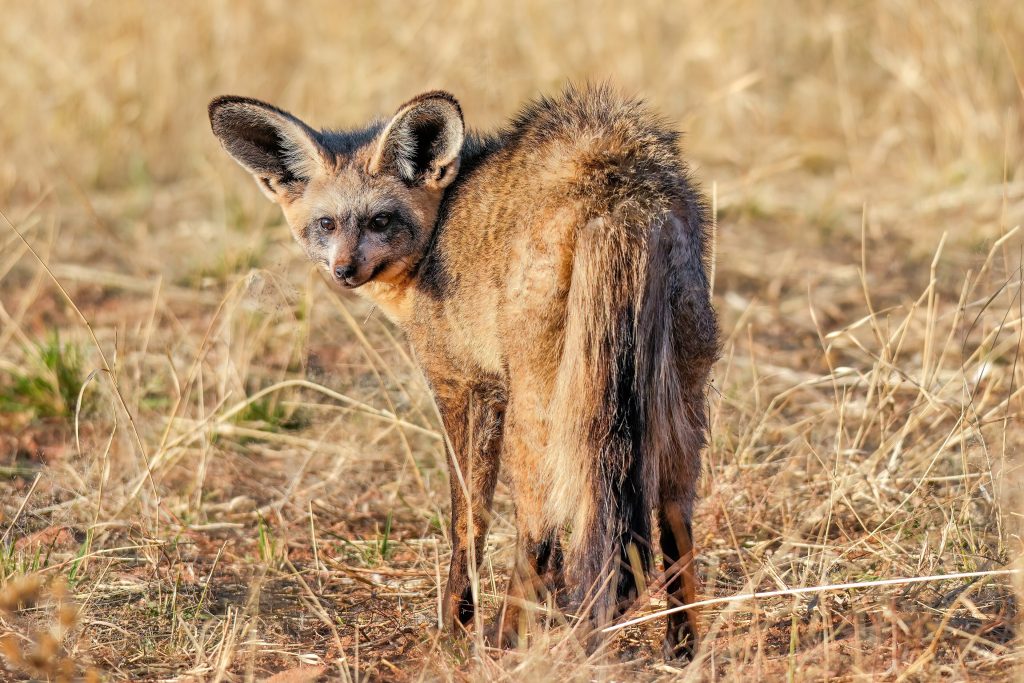
The bat-eared fox is a small silver grey insectivore with enormous ears and a black eye mask, found across Namibia wherever the harvester termite occurs. Termites make up around 80 percent of its diet, and it locates them by listening to the ground with ears that work like a dish antenna. It stands 30 to 35 centimetres at the shoulder and weighs 3 to 5 kilograms.
An Animal Built Around One Insect
Most small carnivores are opportunists. The bat-eared fox is close to a specialist, and the thing it specialises in is termites.
Roughly 80 percent of its diet consists of termites and other insects, with the harvester termite the mainstay. Its distribution across Namibia follows that of the harvester termite closely, so where the termite occurs the fox is relatively common, and where it does not the fox is absent.
Beyond termites it takes lizards, gerbils, small birds, scorpions, beetle larvae, other insects and occasionally fruit. But the termite is the reason it exists in the form it does.
That specialisation is unusual among the canids. Jackals, foxes and their relatives are mostly omnivorous opportunists eating whatever they can catch or unearth, and the bat-eared fox is the one member of the group that has committed to a narrow food source.
The Ears and How They Are Used
The ears are enormous relative to the animal and they are the whole point.
A foraging bat-eared fox walks slowly across open ground with its head lowered, ears angled towards the surface, listening for movement underground. Observers describe it as the ears operating like a radio dish. When it locates a concentration of insects, it stops and digs rapidly with its forepaws.
Watching this is one of the more absorbing things you can do on a Namibian night drive, because the animal is clearly doing something deliberate rather than casting about at random. It listens, moves a few metres, listens again, then commits.
The ears do double duty as heat radiators. Blood flowing through the large surface area sheds heat, which matters for a small animal in an environment with daytime temperatures well above body heat.
The black mask across the eyes and the dark ear backs and tail tip complete a distinctive face that is unmistakable once seen.
Where Bat-Eared Foxes Live in Namibia
They are relatively common throughout the country in suitable habitat, which means dry open country with harvester termites and diggable ground.
Short grass plains, open savanna, semi desert and farmland all suit them. They avoid dense vegetation, which makes sense for an animal that hunts by listening to the ground and needs to see approaching predators.
Etosha’s open plains hold them, along with the Kalahari in the east, the central farmland and the semi desert of the south and west. They occur into genuinely arid country provided termites are present.
Their distribution across Africa is another of the split ranges: one population in southern Africa and one in East Africa, separated by a gap of roughly a thousand kilometres. Black backed jackal and aardwolf show the same pattern, which points to a once continuous belt of dry country that has since been broken.
Look for them on short grass and gravel plains in the last hour of daylight rather than at night, when most visitors assume they will find them. Pairs and family groups come out to forage in the cooler part of the afternoon, and in the low light the ears catch the sun and make them visible from a surprising distance.
Pairs, Family Groups and Breeding
Bat-eared foxes pair for life, and the pair with its offspring is the social unit you will usually see.
Groups of two to about six animals are common, made up of a mated pair and their young from the current and sometimes the previous year. They den underground, digging their own burrows or taking over those of other animals, and a territory usually contains several.
The species does something unusual among canids in how it divides parental work. The male takes on the great majority of the care of the cubs, including grooming, guarding and playing with them, while the female spends her time foraging to sustain milk production. That reversal of the usual arrangement is well documented and is a direct consequence of the diet: termites are low in energy, so a lactating female has to spend an enormous share of her time eating.
Cubs emerge from the den at a few weeks old and begin foraging with the group not long after, learning the listen and dig technique by copying the adults.
Predators and Threats
Being small, mainly nocturnal and living in open country makes for a difficult existence.
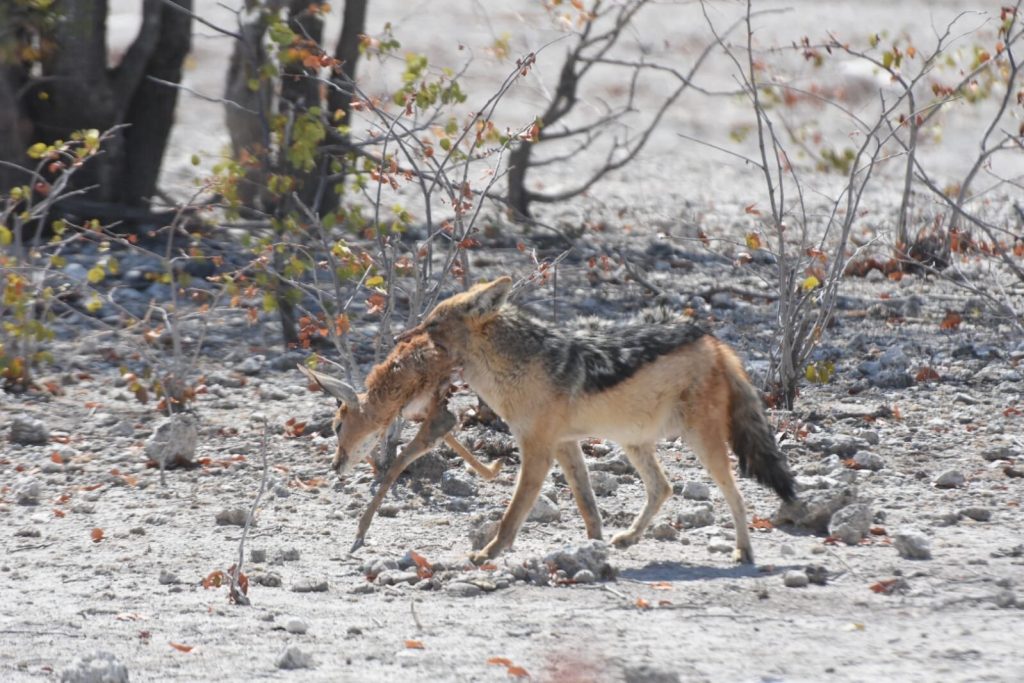
Black backed jackal kill bat-eared foxes and are one of their main predators, which is a reminder that the smaller carnivores in Namibia prey on each other as readily as on anything else. Caracal, African wild cat, larger raptors including eagles, and pythons all take them. Jackals also kill yellow mongoose and Cape fox.
The defence is vigilance and speed rather than confrontation. Family groups forage with at least one animal alert at any moment, and they are quick and agile over short distances with a habit of doubling back sharply when pursued.
They are not persecuted by farmers in the way jackal are, since they take no livestock and eat quantities of termites that farmers tend to regard as beneficial. Road deaths and habitat conversion are the human pressures that matter, and the species is listed as least concern.
Their Role in the Ecosystem
An animal eating termites in enormous numbers has knock on effects.
Harvester termites strip grass and can substantially reduce grazing available for livestock and wild herbivores. A predator taking large quantities of them provides a service farmers benefit from whether or not they realise it.
Their digging also matters. Bat-eared foxes turn over soil constantly while foraging and while excavating dens, which aerates ground and creates burrows subsequently used by other species.
In a country where much of the wildlife conversation is about large mammals and conflict, the small insectivores doing steady unglamorous work across the farmland get almost no attention.
Telling Bat-Eared Fox from Cape Fox
Two small canids share much of the same country in Namibia and visitors regularly confuse them.
The bat-eared fox is silver grey with enormous rounded ears, a black mask across the eyes, dark ear backs, dark legs and a black tipped bushy tail. It forages in pairs and family groups, often several animals together, moving slowly with the head down.
The Cape fox, Vulpes chama, is a true fox and the only one in southern Africa. It is more slender, with a silver grey back, reddish flanks and face, noticeably smaller pointed ears and no eye mask. It is almost always alone and moves faster and more purposefully.
Behaviour separates them just as clearly as appearance does. A small canid stopping repeatedly to listen at the ground and then dig is a bat-eared fox. One trotting across open ground with a clear destination is more likely a Cape fox.
Both are nocturnal, both occur across much of the country, and both turn up on night drives. The Cape fox is the scarcer sighting of the two.
Where to See Bat-Eared Fox
Etosha. Open plains and short grass areas, particularly in the west and around the pan edges. Late afternoon and early morning, and on rest camp night drives.
The Kalahari. Red dune country in the east and southeast, where the open interdune valleys and termite activity suit them well.
Private reserves. Night drives at Okonjima, Erindi and the Etosha border properties produce them regularly, along with aardwolf and porcupine.
Central farmland. Guest farms across the highlands hold them, and they are frequently seen on gravel roads at dusk on a self drive trip.
Best Time to See Bat-Eared Fox
They are mostly nocturnal, so night drives are the most reliable route, which in practice means private reserves or the Etosha rest camp drives.
In the cooler hours of the day, particularly late afternoon and early morning, pairs and family groups come out to forage in the open, and in the dry winter months this daytime activity increases. That makes May to September the better window for seeing them without a night drive.
Look on short grass and gravel rather than in bush, and scan for the ears rather than the body, which is small, low and the colour of the ground.
Bat-Eared Fox Questions
What do bat-eared foxes eat?
Around 80 percent of the diet is termites and other insects, with the harvester termite the mainstay. They also take lizards, gerbils, small birds, scorpions, beetle larvae and occasionally fruit. The specialisation is unusual among canids, which are otherwise opportunistic omnivores, and it explains why the species distribution across Namibia closely follows that of the harvester termite.
Why do they have such big ears?
Two reasons. They use them to listen for insects moving underground, walking slowly with the head lowered and the ears angled at the surface before stopping to dig with the forepaws. Observers compare it to a radio dish. The ears also work as heat radiators, shedding warmth through their large surface area, which matters for a small animal in a hot environment.
Are bat-eared foxes common in Namibia?
Relatively common throughout the country wherever harvester termites occur and the ground is open enough to forage and dig. They avoid dense vegetation. Etosha’s plains, the Kalahari, the central farmland and the semi desert of the south and west all hold them. The species is listed as least concern and is not persecuted by farmers the way jackals are.
Do male bat-eared foxes look after the young?
Yes, and to an unusual degree. The male provides most of the care for the cubs, including grooming, guarding and playing, while the female spends her time foraging. It is a direct consequence of the diet: termites are low in energy, so a lactating female must spend an enormous proportion of her time eating to sustain milk production. The reversal is well documented in the species.
What kills bat-eared foxes?
Black backed jackal are among their main predators, which is a reminder that Namibia’s smaller carnivores prey on each other freely. Caracal, African wild cat, large raptors and pythons also take them. Their defence is vigilance rather than confrontation, with family groups keeping at least one animal alert while the others forage, and considerable speed and agility over short distances.
Are they related to true foxes?
Only distantly. Otocyon megalotis sits on its own branch of the canid family, distinct enough that it is placed in its own genus, and it is not closely related to the true foxes of the genus Vulpes. The Cape fox, which also occurs in Namibia, is a true fox and looks quite different, being more slender with smaller ears and a silver grey back.
When is the best time to see one?
Night drives are the most reliable, which means private reserves or the Etosha rest camp drives, since self driving after dark in the park is prohibited. Failing that, look on open short grass and gravel plains in the last hour of daylight or the first of the morning, particularly during the cooler months from May to September when daytime activity increases. Scan for the ears rather than the body.
Booking Your Namibia Trip
The safari companies and tour operators listed on this website put trips like this together for a living and know which camps, guides and routes actually deliver. We are an independent guide to Namibia; we do not book or sell tours ourselves.
When you are ready, arrange your safari, tour or holiday with one of the recognised operators listed here. Tell them your dates and what matters most, and a real person, not a form, will handle the itinerary, park bookings and logistics for you.