Jackals of Namibia
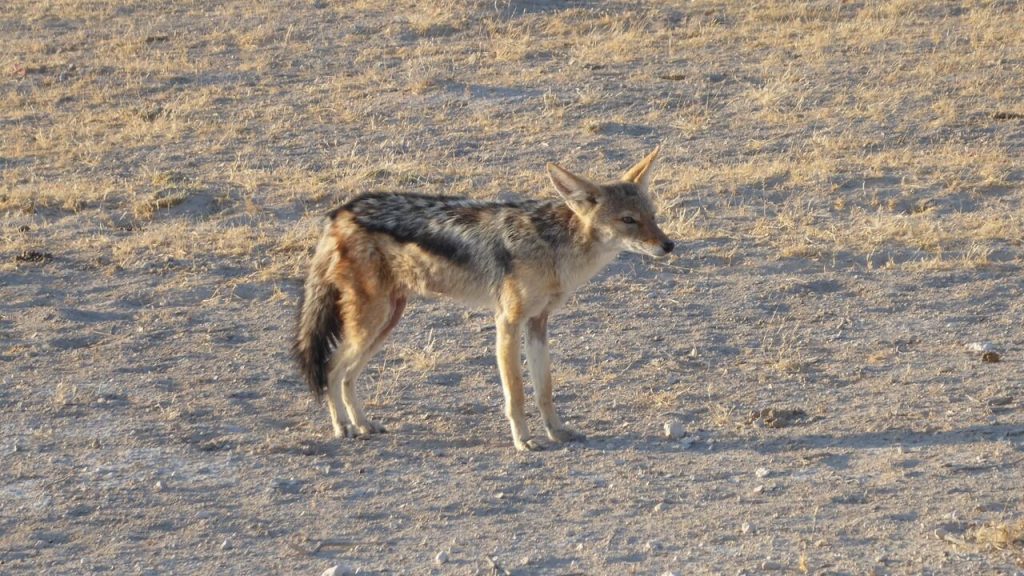
Two jackal species occur in Namibia, and one of them you will see constantly while the other you almost certainly will not. Black backed jackal are common countrywide, from the Skeleton Coast where they hunt seal pups to the farmland of the interior. Side striped jackal are confined to the far northeast and are nowhere common. Black backed jackal pair for life.
The Two Namibian Jackals
Black backed jackal, Canis mesomelas and increasingly classified as Lupulella mesomelas, is the one you will meet. It has a reddish tan coat, a distinctive dark saddle across the back tinged with silver grey, long pointed ears and a bushy black tipped tail. It occupies almost every habitat here, from coastal desert to savanna to farmland, preferring open country with little dense cover.
Side striped jackal, Canis adustus, is more subdued in colour with an indistinct pale stripe along each flank and a white tipped tail. It is nowhere common in Namibia, occurring in the Zambezi Region and occasionally in Khaudum or the Owambo areas.
Where the two overlap elsewhere in Africa they partition habitat, with black backed jackal taking the open grassland and side striped the wooded country. Work in Zimbabwe found that partition is enforced by aggression, with black backed jackal displacing side striped from grassland.
Both are ancient. DNA evidence places black backed and side striped jackal in a lineage sitting outside the main wolf and dog group, which is why some taxonomists now put them in their own genus. Black backed jackal has changed little since the Pleistocene, and fossils have been found in South Africa dating back at least two million years.
The Split Range That Nobody Can Explain
Black backed jackal has one of the odder distributions of any African mammal, and it is worth knowing because it says something about how this continent’s dry country has shifted.
The species occurs in two entirely separate populations: one across southern Africa including Namibia, and one in the Horn of Africa taking in Ethiopia, Somalia and neighbouring countries. Between them lies a gap of roughly 900 to 1,000 kilometres where the animal does not occur at all.
The usual explanation is that its preferred habitat, dry acacia bush and savanna, once formed a continuous belt linking southwestern Africa to the Horn, and that the belt has since been broken by climatic change. Aardwolf and bat eared fox show similar split distributions, which supports the idea.
Fossil remains have never been found north of Ethiopia, which suggests the species has always been restricted to sub Saharan Africa rather than having retreated from a wider range.
Coastal Jackals and the Seal Colonies
The most striking thing Namibian jackals do happens on the Skeleton Coast, and it is a genuine behavioural adaptation rather than opportunism.
A population of black backed jackal on this shoreline lives largely on Cape fur seal pups. At Cape Cross and other colonies they work the fringes, taking any pup that strays from its mother, and carrying the kill away from the colony to eat it.
Entering a seal colony is not a casual undertaking. Fur seals are fierce and unpredictable, and an adult female can kill a jackal. The jackals locate pups by the calls the young animals make, then commit to a short and dangerous run into the colony.
Beyond seals, coastal jackals are unselective scavengers of whatever the sea puts on the beach: dead fish, penguins, cormorants and other seabirds. On this coast their only large competitor is the brown hyena.
Studies of jackal diet across southern Africa show it varies enormously with place. In the Namib interior they eat mostly insects. On this coast it is seals and seabirds. In parts of South Africa it is springbok, or rodents and wild fruit.
Cape Cross is the most accessible place in Namibia to see the seal hunting behaviour, and you will usually see jackals working the edges of the colony within minutes of arriving. Watch the fringes rather than the mass of animals. It is also worth knowing that mangy and injured individuals are common there, since the colony sustains more jackals than the surrounding desert could.
Territory, Pairing and Family Life
Black backed jackal form lifelong pair bonds, and the pair is the basic social unit rather than the pack.
A mated pair marks and defends a territory containing one or more underground dens. Pair formation begins with consorting and mutual grooming months before mating happens, and bonds have been documented lasting at least six years and in practice usually until one animal dies. Offspring from the current or previous year sometimes remain with the parents as helpers.
Territory size in Namibia is unusually large. One study recorded mean annual home ranges of around 47 square kilometres, mutually exclusive between mated pairs, giving an extremely low density of about 0.01 jackal per square kilometre. That is considerably larger than reported elsewhere for the species.
The likely reason is the dry season, when understorey vegetation burns off and waterholes dry, causing a steep seasonal decline in small vertebrate prey. Where food is thin, territories must be big.
Jackals in that study strongly selected dirt roads for movement and avoided dense vegetation and streams, which researchers suggested was a way of avoiding larger predators.
What Jackals Eat
Black backed jackal are opportunists in the fullest sense and their diet list is long.
Invertebrates make up a large share in the interior: beetles, crickets, termites, millipedes. Beyond that they take small rodents, hares, birds, reptiles, carrion, fruit and young antelope. On farmland they take lambs and kids, which is why they are shot.
Scavenging is central. Where a large carcass exists, jackals gather, and as many as thirty have been recorded at the fringes of a kill alongside vultures, waiting out the larger predators.
They also kill other small carnivores. Bat eared foxes, yellow mongoose and Cape foxes have all been recorded as jackal prey, which puts them in an awkward position ecologically: predator, scavenger and competitor at once.
Jackals and Farmers
Black backed jackal are the most persecuted carnivore in southern Africa and the situation in Namibia is no different.
They take lambs and kids from small stock farms, and losses on sheep and goat operations can be substantial. Control efforts have run for over a century using shooting, trapping, poison and hunting with dogs, and the species has absorbed all of it without noticeable population decline.
That resilience is itself instructive. Removing jackals from an area tends to draw others in from surrounding land, and there is evidence that persistent control can disrupt territorial structure in ways that make the problem worse rather than better.
Non lethal approaches used against cheetah, including livestock guarding dogs and better kraaling, work against jackal too, and some Namibian farmers have shifted towards them.
Where to See Jackals in Namibia
Cape Cross and the coast. The seal hunting population, visible around colony edges through the day. The most reliable jackal watching in the country.
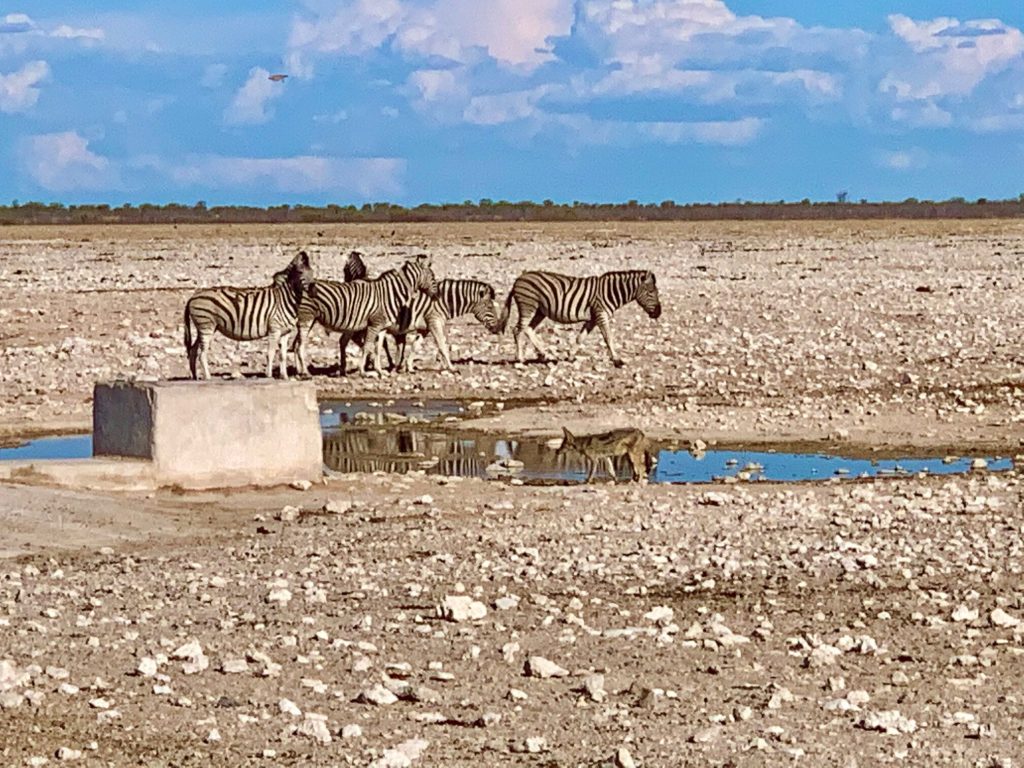
Etosha. Common throughout, at waterholes, around kills and trotting along roads. Frequently the first predator visitors see.
Farmland and guest farms. Present across the central highlands. Their calls at night are one of the defining sounds of a Namibian camping trip.
Zambezi Region. The only part of Namibia holding side striped jackal, though they are nowhere common and sightings are a matter of luck.
Best Time to See Jackals
Any month and most times of day. Black backed jackal are both diurnal and nocturnal, active in the early morning and late afternoon and resting under bushes through the hottest hours.
Their calling at night, a rising wail followed by short yelps, carries a long way and is one of the more atmospheric sounds of a night in the Namibian bush. Camping is the best way to hear it.
At Cape Cross, the seal breeding peak in November and December brings the highest jackal activity, since pups are abundant and vulnerable.
Jackals in Namibia Questions
Which jackal species live in Namibia?
Two. Black backed jackal is common countrywide, recognisable by its reddish tan coat, dark silver flecked saddle and black tipped tail. Side striped jackal is far less common, more subdued in colour with a pale flank stripe and a white tipped tail, and is confined to the Zambezi Region with occasional records from Khaudum and the Owambo areas.
Do jackals really hunt seals?
Yes, on the Skeleton Coast. A population of black backed jackal there lives largely on Cape fur seal pups, working the fringes of colonies such as Cape Cross and taking any pup that strays from its mother. They locate pups by the calls the young make. It is genuinely dangerous, since fur seals are unpredictable and an adult can kill a jackal.
Do jackals mate for life?
Black backed jackal form lifelong pair bonds and will only seek another partner if the current one dies. Pair formation involves consorting and mutual grooming months before mating. The pair defends a territory containing underground dens, and offspring from the current or previous year sometimes stay on as helpers. Bonds lasting at least six years have been documented.
Why do black backed jackals live in two separate places?
Nobody is certain. The species occurs in southern Africa and in the Horn of Africa, with a gap of roughly 900 to 1,000 kilometres between. The usual explanation is that dry acacia bush and savanna, its preferred habitat, once formed a continuous belt linking the two regions and has since been broken by climate change. Aardwolf and bat eared fox show similar split ranges.
Are jackals a problem for farmers?
Yes, and they are the most persecuted carnivore in southern Africa as a result. They take lambs and kids from small stock operations, and control using shooting, trapping and poison has run for over a century without denting the population. There is evidence that persistent removal disrupts territorial structure and draws animals in from surrounding land, sometimes making losses worse.
Are jackals dangerous to people?
Not in normal circumstances. They avoid people and are far too small to threaten an adult. The genuine concern is rabies, which occurs in Namibian jackal populations and is thought to be the original source of the kudu rabies epidemics. A jackal showing no fear of people, moving unsteadily or salivating should be left alone and reported.
Where is the best place to see jackals?
Cape Cross, where the seal hunting population works the colony edges through the day and is visible within minutes of arriving. Etosha produces them constantly at waterholes and along roads. On farmland and at campsites across the central highlands you will hear them at night whether or not you see them, and their calling is one of the defining sounds of a Namibian trip.
Booking Your Namibia Trip
The safari companies and tour operators listed on this website put trips like this together for a living and know which camps, guides and routes actually deliver. We are an independent guide to Namibia; we do not book or sell tours ourselves.
When you are ready, arrange your safari, tour or holiday with one of the recognised operators listed here. Tell them your dates and what matters most, and a real person, not a form, will handle the itinerary, park bookings and logistics for you.