Palmwag Concession
Palmwag Concession covers around 550,000 hectares of basalt semi-desert in northwestern Namibia and is the country’s largest tourism concession on communal land. It holds the largest free roaming black rhino population on earth, tracked on foot with community trackers. The concession is held by three conservancies, and a permit bought at the gate lets self drivers in.
Who Actually Owns Palmwag
This is the thing most visitors do not know and it changes how the place reads.
Palmwag is not a national park and not private land. It is communal land, and the concession is held by three neighbouring communal conservancies known collectively as the Big Three: Sesfontein, Anabeb and Torra.
Those conservancies run it in collaboration with the Ministry of Environment, Save the Rhino Trust and two tourism operators. It is Namibia’s largest tourism concession on communal land, which makes it the flagship of a model the country is known for internationally.
Practically, that means the fees you pay and the beds you book return income to the communities living around the concession, and the trackers who take you out are drawn from those communities. The rhino survive because local people have a reason to protect them.
Following Palmwag, further concessions have been granted to conservancies inside Skeleton Coast, Bwabwata and Nkasa Rupara national parks, and conservancies around Etosha have been granted traversing rights inside the park.
The Black Rhino
Palmwag holds the largest free roaming population of desert adapted black rhino in the world, somewhere around two hundred animals in unfenced country.
The word free roaming matters. Almost every other black rhino on earth lives behind a fence in a reserve or a managed park. These animals range across open communal land with no boundary, which makes this population unique and makes it fragile.
Save the Rhino Trust monitors them daily using trackers drawn from local communities, and maintains a detailed database of individual animals built from photographic and life history records. The organisation was formed when the Kunene population had fallen to a remnant, and its method was to give the men who knew the country best a secure livelihood protecting the animals rather than helping poachers find them.
Numbers have climbed steadily over three decades. This is one of very few places in the world where black rhino numbers are increasing rather than falling.
Rhino tracking on foot is the concession’s signature activity, starting before dawn with trackers finding fresh spoor and following it across rocky ground, sometimes for several hours.
Do not post rhino photographs with location data attached, and switch geotagging off before you go out. Poachers use social media, and in a population that lives on open unfenced land with no perimeter to defend, a geotagged image is a more useful piece of intelligence than it would be anywhere else. This is a standard request from the trackers themselves.
The Basalt and the Etendeka Plateau
The terrain here is what makes the photographs, and all of it is volcanic.
Around 125 million years ago, as Gondwana broke apart, enormous magma eruptions laid down basalt across this region. What remains is the Etendeka Plateau: flat topped hills, rubble strewn slopes and dark rock terraces stretching to the horizon, cut through by canyons and dry riverbeds.
The rock is dark red brown and largely bare, scattered with tufts of grass that turn gold in the dry season. Rare aloes grow among it, along with poisonous euphorbias including the Damara milk bush, which black rhino eat regardless.
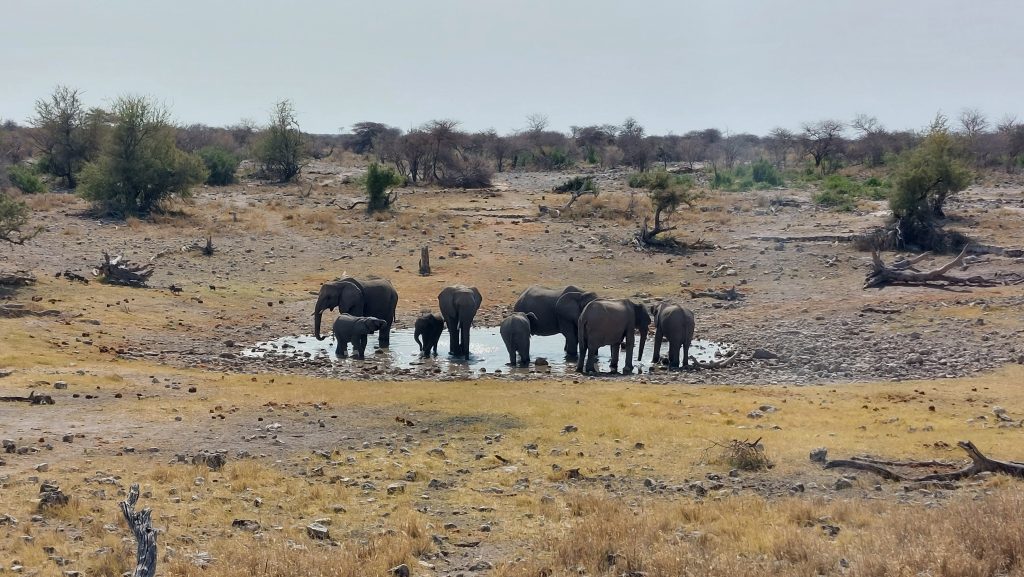
The Uniab River is the concession’s water source, a rarely flowing dry river running around 120 kilometres. Near the entrance gate it emerges as a permanent spring, which draws wildlife including the local desert adapted elephant and makes that stretch the most productive part of the concession for general game.
The name Palmwag refers to the makalani palms growing along that spring.
Wildlife Beyond the Rhino
Density is low, the country is enormous and the sightings are correspondingly rare and correspondingly good.
Desert adapted elephant work the riverbeds and are seen most reliably near the Uniab spring. Desert lion range across the concession with home territories among the largest recorded for the species, and seeing one is a matter of considerable luck.
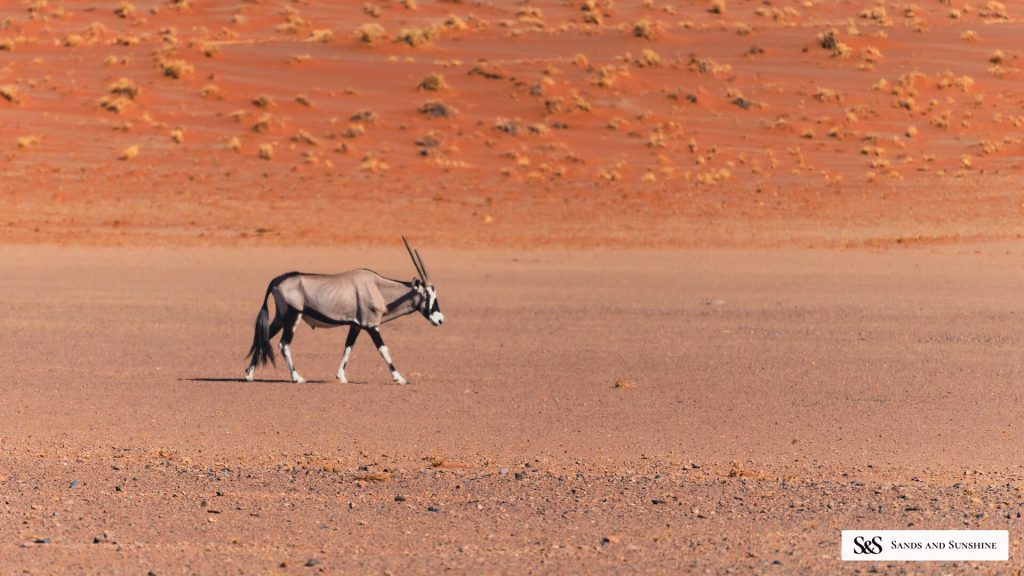
Hartmann’s mountain zebra work the rocky ground in numbers, alongside oryx, springbok, giraffe and kudu. Cheetah, leopard, brown hyena and black backed jackal are present.
Birding is better than the bare rock suggests. Raptors work the plateau, Rüppell’s korhaan calls from the gravel, and the near-endemics of the escarpment including the Herero chat and Benguela long billed lark occur here.
Anyone expecting Etosha densities will be disappointed. Anyone who understands that a single rhino tracked on foot across open country is worth twenty animals at a waterhole will not be.
Self Driving the Concession
Palmwag is unusual among Namibian concessions in that independent travellers can drive it, which is worth knowing because most concessions are lodge access only.
A permit is required and is bought at the entrance gate north of Palmwag Lodge or at the lodge reception. You receive an information sheet with a map and the rules, and sign to confirm you will follow them.
The rules matter and are enforced. Driving off the main tracks is forbidden. Camping is only permitted in designated areas. You must be entirely self sufficient and take all refuse out with you.
The C43 running in from north and south is well graded gravel. Inside the concession the tracks are rough and the riverbed routes require genuine four wheel drive. This is not a two wheel drive proposition once you are through the gate.
Rhino tracking cannot be done independently. That activity runs only through the lodges with Save the Rhino Trust trackers, for reasons that should be obvious.
Where to Stay
Three lodges operate inside the concession and there are eight campsites.
Palmwag Lodge sits by the entrance gate near the spring, with rooms and a campsite, and is the affordable base for self drivers wanting rhino tracking without premium camp rates.
Desert Rhino Camp is the property built around the tracking activity, operating in partnership with Save the Rhino Trust, and it sits at the top of the Namibian market. Hoanib Skeleton Coast Camp operates in the far northwest of the concession area.
The eight campsites have no infrastructure at all: Kai-Ais, Crowthers, Theun’s, Blackridge, three along the Mudorib and Elephant Song. What they offer is space and complete solitude, with the caveat that solitude here means no other people rather than no other animals.
Anyone camping needs to be genuinely self sufficient and comfortable with the possibility of elephant walking through.
Best Time to Visit Palmwag
May to October is the dry season and the strongest window. Animals concentrate near the remaining water, tracking is easier without vegetation, and the tracks are at their most passable.
Rhino tracking runs year round and is easier in the dry months when animals are tied to fewer water points and spoor is more readable.
The rains from January to March make riverbed routes hazardous and can cut access entirely. Flash flooding in dry riverbeds is a real risk in this country and not a theoretical one.
Winter nights are cold and predawn starts for rhino tracking are genuinely chilly, so pack for it.
Getting to Palmwag
Palmwag sits in northwestern Damaraland on the C43, roughly between Sesfontein to the north and Khorixas and Kamanjab to the south.
From Twyfelfontein and central Damaraland it is a few hours north. From Etosha’s Galton Gate the route runs west via Kamanjab. From Swakopmund it is a long day up the coast and inland.
The roads in are well graded gravel. The final stretch to the gate is straightforward, and everything beyond it is not.
Charter flights serve airstrips at the camps for guests arriving by air, which is how most premium camp guests reach the concession.
Palmwag Concession Questions
Can I visit Palmwag without staying at a lodge?
Yes, which makes it unusual among Namibian concessions. A permit bought at the entrance gate north of Palmwag Lodge, or at the lodge reception, allows self drive access at a modest daily fee. You sign to confirm you will stay on the main tracks, camp only in designated areas and be entirely self sufficient. Rhino tracking is the exception and runs only through the lodges.
Who owns the Palmwag Concession?
It is communal land, and the concession is held by three neighbouring communal conservancies known as the Big Three: Sesfontein, Anabeb and Torra. They run it with the Ministry of Environment, Save the Rhino Trust and two tourism operators. It is Namibia’s largest tourism concession on communal land and the flagship of the country’s community conservation model.
How many rhino are in Palmwag?
Around two hundred desert adapted black rhino, the largest free roaming population in the world. Free roaming is the key word: almost every other black rhino on earth lives behind a fence, while these range across open communal land with no boundary. Save the Rhino Trust monitors them daily with trackers drawn from local communities, and numbers have climbed steadily over three decades.
Do I need a 4×4 for Palmwag?
Yes, once you are through the gate. The C43 running in from north and south is well graded gravel manageable in most vehicles, but tracks inside the concession are rough and the riverbed routes require genuine four wheel drive. Driving off the main tracks is forbidden, so a capable vehicle is about handling what is there rather than going anywhere else.
What is rhino tracking like?
It starts before dawn. Save the Rhino Trust trackers find fresh spoor and you follow it on foot across rocky ground, sometimes for several hours, with guides maintaining careful distance. Sightings are consistent rather than guaranteed and the tracking itself is much of the experience. Reasonable fitness is required and camps set minimum ages.
What else is there to see?
Desert adapted elephant along the riverbeds, most reliably near the Uniab spring at the entrance. Desert lion range across the concession and are seen rarely. Hartmann’s mountain zebra work the rocky ground in numbers, alongside oryx, springbok, giraffe and kudu. Birding is strong for escarpment near-endemics including the Herero chat and Benguela long billed lark.
Why does the country look volcanic?
Because it is. Around 125 million years ago, as Gondwana broke apart, enormous magma eruptions laid down basalt across the region, forming what is now the Etendeka Plateau. The flat topped hills, dark rock terraces and rubble slopes are all basalt, scattered with rare aloes and poisonous euphorbias including the Damara milk bush that black rhino eat regardless.
Booking Your Namibia Trip
The safari companies and tour operators listed on this website put trips like this together for a living and know which camps, guides and routes actually deliver. We are an independent guide to Namibia; we do not book or sell tours ourselves.
When you are ready, arrange your safari, tour or holiday with one of the recognised operators listed here. Tell them your dates and what matters most, and a real person, not a form, will handle the itinerary, park bookings and logistics for you.