Quiver Tree Forest
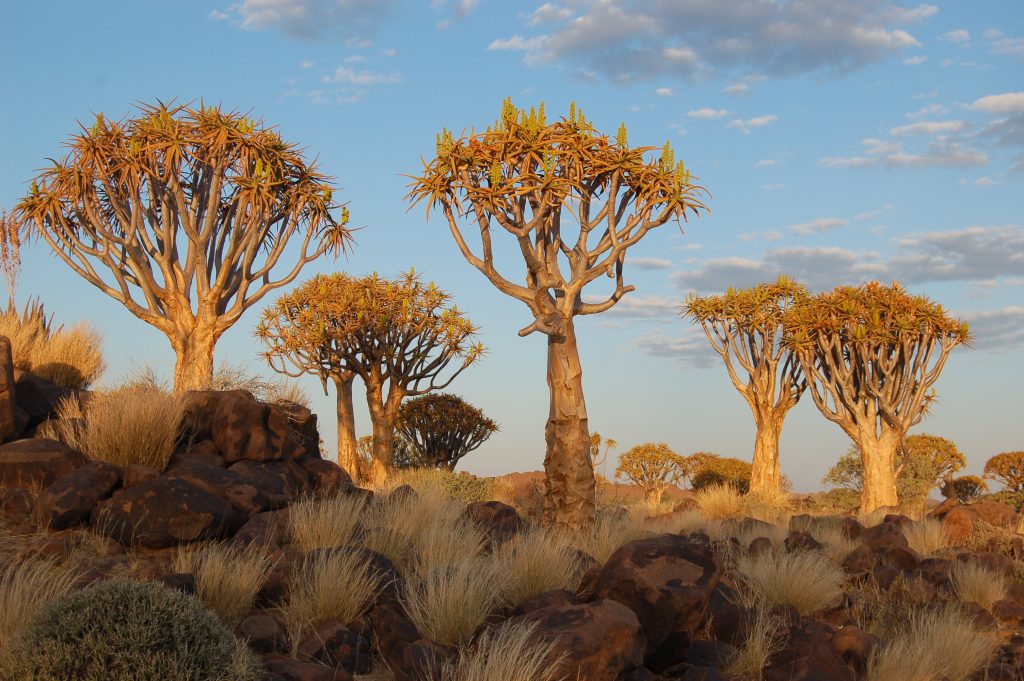
The Quiver Tree Forest is a natural stand of around 250 quiver trees growing on dolerite about 14 kilometres northeast of Keetmanshoop in southern Namibia. It is a declared national monument, nothing in it was planted, and the oldest trees are two to three centuries old. Permits are bought at the farm gate and cover Giant’s Playground alongside it.
Quiver Tree Forest Tours and What the Site Is
The forest sits on Gariganus Farm, a working property that has protected the stand for generations, and the whole thing is smaller than the word forest suggests. That is not a criticism. Roughly 250 trees stand across a dolerite outcrop, spaced widely, and you walk among them on marked paths in twenty minutes or an hour depending on how much you stop.
Quiver trees grow scattered across southern Namibia and the Northern Cape, and you will pass them on roadsides throughout the region. What makes this site worth the stop is concentration. Seeing several hundred together, of varying ages, on black rock, is a completely different impression from the ones and twos you see elsewhere.
Permits are bought at the reception of the rest camp on the farm, and the same ticket normally covers Giant’s Playground on the adjoining property. There are no facilities within the forest itself beyond the paths.
What a Quiver Tree Actually Is
It is not a tree. Aloe dichotoma, now often classified as Aloidendron dichotomum, is an aloe that grows to tree size, which puts it in a small group of succulents that behave like trees without being them.
The trunk is thick and covered in flaking golden bark with sharp edges. The branches fork repeatedly in pairs, which is what dichotoma refers to, giving the crown its distinctive upturned shape. The stored water in the trunk is what lets them survive here, and the fibrous interior is unusually light.
The name comes from that interior. San hunters hollowed out the branches to make quivers for their arrows, and the Afrikaans name kokerboom means the same thing. Local tradition holds that the trees bring luck and that digging one up reveals diamonds, which is one reason they have not been dug up.
They flower in winter, roughly June and July, sending up bright yellow blooms that draw sunbirds, weavers and baboons after the nectar. That is a strong reason to visit in midwinter beyond the light.
Photographing the Quiver Tree Forest
Timing decides everything here and it is not complicated. The first and last hour of daylight turns the bark gold and gives you long shadows across the dark rock. The middle of the day flattens the whole site into grey and washes the bark out completely.
Sunset is the classic, with the trees silhouetted against the sky or lit warm from the side. Sunrise is quieter and gives cleaner light from the other direction. Both are worth doing if you are staying on the farm, since the forest is a short walk from the rest camp and you can be out there without driving.
Night photography is the other draw. The skies here are very dark, the branching shapes make strong foregrounds, and the Milky Way over a quiver tree is one of the standard Namibian astrophotography shots. Check moon phase against your dates.
Stay on the farm rather than in Keetmanshoop if photographs are the reason you are coming. Fifteen minutes of driving in each direction sounds trivial and it is the difference between rolling out of bed for sunrise and deciding, in the dark and the cold, that you would rather not. The rest camp puts you a few minutes’ walk from the trees.
Giant’s Playground on the Same Permit
Giant’s Playground sits alongside the forest and the same ticket usually covers both, which makes them a natural pairing rather than two separate stops.
It is a field of enormous dolerite boulders stacked into arrangements that look assembled and are entirely the result of molten rock intruding, cooling and then weathering over an extremely long period. Blocks sit balanced on blocks, and the effect is of something built and abandoned.
Marked paths run through it and the maze description is accurate, so keep to them and tell the rest camp you are going in. Allow one to two hours, wear proper shoes and carry water. Quiver trees grow among the boulders, which gives you both subjects in a single frame.
Quiver Tree Forest. Around 250 trees on dolerite, 14 km from Keetmanshoop on the C17. National monument. Twenty minutes to an hour. Sunrise and sunset are the windows.
Giant’s Playground. Stacked dolerite boulders on the adjoining property, usually on the same permit. One to two hours. Late afternoon light, sturdy shoes, stay on the paths.
Mesosaurus Fossil Site. Further along the C17, about half an hour. Fossils around 280 million years old, ringing dolerite rocks, and thousands more quiver trees on the property.
Quiver trees elsewhere. Scattered across the south and visible from roadsides throughout the region, including near Fish River Canyon and along the B4 towards Lüderitz.
Wildlife and Plants Around the Forest
This is not a wildlife stop, though there is more life among the rocks than the bare appearance suggests. Rock dassies and ground squirrels are common and easy to see. Meerkats occur in the area. Various lizards work the warm dolerite.
Birdlife picks up sharply when the trees flower in winter, with sunbirds and weavers feeding on the nectar and using the crowns for nests. Sociable weaver colonies build enormous communal nests on quiver trees and telegraph poles across the south, and the structures are worth looking at closely.
Other succulents share the ground, including euphorbias, and the dolerite itself is the reason everything grows where it does, holding what little moisture reaches it.

Conservation and the Threat to Quiver Trees
Quiver trees are struggling and it is worth knowing while you are standing among them. Populations across their range are dying back at the northern, hotter end of their distribution while apparently doing better further south, which researchers have linked to a warming and drying climate.
They grow extremely slowly, take decades to reach any size, and cannot easily shift range at the pace conditions are changing. A stand like this one, protected on private land and left alone, is more valuable than it looks.
Practically, that means the usual rules matter here. Stay on the paths, do not climb the trees, do not break off bark, which is sharp anyway, and take nothing away.
Best Time to Visit the Quiver Tree Forest
April to September gives comfortable temperatures and the strongest light, and midwinter has the added draw of the yellow flowers in June and July, which changes the trees considerably and brings in birds.
Summer from October to March is hard going in the far south, with temperatures regularly above 40 degrees and the dolerite radiating heat well into the evening. Early morning is the only comfortable window, and Giant’s Playground becomes genuinely unpleasant at midday.
Whenever you come, the site is about the ends of the day rather than the season. Arriving at noon and leaving an hour later is the commonest mistake.
Getting to the Quiver Tree Forest
The forest lies about 13 to 14 kilometres northeast of Keetmanshoop on the C17, signposted to Quivertree Forest Rest Camp where permits are bought. The road is gravel and manageable in an ordinary car in dry conditions.
Keetmanshoop is roughly 500 kilometres and five hours south of Windhoek on the B1, 334 kilometres east of Lüderitz on the B4, and about two hours from Fish River Canyon. The forest fits naturally into any southern loop.
The Mesosaurus Fossil Site is a further half hour along the same C17, so the three sites work as a single afternoon and evening if you plan the light properly.
Quiver Tree Forest Questions
What does it cost to visit the Quiver Tree Forest?
A permit bought at the Quivertree Forest Rest Camp reception has been quoted at roughly 110 to 130 Namibian dollars per person recently, with older sources listing around 100, and it normally covers Giant’s Playground as well. Guests staying at the rest camp may find entry included in the rate. The Mesosaurus Fossil Site charges separately. Confirm at reception, since the figure has moved more than once.
How long do I need at the Quiver Tree Forest?
Twenty minutes to an hour for the forest itself, since it is a compact site and you walk among the trees on marked paths. Add one to two hours for Giant’s Playground on the same ticket. The practical plan is to arrive mid to late afternoon, do the boulders first, then be in the forest for sunset, which uses the light on each at its best.
Why are they called quiver trees?
San hunters hollowed out the light fibrous branches to make quivers for their arrows, and the Afrikaans name kokerboom carries the same meaning. They are not really trees at all but aloes, Aloe dichotoma, that grow to tree size. Dichotoma refers to the way the branches fork repeatedly in pairs, which gives the crown its shape.
When do quiver trees flower?
In winter, roughly June and July, producing bright yellow blooms on the crowns. It is a good reason to visit in midwinter beyond the light, since the flowers bring sunbirds, weavers and sometimes baboons after the nectar and the trees look quite different from their bare state.
Is the Quiver Tree Forest worth visiting?
Yes, provided you time it for sunrise or sunset. Quiver trees grow all over the south and you will see them from the roadside, so the value here is seeing several hundred of varying ages together on dark rock. Visitors who arrive in the middle of the day, when the light is flat and the bark washes out, often wonder what the fuss is about. It is a timing problem rather than a verdict.
How old are the trees?
The oldest in the stand are commonly given as two to three centuries. They grow extremely slowly, which is part of why the species is vulnerable, since a mature tree cannot be replaced within a human lifetime. Populations at the hotter northern end of their range are dying back, which researchers link to a warming and drying climate.
Can I camp at the Quiver Tree Forest?
Yes. Quivertree Forest Rest Camp on Gariganus Farm has camping alongside bungalows and guesthouses, with a pool, restaurant and braai facilities, and the forest is a short walk away. Mesosaurus Fossil Camp further along the C17 is a quieter alternative with chalets and camping, and its own property holds thousands of quiver trees.
Booking Your Namibia Trip
The safari companies and tour operators listed on this website put trips like this together for a living and know which camps, guides and routes actually deliver. We are an independent guide to Namibia; we do not book or sell tours ourselves.
When you are ready, arrange your safari, tour or holiday with one of the recognised operators listed here. Tell them your dates and what matters most, and a real person, not a form, will handle the itinerary, park bookings and logistics for you.