Lüderitz
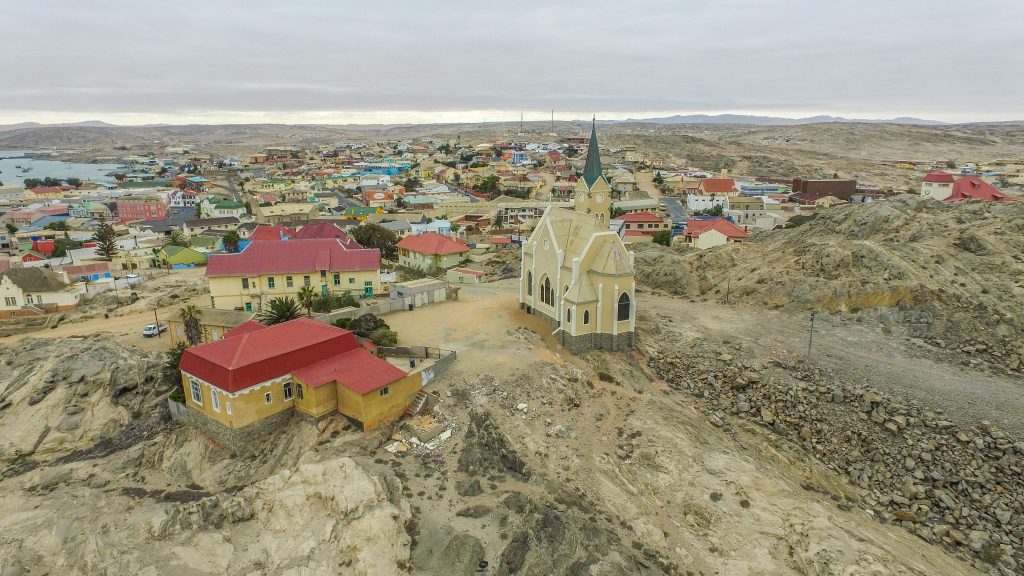
Lüderitz is a small German colonial port town on Namibia’s southern Atlantic coast, wedged between the Namib Desert and the sea at the edge of the restricted diamond zone. Visitors come for African penguin cruises to Halifax Island, the peninsula drive to Diaz Point, and the pastel Art Nouveau architecture. It lies around 700 kilometres southwest of Windhoek at the end of the B4.
Lüderitz Town Tours and Colonial Architecture
The town is odd in a way that lands well. Wilhelmine and Art Nouveau buildings in pale greens, pinks and yellows sit on bare granite outcrops with the Atlantic on one side and desert on the other, and nothing about the setting suggests they should be there. The diamond money that built them arrived suddenly and left just as fast, which is why the architecture stopped where it did.
Felsenkirche, the rock church, sits on a granite hill above town and is the landmark you see from everywhere. Its stained glass was a gift from Kaiser Wilhelm II, and it opens for limited hours in the late afternoon, so check before climbing up. The view over the bay from beside it is the best in town and works well at sunset.
Goerke Haus, built for a diamond company manager, is the grand house of the boom period and can be visited, though it holds little original furniture. The Lüderitz Museum covers diamond mining, indigenous cultures and marine life on limited afternoon hours. The centre is small enough to walk in a morning.
The harder history sits underneath all of this. Shark Island, now a campsite and a peninsula rather than an island, was the site of a concentration camp during the German colonial period in which large numbers of Herero and Nama people died. It is not signposted the way it should be, and visitors should know what they are camping on.
Halifax Island Penguin Cruises from Lüderitz Harbour
The catamaran trip is the activity most visitors book and it is the best thing in town. Boats leave the harbour early, usually around eight in the morning, and run out around the peninsula to Halifax Island, home to one of Namibia’s African penguin colonies.
African penguins are endangered and the colonies on this coast have shrunk considerably, which makes seeing them here meaningful rather than routine. The same trip usually produces Heaviside’s dolphins, endemic to the Benguela coast, along with Cape fur seals, cormorants and flamingos in the bay.
Trips run roughly two hours and need booking ahead. Take more warm clothing than the weather suggests, because this coast is cold and windy on the water even when the town looks sunny.
Lüderitz Peninsula Drives and Diaz Point
The peninsula circuit south and west of town is a half day loop past a series of bays and inlets, and it is where the coastline gets dramatic. Griffith Bay, Sturmvogelbucht, Essy Bay, Kleiner Fjord and Grosse Bucht each have their own character, and several have picnic spots.
Diaz Point is the anchor. A replica of the stone cross that Bartolomeu Dias planted here in 1488 stands on a rocky headland reached by a short footbridge, with seabirds, seals and often heavy surf below. It is exposed and it is almost always blowing.
Some of the peninsula tracks are gravel and sandy in stretches, which makes this a better outing in a higher clearance vehicle. Oryx and springbok turn up on the desert edge on the way out of town, which is not what you expect beside the sea.
Lüderitz is one of the windiest inhabited places on this coast, and the wind is not an occasional inconvenience. Plan boat trips and the peninsula drive for the morning, since afternoons routinely blow hard enough to cancel sailings and make walking unpleasant. Bring a windproof layer whatever the season.
Agate Beach and the Coast North of Lüderitz
Agate Beach lies about five kilometres north of town, a long stretch of dark sand that glitters with mica and occasionally turns up the agates it is named for. There are braai stands and seating, and it is where the town goes at weekends.
Swimming is theoretically possible and practically unpleasant, because the Benguela current keeps water temperatures low all year. The beach is for walking, birdwatching and looking for stones. Flamingos work the lagoon on the drive out.
Sperrgebiet Tours to Bogenfels and the Ghost Towns
South of Lüderitz lies the Sperrgebiet, the restricted diamond area closed to the public for over a century and now partly incorporated into Tsau Khaeb National Park. Access requires permits, a licensed guide and advance booking, and it cannot be done independently.
What the guided trips reach is worth the paperwork. Bogenfels is a natural rock arch rising some 55 metres straight out of the sea, and it is among the more startling things on this coastline. The route there passes Pomona and Elizabeth Bay, abandoned diamond settlements that make Kolmanskop look busy, along with mining machinery left where it stopped.
These are full day trips run by a small number of operators out of Lüderitz. Book before you arrive rather than hoping to arrange it on the day, since departures are limited.
Seafood, Oysters and Crayfish in Lüderitz
The cold water that makes swimming miserable produces first rate seafood. Lüderitz oysters have a strong reputation across southern Africa, and west coast rock lobster, locally called crayfish, is the other speciality along with kabeljou and Namibian abalone.
The town has a handful of restaurants well out of proportion to its size, several on the waterfront with views across the bay. Prices are low by international standards and the quality is high, which makes eating here one of the pleasures of coming this far south.
Kitesurfing and Wind Sports at Lüderitz
The wind that annoys everyone else is the reason a small international speed sailing community comes here. A purpose built channel outside town has hosted world record attempts in kitesurfing and windsurfing speed, drawing riders during the windy season.
For casual visitors this is spectator interest rather than participation, since the conditions are extreme rather than beginner friendly. It does explain the occasional presence of very serious looking equipment in a town of this size.
Wild Horses at Garub on the Road to Lüderitz
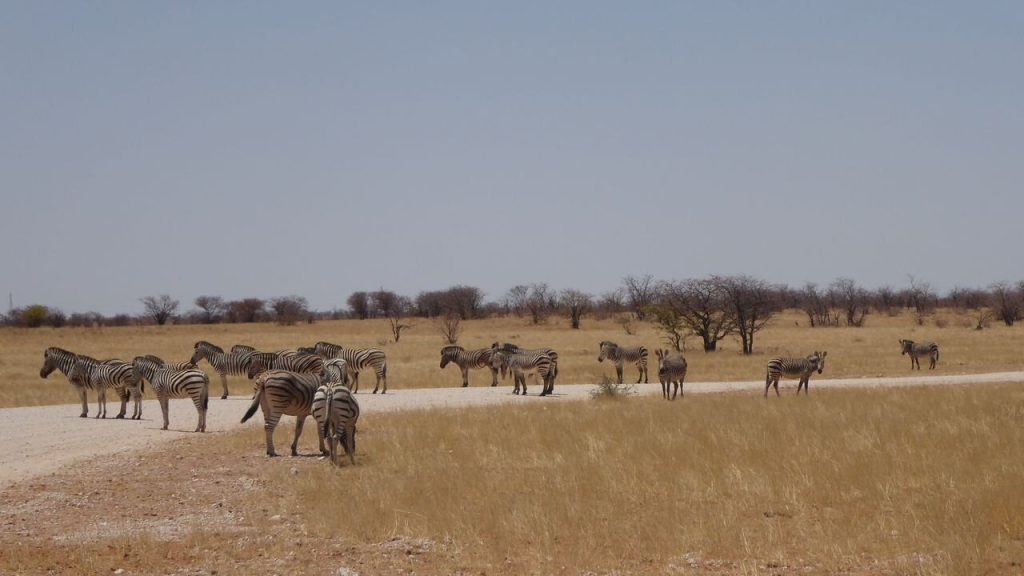
The B4 into Lüderitz crosses the Sperrgebiet from Aus, and roughly 20 kilometres west of Aus a gravel turning leads to the Garub waterhole and a viewing hide. This is where Namibia’s feral desert horses come to drink.
Their origins were argued over for decades and research points to the Kubub stud farm near Lüderitz, whose horses were abandoned during the First World War and joined by cavalry animals from a bombed South African camp at Garub. They found refuge in the closed diamond zone and have lived without human management since.
Population figures vary a great deal depending on when a source was written, from around 90 to 150 in some accounts up to 250 or 300 in others, and the herd has come under real pressure from drought and from spotted hyena preying on foals. Horses are often visible from the roadside rather than only at the hide, and the borehole at Garub is what keeps them alive.
Where to Stay in Lüderitz
Accommodation runs from guesthouses in restored colonial houses through to a hotel built directly on the ocean rocks with unobstructed Atlantic views from every room. There is a campsite on Shark Island with sea views and electricity, which suits campers who genuinely do not mind wind.
Most visitors stay one or two nights, which is enough for the town, a penguin cruise and the peninsula, with Kolmanskop taking a morning. Book ahead in the December and January local holiday period.
Best Time to Visit Lüderitz
The town works year round because the Benguela current keeps temperatures moderate whatever the interior is doing. April to October is cooler and more comfortable for sightseeing, and it lines up with the main Namibian travel season.
Wind is the real seasonal variable rather than temperature. It blows hard through much of the year and peaks in the warmer months, which is when the speed sailing community arrives. Fog is common in the mornings. Whenever you come, mornings are calmer than afternoons.
Getting to Lüderitz
Lüderitz sits at the western end of the B4, roughly 334 kilometres from Keetmanshoop and around 700 from Windhoek. The road is tarred the whole way, which makes this an easier drive than most Namibian routes, long as it is.
From Fish River Canyon it is about 465 kilometres. The stretch between Aus and Lüderitz crosses open desert with sand regularly drifting across the tar, and it is worth taking slowly. Fuel up in Aus or Keetmanshoop.
Lüderitz has an airport handling limited charter traffic, sitting almost opposite Kolmanskop. Most visitors arrive by road as part of a southern loop taking in Keetmanshoop, the Quiver Tree Forest, Fish River Canyon and Aus.
Lüderitz Travel Questions
What do activities in Lüderitz cost?
The Halifax Island penguin catamaran cruise has run around 500 Namibian dollars per person, with under twelves often free. The Lüderitz Museum charges roughly 30 Namibian dollars. Kolmanskop permits are separate and have been quoted anywhere from about 85 to 130 Namibian dollars for standard entry, with a photography day pass considerably higher. Sperrgebiet trips to Bogenfels are full day guided excursions and cost substantially more, priced on request. Published figures for the permits in particular vary widely between sources, so confirm locally.
How long should I spend in Lüderitz?
Two nights covers it comfortably: a morning penguin cruise, an afternoon on the peninsula, and a separate early morning at Kolmanskop. One night works if you are prepared to move quickly and skip either the boat or the peninsula. Given the driving distance to get here, most people find two nights the better use of the effort.
Is Lüderitz worth the detour?
It is a long way from everything and it divides opinion for that reason. Travellers who want Kolmanskop, penguins and a strange colonial town on a wild coast tend to rate it among the highlights of a Namibian trip. Those looking for wildlife and dunes will find the detour hard to justify against the driving. It fits naturally into a fourteen day southern loop and awkwardly into anything shorter.
Can I see penguins at Lüderitz?
Yes, on the boat trip to Halifax Island, which holds one of Namibia’s African penguin colonies. You cannot land on the island, so viewing is from the water. The species is endangered and colony numbers on this coast have fallen considerably, so the sighting matters more than a typical wildlife stop. Trips leave early and need booking ahead.
Do I need a 4×4 in Lüderitz?
Not for the town or for the B4, which is tarred all the way. The peninsula circuit includes gravel and some sandy sections where higher clearance is helpful, and the Kolmanskop access road is short and straightforward. Sperrgebiet trips south to Bogenfels are run in operator vehicles, so you do not need your own for those.
What is the difference between Lüderitz and Kolmanskop?
Kolmanskop is the abandoned diamond mining town about twelve to fifteen kilometres inland, now half buried in sand and visited on a permit for a few hours. Lüderitz is the living port town where you sleep, eat and catch the boats. They are almost always visited together, with Kolmanskop as a morning excursion from a Lüderitz base.
Where can I see the wild horses near Lüderitz?
At Garub, roughly 20 kilometres west of Aus on the B4, where a short gravel turning leads to a viewing hide overlooking a waterhole. Horses are also frequently visible from the roadside between Aus and Lüderitz. Numbers fluctuate sharply with drought and predation, so sightings are likely rather than certain, and early morning at the hide is the strongest bet.
Booking Your Namibia Trip
The safari companies and tour operators listed on this website put trips like this together for a living and know which camps, guides and routes actually deliver. We are an independent guide to Namibia; we do not book or sell tours ourselves.
When you are ready, arrange your safari, tour or holiday with one of the recognised operators listed here. Tell them your dates and what matters most, and a real person, not a form, will handle the itinerary, park bookings and logistics for you.