Petrified Forest, Khorixas
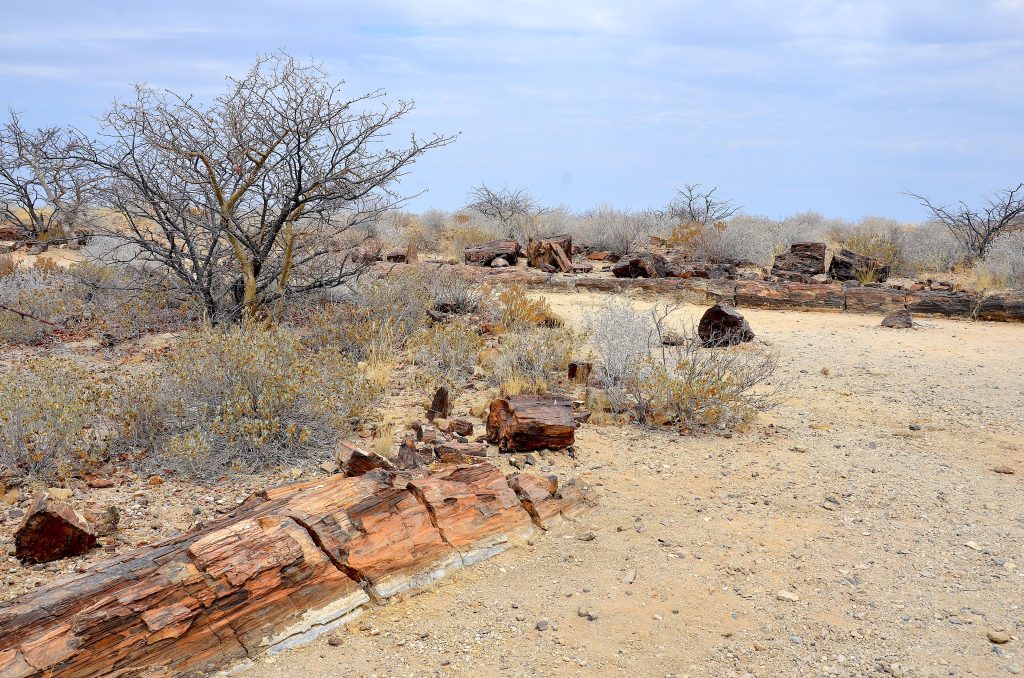
The Petrified Forest near Khorixas holds around fifty fossilised tree trunks lying in open veld, some up to 34 metres long, dating to roughly 260 to 280 million years ago. The trees did not grow here. They were carried in by an enormous flood and buried, then turned to stone over an unimaginable span. Guided visits are compulsory and the site is a national monument.
What the Petrified Forest Actually Is
The name misleads and it is worth clearing up first. This is not a forest that turned to stone where it stood.
What lies here is an accumulation of enormous fossilised trunks scattered across open ground, some half buried in sandstone, with no root systems or branch remnants attached. That absence is the clue: these trees were transported, not grown in place.
Around fifty individual trunks are visible, with the largest reaching around 34 metres in length and six metres in circumference, and more are presumed to remain buried. Several have broken into sections of a couple of metres each.
The preservation is what makes them worth the stop. Growth rings, bark texture and the nodes where branches once joined are all visible in solid stone, and standing over a trunk you can read the wood grain as clearly as on a felled tree.
How Trees Get to Damaraland and Turn to Stone
The sequence is genuinely odd and the guides explain it well.
Around 280 million years ago, in the Permian, this land was part of the supercontinent Gondwana. At the end of one of the great ice ages, the Dwyka glaciation, an enormous flood swept down a river system and carried tree trunks from far to the north, possibly from what is now Angola or central Africa, depositing them here.
The same flood carried vast quantities of sand and mud, which buried the trunks completely and cut them off from oxygen. Without air the organic material could not rot, so instead of decaying it sat and waited.
Over millions of years under enormous pressure, silicic acid dissolved the wood cell by cell and replaced each one with quartz. That process, silicification, is why the structure survives in such detail: every cell was individually fossilised rather than the whole trunk being cast as a mould.
The surrounding sand became sandstone, which is now eroding away, which is why the trunks are reappearing at the surface.
The trees themselves were Cordaites, a cone bearing group and an ancestor of modern conifers such as firs and spruces. They belong to the Gymnospermae, the same broad group that includes the welwitschias growing beside them today.
Several privately run roadside sites in this area advertise petrified trees and are not the official National Monument. They vary considerably in quality and in conservation standards. The official site sits around 40 to 50 kilometres west of Khorixas on the C39, signposted Versteende Woud, and it has the most substantial trunks and the proper guiding. Make sure you are at the right one.
The Welwitschias on Site
The petrified trunks share the ground with living fossils, which makes this one of the better places in Namibia to see both at once.
Welwitschia mirabilis grows abundantly across the site. The plant produces exactly two leaves in its lifetime and never replaces them, surviving on fog and reaching ages measured in centuries and sometimes past a thousand years.
The site has a particular specimen worth asking your guide to point out: an entangled male and female pair, growing together for around five centuries, known locally as the Namibian Romeo and Juliet. Welwitschias are dioecious, meaning individual plants are male or female, and normally they grow well apart.
Guides at the site cover the welwitschia in as much depth as the trunks, and for many visitors the plants turn out to be the more memorable half of the visit.
The Site’s History and Protection
Two farmers came across the trunks in the nineteen forties, exposed by soil erosion, and word spread.
Souvenir hunters began removing pieces, which is what prompted protection. The site was declared a national monument on the first of March 1950, and it is now strictly forbidden to remove even a small fragment of petrified wood.
That prohibition is enforced and worth taking seriously. Petrified wood is sold in shops across Namibia and buyers rarely ask where it came from, which sustains a market that damages sites like this one.
Public access is by guided tour only, which is both a conservation measure and a source of local employment. The guides are government appointed and mostly very good, and the fee includes them.
Visiting the Petrified Forest
The walk takes around forty minutes and is accessible to anyone in reasonable condition, on a marked route between the main trunks and the welwitschia specimens.
There is covered parking, which is a small but genuinely welcome detail on a hot Damaraland morning, along with toilets and refreshment facilities and a small shop.
Go early or late in the day, particularly in summer when temperatures here climb considerably. The site is open ground with limited shade and the middle of the day is hard work.
Entry fees have been quoted around 250 Namibian dollars per person including the guide in recent accounts, though considerably lower figures circulate in older sources. As with most Namibian fees, confirm on arrival rather than budgeting from a published number.
Fitting It Into a Damaraland Route
The Petrified Forest sits neatly on the central Damaraland circuit and works well as a morning stop rather than a destination.
Twyfelfontein, with its rock engravings, is a short drive away, along with the Organ Pipes and Burnt Mountain. Vingerklip lies east towards Outjo. Together these make a comfortable two or three day circuit from a base near Khorixas or Twyfelfontein.
It also falls naturally on the route between the Skeleton Coast and Etosha, or between Swakopmund and the north, which is how many self drive travellers reach it.
Damara Mopane Lodge near Khorixas and the properties around Twyfelfontein are the usual bases.
Why Gondwana Matters Here
The Petrified Forest is one of the few places in Namibia where you can stand on the physical evidence of continental drift, which is worth a moment before you get back in the car.
When these trees were carried here, Africa was joined to South America, India, Australia and Antarctica in the supercontinent Gondwana. There was no Atlantic Ocean. A river system could carry timber across country that is now split between separate continents thousands of kilometres apart.
Gondwana began breaking up around 160 million years ago, long after these trunks were buried, and the pieces drifted into the arrangement we now recognise. The trees stayed where the flood left them while the continent moved out from under them.
Namibia holds a second piece of that same story further south. Mesosaurus fossils near Keetmanshoop occur in only two places on earth, here and in South America, and that distribution was part of the evidence that established continental drift in the first place.
Between the two sites, this country offers an unusually direct look at a planet arranged differently.
Best Time to Visit
May to September gives comfortable temperatures for walking on open ground with little shade. The trunks look the same year round, so there is no seasonal reason to come at any particular time.
Time of day matters far more than season. Early morning and late afternoon give both cooler conditions and lower light that picks up the texture of the stone, which flattens out completely at midday.
Summer from October to March brings serious heat in Damaraland, and the forty minute walk becomes unpleasant after about nine in the morning.
Getting to the Petrified Forest
The site lies roughly 40 to 50 kilometres west of Khorixas on the C39, signposted, with a short access road. Sources differ slightly on the distance and the signage is clear enough that it does not matter.
The road is gravel and usually in reasonable condition, accessible in a standard vehicle, though a higher clearance vehicle is more comfortable on Namibian gravel as a rule.
Khorixas is the nearest town with fuel and supplies. From Twyfelfontein it is a short run, and from Outjo or the Etosha area allow a few hours.
Petrified Forest Questions
How old are the petrified trees?
Around 260 to 280 million years, dating to the Permian period. They belong to an ancient cone bearing group called Cordaites, part of the Gymnospermae, which are ancestors of modern conifers such as firs and spruces. The same broad plant group includes the welwitschias growing on the site today.
Did the trees grow where they now lie?
No, and the absence of roots and branches is the evidence. They were carried here by an enormous flood at the end of an ice age, probably from what is now Angola or central Africa, and buried in sand and mud that cut them off from oxygen. Without air they could not rot, and over millions of years silicic acid replaced each wood cell with quartz.
What does it cost to visit?
Recent accounts put entry at around 250 Namibian dollars per person, which includes a government appointed guide, though considerably lower figures appear in older sources. As with most Namibian fees, confirm on arrival rather than budgeting from anything published. There is covered parking, toilets, refreshments and a small shop on site.
Do I need a guide?
Yes, public access is by guided tour only. It is both a conservation measure, after souvenir hunters began removing pieces before the site was protected, and a source of local employment. The guides are government appointed, the fee includes them, and they are mostly very good on both the geology and the welwitschias.
How long does a visit take?
The walk takes around forty minutes on a marked route between the main trunks and the welwitschia specimens, and is manageable for anyone in reasonable condition. Allow an hour in total with the briefing and the shop. It works as a morning stop on a Damaraland circuit rather than as a destination in its own right.
Can I take a piece of petrified wood home?
No. Removing even a small fragment is strictly forbidden and the site was declared a national monument precisely because souvenir hunters were taking their toll. Petrified wood is sold in shops across Namibia and buyers rarely ask about provenance, which sustains a market that damages sites like this one. Buy something else.
Is the Petrified Forest worth visiting?
For travellers with any interest in geology or natural history, yes. It is not a high energy destination and it is a quietly striking one: trunks 34 metres long with the wood grain preserved in solid stone, alongside living welwitschias that were old when Europe was medieval. Visitors who arrive expecting a forest of standing stone trees are the ones who leave disappointed.
Booking Your Namibia Trip
The safari companies and tour operators listed on this website put trips like this together for a living and know which camps, guides and routes actually deliver. We are an independent guide to Namibia; we do not book or sell tours ourselves.
When you are ready, arrange your safari, tour or holiday with one of the recognised operators listed here. Tell them your dates and what matters most, and a real person, not a form, will handle the itinerary, park bookings and logistics for you.