Eland in Namibia
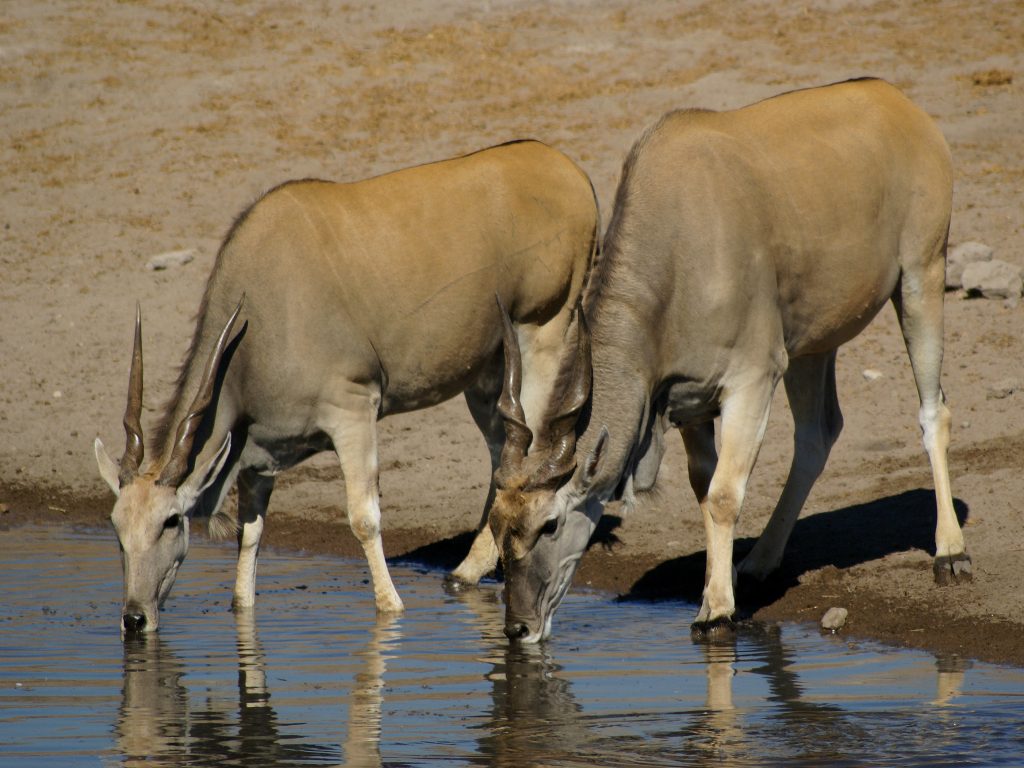
The eland is the largest antelope in Africa and one of over twenty antelope species in Namibia, which range from this animal down to the Damara dik dik. Bulls can exceed 900 kilograms and still clear a two metre fence from standing. They make an audible clicking sound as they walk, and they carried deep significance for the San people who painted them.
The Largest Antelope in Africa
Tragelaphus oryx is built on a scale that surprises people who have only seen photographs.
Bulls stand around 1.6 metres at the shoulder and can weigh over 900 kilograms, which is heavier than most cattle and puts them well beyond any other antelope. Cows are considerably smaller at around 450 kilograms.
Both sexes carry straight, tightly spiralled horns, with cow horns typically longer and thinner and bull horns shorter, heavier and more massively based. Mature bulls develop a heavy dewlap hanging from the throat, a tuft of dark hair on the forehead, and a blue grey tinge to the neck and shoulders where the coat thins with age.
For all the bulk they are unexpectedly athletic. Eland clear fences of two metres and more from a standing start, which farmers find exasperating and which explains how they move across a country full of livestock fencing.
They are also fast over distance, capable of a sustained trot that covers ground for long periods, which suits an animal that ranges widely.
The Clicking Knees
The detail everyone remembers about eland is the noise, and it is worth listening for rather than looking for.
A walking eland produces a distinct clicking sound, audible from a considerable distance, usually attributed to tendons or joints slipping over bone in the forelegs. A herd moving through bush announces itself before it appears.
The current view is that the click carries information. Larger, heavier bulls produce a deeper and louder click, so the sound may function as an honest signal of size and dominance, allowing animals to assess each other without a physical contest.
Whether or not that interpretation holds, the practical value to a visitor is real: in thick bush you will often hear eland before you see them, and knowing what the sound is turns a puzzling noise into an identification.
Stop the engine and listen in mopane and thick bush country. Eland clicking carries further than the animals are visible, and it is one of the few African species you can reliably identify by sound alone without any birding or tracking knowledge. Guides use it constantly and rarely mention it unless asked.
Water Independence and Arid Country
Eland manage in dry country better than their size suggests, which is why Namibia suits them.
They are mixed feeders, browsing leaves, pods and fruit and grazing grass when it is available, which gives them food across seasons rather than only when the grass is green. They use their horns to break branches down to reach foliage out of range.
Much of their water comes from what they eat, and they can go long periods without drinking. Like the oryx they tolerate body temperature rising rather than spending water on cooling, and they feed at night and early morning when moisture content in plants is higher.
They range widely, covering considerable distances between feeding areas, which is part of how they cope where resources are thin and scattered.
Research at Waterberg found the eland population there showed a weak positive relationship with annual rainfall, which fits an animal that does better in good years without collapsing in poor ones.
Herds and Behaviour
Eland are social and their herd structure is loose rather than fixed.
Groups of females and young form the core, sometimes running to substantial numbers where conditions allow, and composition changes constantly as animals join and leave. Bulls may be solitary, in bachelor groups, or attached to a female herd.
They are strikingly shy for their size. Eland are among the more wary large antelope in Namibia and will move off at distance rather than standing to look, which combined with their range means they are seen less often than their numbers suggest.
Calves are born after a gestation of around nine months, and they form creches within the herd, with young animals grouping together while the adults feed.
Predation on adults is limited by size, though lion take them where both occur, and calves are vulnerable to a wider range of predators.
Eland in San Rock Art and Culture
No animal appears more often in southern African rock art than the eland, and the reason is not that it was the most hunted.
For San communities the eland carried spiritual weight beyond its value as meat and fat. It appears repeatedly in paintings and engravings across the region, including at Namibian sites, often in contexts that appear ritual rather than descriptive, and frequently associated with figures interpreted as shamans in trance.
The animal’s fat was particularly valued, and eland feature in San initiation and marriage practices recorded across southern Africa.
At Twyfelfontein and Brandberg, the rock art includes eland among the animals depicted, and guides at both sites will point them out. The White Lady panel at Brandberg sits within a wider body of work in which large antelope recur.
Knowing that changes how the rock art reads. These are not simply pictures of animals people ate.

Eland Among Namibia’s Antelope
Namibia holds over twenty antelope species and eland sits at one end of a considerable range.
At the other end is the Damara dik dik, the country’s smallest antelope, standing around 35 centimetres and weighing five kilograms, working thicker bush in pairs. Between them sit kudu, oryx, springbok, black faced impala, blue wildebeest, red hartebeest, waterbuck, steenbok, duiker and klipspringer, along with the sable, roan and tsessebe of the north and the wetland species of the Zambezi.
Eland occur across much of that range and overlap with almost all of them, since their mixed feeding and water independence let them use country that suits both grazers and browsers.
They are widely farmed as game too, and eland meat appears on Namibian menus alongside oryx, kudu and springbok, though less commonly than the other three.
Eland as Farmed Game
Eland occupy an unusual position in Namibia because they sit between wildlife and livestock in a way few African species do.
They have been domesticated experimentally in several countries, and they take to handling better than most wild antelope. They produce meat and milk, tolerate arid conditions that trouble cattle, and require less water, which has made them a recurring subject of interest for dry country farming.
In Namibia they are widely held on game farms across the central highlands, where wildlife based land use has expanded substantially over recent decades. That has increased eland numbers and distribution, in the same way it has for springbok and oryx.
The consequence for a visitor is that many of the eland you see will be on private land rather than in a national park, and that the herds on game farms are often larger and more approachable than the wary animals in open country.
Eland meat appears on Namibian menus alongside oryx, kudu and springbok, though less commonly than those three, and it is lean and mild.
Where to See Eland in Namibia
Etosha. Present throughout but seen less often than the commoner plains game, since they are wary and range widely. Waterholes in the west and the quieter sections give the best chance.
Waterberg Plateau Park. Established alongside the rare species the park was proclaimed to hold, and studied there over decades. Guided drives on the plateau.
The Kalahari. Red dune country in the east and southeast, where eland do well and where large herds occur on private reserves.
Private reserves and game farms. Widely held across the central highlands, often in larger and more visible numbers than in the open parks.
Best Time to See Eland
The dry season from May to October, as with most Namibian wildlife, since animals come to water more predictably and cover thins out.
Early morning and late afternoon are when they move and feed. Through the heat of the day they stand in shade, and their colouring makes them surprisingly hard to pick out in dappled mopane whatever the size.
Because they are wary and wide ranging, eland are one of the species where a private reserve or game farm gives considerably better odds than an open park.
Eland Questions
How big is an eland?
The largest antelope in Africa. Bulls stand around 1.6 metres at the shoulder and can exceed 900 kilograms, which is heavier than most cattle. Cows are considerably smaller at around 450 kilograms. Both sexes carry straight, tightly spiralled horns, with cow horns typically longer and thinner and bull horns shorter and more heavily based.
Why do eland click when they walk?
The sound is usually attributed to tendons or joints slipping over bone in the forelegs, and it carries a considerable distance. Larger, heavier bulls produce a deeper and louder click, so it may work as an honest signal of size that lets animals assess each other without fighting. In thick bush you will often hear eland before you see them.
Can eland really jump fences?
Yes, clearing two metres and more from a standing start while weighing over 900 kilograms, which farmers find exasperating. That jumping ability is how they move through a country full of livestock fencing. They are also capable of a sustained trot that covers ground for long periods, which suits an animal that ranges widely across thin resources.
Do eland need to drink?
Not regularly. They are mixed feeders, browsing leaves, pods and fruit and grazing grass when available, and much of their water comes from food. They tolerate body temperature rising rather than spending water on cooling, and feed at night and early morning when plant moisture content is higher. That water independence is why they do well in arid Namibia.
Why do eland appear so often in San rock art?
Because they carried spiritual weight beyond their value as food. Eland appear repeatedly in paintings and engravings across southern Africa, often in ritual rather than descriptive contexts and frequently associated with figures interpreted as shamans in trance. The fat was particularly valued and eland feature in recorded San initiation and marriage practices. Twyfelfontein and Brandberg both include them.
Where is the best place to see eland in Namibia?
Private reserves and game farms give better odds than the open parks, because eland are wary and range widely. Waterberg Plateau Park holds an established population studied over decades. The Kalahari in the east suits them and holds larger herds. In Etosha they are present throughout but seen less often than the commoner plains game.
What is Namibia’s smallest antelope?
The Damara dik dik, standing around 35 centimetres and weighing about five kilograms, which works thicker bush in pairs and is easy to miss entirely. Namibia holds over twenty antelope species ranging from it up to the eland, which is the largest in Africa. The contrast between the two extremes is one of the more striking things about the country’s antelope list.
Booking Your Namibia Trip
The safari companies and tour operators listed on this website put trips like this together for a living and know which camps, guides and routes actually deliver. We are an independent guide to Namibia; we do not book or sell tours ourselves.
When you are ready, arrange your safari, tour or holiday with one of the recognised operators listed here. Tell them your dates and what matters most, and a real person, not a form, will handle the itinerary, park bookings and logistics for you.