Sesfontein and the Northern Kunene
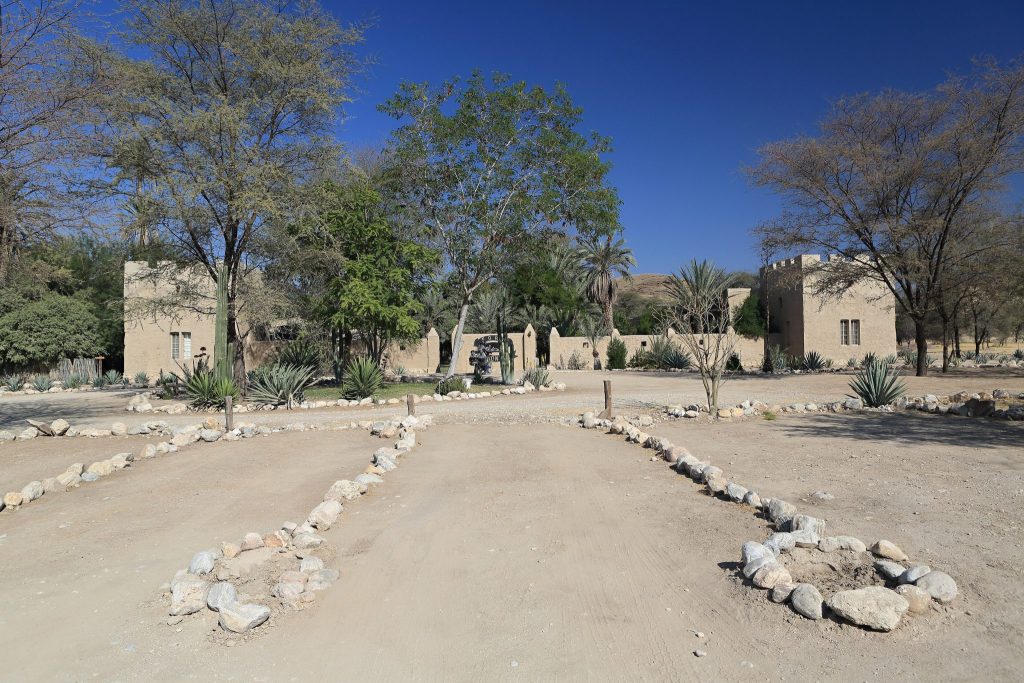
Sesfontein is the last fuel and supplies before Kaokoland proper, a small settlement built around a restored German colonial fort in the northern Kunene. It holds one of Namibia’s founding communal conservancies and sits at the junction where the road north to Opuwo meets the route west into the Hoanib. The name means six springs.
Where Sesfontein Sits
The position explains everything about the place.
Sesfontein lies in the northern Kunene Region, north of Palmwag and south of Opuwo, at the point where the tarred and graded country gives way to genuine 4×4 territory.
Travellers reach it from Palmwag and Damaraland to the south on the C43, from Opuwo to the north, or from the coast via the Skeleton Coast gates. It is the junction for anyone heading west into the Hoanib riverbed or north into Kaokoland.
The name comes from six springs that rise here, which is why a settlement exists at all in country this dry.
Around a thousand people live in and around it, and it serves a much larger surrounding population coming in for supplies and services.
For most travellers Sesfontein is a fuel stop and an overnight rather than a destination, and that is a legitimate use of it.
Fill up at Sesfontein and treat it as your last dependable fuel going west or north. Fuel here is available and not guaranteed, so carry jerry cans if you are heading into the Hoanib or towards Puros. Deep sand roughly doubles consumption, which means range calculations based on tar figures are wrong by half in this country.
The Fort
The building at the centre of the settlement has an unusual history.
A German colonial fort was built here in the early twentieth century as an outpost of the Schutztruppe, positioned to control movement in the far northwest and to enforce a veterinary cordon against cattle disease.
It fell into ruin after German rule ended and stood derelict for decades.
It was restored in the nineteen nineties and converted into a lodge, which is now the best known accommodation in the settlement, with rooms around a courtyard and a garden that is a genuine surprise after the surrounding country.
The Schutztruppe association means the building sits inside the same difficult history as Waterberg and Shark Island, and it is worth knowing what you are sleeping in rather than treating it as picturesque colonial architecture.
Other accommodation and campsites operate in and around the settlement.
The Sesfontein Conservancy
Sesfontein is one of the conservancies that made the Namibian model work, and it is where the strains are currently most visible.
It is one of the three conservancies holding the Palmwag Concession, alongside Anabeb and Torra, which is Namibia’s largest tourism concession on communal land and holds the largest free roaming black rhino population on earth.
Conservancy members describe the change the model brought. Before it, there was no control and anyone who wanted to kill a giraffe simply did. Now a legal hunter pays a fee that goes to the community, and members point to electricity in the village and children in school as the result.
The aspiration members express is worth quoting in substance: that their children should see a rhino with their own eyes rather than only in Etosha.
Communities here depend on livestock farming as their main income while their cattle and goats share the country with free roaming wildlife.
Namibia now has around 86 to 87 registered communal conservancies covering roughly a fifth of the country.
The Drought and What It Tested
Sesfontein is where researchers have looked at whether the conservancy model survives climate stress, and the answer is not straightforward.
Namibia endured an eleven year dry spell that only recently broke. In 2024, as it stretched into its eleventh year, the president declared a national drought emergency.
Conservancies could not offset the livestock losses that resulted, and for the first time some members began questioning the benefits of the programme.
That matters because the whole model rests on wildlife being worth more to communities than it costs them. When drought kills the cattle and the wildlife income does not cover it, the arithmetic that underpins forty years of conservation policy comes under pressure.
Namibian conservation experts argue that the answer is to cement the economic value of wildlife further in policy, on the reasoning that if people in the areas wildlife roams can benefit from it, the animals stand a better chance in a more inhospitable future.
Regional climate projections are for a drier and hotter northwest, so this is a live question rather than a historical one.
The Hoanib
West of Sesfontein runs one of the most important ephemeral rivers in Namibia.
The Hoanib is one of five ephemeral river systems supporting the country’s desert dwelling elephants, of which around 150 remain across all five.
The riverbed functions as a linear oasis. Water sits below the sand, deep rooted trees reach it, and a corridor of ana trees and camel thorn runs through country that supports almost nothing else.
Desert lion range along it, with home territories among the largest recorded for the species anywhere.
The lower Hoanib and the coastal section fall inside concession areas reached by fly in camps rather than by road, and Hoanib Skeleton Coast Camp operates there.
Self drivers can access parts of the upper Hoanib from Sesfontein, and it is demanding driving requiring genuine 4×4 capability, recovery gear and preferably a second vehicle.
Palmwag to the South
The concession south of Sesfontein is the region’s main draw and is covered fully on its own page.
Palmwag covers around 550,000 hectares of basalt semi-desert and is held by the three conservancies including Sesfontein.
It holds around two hundred free roaming black rhino, tracked on foot with Save the Rhino Trust trackers, which is available in no other country.
Desert adapted elephant work the riverbeds, most reliably near the Uniab spring at the entrance gate, and desert lion range across the concession.
A permit bought at the gate allows self drive access, which is unusual among Namibian concessions, though rhino tracking runs only through the lodges.
Most travellers combine Sesfontein with Palmwag rather than treating them separately.

Going North to Kaokoland
What lies beyond Sesfontein is worth knowing before committing.
The road north leads to Opuwo, the capital of the Kunene Region and the last town with dependable services, from where it is 180 kilometres of gravel to Epupa Falls on the Kunene River.
Beyond that, the tracks to Puros, the Marienfluss and the Hartmann Valley are expedition driving requiring recovery equipment, extra fuel and a second vehicle.
Van Zyl’s Pass, the notorious descent into the Marienfluss, is one way downhill only and prohibited under most rental agreements.
This is Himba country, and community visits should be arranged through local guides who know the families and speak the language, with practical gifts bought in Opuwo rather than sweets or cash.
Most travellers go as far as Epupa and turn around, which is a complete trip rather than a failure of nerve.
Desert Adapted Elephant in the Region
The country around Sesfontein is one of the few places on earth holding desert dwelling elephants, and the figures are worth getting right.
Around 150 genuinely desert dwelling elephants survive across five ephemeral river systems in the northwest: the Ugab, Huab, Uniab, Hoanib and Hoarusib. Roughly 80 occupy the three northern rivers and 50 to 62 the southern two.
Travel writing frequently quotes figures of 600 to 700, which refer to all elephants across the wider northwest including the non-desert Northern Highlands populations. That is a different thing, and the confusion produces desert elephant numbers five times too high.
These animals are not a separate subspecies. Genetic work shows Namibian elephants are in effect one population, and the desert survival skills are learned and passed down within family groups rather than inherited.
They range enormous distances between water points, dig for water in apparently dry sand, and move along the riverbeds at night, which is why camping in a riverbed here is a genuinely bad idea.
Sightings depend on where the herds have moved that week rather than on season, so ask your camp rather than assuming.
Practical Notes
Sesfontein is small and the practicalities matter.
Fuel is available and should be treated as the last dependable supply west or north, with jerry cans carried for anything beyond.
Supplies are limited. Stock up at Khorixas, Kamanjab or Opuwo depending on direction of travel.
Cash only across most of the region, so draw before you arrive since there is no reliable ATM.
Mobile coverage is limited to non-existent in most directions.
Roads in are gravel and manageable in a high clearance vehicle in the dry season. Everything west and north deteriorates from there.
May to October is the practical window, since the rains make dry riverbeds flash flood and tracks unreliable.
Sesfontein Questions
Why stop at Sesfontein?
Because of what lies beyond it. It is the last dependable fuel and supplies before Kaokoland proper, sitting at the junction where the road north to Opuwo meets the route west into the Hoanib. It also holds a restored German colonial fort converted into a lodge, and it is one of the three conservancies holding the Palmwag Concession.
What does the name mean?
Six springs, which is why a settlement exists here at all in country this dry. The springs support the village and the surrounding population, and they are the reason the German colonial administration positioned a Schutztruppe outpost here in the early twentieth century to control movement in the far northwest.
What is the fort?
A German colonial Schutztruppe outpost built in the early twentieth century, which fell into ruin after German rule ended and stood derelict for decades before being restored in the nineteen nineties and converted into a lodge. The Schutztruppe association places it inside the same difficult history as Waterberg and Shark Island, which is worth knowing rather than treating it as picturesque architecture.
What is the Sesfontein Conservancy?
One of the communal conservancies underpinning Namibia’s conservation model, and one of three holding the Palmwag Concession alongside Anabeb and Torra. Members describe the change directly: before it there was no control and anyone who wanted to kill a giraffe did, while now a legal hunter’s fee goes to the community, with electricity in the village and children in school as results.
How has the drought affected the area?
Considerably. Namibia endured an eleven year dry spell that only recently broke, with a national drought emergency declared in 2024. Conservancies could not offset the livestock losses, and for the first time some members questioned the programme’s benefits. That matters because the model rests on wildlife being worth more to communities than it costs them.
Can I drive into the Hoanib from here?
Parts of the upper Hoanib, yes, and it is demanding driving requiring genuine 4×4 capability, recovery gear and preferably a second vehicle. The lower Hoanib and the coastal section fall inside concession areas reached by fly in camps rather than by road. The riverbed supports desert dwelling elephants, of which around 150 remain across five ephemeral river systems.
What should I carry?
Fuel, including jerry cans if heading west or north, since deep sand roughly doubles consumption and range calculations based on tar figures are wrong by half. Cash, since there is no reliable ATM and most of the region is cash only. Supplies bought at Khorixas, Kamanjab or Opuwo. Recovery gear and a second spare tyre for anything beyond the graded roads.
Booking Your Namibia Trip
The safari companies and tour operators listed on this website put trips like this together for a living and know which camps, guides and routes actually deliver. We are an independent guide to Namibia; we do not book or sell tours ourselves.
When you are ready, arrange your safari, tour or holiday with one of the recognised operators listed here. Tell them your dates and what matters most, and a real person, not a form, will handle the itinerary, park bookings and logistics for you.