Kamanjab
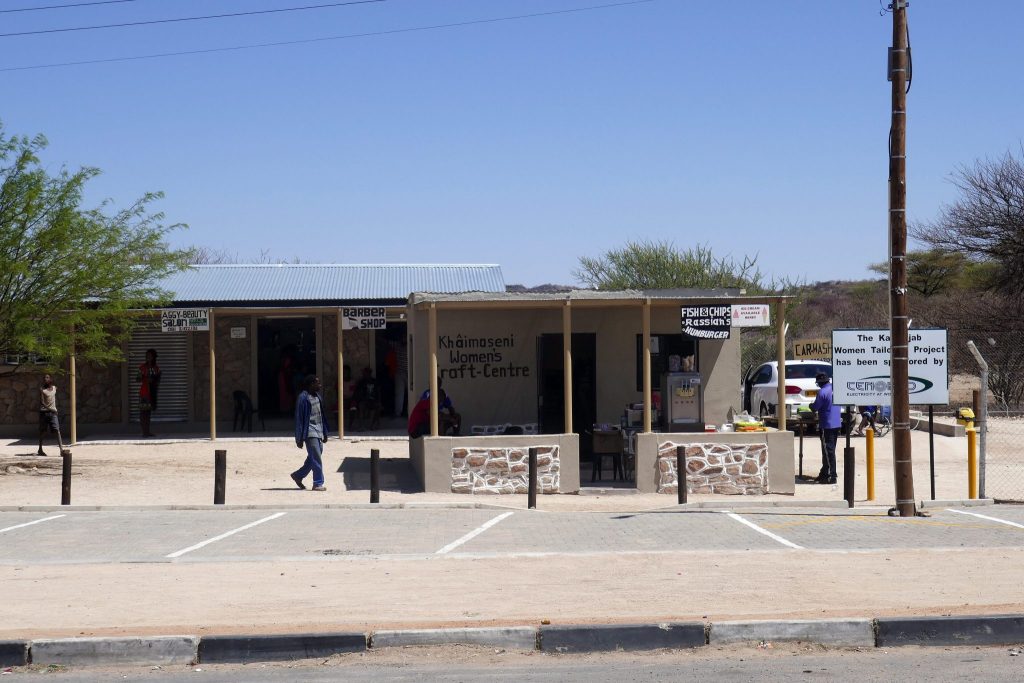
Kamanjab is the crossroads of northwestern Namibia, the point where routes to Etosha’s western gate, Damaraland, the Kunene and the coast separate. It is a small farming settlement with fuel, a shop and guest farms, and its value is entirely positional. Most travellers reach Galton Gate or Palmwag by passing through it.
The Junction
Kamanjab matters because of where the roads go rather than what is in the town.
It sits in the Kunene Region on the C40, at the point where several routes diverge. North and east lead towards Etosha, with Galton Gate on the park’s western boundary a manageable run away. West and north lead towards Palmwag, Sesfontein and the Kunene. South leads towards Khorixas and the central Damaraland circuit.
That makes it the natural fuel and supply stop for anyone moving between Etosha and Damaraland, or heading into the northwest.
Palmwag is around 181 kilometres from Galton Gate, and Kamanjab sits between the two on that axis.
The settlement itself is small, with a petrol station, a shop, a few businesses and guest farms in the surrounding country.
Travellers rarely stay in Kamanjab proper. They stay on the farms and lodges around it.
Fill up at Kamanjab whichever direction you are heading. Going west towards Palmwag and Sesfontein, fuel gets sparse and expensive. Going north to Galton Gate, the western section of Etosha has fewer facilities than the main circuit and Olifantsrus has no fuel at all. Going south to Khorixas is more forgiving. Kamanjab is the last easy fill on two of those three routes.
Galton Gate and Western Etosha
Kamanjab is the way in to the quietest part of Etosha.
Galton Gate serves the western section of the park, reached from Kamanjab, and gives access to Dolomite Camp and Olifantsrus.
Some sources describe the gate as accessible only to guests staying at those camps, so confirm the current position before planning a route through it.
The western section is considerably less visited than the main circuit around Okaukuejo, Halali and Namutoni, which is its attraction.
Dolomite Camp sits on a ridge with views across the western plains. Olifantsrus is camping only, remote, with a hide that is excellent for elephants, and it has no fuel.
A 4×4 is more useful in the western section than on the main circuit, particularly after rain.
The Guest Farms
The accommodation around Kamanjab is its main offering and it is a specific kind.
The surrounding country is commercial farmland, much of it converted wholly or partly to game, which is the pattern across the Namibian highlands.
Guest farms in the area offer game drives, walks and horse riding at a fraction of private reserve prices, with plains game including oryx, kudu, springbok, giraffe and zebra.
Several properties in the wider area run cheetah and predator conservation work, reflecting that Namibian farmland holds around 90 percent of the country’s cheetah, since lion and hyena that kill their cubs are absent from it.
Leopard densities on Namibian freehold farmland are also higher than inside national parks.
That makes a night on a guest farm here a reasonable wildlife proposition rather than only a bed between destinations.
Himba Community Visits
Kamanjab has a Himba community visit and it needs a caveat.
A settlement near the town offers organised visits, and it is considerably more accessible than Kaokoland proper, which is why it appears on itineraries that do not reach Opuwo or Epupa.
Accessibility is exactly why it warrants the standard questions before booking. Ask who owns the operation, where the money goes, whether it is a working settlement or a constructed village, and whether people are employed or performing.
Several honest operations in Namibia state openly that they are a set up rather than a working homestead, which is preferable to pretending otherwise.
Visits close to accessible towns tend to be more commercialised than those arranged further out through local guides who know the families.
If Himba culture matters to you, the arrangement at Opuwo and Epupa with a guide who speaks the language is the better version. If your route does not reach there, ask the questions and go informed.
Where the Routes Go
To Etosha. Galton Gate on the western boundary, serving Dolomite Camp and Olifantsrus, the quietest section of the park. Confirm access rules before routing through it.
To Palmwag. West and north on the C40 and C43 towards the concession, rhino tracking and Sesfontein. Fuel gets sparse beyond here.
To Damaraland. South towards Khorixas for Twyfelfontein, the Organ Pipes, Burnt Mountain and the Petrified Forest.
To the coast. Southwest through Damaraland and Uis to Henties Bay and Swakopmund on the C35 and C36.
Towards Palmwag and the Rhino
The route west from Kamanjab leads to what the northwest is known for.
The Palmwag Concession covers around 550,000 hectares of basalt semi-desert and is held by three communal conservancies, Sesfontein, Anabeb and Torra, making it Namibia’s largest tourism concession on communal land.
It holds around two hundred free roaming black rhino, the largest such population on earth, tracked on foot with Save the Rhino Trust trackers. Almost every other black rhino alive lives behind a fence.
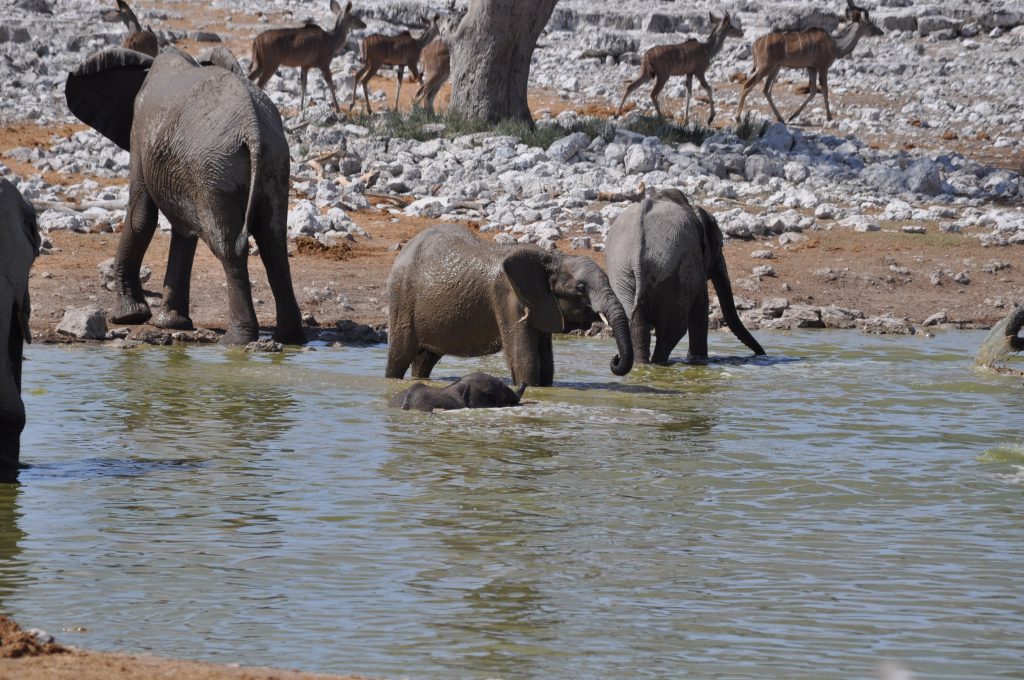
Desert adapted elephant work the riverbeds, most reliably near the Uniab spring at the entrance gate, and desert lion range across the concession with home territories among the largest recorded for the species.
A permit bought at the gate allows self drive access, which is unusual among Namibian concessions, though rhino tracking runs only through the lodges.
Kamanjab is the last comprehensive supply point before all of it.
Staying on a Guest Farm
The farms around Kamanjab are the reason to give the area a night rather than a fuel stop.
Most operate as working farms with guest accommodation attached, which means dinner at a shared table, hosts who know the country and a considerably more personal stay than a lodge.
Rates run well below private reserve prices for game drives, walks and horse riding across land holding oryx, kudu, springbok, giraffe, zebra and warthog.
Some run night drives, which produce aardwolf, bat eared fox, porcupine, genet and African wild cat, none of which the national parks permit you to look for after dark.
Several properties across the wider northwest are involved in predator conservation, reflecting that Namibian farmland carries the fate of the country’s cheetah and much of its leopard population.
For travellers breaking the drive between Etosha and Damaraland, this is a better night than a roadside hotel and costs about the same.
Practical Notes
The things that matter here are logistical.
Fuel, a shop and basic services are available in the settlement. Anything substantial means Outjo, Khorixas or Opuwo depending on direction.
Roads in every direction are gravel beyond the immediate area, usually graded and manageable in a high clearance vehicle in the dry season.
Mobile coverage exists in the settlement and deteriorates quickly outside it.
Cash is worth carrying, since community campsites, park fees and small businesses across the northwest frequently do not take cards.
The dry season from May to October is the practical window for everything reached from here, since the rains make the northwestern tracks unreliable.
Best Time to Pass Through
The season here is dictated by where you are going next rather than by the settlement.
May to October is the dry season and the practical window for the northwest. Tracks towards Palmwag, Sesfontein and Kaokoland are passable, dry riverbeds are safe to cross, and game concentrates at the remaining water.
September and October are strongest for wildlife in Etosha’s western section and in the Palmwag Concession, as water disappears and animals become tied to known points.
The rains from January to March make the northwestern tracks unreliable and dry riverbeds flash flood without warning, which is a genuine hazard rather than a theoretical one in this country.
Winter nights are cold across the northwest, dropping to single figures, which catches out visitors camping on guest farms.
Heat builds severely from October, and the western section of Etosha offers less shade and fewer facilities than the main circuit.
Kamanjab Questions
Why do travellers stop at Kamanjab?
Position. It sits at the point where routes to Etosha’s western Galton Gate, Palmwag and the Kunene, Damaraland and the coast separate, which makes it the natural fuel and supply stop for anyone moving between Etosha and the northwest. The settlement itself is small, with a petrol station, a shop and guest farms in the surrounding country.
Is it the gateway to western Etosha?
Yes, Galton Gate on the park’s western boundary is reached from Kamanjab and serves Dolomite Camp and Olifantsrus. Some sources describe the gate as accessible only to guests staying at those camps, so confirm the current position before routing through it. The western section is considerably less visited than the main circuit, which is its attraction.
Should I fill up here?
Yes, whichever direction you are heading. Going west towards Palmwag and Sesfontein, fuel becomes sparse and expensive. Going north to Galton Gate, the western section of Etosha has fewer facilities than the main circuit and Olifantsrus has no fuel at all. Kamanjab is the last easy fill on two of the three main routes out.
What accommodation is there?
Guest farms in the surrounding country rather than hotels in the settlement. Much of the land is commercial farmland converted wholly or partly to game, offering drives, walks and horse riding at a fraction of private reserve prices, with oryx, kudu, springbok, giraffe and zebra. Several properties in the wider area run cheetah and predator conservation work.
Is the Himba visit near Kamanjab worth doing?
Ask the standard questions first: who owns the operation, where the money goes, whether it is a working settlement or a constructed village, and whether people are employed or performing. Visits close to accessible towns tend to be more commercialised. If Himba culture matters to you, the arrangement at Opuwo or Epupa with a local guide who knows the families is the better version.
Why is there so much wildlife on the farms?
Because Namibian farmland is genuinely good habitat for some species. Around 90 percent of the country’s cheetah live on farmland rather than in parks, since lion and hyena that kill their cubs are absent. Leopard densities on freehold farmland are also higher than inside national parks. A night on a guest farm here is a reasonable wildlife proposition rather than only a bed.
When should I travel through?
May to October, the dry season, which is the practical window for everything reached from Kamanjab. The rains make the northwestern tracks towards Palmwag, Sesfontein and Kaokoland unreliable, and dry riverbeds in that country flash flood. Roads in every direction are gravel beyond the immediate area, usually graded and manageable in a high clearance vehicle when dry.
Booking Your Namibia Trip
The safari companies and tour operators listed on this website put trips like this together for a living and know which camps, guides and routes actually deliver. We are an independent guide to Namibia; we do not book or sell tours ourselves.
When you are ready, arrange your safari, tour or holiday with one of the recognised operators listed here. Tell them your dates and what matters most, and a real person, not a form, will handle the itinerary, park bookings and logistics for you.