Hoba Meteorite
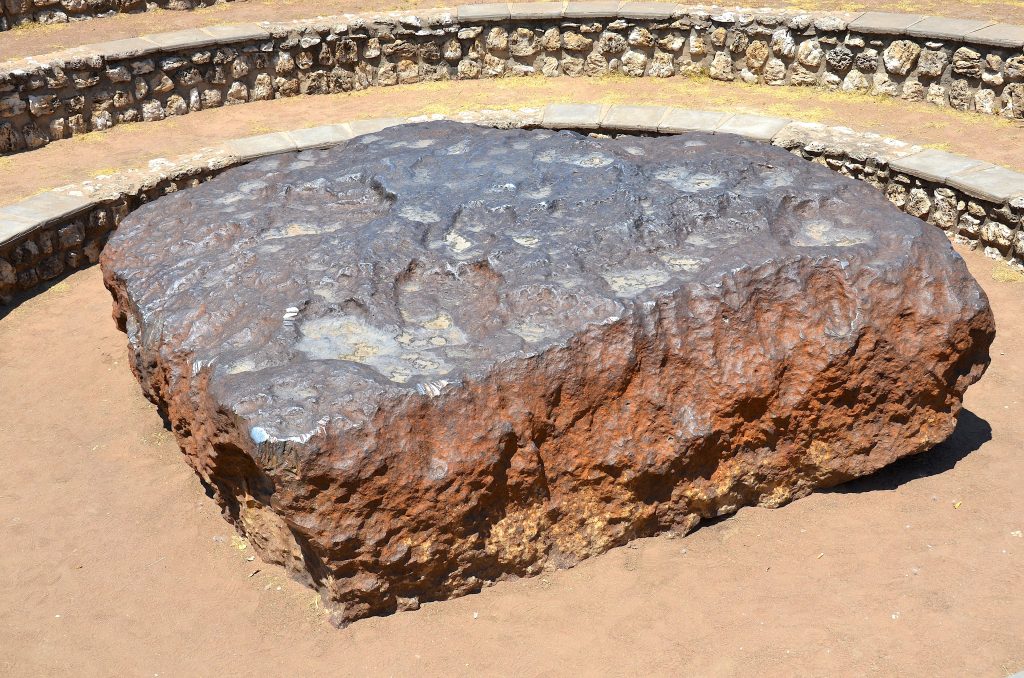
The Hoba Meteorite near Grootfontein is the largest intact meteorite ever found on earth and the largest naturally occurring piece of iron known on the planet’s surface, weighing around 60 tonnes. It fell roughly 80,000 years ago and has never been moved, because nobody has worked out how. You can walk up and stand on it.
The Largest Meteorite on Earth
Hoba is a slab rather than the lump most people picture, roughly 2.7 by 2.2 metres across and about a metre thick, and yet it weighs somewhere around 60 tonnes.
Published weights vary between about 50 and 66 tonnes, with 60 the figure most sources settle on. The reason for the spread is straightforward: nobody has weighed it, because moving it has never been practical.
The composition explains the density. It is roughly 82 percent iron and 16 percent nickel, with trace elements including cobalt, which makes it an iron meteorite by classification. There is more iron in this one object than in most working mines’ daily output.
The rock itself is estimated at 200 to 400 million years old, which is the age of the material rather than the date of its arrival. It reached Earth around 80,000 years ago, with some estimates running to 300,000.
The Crater That Is Not There
The obvious question at the site is where the impact crater went, and the answer is disputed in an interesting way.
An object of this mass should have arrived with enormous force. What is agreed is that it did not, and the explanation usually offered is the shape. Hoba is flat and tabular rather than rounded, which would have made it behave something like a skipping stone in the upper atmosphere, entering at a shallow angle and shedding speed.
By the time it reached the ground it was probably travelling at less than several hundred metres per second, which is slow for a meteorite and fast for anything else.
Beyond that, sources differ. Some hold that a small crater around 20 metres across and five metres deep formed and has since eroded away entirely. Others state flatly that no crater and no altered rock have ever been found associated with the site.
Either way, what a visitor sees is a slab of iron sitting in the ground with no scar around it, which is precisely what makes it strange.
This is one of the few world class natural objects anywhere that you are allowed to touch, walk around and stand on. Visitors expecting a roped off exhibit are frequently taken aback. Take the opportunity, and then look at the surface closely, because the pitting and the cut marks from decades of samples and vandalism are part of the story too.
How It Was Found
The discovery story is well documented because the man who made it wrote it down.
In 1920 a farmer named Jacob Hermanus Brits was working land on the farm Hoba West when he came across it. His own account, kept at the Grootfontein Museum, describes hunting on the farm one winter and noticing a strange rock, only the upper part of which was visible above the calcareous soil. He sat on it, scratched it with his knife, saw a shine beneath the surface, chiselled off a piece and took it into Grootfontein, where it was identified as a meteorite.
A version in which his plough struck it and stopped is also widely repeated, and the two accounts have merged over the years.
Workers excavated the surrounding soil to reveal the full slab. The first scientific report followed later that decade, with metallurgical analysis published subsequently.
The name comes from the farm. Hoba is also said to carry the meaning of a gift, which is the kind of coincidence that gets repeated whether or not it holds up.
Vandalism and Protection
Being touchable has cost the meteorite a good deal over the past century.
Souvenir hunters, scientific sampling and outright vandalism all removed material, and the object visible today is noticeably reduced from what was excavated. Estimates of its original mass run higher than the current figure for exactly that reason.
It was declared a national monument in March 1955, when the territory was administered by South Africa and the authorities wanted to stop the damage. That helped and did not solve it.
In the mid nineteen eighties, Rössing Uranium made funds available to the National Monuments Council to combat vandalism, and a project followed to protect the meteorite and develop the surroundings. The farm owner donated the land around it to the Council in 1987, and an information centre was established the same year.
A stone amphitheatre was built around the meteorite, sunk into the ground so visitors descend to it, along with a visitors’ centre, a small gift shop and a walkway planted with indigenous trees labelled with their names.
Visiting the Site
The visit is short and the setting is better than the description suggests.
You descend the stone terraces into the amphitheatre, walk around the slab, touch it and photograph it. Information boards cover the discovery, the composition and the science. Most people spend thirty to forty five minutes including the walkway and the centre.
Entry has been quoted around 50 Namibian dollars per person, which is modest by Namibian standards. There is a gift shop selling curios.
Facilities are limited beyond that and there are few dining options nearby, so bringing something to eat is sensible if you plan to linger. The planted walkway with its labelled indigenous trees is a pleasant few minutes and is easily skipped by people who assume there is nothing but the rock.

Fitting It Into a Route
Hoba sits about 19 to 20 kilometres west of Grootfontein, which places it neatly on the road between the central highlands and the north.
Grootfontein is known as the gateway to the north, and travellers heading for Etosha’s eastern side, for Khaudum, or east along the B8 towards the Zambezi Region pass close by. That makes the meteorite a natural half hour break rather than a detour.
Combined with Etosha a few hours north, or with the Waterberg to the south, it slots into a northern itinerary without costing a day. Very few people travel to Namibia for a meteorite and a good many are glad they stopped.
Why It Matters Scientifically
Beyond being the biggest, Hoba is scientifically useful because it is intact and in place.
Most large meteorites fragment on entry or on impact, scattering material across a strewn field. Hoba arrived whole and stayed whole, which means the composition can be studied without the complications of a break up.
Its origin is unknown. Nobody has established where in the solar system the parent body was, and the object gives no obvious clue beyond its composition, which places it within a broad class of iron meteorites thought to derive from the cores of shattered asteroids.
The number that puts it in context: roughly 17 meteorites reach the Earth’s surface every day, almost all of them small. Hoba is at the far end of a very long distribution.
Best Time to Visit
The meteorite is indifferent to season and the visit works year round.
Early morning or late afternoon is worth aiming for, since the site is open and the midday heat in this part of Namibia is substantial with limited shade in the amphitheatre.
Weather in the region can change quickly and the summer rains from about November to March bring afternoon thunderstorms, which are dramatic rather than disruptive for a stop this short.
Getting to the Hoba Meteorite
The site lies roughly 19 to 20 kilometres west of Grootfontein on the farm Hoba West, signposted from town, in the Otjozondjupa Region near the Otavi Mountains.
Grootfontein sits on the B8 in northern Namibia, reachable on tar from Otjiwarongo and Otavi to the south and from Rundu to the northeast. Access to the meteorite is on a short gravel road manageable in any vehicle.
Etosha’s eastern gate at Von Lindequist is a few hours west via Tsumeb, and the Zambezi Region runs east along the B8.
Hoba Meteorite Questions
How big is the Hoba Meteorite?
Around 2.7 by 2.2 metres across and about a metre thick, weighing somewhere near 60 tonnes, with published figures ranging from 50 to 66. Nobody has weighed it because moving it has never been practical. It is roughly 82 percent iron and 16 percent nickel with trace cobalt, which is why something that size is so heavy.
Why is there no crater?
Because it probably arrived slowly. The flat tabular shape would have made it behave something like a skipping stone in the upper atmosphere, entering at a shallow angle and losing speed, so it hit the ground at less than several hundred metres per second. Sources differ on whether a small crater around 20 metres across formed and eroded away, or whether none formed at all.
Can I touch the meteorite?
Yes, and stand on it. This is one of very few world class natural objects that visitors can walk up to and handle freely, which surprises people expecting a roped off exhibit. That accessibility has come at a cost, since souvenir hunters and vandals have removed material over the past century and the slab is noticeably smaller than what was excavated.
How old is it?
The rock itself is estimated at 200 to 400 million years, which is the age of the material rather than of its arrival. It reached Earth around 80,000 years ago, with some estimates running to 300,000. Its origin is unknown: nobody has established which parent body in the solar system it came from.
Who found it and when?
A farmer named Jacob Hermanus Brits in 1920, on the farm Hoba West. His own written account, kept at the Grootfontein Museum, describes noticing a strange rock while hunting, sitting on it, scratching it with a knife, seeing a shine beneath the surface and chiselling off a piece to take into town. A version in which his plough struck it is also widely told.
What does it cost to visit?
Entry has been quoted around 50 Namibian dollars per person, modest by Namibian standards. There is a visitors’ centre with information boards, a small gift shop and a planted walkway with labelled indigenous trees. Facilities are limited beyond that and dining options nearby are few, so bring something with you if you plan to stay a while.
Is it worth the stop?
For a half hour on a route you are already driving, yes. Hoba sits about 20 kilometres west of Grootfontein on the road between the central highlands and the north, so travellers heading for Etosha’s eastern side, Khaudum or the Zambezi Region pass close by. Almost nobody comes to Namibia for a meteorite and most who stop are glad they did.
Booking Your Namibia Trip
The safari companies and tour operators listed on this website put trips like this together for a living and know which camps, guides and routes actually deliver. We are an independent guide to Namibia; we do not book or sell tours ourselves.
When you are ready, arrange your safari, tour or holiday with one of the recognised operators listed here. Tell them your dates and what matters most, and a real person, not a form, will handle the itinerary, park bookings and logistics for you.