Namibian Food and Drink
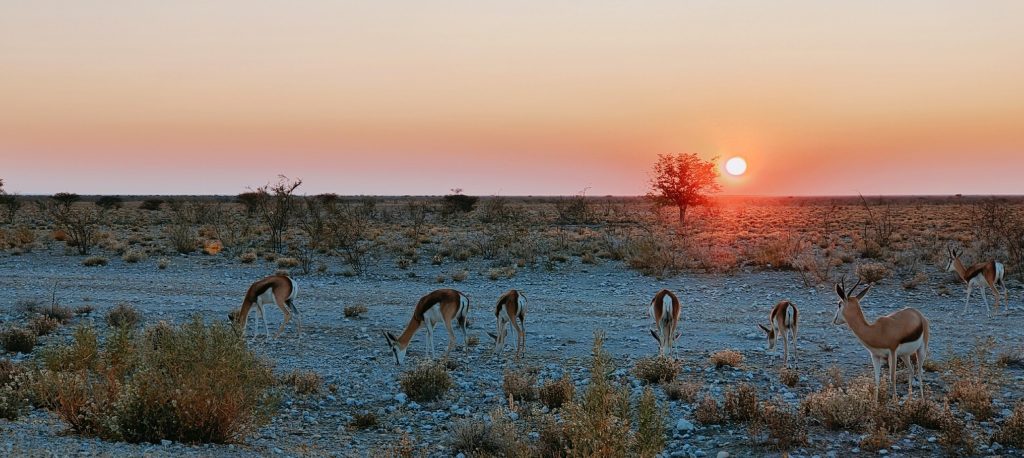
Namibian food is a collision of German colonial baking, Afrikaner braai culture and indigenous cooking, held together by game meat that is excellent and cheap by any international standard. Oryx, kudu and springbok are on menus everywhere. The beer is brewed to the German purity law. The street food to seek out is kapana, grilled over coals and eaten standing up.
Game Meat
This is what visitors remember and it is the strongest argument for eating in Namibia.
Oryx, kudu and springbok appear on menus across the country, along with eland, zebra and warthog in places. The meat is lean, dark and gamey without being strong, and it is inexpensive by international standards because much of it comes from Namibian game farms rather than imports.
Oryx is the most common and among the best: dense, dark and beefy. Kudu is slightly milder and a good introduction. Springbok is the finest grained and mildest of the three, and eland is leaner again.
Preparations run from plain grilled steak and fillet through carpaccio to slow cooked stews and game platters that let you compare several at once. Joe’s Beerhouse in Windhoek is the institution for the platter, and it is both touristy and genuinely good.
Namibian beef deserves a mention alongside the game. The country’s cattle are grass fed on open range and Namibian beef is exported to Europe under quality certification, so a steak here is not a compromise.
Order the game platter once, early in the trip, at a place that does it properly. Comparing oryx, kudu, springbok and eland side by side tells you which you actually like, and every menu for the rest of the trip becomes easier to read. Doing it on the last night, which is when most people get round to it, is a waste of the information.
Kapana and the Street Food
Kapana is the food Namibians actually eat and most visitors never try.
It is beef, cut thin, grilled fast over open coals at market stalls and sold by weight, eaten standing up with your fingers. It comes with a chilli and spice mix you dip into, along with salt, and sometimes with a tomato and onion relish or a piece of bread.
Single Quarters market in Katutura, Windhoek, is the place to eat it. The stalls work in a rhythm that takes a moment to read: you point, they cut, you eat. It costs very little and it is the most interesting hour of food in the capital.
Going with a guide the first time removes the awkwardness of not knowing how the ordering works, and township tours frequently include it.
Beyond kapana, biltong and droëwors are everywhere. Biltong is air dried spiced meat, sliced or in strips, and droëwors is the dried sausage version. Both are sold at every filling station in the country and are the standard road trip food.
Indigenous Staples
The everyday food of most Namibian households is porridge based and it appears on local menus rather than tourist ones.
Oshifima, also called pap or mieliepap, is a stiff porridge made from mahangu, which is pearl millet, or from maize meal. It is eaten with the hands, rolled into a ball and used to scoop up stew, meat or relish.
Mahangu is the northern staple and it grows where maize will not, which is why it matters in a country this dry. It is also fermented into oshikundu, a mildly sour non alcoholic drink.
Potjiekos is the Afrikaans contribution: a stew cooked slowly in a three legged cast iron pot over coals, layered rather than stirred, and it takes hours by design. It is the dish around which Namibian social evenings are built.
Braai is less a dish than a national institution. It means barbecue and it means the gathering around it, and every campsite in Namibia has a braai place because it is assumed you will use it.
The German Legacy
German colonial rule ended over a century ago and left a food culture that is still visible daily.
Bakeries in Windhoek, Swakopmund and Lüderitz produce brötchen, apple strudel, black forest cake and rye breads that would not be out of place in Bavaria. Swakopmund in particular has a serious cafe culture built around them.
Sausage is the other legacy: bratwurst, landjäger and various wurst appear on menus and in butchers throughout the country, often alongside game.
Schnitzel is on more menus than seems reasonable, frequently made with game rather than pork, which is a genuinely Namibian hybrid.
Eisbein, sauerkraut and German style pork dishes turn up in the older restaurants, particularly in Swakopmund and Windhoek, and they sit oddly and enjoyably alongside oryx carpaccio on the same card.
Seafood on the Coast
The Benguela current makes the Namibian coast one of the more productive fishing grounds anywhere, and the coast eats accordingly.
Oysters are the speciality. Farmed on platforms in Walvis Bay and at Lüderitz in cold nutrient rich water, they grow faster than in most places and they are excellent and cheap. They appear on catamaran cruises with sparkling wine as a matter of routine.
Kingklip, hake and monkfish are the common fish on menus. Rock lobster, called crayfish locally, is fished at Lüderitz and is a genuine delicacy.
Swakopmund and Walvis Bay have the best seafood restaurants in the country, and eating fish anywhere inland is a considerably worse proposition given the distances.
Shore anglers along the coast catch kabeljou, steenbras and galjoen, and a permit is required for recreational fishing.
Beer, Wine and Spirits
Namibian beer is a source of national pride and the reason is a German law.
Namibia Breweries produces its beers according to the Reinheitsgebot, the German purity law of 1516, using only water, malted barley and hops. Windhoek Lager is the flagship and is drunk everywhere, with Windhoek Draught, Tafel Lager and Urbock among the others.
The result is a clean unfussy lager that suits the climate, and Namibian beer is exported and well regarded across southern Africa.
Wine is almost entirely South African and the selection in restaurants and supermarkets is good and inexpensive. A small Namibian wine industry exists near the Naute Dam in the south, where a distillery also produces spirits from dates and prickly pear grown under irrigation.
Amarula, the cream liqueur made from marula fruit, is regional rather than strictly Namibian and turns up everywhere. Marula fruit itself is gathered across northern Namibia and fermented into a traditional drink.
Oshikundu, the fermented mahangu drink, is the traditional non alcoholic option and worth trying where offered.
Seasonal and Unusual Foods
Two Namibian foods are worth looking for if your timing is right.
Omajova are enormous mushrooms that grow on termite mounds after the first good rains, roughly January to March, reaching the size of a dinner plate. They are gathered and sold at roadsides in the north and central regions and are considered a delicacy, with a texture closer to meat than to a European mushroom.
Mopane worms are the caterpillars of the emperor moth, harvested from mopane trees, dried and eaten as a protein rich snack or rehydrated into stews. They are a serious food source across northern Namibia rather than a novelty, and they taste roughly of dried mushroom.
Nara melons from the Namib dunes are harvested by the Topnaar community of the Kuiseb and have been a staple there for a very long time.
Marula fruit, wild spinach and various indigenous plants feature in northern cooking and rarely on tourist menus.
Eating on a Self Drive Trip
The practicalities matter here more than in most countries because of the distances.
Supermarkets in Windhoek, Swakopmund, Otjiwarongo, Tsumeb and the larger towns are well stocked and considerably cheaper than anything you will find on the road. Stock up before heading into Damaraland, Kaokoland or the south.
Between towns there is often nothing. Filling stations sell biltong, crisps and cold drinks and little else. Padstal farm stalls appear on some routes and are worth stopping at.
Solitaire, on the road between Sesriem and Swakopmund, is famous for apple pie and is the standard stop on that leg for good reason.
Most lodges include meals or serve dinner, and campsites all have braai facilities. Self catering campers should carry more than they think, since a wrong turn or a closed shop changes the arithmetic quickly.
Namibian Food and Drink Questions
What is the national dish of Namibia?
There is no single official one, though potjiekos and oshifima with stew both have a claim. Potjiekos is a slow cooked stew made in a three legged cast iron pot over coals, layered rather than stirred. Oshifima is a stiff porridge of mahangu millet or maize eaten by hand with stew or relish, and it is the everyday staple across most of the country.
Is game meat worth trying?
Yes, and it is the strongest reason to eat well in Namibia. Oryx, kudu and springbok are on menus everywhere, lean and dark without being strong, and cheap by international standards since most comes from Namibian game farms. Oryx is dense and beefy, kudu milder, springbok the finest grained. Order a game platter early in the trip to compare them.
What is kapana?
Beef cut thin and grilled fast over open coals at market stalls, sold by weight and eaten standing up with your fingers, dipped in a chilli and spice mix. Single Quarters market in Katutura, Windhoek, is the place for it. It costs very little, it is what Namibians actually eat, and going with a guide the first time removes the awkwardness of not knowing the ordering rhythm.
Why is Namibian beer German?
Because Namibia Breweries brews to the Reinheitsgebot, the German purity law dating from 1516, using only water, malted barley and hops. It is a legacy of German colonial rule and a source of considerable national pride. Windhoek Lager is the flagship, with Windhoek Draught, Tafel and Urbock alongside it, and Namibian beer is well regarded across southern Africa.
Where is the best seafood?
Swakopmund and Walvis Bay. The cold nutrient rich Benguela current makes this one of the more productive fishing grounds anywhere, and the oysters farmed at Walvis Bay and Lüderitz grow faster than in most places and are excellent and cheap. Kingklip, hake and monkfish are the common fish, and rock lobster is fished at Lüderitz.
What are omajova?
Enormous mushrooms that grow on termite mounds after the first good rains, roughly January to March, reaching the size of a dinner plate. They are gathered and sold at roadsides in the north and central regions and are considered a delicacy, with a texture closer to meat than to a European mushroom. Seasonal, so timing decides whether you find them.
Where do I eat on a self drive trip?
Stock up in the larger towns, where supermarkets are well stocked and far cheaper than anything on the road, before heading into Damaraland, Kaokoland or the south. Between towns there is often nothing beyond biltong and cold drinks at filling stations. Most lodges include or serve dinner and every campsite has braai facilities. Solitaire’s apple pie is the standard stop between Sesriem and the coast.
Booking Your Namibia Trip
The safari companies and tour operators listed on this website put trips like this together for a living and know which camps, guides and routes actually deliver. We are an independent guide to Namibia; we do not book or sell tours ourselves.
When you are ready, arrange your safari, tour or holiday with one of the recognised operators listed here. Tell them your dates and what matters most, and a real person, not a form, will handle the itinerary, park bookings and logistics for you.