Namibia vs Kenya and Tanzania

East Africa has the animals and Namibia has the country. The Serengeti and the Mara hold densities and a migration Namibia cannot match. Namibia offers desert, dunes, a shipwreck coast and self driving at a fraction of the cost. For a first safari the answer is usually East Africa. For a second it is usually here.
The Honest Comparison
These are different products and pretending otherwise wastes a reader’s time.
Kenya and Tanzania are built around the great migration ecosystem: the Serengeti, the Ngorongoro Crater and the Masai Mara, holding some of the highest large mammal densities on earth alongside a wildebeest migration involving well over a million animals.
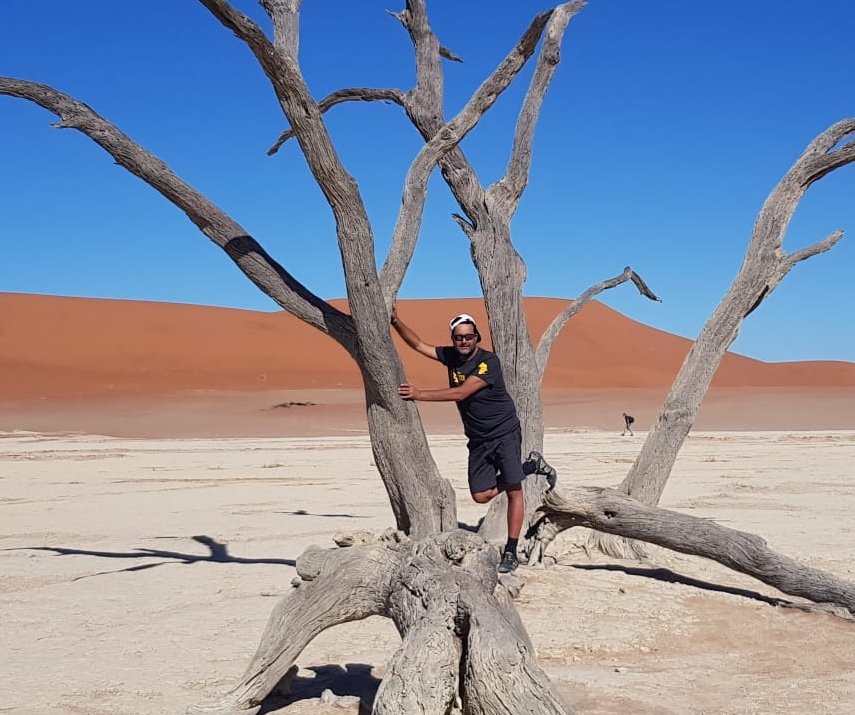
Namibia is built around terrain. The oldest desert on earth, the highest dunes in the world, a fog bound Atlantic coast with shipwrecks and seal colonies, canyons, granite massifs and rock art tens of thousands of years old.
Wildlife exists in Namibia and it is thinner, more dispersed and harder won. Etosha is genuinely good and it is not the Serengeti.
The reverse is also true. East Africa has nothing resembling Sossusvlei, the Skeleton Coast or Kaokoland.
Travellers who want to see a great many animals should go east. Travellers who want to drive through somewhere astonishing should come here.
If this is your first African trip and you have two weeks and a decent budget, go to East Africa. Namibia will still be here, and it is a considerably better second or third safari than first. Coming here first and then going to the Serengeti works fine; going to the Serengeti and then arriving in Etosha expecting the same thing produces disappointment that is nobody’s fault.
Wildlife: East Africa Wins
There is no useful argument here and the reasons are structural.
The Serengeti and Masai Mara sit in high rainfall grassland supporting enormous herbivore biomass, which supports predator densities to match. Lion, cheetah and hyena sightings are frequent and reliable rather than fortunate.
The migration is a genuine spectacle with no equivalent anywhere, involving well over a million wildebeest alongside zebra and gazelle, and the river crossings are the single most photographed wildlife event in Africa.
Namibia’s Etosha holds 114 recorded mammal species and works by a different mechanism: no perennial rivers, so in the dry season every animal must come to a small number of springs and boreholes. That produces excellent viewing and lower densities.
Buffalo are absent from Etosha entirely, excluded on veterinary grounds protecting the country’s foot and mouth free status for livestock export, so a full Big Five list requires the Zambezi Region.
If your measure is animals seen per day, East Africa wins comfortably and it is not close.
Where Namibia Wins
The counter case is equally firm and rests on things East Africa does not have.
Terrain variety is the obvious one. A Namibian itinerary changes character every two days: dune, coast, mountain, savanna. An East African one is grassland, woodland and crater.
Self driving is the second. Namibia is among the best self drive countries in Africa, with tar between main centres, graded gravel elsewhere and excellent rental infrastructure for equipped 4×4 camping vehicles. East African parks are almost always done with a driver guide.
Solitude is the third and it is the real differentiator. Namibia is the second least densely populated country on earth. A famous Serengeti sighting can attract twenty vehicles; a Namibian waterhole frequently has one.
Namibia also holds things found almost nowhere else: free roaming black rhino tracked on foot in the Palmwag Concession, desert adapted elephant and lion, brown hyena feeding on seal colonies, and the world’s largest cheetah population living on farmland.
Dark skies are the fourth, with a Gold Tier International Dark Sky Reserve at NamibRand, the first in Africa.
Cost
The difference is substantial and it decides the trip for many travellers.
East African safaris are guided by default, with park fees among the highest in Africa, particularly in the Serengeti and Ngorongoro, and the standard product is a vehicle, driver guide and lodge package.
Namibia can be self driven and self catered. Two people camping can travel on roughly 200 to 300 US dollars a day between them, covering vehicle, fuel, campsites, park fees and food. Mid range self drive with lodges runs around 400 to 450 a day for two.
Namibia does have premium camps at several hundred to over a thousand US dollars per person per night, and they are an option rather than the only route in.
Namibian park fees are modest by comparison, at around N$280 per international adult per day at Etosha plus N$60 per vehicle.
Broadly, a Namibian trip can be done for a fraction of an East African one and still be excellent, which is the strongest practical argument for coming here.
Practical Differences
Malaria. Much of Namibia carries little to no risk year round, with Etosha in a low risk zone. East African safari areas normally require prophylaxis. A real factor for families.
Getting around. Namibia self drives easily. East Africa is driver guide or fly in, with internal flights common between parks.
Crowds. Namibian sites are quiet outside Sossusvlei at sunrise. Serengeti and Mara sightings can draw substantial numbers of vehicles.
Distances. Namibian driving days are long, at 50 to 60 kilometres an hour on gravel. East African parks are closer together but slower on rough park roads.
Cultural Travel
Both regions offer cultural tourism and the products are quite different.
East Africa’s best known version is the Maasai, whose villages and cultural visits are a standard part of safari itineraries in Kenya and northern Tanzania, and which range from genuine community enterprise to heavily commercialised.
Namibia’s equivalents are the Himba of Kaokoland, the Ju/’hoansi San of the Nyae Nyae Conservancy, and the Herero, whose Victorian style dress is worn as a marker of identity rather than as costume.
The Namibian arrangement is unusual in that the conservancy model gives communities legal rights over tourism on their own land. Nyae Nyae, registered in 1998 as the country’s first communal conservancy, is where Ju/’hoansi communities hold those rights directly.
The same questions apply in both regions before booking: who owns the operation, where the money goes, whether it is a working settlement or a constructed village, and whether people are employed or performing.
Namibia also carries a colonial history that is unavoidable at specific sites, including the Waterberg, Shark Island at Lüderitz and the Genocide Memorial in Windhoek, recognised as the first genocide of the twentieth century.
That history is closer to the surface here than in most safari destinations, and travellers who take an interest find it a substantial part of the trip.

Which Suits Which Traveller
The recommendations are specific rather than general.
First safari, two weeks, decent budget: East Africa. Higher density means more in fewer days, everything is arranged, and the migration is a genuine spectacle.
Second or third safari: Namibia. Desert adapted species, rhino tracking on foot and the Etosha waterhole system offer something you will not have done.
Photographers: Namibia, for terrain variety, light, dark skies and the freedom self driving gives to be somewhere at dawn without group pressure.
Families: Namibia, largely for malaria, since much of it carries little to no risk while East African safari areas normally require prophylaxis. Self driving also lets you set the pace around children.
Budget travellers: Namibia, decisively, since camping and self catering bring costs to a level East Africa cannot match.
Anyone who wants beaches attached: East Africa, since Zanzibar and the Kenyan coast are a short flight away and Namibia’s coast is cold and foggy.
Seasons
The calendars are broadly similar with one important difference.
Both regions have a dry season that concentrates game, roughly May to October in Namibia and June to October across much of East Africa.
The difference is the migration, which moves through the ecosystem on its own schedule. The Mara river crossings typically fall between around July and October, and the calving season in the southern Serengeti falls around January to March. Timing an East African trip means timing the herds rather than only the weather.
Namibia has no equivalent moving target. The dry season concentrates game at waterholes and that is the whole calculation.
Namibia’s green season from November to April brings storm cloud, calving, migrant birds and considerably lower rates against dispersed wildlife and heat above 40 degrees inland.
Both regions have cold nights in winter, and Namibian desert nights drop close to freezing between May and August, which surprises visitors more than East African highland cold does.
Doing Both
Many travellers eventually do, and the sequence matters.
East Africa first, Namibia second, is the order most people find works. The migration and the density land hardest when they are new, and Namibia then offers something different rather than something lesser.
Combining them in one trip is possible and expensive, since they are not close and the routing usually goes through Johannesburg, Addis Ababa or Nairobi.
The more natural Namibian combination is with Botswana or South Africa. Namibia’s Zambezi Region reaches within about 100 kilometres of Chobe via the Ngoma crossing, and the Noordoewer crossing links the far south to South Africa’s Northern Cape.
Those pairings give high density game viewing alongside Namibian terrain without crossing the continent.
For travellers determined to see both regions, two separate trips are almost always better value than one long one.
Namibia vs East Africa Questions
Which has better wildlife?
Kenya and Tanzania, and it is not close. The Serengeti, Ngorongoro and Masai Mara sit in high rainfall grassland supporting enormous herbivore biomass and matching predator densities, with a migration involving well over a million wildebeest. Namibia’s Etosha holds 114 mammal species concentrated at waterholes in the dry season, which produces excellent viewing at lower densities.
Which is cheaper?
Namibia, substantially. East African safaris are guided by default with high park fees, particularly in the Serengeti and Ngorongoro. Namibia can be self driven and self catered, with two people camping travelling on roughly 200 to 300 US dollars a day between them, or 400 to 450 with mid range lodges. Etosha park fees run around N$280 per international adult per day.
Which should I choose for a first safari?
East Africa, if you have two weeks and a decent budget. Higher density means seeing more in fewer days, everything is arranged, and the migration is a genuine spectacle with no equivalent. Namibia is a considerably better second or third safari, since desert adapted species and rhino tracking on foot offer something you will not have done before.
Can I self drive in East Africa?
It is possible and uncommon. East African parks are almost always done with a driver guide, and internal flights connect the main areas. Namibia by contrast is among the best self drive countries in Africa, with tar between main centres, graded gravel elsewhere and excellent rental infrastructure for equipped 4×4 camping vehicles, which is a large part of the cost difference.
Which is better for families?
Namibia, largely because of malaria. Much of it carries little to no risk year round, with Etosha in a low risk zone considered lowest in winter, while East African safari areas normally require prophylaxis. Self driving also lets you set the pace around children rather than following a group schedule, and the coast offers activities that are not game drives.
What does Namibia have that East Africa does not?
Terrain variety, with an itinerary that changes character every two days. Solitude, since Namibia is the second least densely populated country on earth and a Serengeti sighting can draw twenty vehicles where a Namibian waterhole has one. Free roaming black rhino tracked on foot, desert adapted elephant and lion, brown hyena feeding on seals, and a Gold Tier dark sky reserve.
Should I combine them?
Two separate trips are almost always better value, since the regions are not close and routing usually goes through Johannesburg, Addis Ababa or Nairobi. The more natural Namibian combination is with Botswana or South Africa, since the Zambezi Region reaches within about 100 kilometres of Chobe and the Noordoewer crossing links the far south to the Northern Cape.
Booking Your Namibia Trip
The safari companies and tour operators listed on this website put trips like this together for a living and know which camps, guides and routes actually deliver. We are an independent guide to Namibia; we do not book or sell tours ourselves.
When you are ready, arrange your safari, tour or holiday with one of the recognised operators listed here. Tell them your dates and what matters most, and a real person, not a form, will handle the itinerary, park bookings and logistics for you.