Namibia Desert Safari Itinerary
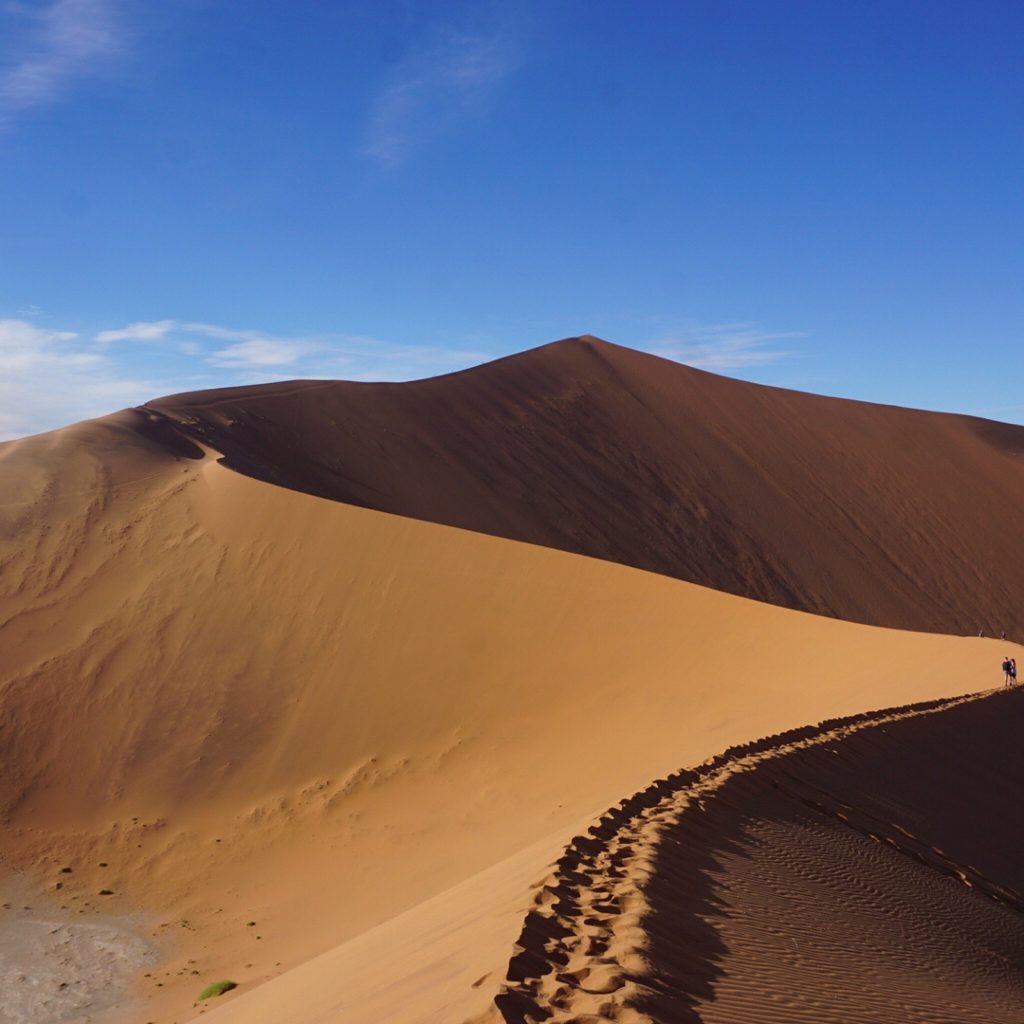
A Namibia desert safari itinerary skips Etosha entirely and spends its time across three separate desert systems: the red Kalahari sands, the Namib dune sea and the fog belt on the Atlantic. The ten night route below runs Windhoek, the Kalahari, NamibRand, Sossusvlei, the Namib gravel plains and Damaraland. It suits travellers who want adaptation rather than abundance.
What a Desert Safari in Namibia Covers
Most Namibian itineraries treat the desert as scenery on the way to the wildlife. A desert led trip treats it as the subject, which changes both the route and what you look at when you get there.
Three distinct systems are involved and they are not variations of the same thing. The Kalahari in the east is a red sand savanna with grass and camel thorn, technically not a true desert at all. The Namib on the west coast is the oldest desert on earth and among the driest, running from the dune sea in the south to the gravel plains further north. The coastal fog belt is different again, a place where almost nothing drinks rainwater and everything drinks mist.
What you get instead of big game is a set of animals and plants doing something difficult. Once you start looking for that, the emptiness stops reading as empty.
Nights 1 and 2: Kalahari Red Dunes and Meerkat Tours
Head southeast or south from Windhoek into the Kalahari, roughly three hours to the lodges around Mariental and the Hardap area. The change from the central highlands is abrupt: long parallel red dunes with grass growing on them, camel thorn trees, and a completely different palette from the Namib.
Activities here are gentle and rewarding. Guided walks with San trackers cover bush food, tracking and traditional technology, and they are among the better cultural experiences in the country when run with the community rather than around it. Several lodges run habituated meerkat visits where you sit on the ground at dawn while a colony emerges and warms up around you.
Game here is plains species rather than predators: oryx, springbok, hartebeest, ostrich and, at night, brown hyena, bat eared fox and aardwolf. Two nights is enough and it sets up the contrast with the Namib.
Nights 3 to 5: NamibRand and the Sossusvlei Dune Sea
West into the Namib proper. The NamibRand Nature Reserve east of Namib-Naukluft covers around 200,000 hectares of private land and is one of the finest places in the country to be quiet in. Wolwedans runs several camps here.
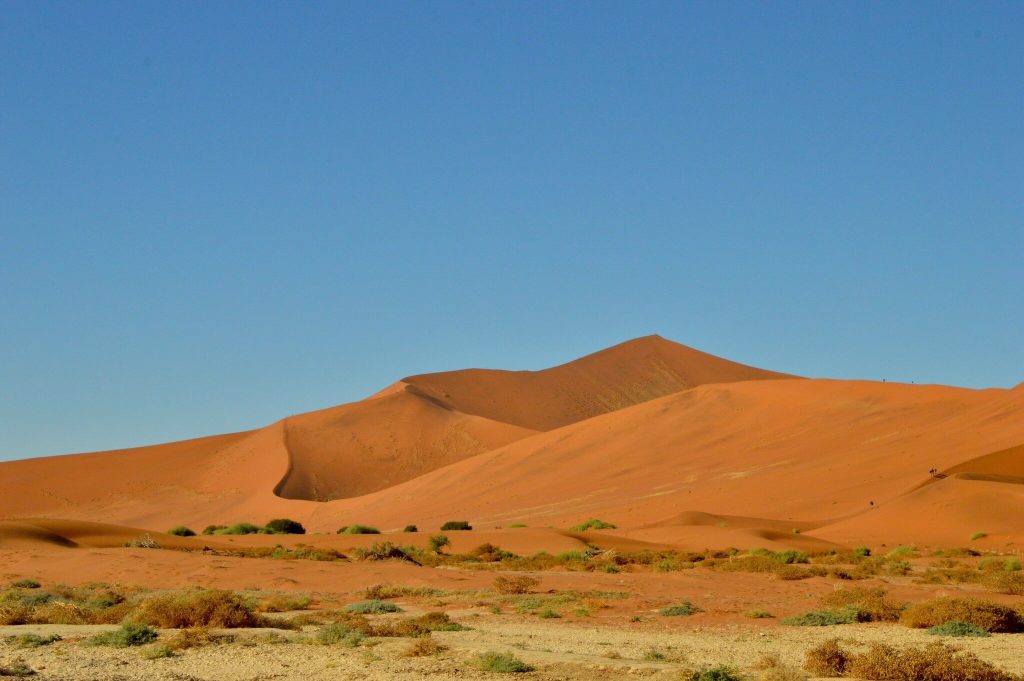
Then Sossusvlei. The star dunes rise past 300 metres and the sand sea is a UNESCO World Heritage site. Deadvlei in the first ninety minutes after sunrise, with the dune behind it still in shadow and the dead camel thorns catching light, is the image that draws people to this country. Big Daddy takes an hour to ninety minutes up the ridge and drops you into the pan.
Three nights across the NamibRand and Sesriem lets you do the pans properly, take a balloon flight, and spend one morning somewhere without other vehicles. If you can book inside the Sesriem gate, guests within the fence pass through the inner gate an hour ahead of everyone else.
Desert Wildlife Watching and Living Desert Tours
This is where a desert safari earns its name, and it happens on foot with a guide rather than from a vehicle. The species are small and almost invisible until someone shows you how to look.
Namaqua chameleon, palmato gecko with translucent skin and enormous eyes, sidewinding adder that vanishes into sand in seconds, the dancing white lady spider, and darkling beetles that climb the dune crest before dawn and stand head down so fog condenses on their backs and runs to their mouths. Guides read tracks and dig animals out of the sand.
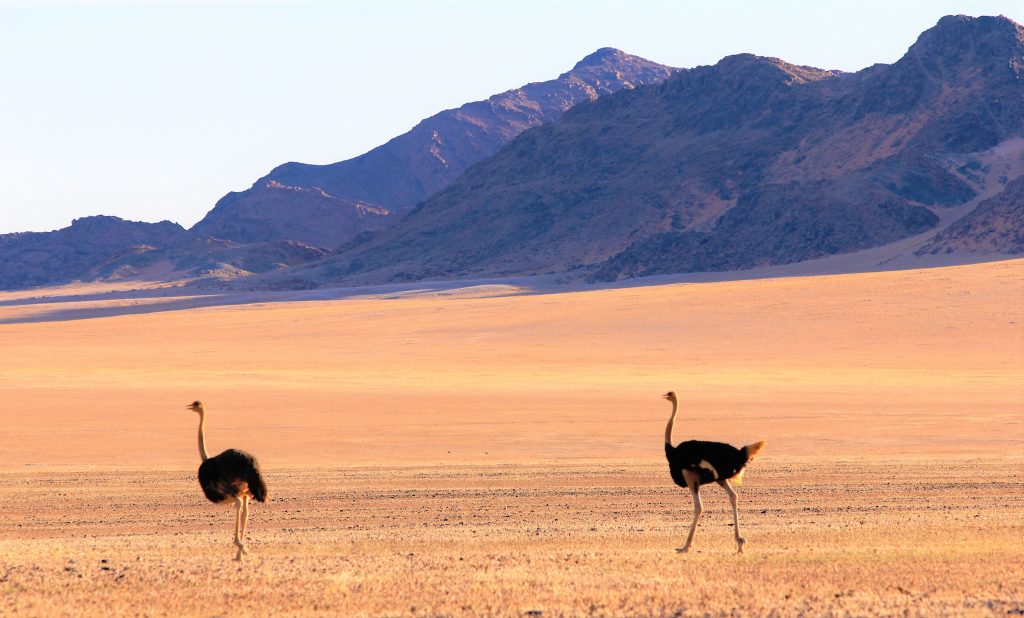
Larger desert species turn up across the route: oryx standing in full sun on open gravel where nothing else will go, springbok, ostrich, Hartmann’s mountain zebra in the rocky west, and brown hyena on the coast. Living desert tours from Swakopmund are the best organised version of this and consistently outrate activities costing three times as much.
Book at least two guided walking activities on a desert trip rather than relying on drives. Almost everything interesting in the Namib is under fifteen centimetres long and buried, and you will walk past all of it without a guide. This is the single difference between a desert safari and a scenic drive through a desert.
Nights 6 and 7: The Namib Gravel Plains and Sandwich Harbour
Head northwest to the coast, five to six and a half hours over the Gaub and Kuiseb passes on the C14. That drive crosses the gravel plains of the Namib section and is one of the emptiest stretches in the country.
From a base at Swakopmund, the Namib section of Namib-Naukluft holds the welwitschia plains and Moon Valley, reached on a loop inland and needing a permit arranged beforehand rather than at a gate. The welwitschia is the plant the desert is known for, growing two leaves that keep extending for a lifetime that can pass a thousand years.
Sandwich Harbour south of Walvis Bay is where the dune sea runs straight into the Atlantic, reached by guided 4×4 along the beach and timed around the tide. It is the most dramatic meeting of desert and ocean anywhere on this coast and it cannot be self driven sensibly.
Nights 8 and 9: The Skeleton Coast and Damaraland Desert
North up the salt road past Cape Cross Seal Reserve, where tens of thousands of Cape fur seals occupy the shoreline, and on towards the Ugab gate of Skeleton Coast National Park. The southern section is open to self drivers with a permit and gate timings are stricter than most Namibian parks.
Turning inland brings you to Damaraland, which is desert of another kind again: red rock, flat topped mountains and dry riverbeds where desert adapted elephant range across enormous distances between water. Sightings are uncertain and depend entirely on where the herds have moved.
Rock art at Twyfelfontein sits here, along with the Petrified Forest near Khorixas, where fossilised tree trunks lie in gravel having arrived by flood long before this became a desert. It is the deep time end of a desert trip.
Stargazing in the NamibRand Dark Sky Reserve
The NamibRand holds International Dark Sky Reserve status, the only one on the African continent. There is almost no artificial light for an enormous distance and the air is exceptionally dry, which is the combination that makes this exceptional rather than merely good.
Several lodges run guided stargazing with telescopes, and Sossusvlei Desert Lodge has an on site astronomer. Star beds and rooftop sleep outs are widely available across the desert properties.
Winter nights give the clearest air and are cold enough that people give up earlier than they meant to. Check new moon dates against your travel window, since a full moon washes out the Milky Way entirely.
Desert Plants: Welwitschia, Quiver Trees and Lichen Fields
The botany here is stranger than the wildlife and it gets overlooked. Welwitschia mirabilis is neither tree nor shrub but its own branch of the plant family tree, producing exactly two leaves that grow, split and fray for the whole of a life that can run past a thousand years. The Welwitschia Drive inland of Swakopmund holds specimens believed to be that old.
Quiver trees, actually aloes, stand across the south with the finest concentration in the forest outside Keetmanshoop. Nara melons anchor dune hummocks and survive on fog. Camel thorn trees line the dry riverbeds and are what died at Deadvlei.
The lichen fields on the gravel plains are the ones to be careful about. They look like grey stones, they are alive, they take decades to recover from a single vehicle track, and driving off marked roads across them is prohibited for that reason.
How This Differs From a Standard Namibia Itinerary
The obvious omission is Etosha, which means no lion, no elephant herds at waterholes and no floodlit rhino watching. That is a substantial thing to give up and it should be a deliberate choice rather than an accident of planning.
What you gain is time. The standard circuit gives Sossusvlei two nights and rushes the coast. This route gives the Namib five and lets you add the Kalahari, which almost no first trip includes although it sits three hours from Windhoek.
It suits repeat visitors, photographers, botanists and travellers who have already done a big game safari elsewhere and want something different. First time visitors wanting a complete picture of Namibia should take the standard ten or fourteen day circuit instead.
Best Time for a Namibia Desert Safari
May to September gives comfortable daytime temperatures for walking and dune climbing, along with the clearest air for photography and stargazing. Desert nights in June and July drop close to freezing, so pack far more warm clothing than a trip to Africa suggests.
October through February brings interior temperatures above 40 degrees, which limits all activity to the early morning. The compensation is dramatic storm skies, far fewer people, lower rates and the rare chance in a strong rainfall year of seeing water reach the Sossusvlei pan. The coast stays cool throughout, which makes a summer desert trip weighted towards Swakopmund workable.
Entry Requirements and Getting There
International flights land at Hosea Kutako International Airport outside Windhoek, with vehicles collected there. Walvis Bay is the alternative if you want to start on the coast and work inland.
Entry rules changed recently and much published advice is out of date. Namibia withdrew visa free entry for many European, North American and Australasian passports, so travellers from those countries now need a visa on arrival or a holiday visa arranged online in advance, with six months of passport validity and three blank pages.
Namibia Desert Safari Questions
What does a Namibia desert safari cost?
Self driving with mid range lodges, two people can expect roughly 400 to 450 US dollars a day, so around 4,000 to 4,500 for ten nights. Using the premium desert camps at NamibRand and Sossusvlei pushes that far higher, since those run from about 600 US dollars per person per night into four figures. A balloon flight adds several hundred dollars per person. Park fees were revised upward recently to roughly 200 to 280 Namibian dollars per international adult per day, and permits for the Welwitschia Drive and Sandwich Harbour must be arranged in advance.
Is a desert safari worth it without Etosha?
For the right traveller, yes, and for a first visit to Namibia, probably not. Dropping Etosha means no lion, no elephant herds and no floodlit waterhole evenings, which is a great deal to forgo. This route suits repeat visitors, photographers and anyone who has done a big game safari elsewhere and wants something genuinely different. First timers are better served by the standard circuit with Etosha included.
What wildlife will I actually see on a desert safari?
Oryx everywhere, along with springbok, ostrich, Hartmann’s mountain zebra in the rocky west and Cape fur seals on the coast. Brown hyena, black backed jackal and bat eared fox are present, mostly at night. The genuinely interesting sightings are small: chameleons, geckos, sidewinding adders, fog basking beetles and the dancing white lady spider, none of which you will find without a guide. Desert adapted elephant in Damaraland are a possibility rather than a certainty.
How many deserts does this itinerary cover?
Three distinct systems. The Kalahari in the east, which is red sand savanna rather than true desert. The Namib dune sea around Sossusvlei and the NamibRand. And the gravel plains and coastal fog belt further north, where life runs on mist rather than rain. Adding Damaraland brings a fourth character again, rocky rather than sandy.
Do I need a 4×4 for a desert trip?
More than on a standard circuit, yes. The main routes are manageable in a two wheel drive during the dry season, but the final five kilometres to the Sossusvlei pans is deep sand, the Damaraland tracks want clearance, and the coastal and Skeleton Coast routes vary. Sandwich Harbour should be done with an operator regardless of what you are driving, since it is tide dependent and soft.
When is the best time for desert photography?
The first and last ninety minutes of daylight, in any month. Deadvlei needs early morning in particular, when the dune behind the pan is still shadowed. For clear air and long shadows, May through September. For dramatic cloud, October and November as the storms build. Check new moon dates if the night sky is part of the plan, since a full moon removes the Milky Way entirely.
Can I combine a desert safari with a wildlife trip?
Yes, and that is what the standard fourteen day circuit does, though it gives less time to each. A cleaner plan on a longer trip is to run this desert route and then add three or four nights at Etosha at the end rather than folding the park into the middle. Two weeks makes that comfortable and ten days does not.
Booking Your Namibia Trip
The safari companies and tour operators listed on this website put trips like this together for a living and know which camps, guides and routes actually deliver. We are an independent guide to Namibia; we do not book or sell tours ourselves.
When you are ready, arrange your safari, tour or holiday with one of the recognised operators listed here. Tell them your dates and what matters most, and a real person, not a form, will handle the itinerary, park bookings and logistics for you.