Namib-Naukluft National Park
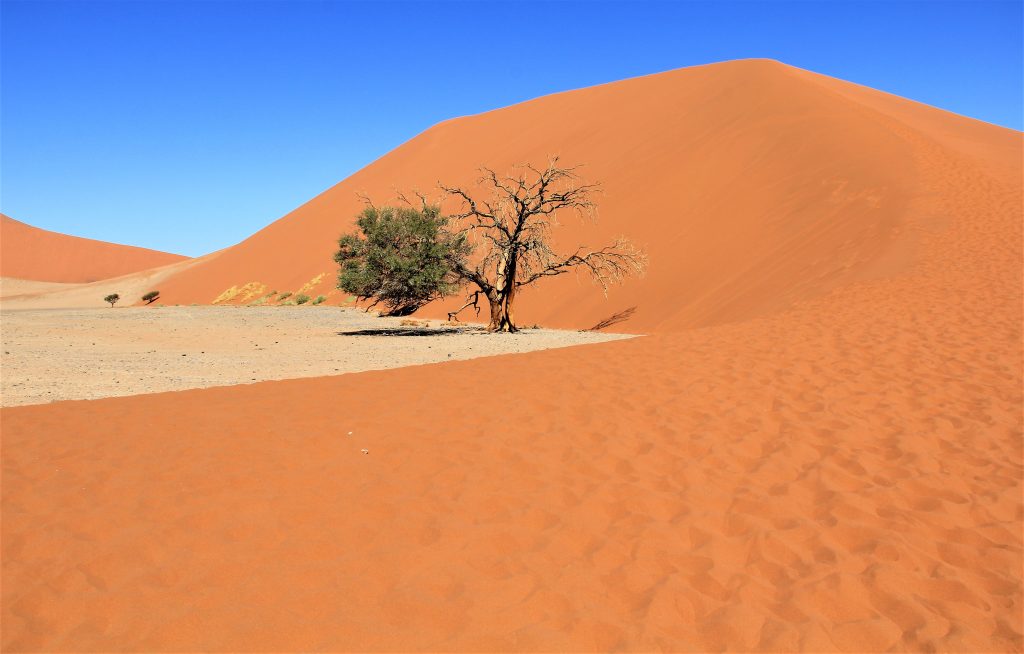
Namib-Naukluft National Park is Africa’s largest national park, covering close to 50,000 square kilometres of western Namibia in four distinct sections: the dunes at Sossusvlei and Sesriem, the Naukluft mountains, the gravel plains of the Namib section, and the Sandwich Harbour lagoon. Visitors reach different sections from Sesriem, Windhoek and Walvis Bay, and some areas need permits arranged in advance. The park protects part of the oldest desert on earth.
Namib-Naukluft Safari Sections and How They Differ
Treating this as one destination is the mistake most first time planners make. The park runs from the Atlantic shoreline to the foot of the Great Escarpment, and its four sections have almost nothing in common beyond aridity. You cannot see them on one trip without a lot of driving, and most visitors only ever set foot in one.
The park grew by accretion rather than design. A German era game reserve came first, the Sandwich Harbour area was folded in decades later, and the Naukluft Mountain Zebra Park was added after the government bought out fourteen commercial farms to protect Hartmann’s mountain zebra. Those pieces were amalgamated into the park as it now stands. Since then it has been grouped into an even larger conservation complex running the length of the Namibian coast.
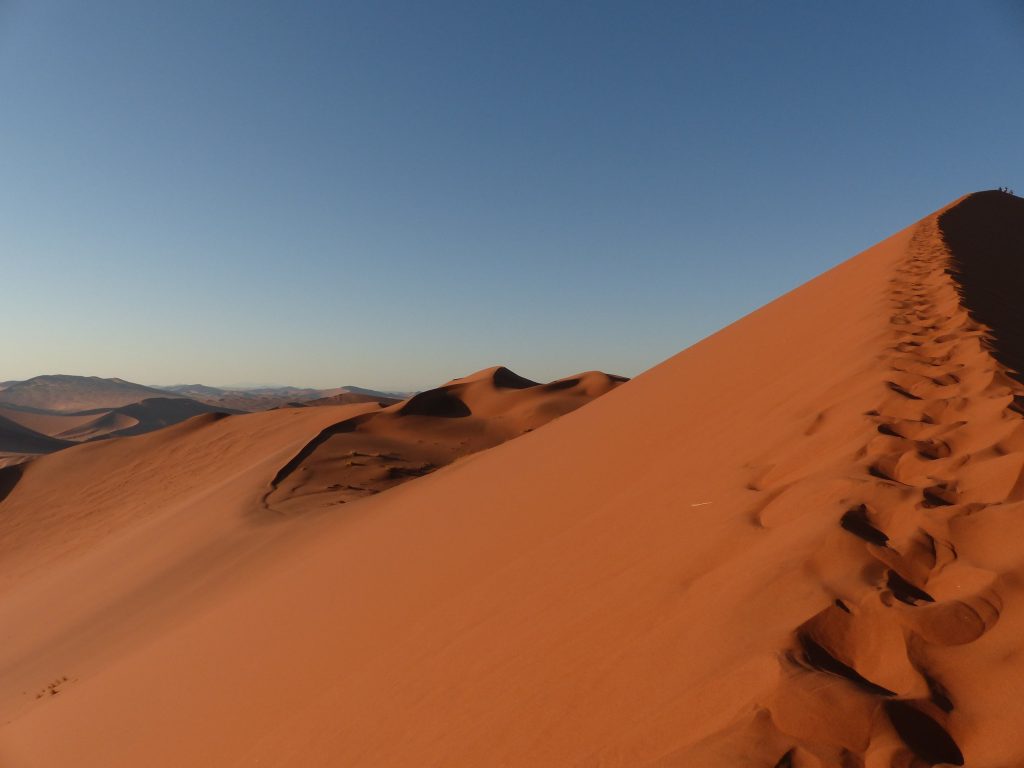
Sesriem and Sossusvlei. The southern dune section and the one nearly everyone visits. Star dunes past 300 metres, clay pans, Sesriem Canyon. Reached from Sesriem gate.
Naukluft. Mountains rising towards 2,000 metres on the eastern edge. Semi desert savanna, springs, hiking trails and a 4×4 route. Almost no dune tourists come here.
Namib section. Gravel plains inland of Swakopmund, holding the Welwitschia plains and Moon Valley. Usually visited as a day trip from the coast.
Sandwich Harbour. A lagoon and bay roughly 45 kilometres south of Walvis Bay where dunes meet the sea. Reached only by guided 4×4 along the beach.
Sossusvlei and Sesriem Tours in the Southern Dune Section
The southern section holds the Namib Sand Sea, one of Namibia’s two UNESCO World Heritage sites, and the dunes here rank among the tallest on earth. This is where the pans sit: Sossusvlei itself, Deadvlei with its dead camel thorn trees, and the quieter Hiddenvlei. Sesriem gate is the way in and the Ministry office there is where park fees are settled.
A Sossusvlei tour runs 60 kilometres of tar from the inner gate to a 2WD car park, then five kilometres of deep sand that needs a 4×4 or the shuttle. Dune 45 sits beside the road at the 45 kilometre mark. Sesriem Canyon, a narrow slot the Tsauchab has cut about a kilometre into the rock, is close to the gate and takes well under an hour.
Since this section is covered in depth on its own page, the short version is this: stay inside the park fence if you can, because the inner gate opens an hour ahead of the outer one and that hour is the difference between good light and flat light.
Naukluft Mountain Hiking Trails and 4×4 Adventures
The Naukluft massif is the part of the park that gets forgotten. Limestone mountains reaching towards 2,000 metres, cut by kloofs with permanent springs, holding semi desert savanna rather than sand. It draws hikers and it draws almost nobody else.
Naukluft hiking here is serious rather than casual. The long circuit trails run over several days through rough terrain with chain assisted sections, and they are restricted to fit walkers in parties with the right registration. Shorter day trails from the Naukluft campsite are far more manageable and give the same country in miniature. There is also a multi day 4×4 route through the mountains for self sufficient drivers.
Wildlife is easier to see here than in the dunes. Hartmann’s mountain zebra move through the rocky ground in numbers, along with kudu, klipspringer, baboon and dassie rat. Leopard are present and almost never seen.
If you have hiking in mind, the Naukluft section is the one to build the trip around, not Sossusvlei. Dune climbing is a forty minute effort. The Naukluft trails are multi day mountain walking in a place with no shade and long gaps between water, so registration, planning and a realistic assessment of fitness all matter.
Namib Section Tours: Welwitschia Drive and Moon Valley
Inland from Swakopmund the park turns into flat gravel plains streaked with lichen fields, and this is where you find the welwitschia. The plant looks like a heap of torn leather straps and it is not a shrub or a tree but something on its own branch of the family tree, growing two leaves that keep extending for the whole of its life. Individual specimens on the Welwitschia Drive are believed to have been alive for well over a thousand years.
Moon Valley sits on the same circuit, an eroded valley of the Swakop River cut into a series of bare rounded hills. Both are usually done as a half day or full day desert tour from Swakopmund rather than from Sesriem, since they are far closer to the coast.
A permit is needed for the Welwitschia Drive, obtained from Ministry offices in Swakopmund or Windhoek rather than at a gate. That catches people out, because there is no barrier where you can pay on the way in.

Sandwich Harbour 4×4 Tours from Walvis Bay
Sandwich Harbour is where the sand sea runs straight into the Atlantic, a lagoon roughly ten kilometres long backed by dunes and fringed with reeds. Bird numbers here are enormous, well into six figures across flamingo, pelican, cormorant and migrant waders, which makes it one of the more important wetlands on this coast.
Getting there is the experience as much as the destination. Sandwich Harbour 4×4 tours run south from Walvis Bay along the beach and over the dune faces, timed around the tide, because at high water the beach route closes and vehicles have to go over the top. Self driving is a bad idea unless you know the tides and the sand intimately, and most visitors go with an operator for good reason.
Permits apply for this section too, and camping needs one arranged ahead. Operators handle the paperwork as part of the tour.
Desert Wildlife Watching in Namib-Naukluft
Nobody comes here for big game and it would be dishonest to suggest otherwise. What the park holds is a set of animals doing something difficult, which is living in a place with almost no rain.
Oryx are the animal you will see most, standing out on open gravel in full sun where nothing else will go, able to let their body temperature rise rather than sweating water away. Springbok and ostrich are common on the plains. Steenbok and kudu work the drainage lines. Brown hyena and black backed jackal are around, mostly at night, and the coastal population of brown hyena scavenges along the shoreline.
The smaller residents are more interesting than the list suggests. Namaqua chameleon, sidewinding adder, palmato gecko, dune beetles that stand on the dune crest at dawn and let fog condense on their backs to drink. Several lodges run guided walks built around these, and a good guide finds things you would step past a hundred times.
Birding Safaris in the Naukluft Mountains and Sandwich Lagoon
Around 200 to 350 bird species have been recorded across the park depending on which section and which count you follow. The dune country is not where the numbers are. For a productive birding safari, head either to the Naukluft mountains or to the coast.
The dune lark is the one many birders come for, since it is Namibia’s only true endemic bird species and lives nowhere but this desert. Rüppell’s korhaan, Ludwig’s bustard, Herero chat and lappet faced vulture all occur. On the coast at Sandwich, African black oystercatcher joins the waders, and Palearctic migrants arrive from roughly November through April.
Camping and Lodge Options for a Namib-Naukluft Safari
Accommodation splits by section, and there is no single base that serves the whole park.
Sesriem area. Sesriem Campsite and Sossus Dune Lodge inside the fence, Dead Valley Lodge just within the gate, plus a spread of lodges and campsites outside from budget to very high end.
Naukluft. A campsite at the foot of the mountains with pitches, trailheads and nature walks. Basic and quiet. Bring everything you need with you.
Central Namib. Around fifty scattered campsites across the gravel plains, mostly unfenced pitches with minimal facilities, permit required. For self sufficient travellers only.
Swakopmund and Walvis Bay. The practical base for the Namib section and Sandwich Harbour. Full range of hotels and guesthouses, with day tours running into the park from both towns.

Permits and Park Rules for Namib-Naukluft Trips
The permit position is the single most confusing part of visiting this park, mostly because different sections work differently. At Sesriem you pay at the Ministry office by the gate, and it can often be settled on the way out rather than the way in. For Welwitschia Drive, Sandwich Harbour and camping in the central Namib, permits have to be arranged beforehand at Ministry offices in Windhoek or Swakopmund. Turning up without one at those sections means turning around.
Most of the park is unfenced and much of it has no infrastructure at all. Driving off marked tracks damages lichen fields that take decades to recover and is prohibited. Carry water for more than you plan to use, tell someone your route, and do not rely on a mobile signal, because across most of this park there is none.
Best Time for a Namib-Naukluft Safari
Winter, roughly May through September, suits everything the park offers. Daytime temperatures sit in the low to middle twenties, the air is dry and clear, and mountain hiking and dune climbing are both realistic. Predawn temperatures near Sesriem drop close to freezing in June and July, so the cold catches people out far more than the heat does at that time of year.
Summer, from November to March, brings daytime highs above 40 degrees inland. Physical activity has to happen before eight in the morning. The upside is fewer visitors, lower rates, dramatic storm skies and, in strong rainfall years, the rare sight of water reaching the pans. The coastal sections behave differently again, staying cool and often fogbound year round, so Sandwich Harbour and the Welwitschia plains are comfortable when the interior is not.
Getting to Namib-Naukluft National Park
For the southern dune section, Sesriem lies roughly 350 kilometres southwest of Windhoek, four and a half to six hours on a mix of tar and gravel, with Solitaire the usual fuel and food stop. From Swakopmund it is around 345 kilometres.
For the Namib section, start in Swakopmund and drive out on the day. For Sandwich Harbour, start in Walvis Bay and go with an operator. The Naukluft campsite is reached from the C14 or via Büllsport, around 250 to 300 kilometres from Windhoek depending on route.
Light aircraft serve airstrips near several Sesriem area lodges from Windhoek and Swakopmund, which suits travellers combining the desert with Etosha or the Skeleton Coast on a short itinerary.
Namib-Naukluft National Park Questions
How much does it cost to enter Namib-Naukluft National Park?
Park fees have been revised upward recently and the published figures on the open web disagree badly as a result. Older sources quote 80 to 150 Namibian dollars per adult per day with a small vehicle charge on top, while the current schedule for major parks sits materially higher, likely in the 200 to 280 Namibian dollar range per international adult once the conservation levy is included. SADC and Namibian residents pay reduced rates and young children usually enter free. Confirm the figure at the Sesriem office or with Namibia Wildlife Resorts rather than relying on any number you find online. Fees are valid for 24 hours from entry.
Do I need a permit for Welwitschia Drive and Sandwich Harbour?
Yes for both, and neither can be bought at a gate. Permits come from Ministry of Environment offices in Windhoek or Swakopmund and need arranging before you set off. Camping in the central Namib section also requires one. The Sesriem and Sossusvlei section is different, since fees are handled at the park office beside the gate. Booked tour operators sort the paperwork out on your behalf.
What does accommodation in the park cost?
Campsites at Sesriem have run in the region of 780 to 980 Namibian dollars per pitch per night. Lodges just outside the gate typically fall between 200 and 300 US dollars per room. The private reserve properties east of the park charge from roughly 600 US dollars per person per night into four figures, all inclusive. Naukluft and central Namib campsites are considerably cheaper and considerably more basic, with facilities that in some cases amount to a pitch and a long drop.
Is Namib-Naukluft the same thing as Sossusvlei?
No, though the names get used interchangeably. Sossusvlei is one pan in the southern dune section of the park. The park itself is nearly 50,000 square kilometres and takes in mountains, gravel plains and a coastal lagoon alongside the dunes. Almost all visitor traffic goes to the Sossusvlei area, which is why the two names have blurred together.
Can I see the Big Five here?
No. There are no elephant, rhino, lion or buffalo in this park, and leopard are present but hardly ever seen. This is a desert ecology park rather than a game park. Oryx, springbok, ostrich, Hartmann’s mountain zebra and a range of specialised reptiles and insects are what you come for. If big game is the priority, pair the desert with Etosha rather than expecting both in one place.
How many days should I allow?
Two nights at Sesriem covers the dune section properly. Add a day either side if you want Sesriem Canyon and a second morning at a quieter pan. The Namib section works as a day trip from Swakopmund and Sandwich Harbour as a half day from Walvis Bay. The Naukluft trails need three to five days on their own. Seeing all four sections realistically means a two week Namibian itinerary.
Is a 4×4 needed for the park?
It depends entirely on the section. The gravel roads to Sesriem and the tar road inside the dune section are fine in an ordinary car. The last five kilometres to the pans, the Naukluft 4×4 route and the beach run to Sandwich Harbour all need proper four wheel drive and, on the coast, real experience with tides and soft sand. Hiring a 4×4 for a Namibian road trip is worth doing anyway, mostly for clearance on corrugated gravel.
Booking Your Namibia Trip
The safari companies and tour operators listed on this website put trips like this together for a living and know which camps, guides and routes actually deliver. We are an independent guide to Namibia; we do not book or sell tours ourselves.
When you are ready, arrange your safari, tour or holiday with one of the recognised operators listed here. Tell them your dates and what matters most, and a real person, not a form, will handle the itinerary, park bookings and logistics for you.