Lions in Namibia
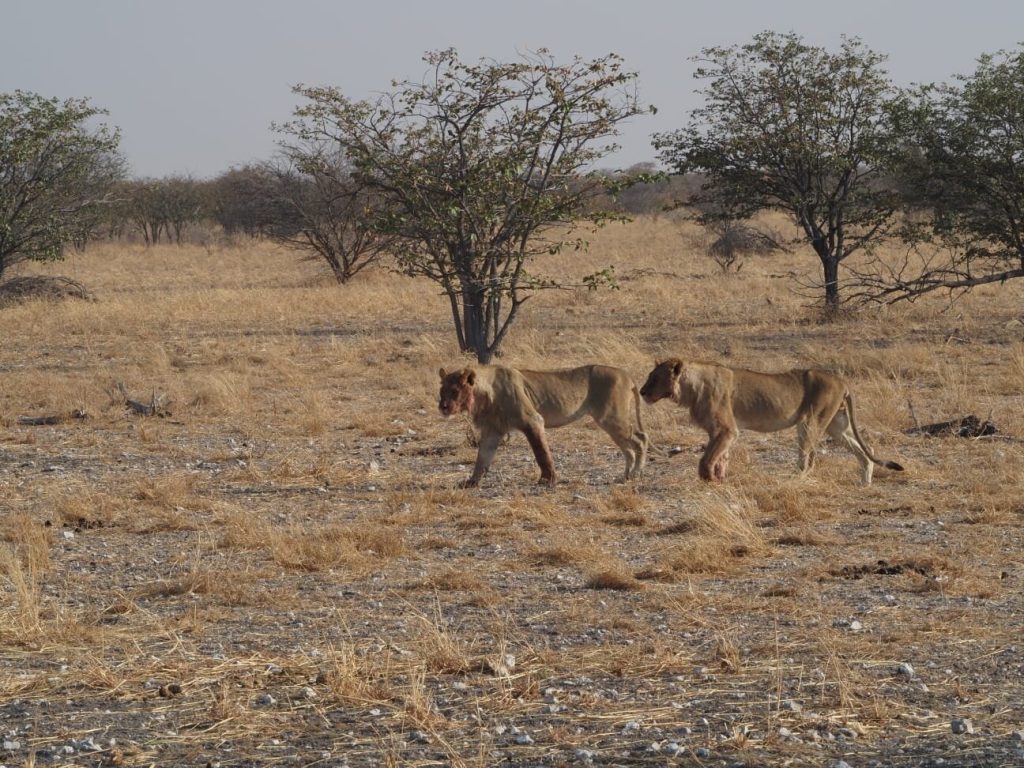
Lions in Namibia occur in three main areas: Etosha National Park, which holds the country’s largest population, the Zambezi Region parks in the northeast, and the arid Kunene in the northwest. Etosha is where nearly all visitors see them, with densities of roughly 1.6 to 2.7 lions per hundred square kilometres. The national population has been surprisingly little studied.
Where Lions Occur in Namibia
Lion distribution here is patchy rather than continuous, and the three main strongholds are quite different from one another.
Etosha National Park holds the largest concentration, with published density figures of around 1.6 to 2.7 lions per hundred square kilometres, which across a park of 22,270 square kilometres puts the population in the range of several hundred animals. Estimates commonly cited run to three or four hundred lions across roughly twenty five prides.
The Kunene Region in the northwest holds the desert adapted lions, a small population living at densities around 0.5 to 0.7 per hundred square kilometres. These are covered separately on our desert lions page, since their ecology and the conservation issues around them differ substantially from the rest of the country.
The Zambezi Region parks in the northeast hold lion as part of the wider transfrontier population moving across borders with Botswana, Angola and Zambia. Khaudum and the Tsumkwe area to the south hold further animals.
Across the continent, lion range has been reduced to roughly 12 percent of its historical extent, with somewhere between 20,000 and 30,000 free-ranging lions remaining in Africa and the species listed as vulnerable.
How Little We Actually Know
This is worth stating because it is unusual and it affects how any figure should be read.
Between the start of the last century and recent years, only six lion population or density surveys were published for Namibia. Over comparable periods South Africa produced 33 and Tanzania 41. For a country with the lowest human population density in Africa and correspondingly large potential for unfenced lion range, that is a striking gap.
The consequence is that the Etosha lion population, the country’s largest, is less well quantified than populations a fraction of its size elsewhere. Figures of three to four hundred animals are widely repeated and rest on a thinner evidence base than the confidence with which they are quoted suggests.
The one population now counted properly is the desert adapted lions of the Kunene, following a systematic survey across their entire range. The contrast is instructive: doing it took four teams, 45 surveyors and nine weeks over 41,000 square kilometres.
Lions in Etosha
Etosha is where a visitor will see lions, and the way the park works makes it unusually good for it.
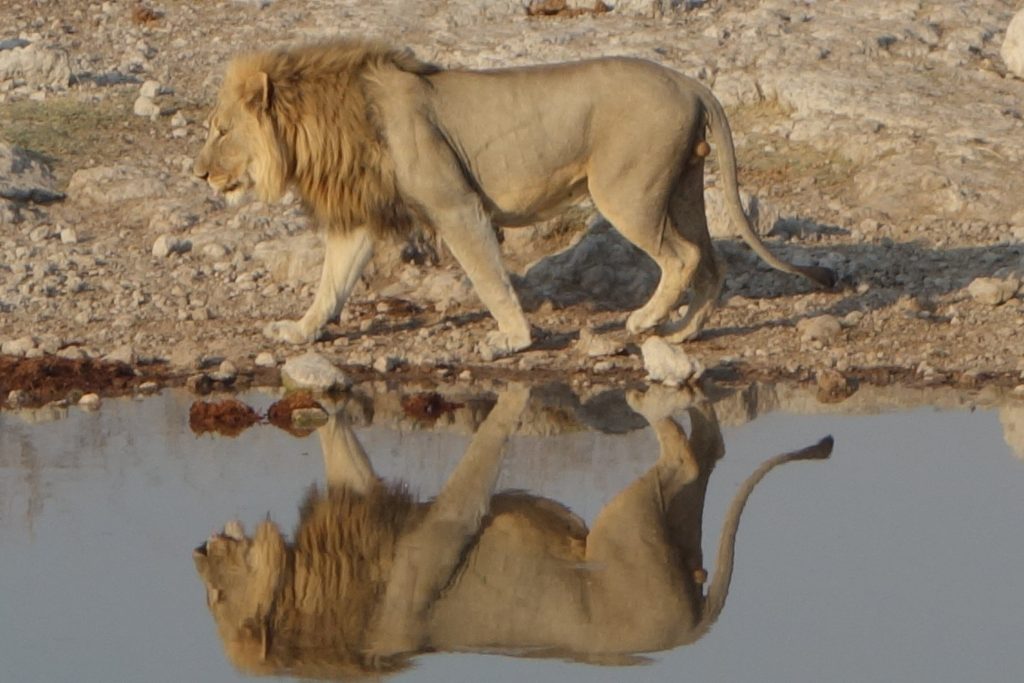
The absence of rivers means every animal must drink at one of around forty springs and boreholes through the dry season, which concentrates both prey and predators. Unlike riverine parks where lions rest through the heat and hunt at night, Etosha’s open terrain and temperatures bring lions to water in daylight.
Okondeka, a natural fountain on the western pan edge north of Okaukuejo, has the strongest reputation, often producing a pride over a kill. Salvadora on the central pan edge is reliable and also the best bet for cheetah. Rietfontein, Kalkheuwel, Chudop and Ombika all produce lions regularly.
The floodlit waterhole at Okaukuejo brings lions in at night, sometimes alongside elephant and black rhino, which is a combination available almost nowhere else. Sit and wait rather than driving between waterholes, since predators frequently appear only after thirty to sixty minutes.
Long term lion research has run from the Etosha Ecological Institute at Okaukuejo for decades, one of the longer running programmes on the continent even if publication has been sparse.
Etosha’s lions drink in daylight, which is genuinely different from most African parks. That means the middle of the morning at a productive waterhole is not the waste of time it would be in a riverine reserve. Park at Okondeka or Salvadora, switch off, and give it a full hour before deciding nothing is happening.
Conflict on Etosha’s Borders
The uncomfortable statistic about Namibian lions concerns what happens when they leave the park.
Over a period of roughly thirty five years, an average of 29 lions per year were destroyed along Etosha’s boundaries, on the farmland surrounding the park where lions cross out and take livestock. That is a substantial and sustained offtake from the population, and it went largely unremarked for decades.
In the western range in the Kunene, at least 37 lion deaths from human lion conflict were recorded over a ten year period, which is fewer in absolute terms but far more consequential given how small that population is.
These mortalities have fallen disproportionately on males. By one assessment the sex ratio in the desert adapted population had reached roughly one male for every five and a half females, well outside the range recorded elsewhere. Male biased mortality happens because males range further, disperse into farmland and are more likely to run into livestock and people.
A population cannot sustain itself without males, which is why the skew matters more than the raw number of deaths.
Lion Prides and Behaviour in Arid Country
Namibian lions live at lower densities and in smaller groups than their counterparts in East Africa, and the reason is prey.
Where prey is thinly spread, large prides cannot feed themselves, so groups tend to be smaller and territories larger. Etosha prides are more substantial than those in the Kunene, reflecting the higher prey density around the waterholes, but even there the ecology is different from the Serengeti or the Masai Mara.
Diet in Etosha centres on zebra, wildebeest, springbok, oryx and giraffe, with elephant calves taken occasionally. Prides organise their movements around waterholes rather than following migrating herds, since the herds here do not migrate so much as commute to water.
They hunt mainly at night and in the cooler hours, though the daylight drinking behaviour brings them into view far more than in bush parks.
Lion Monitoring and Collaring
Namibian lion work has become considerably more sophisticated in recent years, driven largely by the conflict problem.
In the Kunene, 47 GPS and satellite collars have been fitted to lions across the region, feeding movement data to community based rangers who warn livestock owners when animals come close. Trail cameras and mobile reporting software support the same work.
The survey teams also used a technique worth knowing about: individual lions are identified by their whisker spot patterns, the arrangement of spots below the whiskers on each side of the face, which is unique to each animal in small and medium populations and does not change with age. It allows an accurate total count without collaring every animal.
In Etosha, research from the Ecological Institute has run for decades, and collared animals there add to what is known about movement and mortality along the park boundary.
Where to See Lions in Namibia
Etosha, by a wide margin, and the southern waterhole circuit within it.
Okondeka, Etosha. Natural fountain on the western pan edge north of Okaukuejo. The strongest lion reputation in the park, often with a pride over a kill. Afternoon light is best.
Salvadora and Rietfontein. Central pan edge waterholes with open surroundings and regular lion. Salvadora is also the best cheetah spot. Mornings work well.
Okaukuejo floodlit waterhole. Lions come in at night alongside elephant and black rhino, viewable on foot from the platform. Available only to guests staying inside the fence.
Private reserves. Ongava on Etosha’s southern boundary and Erindi in the centre hold established prides, with night drives and off road driving that the park does not permit.
Kunene desert lions are a different proposition entirely, with fewer than sixty adults across tens of thousands of square kilometres, and are covered separately.
Best Time to See Lions in Namibia
The dry season from May to October, with July through September strongest. Water disappears from the veld, prey concentrates at the remaining springs, and lions concentrate with it.
October is the most intense month of all, with animals under real pressure at drying waterholes, though the heat is punishing. In the green season from November to April, water is everywhere, herds disperse, high grass hides everything and lion sightings become far less reliable.
Time of day matters less in Etosha than in most parks because of the daylight drinking. Early morning and late afternoon remain best for activity, but a mid morning wait at a good waterhole is a reasonable use of time here.
Lions in Namibia Questions
How many lions are there in Namibia?
There is no reliable national figure, which is itself notable. Etosha holds the largest population, with densities of roughly 1.6 to 2.7 lions per hundred square kilometres and commonly cited estimates of three to four hundred animals across about twenty five prides. The Kunene desert adapted population was counted properly for the first time at 57 to 60 adults. The Zambezi Region holds further animals as part of a transfrontier population.
Where is the best place to see lions in Namibia?
Etosha National Park, and within it the southern waterhole circuit. Okondeka north of Okaukuejo has the strongest reputation, with Salvadora, Rietfontein, Kalkheuwel and Ombika all producing regularly. The floodlit waterhole at Okaukuejo brings lions in at night alongside elephant and rhino. Private reserves such as Ongava and Erindi offer night drives and off road following that the park prohibits.
Are Namibian lions different from other African lions?
They are the same species, Panthera leo, though those in arid areas live at lower densities, in smaller prides and across larger territories than lions in East Africa, because prey is thinly spread. The desert adapted lions of the Kunene take that further, with some individuals hunting seals on the Atlantic coast. Etosha lions also drink in daylight far more than lions in riverine parks, which makes them easier to see.
Why do Etosha lions drink during the day?
Open terrain and heat. In riverine parks with dense cover, lions rest through the day and drink at night. In Etosha there is nowhere to hide and no alternative water, so predators come to the springs and boreholes during daylight hours, particularly in the peak dry season. That behaviour is the main reason Etosha delivers better lion viewing than its density figures alone would suggest.
How many lions are killed in conflict with farmers?
More than most visitors realise. Over roughly thirty five years, an average of 29 lions a year were destroyed along Etosha’s boundaries where animals cross onto surrounding farmland. In the Kunene, at least 37 conflict deaths were recorded over a ten year period, which matters far more in a population of under sixty adults. Mortality falls disproportionately on males, skewing the sex ratio badly.
How are lions identified for research?
By whisker spots. The arrangement of spots below the whiskers on each side of a lion’s face is unique to the individual in small and medium sized populations, and it does not change as the animal ages. Survey teams photograph both sides of the face to identify each animal without needing to collar it. In the Kunene this is combined with 47 GPS and satellite collars feeding movement data to community rangers.
Is it safe to camp in lion country in Namibia?
Inside Etosha the rest camps are fenced and safe, and the floodlit waterhole platforms are secured. Outside fenced camps, follow the same rules that apply anywhere in lion country: sleep inside a tent or vehicle, do not walk around after dark, keep food secured and follow any briefing from camp staff. Incidents involving visitors are rare and almost always follow ignored advice.
Booking Your Namibia Trip
The safari companies and tour operators listed on this website put trips like this together for a living and know which camps, guides and routes actually deliver. We are an independent guide to Namibia; we do not book or sell tours ourselves.
When you are ready, arrange your safari, tour or holiday with one of the recognised operators listed here. Tell them your dates and what matters most, and a real person, not a form, will handle the itinerary, park bookings and logistics for you.