Gondwana Canyon Park
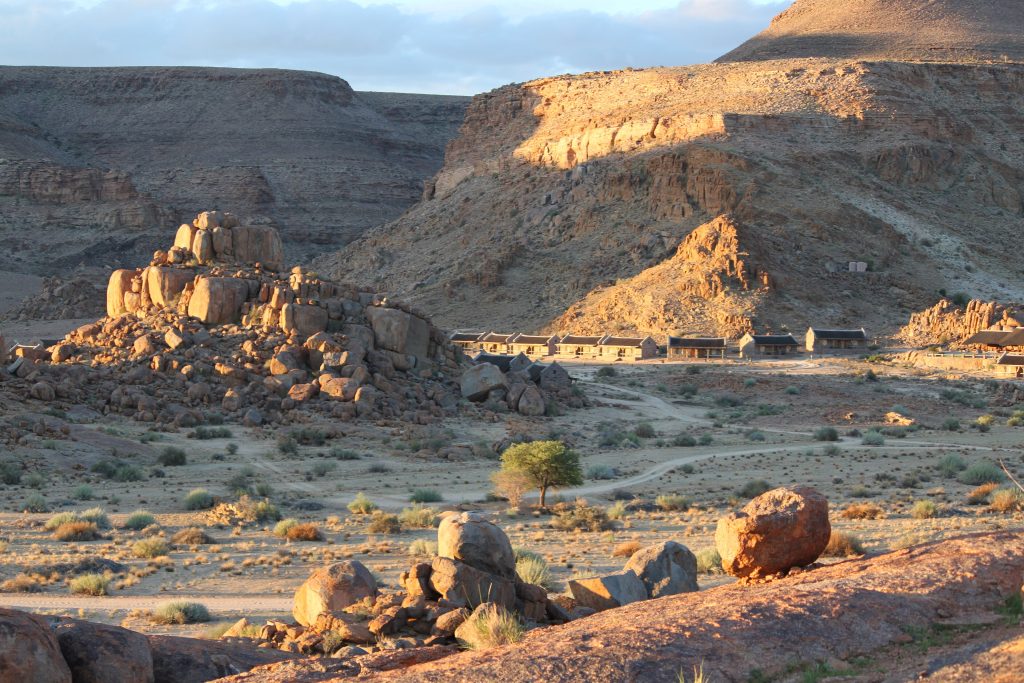
Gondwana Canyon Park is what happens when overgrazed sheep farms are bought up and the fences come down. A private reserve adjoining Fish River Canyon in southern Namibia, assembled from former farmland and rehabilitated over decades, it now supports game the land had lost and offers the accommodation most canyon visitors use.
What It Is
The reserve sits in the far south, adjoining the Fish River Canyon conservation area, and it was built rather than proclaimed.
Former sheep and livestock farms in this country were degraded by generations of overgrazing in marginal semi desert. The land had lost much of its grass cover and most of its wildlife.
Those farms were bought and consolidated, internal fences removed, livestock taken off and the land allowed to recover, with game reintroduced as conditions improved.
The result is a substantial private conservation area alongside one of Namibia’s flagship natural sights, funded by tourism rather than by the state.
It is the same model as the Erongo Mountain Nature Conservancy and NamibRand, applied in the far south: private landowners converting farmland to conservation and paying for it through low volume tourism.
The park’s lodges are the practical reason most travellers come across it, since accommodation options around the canyon are limited.
Book here for the canyon rather than treating it as a separate destination. Hobas at the canyon’s northern end has the main viewpoints and limited accommodation, and Ai-Ais at the southern end is 68 kilometres away by road. The Gondwana properties sit in between with more choice, which makes them the practical base for seeing the rim at sunrise or sunset without a long drive in the dark.
The Rehabilitation
The recovery is the interesting part and it took decades rather than years.
Semi desert rangeland degraded by overgrazing does not bounce back. Grass cover, soil structure and the seed bank all take a long time to rebuild once livestock pressure is removed, and in country receiving very little rain it takes longer again.
Removing internal fencing matters as much as removing the animals, since it allows game to move across the whole area in response to rainfall rather than being confined to one paddock.
Game was reintroduced progressively, with species that had been shot out or excluded returning to country they had historically occupied.
Hartmann’s mountain zebra, oryx, springbok, kudu and klipspringer occupy the reserve, along with smaller predators.
The broader Namibian point is that a substantial share of the country’s wildlife lives on freehold farmland rather than in parks, and conversions like this one are why.
Fish River Canyon
The reason the reserve has visitors at all sits next door.
Fish River Canyon is around 160 kilometres long and up to 550 metres deep, among the largest canyons in the world, cut by the Fish River over an enormous span.
The main viewpoints are at Hobas at the northern end, reached via the C12 and C37, where you pay before driving the final ten kilometres to the rim.
Sunrise and sunset are when the rock strata turn from grey through copper to deep rust within minutes. Winter mornings at the rim drop below freezing.
Day visitors are not permitted to descend into the canyon at all, following incidents of people becoming lost or injured.
The multi day hiking trail runs roughly 85 to 90 kilometres from Hobas to the hot springs at Ai-Ais, taking four to five days, and operates only from 1 May to 15 September with a permit, a recent medical certificate and a minimum party of three.
The Wider Transfrontier Park
The canyon sits inside an international arrangement worth knowing about.
The Ai-Ais Richtersveld Transfrontier Park spans Namibia and South Africa, combining the Namibian canyon country with the Richtersveld across the Orange River.
Visitors can cross between the two at Sendelingsdrift, which uses a pont across the river.
The Namibian side is canyon and hot springs. The South African side is mountainous desert with an exceptional succulent flora, and the two are quite different in character.
Both sit within the broader Succulent Karoo biome, which extends into South Africa and ranks among the world’s top biodiversity hotspots.
That biome is the same one protected by accident inside the Sperrgebiet further west, where a century of exclusion for diamond mining preserved around 1,050 plant species.
Staying There
Accommodation in this area is the practical constraint and the reserve addresses it.
The Gondwana properties around the canyon range from campsites to lodges, which gives more choice than the Namibia Wildlife Resorts options at Hobas and Ai-Ais alone.
Ai-Ais at the southern end is the hot springs resort, with thermal baths and heated pools, and it is where the multi day trail finishes.
Hobas at the northern end holds the main viewpoints and the trail start.
The two are 68 kilometres apart by road, which means seeing both ends properly requires at least two nights in the area.
Most travellers doing the canyon allow two nights, with the rim at sunrise or sunset and the springs the following day.
Where It Sits on a Southern Route
From Windhoek. South on the B1 through Rehoboth, Mariental and Keetmanshoop, then southwest via the C12 and C37. A long two day drive with stops.
The southern loop. Keetmanshoop for the Quiver Tree Forest, the canyon, then northwest to Aus for the wild horses and on to Lüderitz and Kolmanskop.
Into South Africa. The Noordoewer crossing on the B1 is close, making the canyon the last Namibian stop for travellers continuing to the Cape.
North to the dunes. Via Aus, Helmeringhausen and Duwisib Castle towards Sesriem, which converts the southern loop into a full circuit.
The Quiver Trees and the Wider South
The far south holds a set of sights that pair naturally with the canyon and are frequently rushed.
The Quiver Tree Forest northeast of Keetmanshoop is a natural stand of around 250 quiver trees on dolerite, declared a national monument, with the oldest two to three centuries old. They are aloes grown to tree size rather than trees, and San hunters hollowed the light branches to make arrow quivers.
Giant’s Playground sits nearby, a field of dolerite boulders stacked into towers by weathering along joint lines.
The Mesosaurus fossil site in the same area holds fossils found in only two places on earth, here and in South America, which formed part of the evidence establishing continental drift.
West of the canyon, the wild horses at Garub come to a free hide 20 kilometres from Aus, with recent counts running around 90 to 150 after hyena predation on foals reduced the population sharply.
Beyond that, Lüderitz holds Kolmanskop, the diamond ghost town half filled with sand, and Shark Island, the concentration camp site of the 1904 to 1908 genocide.
Best Time to Visit
April to September, and the reasoning is the same as for the whole far south.
Summer here is severe, with the canyon exceeding 48 degrees, which is why the hiking trail closes from mid September to May.
Winter gives comfortable days and cold nights, with rim temperatures dropping below freezing at dawn, and sunrise light that turns the rock through grey, copper and rust within minutes.
Late April and early May are frequently the sweet spot, with the heat broken, the summer crowds gone and the trail opening.
Game viewing on the reserve follows the same dry season logic as elsewhere in Namibia, with animals concentrating near remaining water.
The rim viewpoints and the hot springs are open year round, so the canyon can be visited in any season provided you are not walking into it.
Practical Notes
The far south is emptier than the main circuit and the logistics reflect it.
Fuel is available at Keetmanshoop, Grünau and Aus, with limited options in between, so fill before committing to the canyon roads.
The C12 and C37 to Hobas are gravel and manageable in an ordinary car in dry conditions, with higher clearance more comfortable.
Park entry for the canyon is paid at Hobas before driving the final ten kilometres to the rim.
Carry cash, since community sites, park fees and small businesses across the south frequently do not take cards.
Mobile coverage is limited outside the towns, and distances between anything are substantial.
Winter nights drop below freezing at the rim, and summer days exceed 48 degrees in the canyon, which is a wider swing than most visitors pack for.
Gondwana Canyon Park Questions
What is Gondwana Canyon Park?
A private conservation area in southern Namibia adjoining Fish River Canyon, assembled from former sheep and livestock farms degraded by generations of overgrazing. The farms were bought and consolidated, internal fences removed, livestock taken off and the land allowed to recover, with game reintroduced as conditions improved. It is funded by tourism rather than by the state.
Why does the rehabilitation matter?
Because semi desert rangeland degraded by overgrazing does not bounce back quickly. Grass cover, soil structure and the seed bank take a long time to rebuild once livestock pressure is removed, and longer again in country receiving very little rain. Removing internal fencing matters as much as removing animals, since it lets game move across the whole area in response to rainfall.
What wildlife is there?
Hartmann’s mountain zebra, oryx, springbok, kudu and klipspringer, along with smaller predators, in country that had lost most of its game to farming. The broader Namibian point is that a substantial share of the country’s wildlife lives on freehold farmland rather than in parks, and conversions like this one are a large part of why.
Is it a good base for Fish River Canyon?
Yes, and that is the practical reason most travellers stay. Hobas at the northern end has the main viewpoints and limited accommodation, Ai-Ais at the southern end is 68 kilometres away by road with the hot springs, and the Gondwana properties sit in between with more choice, ranging from campsites to lodges. Two nights covers both ends of the canyon.
Can I hike into the canyon?
Not as a day visitor, which is not permitted at all following incidents of people becoming lost or injured. The multi day trail runs roughly 85 to 90 kilometres from Hobas to Ai-Ais over four to five days, operating only from 1 May to 15 September and requiring a permit, a recent medical certificate and a minimum party of three. The rim viewpoints are open year round.
When should I go?
April to September. Summer in the far south is severe, with the canyon exceeding 48 degrees, which is why the trail closes from mid September to May. Winter gives comfortable days and cold nights, with rim temperatures below freezing at dawn and sunrise light that moves the rock through grey, copper and rust within minutes. Late April and early May are the sweet spot.
What else is nearby?
Ai-Ais hot springs at the canyon’s southern end. The Quiver Tree Forest and Giant’s Playground near Keetmanshoop to the northeast. The wild horses at Garub west of Aus, and Lüderitz with Kolmanskop beyond that. The Noordoewer crossing into South Africa is close, and the Richtersveld across the Orange forms the other half of a transfrontier park.
Booking Your Namibia Trip
The safari companies and tour operators listed on this website put trips like this together for a living and know which camps, guides and routes actually deliver. We are an independent guide to Namibia; we do not book or sell tours ourselves.
When you are ready, arrange your safari, tour or holiday with one of the recognised operators listed here. Tell them your dates and what matters most, and a real person, not a form, will handle the itinerary, park bookings and logistics for you.