Giraffe in Namibia

Namibia holds around 12,000 Angolan giraffe, sometimes called the Namibian giraffe, and the population has grown over the past three decades against a continental trend of decline. More than half of them live on private land rather than in national parks. The desert dwelling giraffe of the northwest have the largest home ranges recorded for any giraffe in Africa.
Namibia’s Giraffe Population
Surveys by the Giraffe Conservation Foundation put the Namibian population at approximately 12,000 Angolan giraffe, and the breakdown is as interesting as the total.
Around 6,500 live on private land, roughly 2,000 on communal land, and about 3,500 in national parks. That means the great majority of Namibia’s giraffe are outside the state protected area network, which follows the same pattern as cheetah, leopard and Hartmann’s zebra in this country.
A second, much smaller population of South African giraffe, around 100 animals, occurs in Bwabwata National Park in the Zambezi Region.
Numbers and distribution have both increased over the past thirty years, driven by well managed conservation and by extensive reintroductions carried out by the Ministry and by private operators. Against a continental picture in which giraffe numbers have fallen substantially, Namibia is a genuine outlier.
The Angolan Giraffe and the Taxonomy Argument
The giraffe you see in Namibia is Giraffa giraffa angolensis, the Angolan giraffe, also known as the Namibian giraffe or the smokey giraffe.
Giraffe taxonomy has been unsettled for years and it is worth knowing that the ground is still moving. Nine subspecies have conventionally been recognised across Africa, of which two occur in Namibia, though newer research suggests the two Namibian forms may be the same thing. Older classifications placed the Angolan giraffe under Giraffa camelopardalis; current usage mostly puts it under the southern giraffe, Giraffa giraffa.
One genetic study went further, suggesting the northern Namib Desert population and the Etosha population each form separate subspecies of their own. Mitochondrial DNA work has not supported that split, so the question remains open.
What this means practically is that any confident statement you read about Namibian giraffe taxonomy is likely to be overstating the certainty. The animal is the same either way.
Desert Dwelling Giraffe and Their Enormous Ranges
The giraffe of northwestern Namibia are the ones that make this population interesting to researchers.
Angolan giraffe have the largest recorded home ranges of any giraffe in Africa, reaching up to 11,600 square kilometres. That is almost certainly a response to aridity: where food is thinly spread, animals must cover more ground to find it.
They live along the dry riverbeds of the Kunene and Damaraland, feeding on the ana trees, camel thorns and other woody vegetation whose deep roots reach water the surface does not show. Like the desert elephants sharing that country, they cope by moving rather than by any dramatic physiological adaptation.
Research on this population identified individual animals through field based identification and photography, and found marked variation in numbers, sex and age structure, herd structure and density between study areas, driven by differences in aridity, forage availability and human impact. Association patterns suggested a matrilineal social structure, with stronger bonds forming in smaller populations.
A giraffe in a dry riverbed in Damaraland is doing something no giraffe in East Africa has to do. It may range across an area larger than several English counties to find enough browse. Watching one walk down the Huab riverbed is not the same sighting as watching one in Etosha, for all that it is the same species.
Where Giraffe Live in Namibia
Giraffe occur widely across the north and centre of the country, in national parks, on private land and on communal conservancies.
They are absent from true desert areas that have no trees, which rules out the dune fields, but they get remarkably close to the desert along the riverbeds that run west towards the Skeleton Coast.
Etosha holds a substantial park population and is where most visitors see them. Khaudum National Park in the northeast holds several hundred. The northwest riverbeds hold the desert dwelling animals. Private reserves and game farms across the central highlands hold the largest share of the national total.
Historically their range in this country was wider, and the Kuiseb River area holds a rich archaeological record including evidence of giraffe as a ceremonial animal for the region’s early inhabitants, which is reflected in rock art at Twyfelfontein where giraffe are among the most frequently engraved animals.
Reintroduction and the Return to Angola
Namibia has been a source population for giraffe conservation elsewhere, which is an unusual position for any African country to be in.
The Ministry and private operators have carried out many reintroductions of Angolan giraffe within Namibia over recent decades, moving animals onto land where they had been lost.
More striking is what happened across the border. The Angolan giraffe had become locally extinct in Angola, the country it is named after. Animals from Namibia were used to reintroduce the subspecies to Iona National Park in southern Angola, immediately north of the Kunene River, restoring it to part of its historic range.
That is a striking piece of conservation and it is barely known outside specialist circles.
Threats to Namibian Giraffe
The picture here is better than in most of Africa, which does not mean it is free of concerns.
Hybridisation with other subspecies is flagged as a risk, and may already have occurred, because Angolan and South African giraffe occur in close proximity, particularly in the Zambezi Region. That is the same problem affecting Namibian zebra and black-faced impala, and it stems from moving animals around.
Small scale illegal hunting is currently not considered a major threat, since giraffe mostly occur in protected areas whether public, private or communal. Human population growth and increasing drought could change that.
The risk from local and international trade in giraffe and giraffe products is described as unknown, which is its own kind of concern.
Across Africa giraffe numbers have declined substantially over recent decades, which is why the Namibian trend matters beyond its borders.
Giraffe Behaviour Worth Watching For
Giraffe reward patience more than most large animals because their behaviour is subtle rather than dramatic.
They live in loose, fluid groups typically of five to twenty animals, and the composition changes constantly, which is why counting a herd twice gives two answers. Groups are often sex segregated, though mixed groups of adult females with young males occur, and young males form their own groups.
The behaviour to look for is necking, in which males swing their necks and heads at each other in contests over dominance. It can be gentle sparring or genuinely violent, and it is one of the more unusual pieces of animal behaviour anywhere.
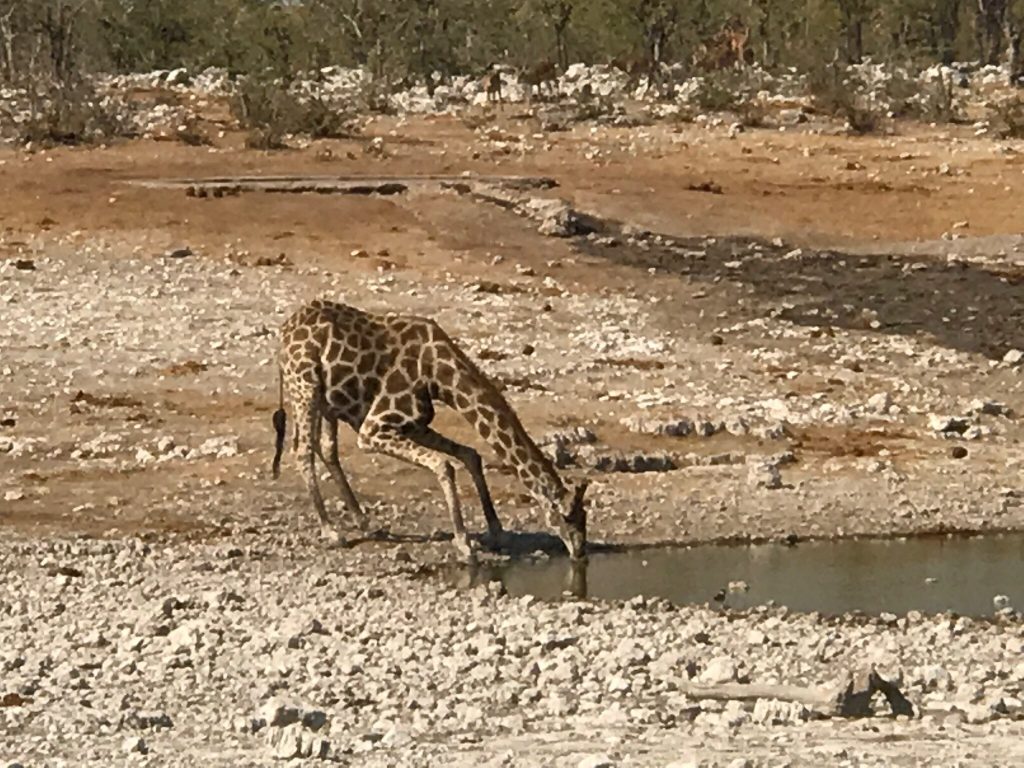
Watch a giraffe drink. Splaying the forelegs to get the head down is slow, awkward and leaves the animal vulnerable, which is why they come to water cautiously and why lion sometimes wait there.
Where to See Giraffe in Namibia
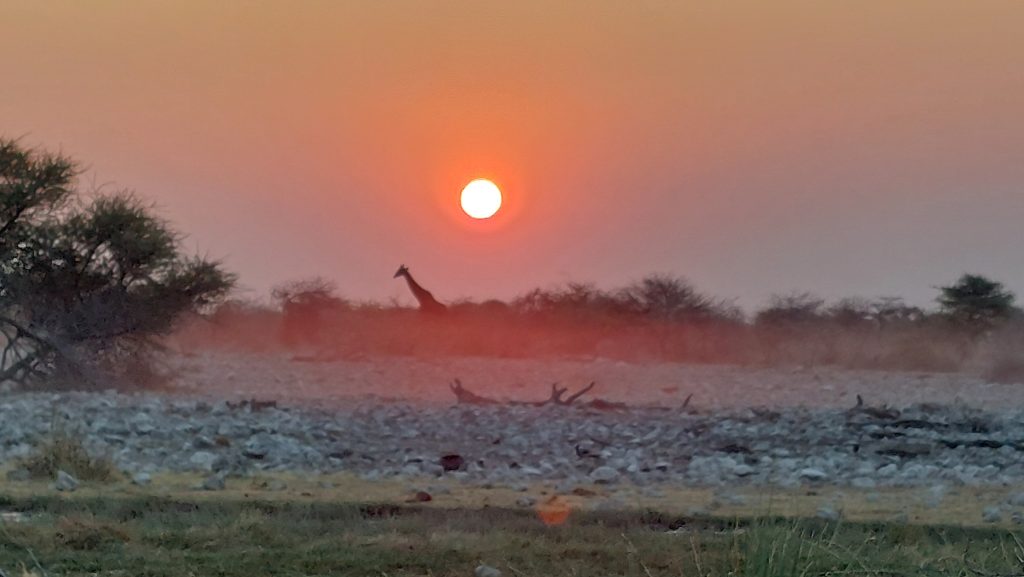
Etosha. Common throughout, particularly in the mopane and around waterholes. Namutoni sunsets with giraffe silhouetted against the sky are the classic shot.
Damaraland riverbeds. The Huab, Aba Huab and Hoanib hold the desert dwelling animals with their enormous ranges. A different sighting entirely from a park giraffe.
Khaudum National Park. Several hundred animals in the northeast, in country very few visitors reach. Requires two vehicles in convoy.
Private reserves and farms. The largest share of the national population. Erindi, Okonjima, Ongava and guest farms across the central highlands all hold giraffe.
Best Time to See Giraffe
Any month. Giraffe are present year round and do not concentrate or disperse seasonally in the way grazers do, since they browse from trees that hold leaves through the dry season.
The dry season from May to October gives thinner vegetation and better visibility, and brings them to waterholes more predictably. Early morning and late afternoon are the strongest for photography, and a giraffe against the sky at sunset needs almost no skill to shoot well.
In Damaraland, ask your camp where animals have been moving. Given ranges of that size, they may simply be somewhere else that week.
Giraffe in Namibia Questions
How many giraffe are there in Namibia?
Around 12,000 Angolan giraffe according to Giraffe Conservation Foundation surveys, split roughly as 6,500 on private land, 2,000 on communal land and 3,500 in national parks. A further 100 or so South African giraffe occur in Bwabwata National Park. Numbers and distribution have both increased over the past thirty years, which runs counter to the continental trend.
What subspecies of giraffe live in Namibia?
Mostly the Angolan giraffe, also called the Namibian giraffe or smokey giraffe, with a small South African giraffe population in Bwabwata. Taxonomy is unsettled: newer research suggests the two Namibian forms may be the same, and one genetic study proposed that the northern Namib and Etosha populations are separate subspecies, though mitochondrial work has not supported that. Treat confident claims with caution.
Are there desert giraffe in Namibia?
There are giraffe living in genuinely arid country in the northwest, along the dry riverbeds of the Kunene and Damaraland. They are the same Angolan giraffe found elsewhere in the country rather than a separate desert form, and they cope by ranging enormously. Angolan giraffe have the largest recorded home ranges of any giraffe in Africa, reaching up to 11,600 square kilometres.
Where is the best place to see giraffe in Namibia?
Etosha for reliability, where they occur throughout and are easily seen at waterholes and in the mopane woodland. The Damaraland riverbeds for the desert dwelling animals, which is a very different sighting. Khaudum in the northeast holds several hundred but is difficult to reach. Private reserves and guest farms across the central highlands hold the largest share of the national population.
Were Namibian giraffe used to restore the species in Angola?
Yes. The Angolan giraffe had become locally extinct in Angola, the country it is named after, and animals from Namibia were used to reintroduce it to Iona National Park in the south, immediately north of the Kunene River. It is one of the more striking conservation successes in the region and is little known outside specialist circles.
Are giraffe endangered in Namibia?
Less so than elsewhere. Giraffe numbers across Africa have fallen substantially in recent decades, but the Namibian population has grown over the past thirty years thanks to conservation management and reintroductions. The main flagged concerns here are hybridisation between subspecies, particularly in the Zambezi Region, and unknown risk from trade. Illegal hunting is not currently considered a major threat.
Why do giraffe splay their legs to drink?
Because their necks are not long enough to reach the ground without it, which sounds absurd and is true. Splaying the forelegs lowers the head far enough to drink. The position is slow to get into and slow to leave, which makes the animal vulnerable, so giraffe come to water carefully and drink in short bursts while watching. Lion sometimes wait at waterholes for exactly that reason.
Booking Your Namibia Trip
The safari companies and tour operators listed on this website put trips like this together for a living and know which camps, guides and routes actually deliver. We are an independent guide to Namibia; we do not book or sell tours ourselves.
When you are ready, arrange your safari, tour or holiday with one of the recognised operators listed here. Tell them your dates and what matters most, and a real person, not a form, will handle the itinerary, park bookings and logistics for you.