Getting Around Namibia
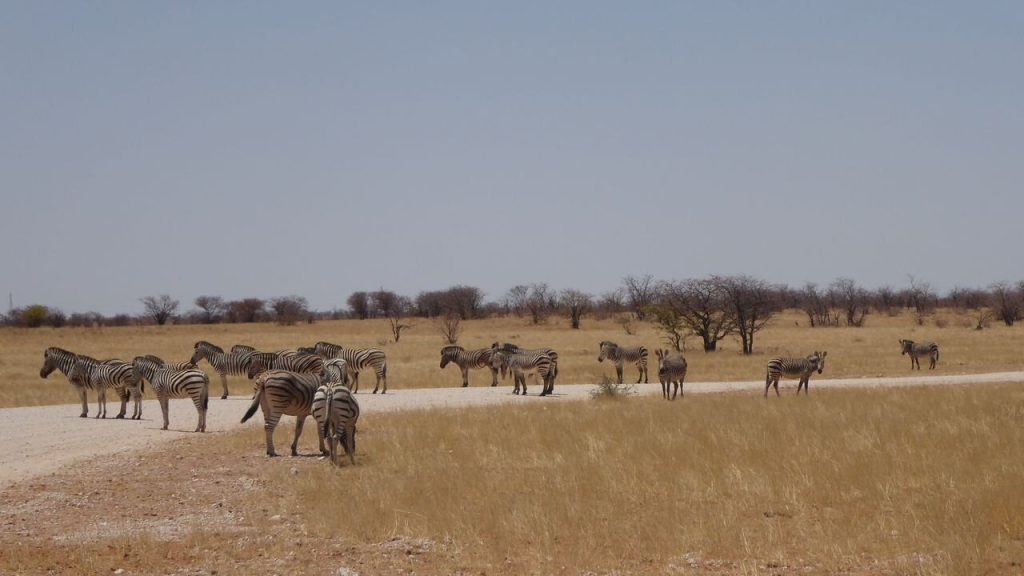
Namibia has four ways of getting around and most visitors should self drive. The country has good tar between main centres, graded gravel elsewhere and almost no traffic. Public transport exists and does not serve the places tourists go. Flying saves days on a short trip. Guided tours remove the driving entirely.
The Four Options
Each suits a different traveller and the choice shapes everything else.
Self driving is what most visitors do and what the country is set up for. Tar roads connect the main centres, gravel roads are graded and mostly in reasonable condition, and the rental infrastructure for equipped 4×4 camping vehicles is among the best in Africa.
Fly in itineraries move you between camps by light aircraft, reaching concession areas no road serves and saving days of driving, at considerably higher cost.
Guided tours, either small group or private with a driver guide, remove the navigation and the gravel road driving while fixing the schedule.
Public transport links Namibian towns and does not reach the national parks, the dunes or the coast’s attractions, which makes it impractical for a standard itinerary.
Calculate driving times at 60 kilometres an hour on gravel, not the 80 or 100 the map suggests. Operators recommend planning at 100 on tar and 50 on gravel, and 60 is a realistic working average once stops, photographs and animals on the road are included. Itineraries built on optimistic speeds are the commonest planning error in Namibia and the one that produces arrivals after dark.
Self Driving
Namibia is among the best self drive countries in Africa and the reasons are structural.
The B roads are tarred and connect Windhoek to Swakopmund, Etosha, the north and the south. The C roads are the main gravel routes and are graded, wide and mostly well maintained. D roads are minor gravel and vary considerably.
Traffic is almost nonexistent outside Windhoek. On some stretches you will see three vehicles in an hour.
Signage is clear and destinations are signposted well in advance, though minor roads can be sparsely marked.
Namibia drives on the left. An international driving permit alongside your national licence is advisable.
The constraints are distance and surface rather than complexity. A day behind the wheel here is longer than almost anywhere, and gravel demands a different technique from tar.
Gravel Road Driving
This is the skill that matters and it accounts for most tourist accidents.
Reduce speed. Operators impose limits of 80 kilometres an hour on gravel against a legal 100, and exceeding them voids insurance cover in an accident. Many recommend planning at 50.
Loose surfaces mean reduced grip, longer stopping distances and a real risk of losing control in a corner or on a sudden correction. Rollovers are the characteristic Namibian accident.
Reduce tyre pressure slightly for gravel and remember to reinflate for tar. Rental operators advise on the right figures.
Slow down for oncoming vehicles and pull left, since stones thrown up crack windscreens.
Corrugations are the constant. There is a speed at which they smooth out and it is usually higher than is safe, which is the trap.
Watch for sand patches at riverbed crossings and take them straight and steadily rather than braking mid crossing.
Animals on the Road
The most dangerous thing on a Namibian road is a kudu and it deserves its own section.
Kudu are large enough to come through a windscreen, they move at dusk and after dark, and their instinct when startled by headlights is to jump, frequently into the vehicle rather than away from it. They also clear two metre fences, so fencing does not keep them off roads.
Warthog, oryx, springbok and baboon all cross roads. Unfenced livestock, particularly cattle and goats, wander onto tar in the north and in communal areas.
The mitigation is simple and firm: do not drive after dark outside towns. Most rental agreements prohibit or strongly discourage it, and an accident after dark may be treated as negligence.
During daylight, watch the verges rather than only the road ahead, and slow where bush comes close to the tar.
If an animal is in the road, brake in a straight line rather than swerving. Swerving is what turns a collision into a rollover, and a single vehicle accident is what your insurance may not cover.
Fuel and Distances
Running out of fuel in Namibia is a genuine possibility rather than a theoretical one.
Fuel is available in the towns and at some settlements, and the gaps between are long. Outjo is the last fuel before Etosha’s Andersson Gate at 108 kilometres. The Okaukuejo pump inside the park is unreliable and should not be planned around.
North of Opuwo there is nothing dependable until Epupa, and beyond that nothing at all. Sesfontein and Palmwag are the northwestern options.
The rule is to fill at every opportunity rather than calculating whether you will make it. Fuel is cheap relative to being stranded.
Deep sand roughly doubles consumption, so range calculations based on tar figures are wrong in Kaokoland and Khaudum. Carry jerry cans for those routes.
Attendants fill the tank, check oil and clean windscreens, and a small tip of a few Namibian dollars is normal. Cash is the safer assumption at filling stations, particularly outside main routes.
Flying Within Namibia
Air travel is the alternative to two days of driving and it comes in three forms.
Scheduled domestic flights operate from Eros Airport in Windhoek, minutes from the city centre, with connections to Ondangwa and Katima Mulilo. A shuttle links Eros to Hosea Kutako International for onward flights.
Light aircraft circuits pick up and drop guests at multiple destinations at fixed times, which is how most fly in safari itineraries work. True charters adjust to your schedule at higher cost.
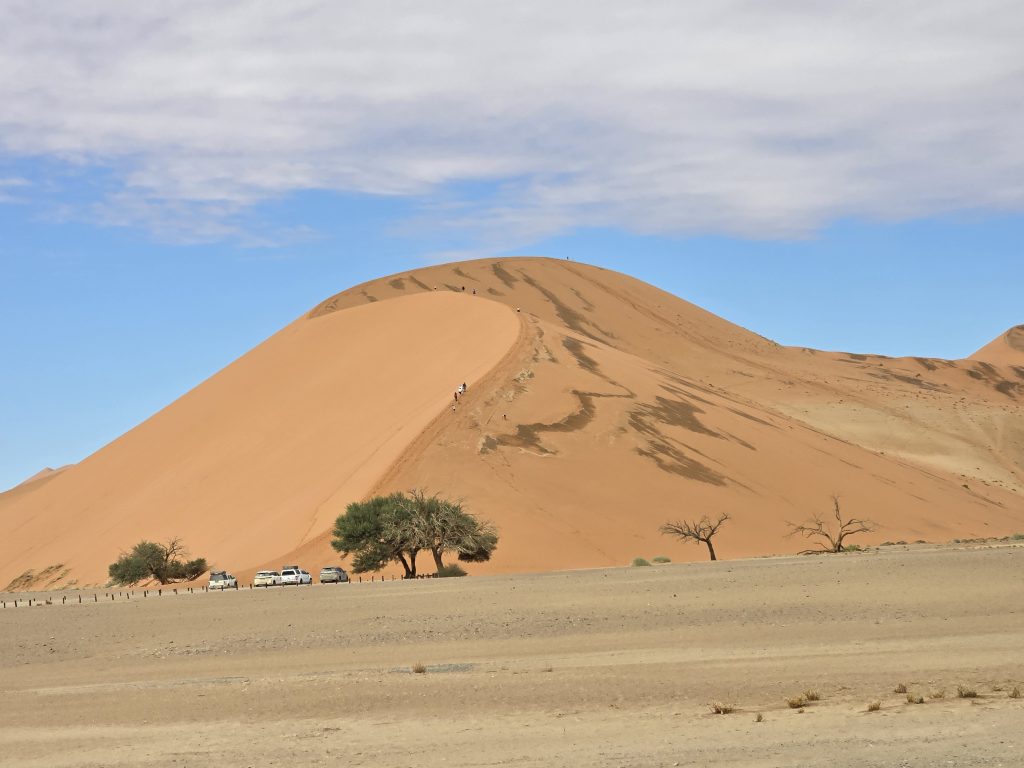
One way scenic transfers between Swakopmund and Sossusvlei replace a driving day with an aerial view over the dune sea and the shipwrecks, which is the best value flying in the country if you are covering that leg anyway.
Baggage limits on light aircraft are commonly around 20 kilograms per person including hand luggage, in soft sided bags only.
Guided Tours and Transfers
Not self driving is a legitimate choice and there are several ways to do it.
Small group tours run scheduled departures on set itineraries, typically in a minibus or converted truck, and are the cheapest guided option. Costs are known upfront and the schedule belongs to everyone.
Private guided trips with a driver guide cost more and give you the flexibility of self driving without the driving. They suit travellers uncomfortable with gravel roads, long distances or navigation, and families who would rather someone else concentrated on the road.
Fly in itineraries with guided activities at each camp are the premium version, removing both driving and transfers.
Day tours and transfers operate from Windhoek, Swakopmund and the main centres for people combining a partly independent trip with guided sections.
Public Transport
It exists and it will not get you where you are going.
Intercity buses connect Windhoek with Swakopmund, the northern towns, Rundu, Katima Mulilo and across the border to South Africa. Combis, shared minibuses, run the same routes more frequently and less comfortably.
The railway carries freight primarily, with limited passenger services that are slow and infrequent.
None of it reaches Etosha’s waterholes, Sossusvlei, Damaraland, the Skeleton Coast or the Fish River Canyon rim. The country’s attractions are dispersed across enormous distances with no public network serving them.
Backpackers do travel Namibia using buses plus organised tours from the towns they reach, which works and constrains the itinerary considerably.
Hitchhiking happens and carries the usual risks, compounded by the emptiness of the roads.
Practical Driving Advice
Planning times. 100 kilometres an hour on tar, 50 to 60 on gravel. Add stops. A 400 kilometre gravel day is a full day, not a morning.
Fuel. Fill at every town. Outjo before Etosha, Opuwo before the northwest, Grootfontein before the northeast. Carry cash and jerry cans where relevant.
Night. Do not drive after dark outside towns. Kudu, livestock and unlit vehicles make it the single largest risk in Namibian travel.
Navigation. Download offline maps before travelling. Coverage is good in towns and on main routes and absent across large areas.
Getting Around Namibia Questions
Should I self drive in Namibia?
Most visitors should. The country has tar between main centres, graded gravel elsewhere, almost no traffic, clear signage and excellent rental infrastructure for equipped 4×4 camping vehicles. The alternatives are fly in circuits, which cost considerably more but save days, and guided tours, which remove the driving and fix the schedule. Public transport does not reach the places tourists go.
How fast can I drive on gravel?
Legally up to 100 kilometres an hour, and rental operators commonly impose 80 and recommend planning at 50. Exceeding an operator’s limit voids insurance cover in an accident, and vehicles carry tracking devices. Plan driving times at 50 to 60 on gravel and 100 on tar. Itineraries built on optimistic speeds are the commonest Namibian planning error.
Why should I not drive at night?
Kudu, mainly. They are large enough to come through a windscreen, move at dusk and after dark, and jump into headlights rather than away from them. Warthog, oryx and unfenced livestock also cross roads. Most rental agreements prohibit or strongly discourage night driving, and an accident after dark may be treated as negligence, voiding cover.
Where do I need to fill up?
At every town. Outjo is the last fuel before Etosha’s Andersson Gate at 108 kilometres, and the pump at Okaukuejo inside the park is unreliable. North of Opuwo there is nothing dependable until Epupa. Grootfontein is the last comprehensive stop before the northeast. Deep sand roughly doubles consumption, so carry jerry cans in Kaokoland and Khaudum.
Can I get around by public transport?
Between towns, yes. Intercity buses and shared combis connect Windhoek with Swakopmund, the northern towns, Rundu and Katima Mulilo. None of it reaches Etosha’s waterholes, Sossusvlei, Damaraland or the Skeleton Coast. Backpackers combine buses with organised tours from the towns they reach, which works and constrains the itinerary considerably.
Is flying worth it?
On a short trip, often. Light aircraft circuits reach concession areas no road serves and save days of driving. The best value is a one way scenic transfer between Swakopmund and Sossusvlei, which replaces a driving day with an aerial view over the dune sea and the shipwrecks. Baggage limits are around 20 kilograms including hand luggage, in soft bags only.
What should I do if an animal runs into the road?
Brake in a straight line rather than swerving. Swerving is what turns a collision into a rollover, and a rollover is a single vehicle accident, which basic rental insurance frequently does not cover. Watch verges rather than only the road ahead, slow where bush comes close to the tar, and do not drive after dark outside towns.
Booking Your Namibia Trip
The safari companies and tour operators listed on this website put trips like this together for a living and know which camps, guides and routes actually deliver. We are an independent guide to Namibia; we do not book or sell tours ourselves.
When you are ready, arrange your safari, tour or holiday with one of the recognised operators listed here. Tell them your dates and what matters most, and a real person, not a form, will handle the itinerary, park bookings and logistics for you.