White Rhino in Namibia
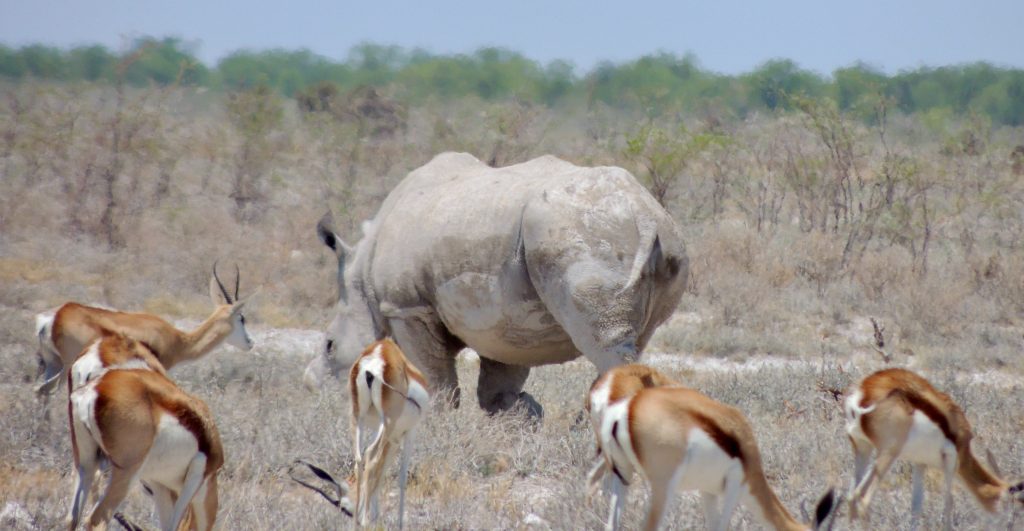
Namibia holds over 1,400 white rhino, the second largest population in the world after South Africa, and every one of them descends from animals reintroduced after the species was hunted to extinction here. The first sixteen arrived at Waterberg from KwaZulu-Natal. Around three quarters now live on private ranches and conservancies rather than in national parks.
Extinct, Then Brought Back
The white rhino was once widespread across Namibia outside the arid zones. By the eighteen eighties it had been hunted out entirely, and the species disappeared from the country.
Reintroduction began when sixteen animals were translocated from KwaZulu-Natal in South Africa to Waterberg Plateau Park, which had been proclaimed to breed and hold rare and endangered species. Buffalo, tsessebe, roan and sable were established there on the same principle.
A second phase of translocations followed two decades later, this time into Etosha, and further animals went onto private land.
The population has since grown at around 6.7 percent a year over a recent twenty year period. Note that several sources still describe Waterberg as the only white rhino population in Namibia, which was true for a while and has not been for a long time.
Where Namibia’s White Rhino Live
Three national parks hold roughly 24 percent of the country’s white rhino. The remaining three quarters sit on around 85 privately managed ranches and conservancies.
That distribution follows the same pattern as cheetah, leopard, giraffe and Hartmann’s mountain zebra in this country: the majority of a headline species living outside the state protected area network, dependent on private and communal landowners.
It also reflects a deliberate model. White rhino carry substantial commercial value and private owners have both the incentive and the resources to protect them, which has expanded the total population well beyond what the parks alone could hold.
The concentration on private land does create a vulnerability. Security varies between properties, and a poaching incursion onto a ranch is a different problem from one inside a fenced national park with a ranger presence.
If seeing white rhino matters to you, book a private reserve rather than relying on a park. Ongava on the Etosha boundary holds both species and runs guided tracking that brings you close to white rhino on foot, which is possible in only a handful of places in Africa. Etosha itself is far better for black rhino than white.
Telling White from Black Rhino
Both species occur in Namibia and the differences are clear once you know what to look at. Colour is not one of them.
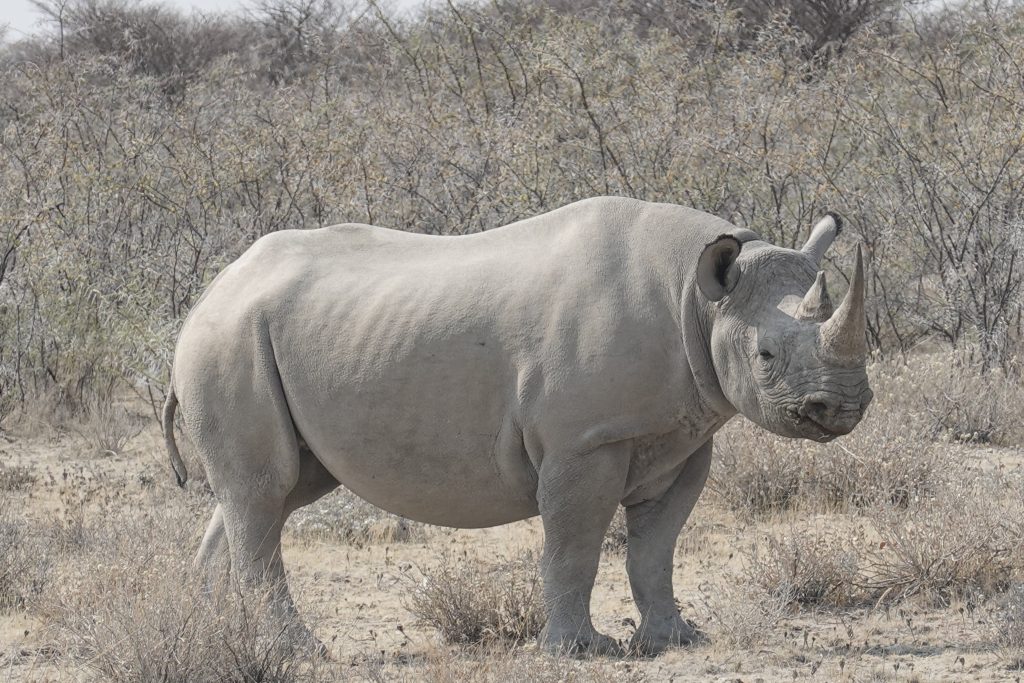
The mouth is the reliable feature. White rhino have a wide, square, flat lipped mouth built for cropping grass close to the ground. Black rhino have a pointed, prehensile upper lip that works like a finger for grasping twigs and leaves.
The name has nothing to do with colour and is usually thought to derive from a description of that wide mouth, which entered English as white. Both animals are grey and both take on the colour of whatever mud they last rolled in.
Beyond the mouth, white rhino are considerably larger, carry a pronounced hump of neck muscle to support a heavy head held low, and graze with the head down. Black rhino are smaller, hold the head higher, and browse.
Temperament differs too. White rhino are comparatively placid and often found in groups. Black rhino are solitary, unpredictable and treated with far more caution by guides on foot.
Grazers, Not Browsers
The ecological difference between the two species is diet, and it explains almost everything else about them.
White rhino are pure grazers, the largest of all grazing animals, and they crop short grass with that wide flat mouth in the way a lawnmower does. They need grassland and they need to drink regularly, which limits where they can live and is why the species never occupied Namibia’s arid zones.
That dependency is worth contrasting with the black rhino of the Kunene, which browse woody plants including the highly toxic Damara milk bush and can go several days without water. One species is confined to good grazing near water; the other survives in country almost nothing else can.
White rhino grazing has a substantial effect on grassland structure, creating and maintaining short grass lawns that other species then use, which makes them a shaper of the country rather than only a resident.

Social Life and Territory
White rhino are the most social of the rhino species, which is another point of difference from the black.
Groups of up to around fourteen animals form, typically females with calves and subadults. Adult bulls hold territories of roughly a square mile, marking them with vigorously scraped dung piles at boundary middens. Female home ranges can be more than seven times larger than a bull’s territory, varying with habitat quality and density.
That midden behaviour is worth looking for. A white rhino dung pile is a communication board, and animals visit, sniff and add to them in a way that carries information about who is around.
Calves stay with the mother for two to three years. A distinguishing detail in the field: white rhino calves typically run ahead of the mother, while black rhino calves follow behind.
Poaching and Protection
Namibia was largely spared the early years of the current rhino poaching crisis and has not been since.
Poaching increased sharply from the middle of the last decade, targeting both rhino species alongside elephant, pangolin and lion for the illegal international wildlife trade. A recent spike in white rhino losses has been recorded while the overall population continues to grow.
Dehorning is now standard practice in high risk areas. Research using Namibian data across black rhino populations found no measurable difference between dehorned and horned animals in age at first reproduction, calving interval, calf survival, cause of death or lifespan, which removes the main welfare objection to a technique that reduces poaching incentive.
Alongside dehorning, protection involves translocation out of high risk areas, satellite tracking units fitted into horns, foot bracelets for monitoring, and a dedicated investigation unit handling wildlife crime with the police and defence force.
Rhino Tourism and How to Behave
A few things matter more with rhino than with almost any other species you will see here.
Do not post photographs with location data attached and be careful about naming precise sighting locations publicly. Poachers use social media, and this is a standard request from conservation organisations across southern Africa rather than an abstract worry. Switch geotagging off before you go out.
On foot, follow your guide’s instructions exactly. Rhino have poor eyesight and excellent hearing, and the distances guides maintain and the routes they walk in on are worked out around wind direction. White rhino are placid by comparison with black rhino and they remain enormous wild animals.
Choose operators and properties that fund protection. Around three quarters of Namibia’s white rhino are on private land, where security is paid for by the owner, and tourism revenue is a substantial part of what makes that viable.
If you see anything suspicious, unfamiliar vehicles on tracks, people on foot where they should not be, report it to your camp rather than investigating.
Where to See White Rhino in Namibia
Ongava. On Etosha‘s southern boundary, holding both species with guided tracking that brings you close to white rhino on foot. The strongest option in the country.
Waterberg Plateau Park. Where the reintroduction began, alongside buffalo, roan, sable and tsessebe. Guided drives and walking trails on the plateau.
Etosha. Present since the second phase of translocations, though far less commonly seen than black rhino, which the park is exceptional for.
Private reserves. Around 85 ranches and conservancies hold three quarters of the national population, including Erindi and Onguma among the properties visitors can book.
Best Time to See White Rhino
The dry season from May to October is better, as with most Namibian wildlife, because grass cover thins and animals concentrate near water. White rhino need to drink regularly, so waterholes are productive.
Early morning and late afternoon are when they move and graze. Through the heat of the day they lie up in shade or wallow in mud, which they do enthusiastically and which is worth watching.
On private reserves running guided tracking, sightings are reliable across the year and less season dependent than in an open park.
White Rhino in Namibia Questions
How many white rhino are there in Namibia?
Over 1,400, the second largest population in the world after South Africa. All of them descend from reintroduced animals, since the species was hunted to extinction in Namibia by the eighteen eighties. Around 24 percent live in three national parks and the remaining three quarters on some 85 private ranches and conservancies.
How do I tell white from black rhino?
The mouth. White rhino have a wide, square, flat lipped mouth for cropping grass. Black rhino have a pointed, prehensile upper lip that works like a finger for grasping twigs. White rhino are larger with a pronounced neck hump and graze head down; black rhino hold the head higher and browse. Both are grey, so colour tells you nothing.
Why is it called a white rhino if it is grey?
The name is usually thought to come from a description of the animal’s wide flat mouth, which entered English as white through a misreading. Both rhino species are grey, and both take on the colour of whatever mud they last wallowed in. The mouth shape, not colour, is what actually separates them, and it reflects the underlying difference: white rhino graze, black rhino browse.
Where were Namibia’s white rhino reintroduced from?
KwaZulu-Natal in South Africa. Sixteen animals were translocated to Waterberg Plateau Park, which had been proclaimed to breed and hold rare and endangered species. A second phase two decades later moved animals into Etosha, with further translocations onto private land. Some sources still describe Waterberg as the only white rhino population in Namibia, which has not been true for many years.
Where is the best place to see white rhino?
Private reserves rather than national parks. Ongava on Etosha’s southern boundary holds both species and runs guided tracking that brings you close to white rhino on foot, which is possible in only a handful of places in Africa. Waterberg Plateau Park is where the reintroduction began. Etosha holds them but is far better known for black rhino.
Are white rhino dangerous?
Considerably less so than black rhino. White rhino are comparatively placid and often found in groups, which is why walking in on foot is possible with them and treated far more cautiously with black rhino. They are still enormous wild animals with poor eyesight, so follow your guide exactly, stay downwind and do not get between a cow and her calf.
Does dehorning harm rhino?
Research using Namibian data across black rhino populations found no measurable difference between dehorned and horned animals in age at first reproduction, calving interval, birth sex ratios, calf survival, cause of death or lifespan. Horn regrows, so the procedure has to be repeated. It is used alongside translocation, satellite tracking units in horns and intelligence led anti poaching work in high risk areas.
Booking Your Namibia Trip
The safari companies and tour operators listed on this website put trips like this together for a living and know which camps, guides and routes actually deliver. We are an independent guide to Namibia; we do not book or sell tours ourselves.
When you are ready, arrange your safari, tour or holiday with one of the recognised operators listed here. Tell them your dates and what matters most, and a real person, not a form, will handle the itinerary, park bookings and logistics for you.