Secretary Bird
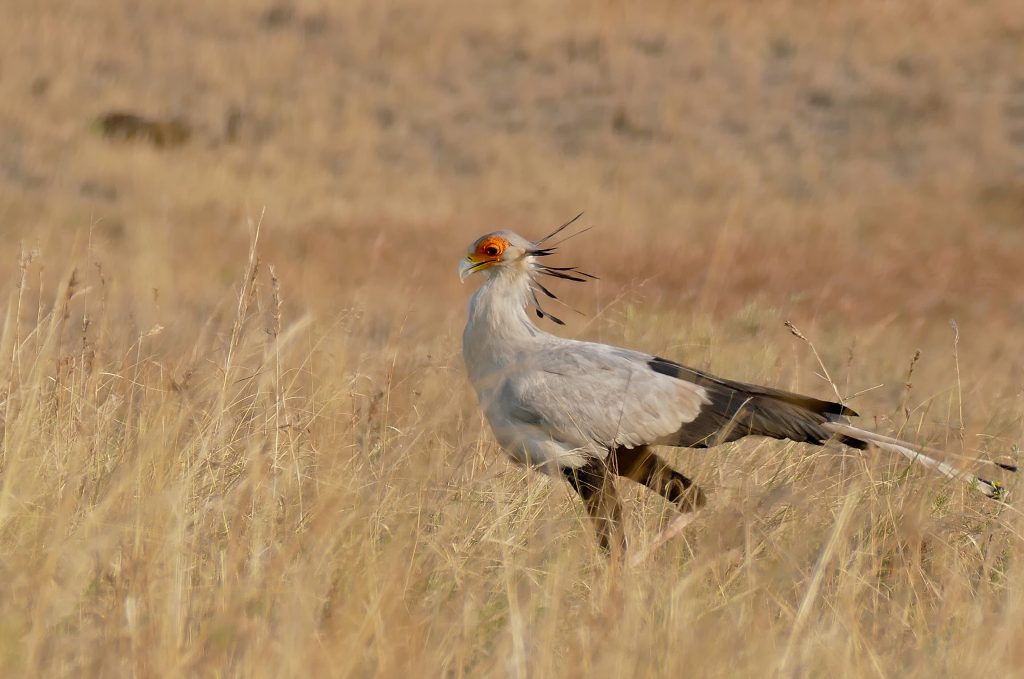
The secretary bird is a raptor that hunts on foot, standing up to 1.3 metres tall on crane like legs and killing snakes by stamping on them. It occurs across Namibia’s open grassland and savanna, including Etosha. The species was uplisted to Endangered after severe declines across its African range, so a Namibian sighting matters more than it did a generation ago.
A Bird of Prey That Walks
Almost everything about this bird is a departure from what raptors normally do.
Sagittarius serpentarius has the hooked bill and forward facing eyes of an eagle mounted on the long legs of a crane, and it does the great majority of its hunting on foot. It can fly perfectly well and mostly does not bother, taking to the air to reach a roost, to move between hunting grounds or when seriously disturbed.
A hunting secretary bird strides through grassland at a steady pace, sometimes covering considerable distances in a day, flushing prey out of cover with its feet. It hunts alone, in pairs or occasionally in loose groups.
The plumage completes the effect: pale grey body, black flight feathers, black feathering down the thighs that reads as a pair of shorts, bare orange red facial skin, and a crest of long dark quills at the back of the head.
Where the Name Comes From
Two explanations circulate and neither has been settled.
The traditional account holds that the crest of quills behind the head resembles the goose feather pens that nineteenth century clerks tucked behind their ears, and that the black thigh feathering suggests formal dress. It is a satisfying story and there is no firm evidence for it.
The competing explanation is linguistic. An Arabic term rendered roughly as saqr et-tair, meaning hunting bird, is proposed as the origin, altered by French speakers into something that sounded like their word for secretary.
The scientific name is less ambiguous. Sagittarius refers to an archer and serpentarius to snakes, which between them describe the bird accurately enough.
How It Kills Snakes
The hunting technique is what the bird is known for and it is genuinely unusual.
A secretary bird kills by stamping. It delivers rapid, extremely forceful kicks with the feet, aimed at the head of the prey, striking with enough power and precision to kill a snake outright. The strike lasts a fraction of a second and researchers measuring it have found the force considerably greater than the bird’s own weight would suggest possible.
Against a venomous snake it spreads its wings, partly as a shield and partly to distract, and works around the animal delivering strikes until the snake stops moving. The long legs keep the body well clear of a striking range that would reach a shorter bird.
Snakes are the famous prey and they are not the main one. The diet is broader: insects, particularly grasshoppers and beetles, along with small mammals, rodents, lizards, birds, eggs, amphibians and occasionally carrion. In most areas insects and rodents make up the bulk of it.
Watch a secretary bird for ten minutes rather than photographing it and driving on. The hunting sequence is worth seeing: the steady stride, the sudden stamp into a grass tuft, the pause, then the stride resuming. It is one of the few large birds in Namibia whose behaviour is genuinely legible from a vehicle at distance.
Endangered and Declining
The conservation trajectory here is worth knowing because it is recent and steep.
The secretary bird was classed as Near Threatened, then uplisted to Vulnerable, and subsequently to Endangered following continued severe declines across its range. Estimates of the surviving population are wide, running from roughly 6,700 to 67,000 mature individuals, and the trend is decreasing.
That range of estimates tells its own story about how hard the species is to count: it occurs at very low density over an enormous area of sub Saharan Africa, and it is uncommon or declining across much of it for all its wide distribution.
The causes are habitat degradation and loss of open grassland, disturbance at nest sites, hunting, and trapping for the trade. Because the bird needs large open habitats, safe nest trees, enough prey and low disturbance, it is squeezed by land use change in a way that a more adaptable species would not be.
Collisions with fences and powerlines and the effects of grassland burning add further pressure.
Secretary Birds in Namibia
Namibia’s open country suits the species and it occurs across the grassland and savanna of the centre and north.
Etosha is the reliable place to look. The park holds around 35 raptor species and secretary birds work the open plains and pan edges, usually alone or in pairs, striding across ground where they are visible at considerable distance.
They also occur on farmland across the central highlands and in the open country of the Kalahari and the Zambezi Region. Anywhere with grass, low disturbance and enough prey is potential habitat.
Namibia’s low human population density and the extent of its open country make it a better prospect than much of the species’ range, which is one reason a Namibian trip gives decent odds on a bird that is genuinely hard to see elsewhere.
Nesting and Breeding
Secretary birds pair for life and defend large territories, which is part of why they occur at such low density.
They build substantial flat nests of sticks on top of flat crowned trees, often acacia, at a height that gives a clear flight line in and a view over the surrounding grass. The same nest is used and added to across years, growing considerably over time.
Clutches are small, usually two or three eggs, and it is common for only one chick to survive to fledging. The young remain in the nest for several months, which is a long dependency and leaves them exposed to disturbance for an extended period.
Because the birds need a specific kind of nest tree in open country, loss of scattered trees to clearing or to charcoal production removes breeding capacity even where the grassland itself survives.
How to Recognise One
There is nothing else in Namibia it can be confused with once seen properly.
Standing 1.2 to 1.3 metres tall, pale grey with black flight feathers and black thigh feathering, long pink legs, bare orange red face and a crest of dark quills. In flight the wings are broad and the two central tail feathers extend well beyond the rest, which is diagnostic at distance.
At a glance across open plain a walking secretary bird can suggest a small crane or a bustard. The crest, the black thighs and the raptor’s hooked bill separate it immediately.
Kori bustard, which shares the same country in Etosha, is bulkier, brown and grey, and walks with the head held lower. The secretary bird walks tall.
Where to See Secretary Birds
Etosha. The open plains and pan edges, particularly the western and central sections. Usually alone or in pairs, visible at distance on bare ground.
Central farmland. Open grassland across the highlands, on guest farms and reserves with scattered flat crowned trees for nesting.
The Kalahari. Open country in the east and southeast, where the grass and low disturbance suit them.
Zambezi Region. Present in the open floodplain country of the northeast alongside a much wider bird list.
Best Time to See a Secretary Bird
They are resident year round and diurnal, so no seasonal or time of day planning is needed to find one.
Grass height matters more than season in practice. After good rains the grass grows tall enough to hide a walking bird, so the dry months from about May to October give better visibility across open ground.
Early morning and late afternoon are when they are most actively hunting. Through the middle of the day they often stand in whatever shade is available or perch in a tree.
Secretary Bird Questions
Why is it called a secretary bird?
Two explanations compete and neither is settled. One holds that the crest of quills behind the head resembles the goose feather pens nineteenth century clerks tucked behind their ears, with the black thigh feathering suggesting formal dress. The other proposes an Arabic term meaning hunting bird, altered by French speakers into something resembling their word for secretary. The scientific name refers to an archer and to snakes.
Do secretary birds really kill snakes by stamping?
Yes. They deliver rapid, extremely forceful kicks aimed at the head, striking with enough power and precision to kill a snake outright in a fraction of a second. Against venomous species they spread the wings as a shield and a distraction while working around the animal. Their long legs keep the body well clear of a strike that would reach a shorter bird.
Is the secretary bird endangered?
Yes. It was uplisted from Near Threatened to Vulnerable and subsequently to Endangered following severe declines across its African range. Population estimates run very wide, from around 6,700 to 67,000 mature individuals, and the trend is decreasing. Habitat degradation, disturbance at nests, hunting and trapping for trade are the main causes, along with collisions with fences and powerlines.
Can secretary birds fly?
Yes, perfectly well, and they mostly do not bother. They do the great majority of their hunting on foot, striding through grassland and flushing prey with their feet, and take to the air mainly to reach a roost, move between hunting grounds or escape serious disturbance. In flight the two elongated central tail feathers are diagnostic at distance.
Where is the best place to see one in Namibia?
Etosha, on the open plains and pan edges, particularly the western and central sections where a walking bird is visible from a long way off. They also occur on open farmland across the central highlands, in the Kalahari and in the Zambezi Region. Namibia’s low human population and extensive open country give better odds than much of the species’ range.
What do secretary birds eat besides snakes?
Rather a lot. Insects, particularly grasshoppers and beetles, make up the bulk in most areas, along with rodents, small mammals, lizards, birds, eggs and amphibians, with occasional carrion. Snakes are the famous prey rather than the main one. Their role in controlling insect and rodent populations across African grassland is substantial.
How do I tell one from a kori bustard?
The secretary bird walks tall on long pink legs with black thigh feathering, a crest of dark quills, bare orange red facial skin and a hooked raptor’s bill. The kori bustard is bulkier, brown and grey, and walks with the head held lower. Both work the same open country in Etosha, and at a distance either can suggest a small crane until you get the detail.
Booking Your Namibia Trip
The safari companies and tour operators listed on this website put trips like this together for a living and know which camps, guides and routes actually deliver. We are an independent guide to Namibia; we do not book or sell tours ourselves.
When you are ready, arrange your safari, tour or holiday with one of the recognised operators listed here. Tell them your dates and what matters most, and a real person, not a form, will handle the itinerary, park bookings and logistics for you.