Henties Bay
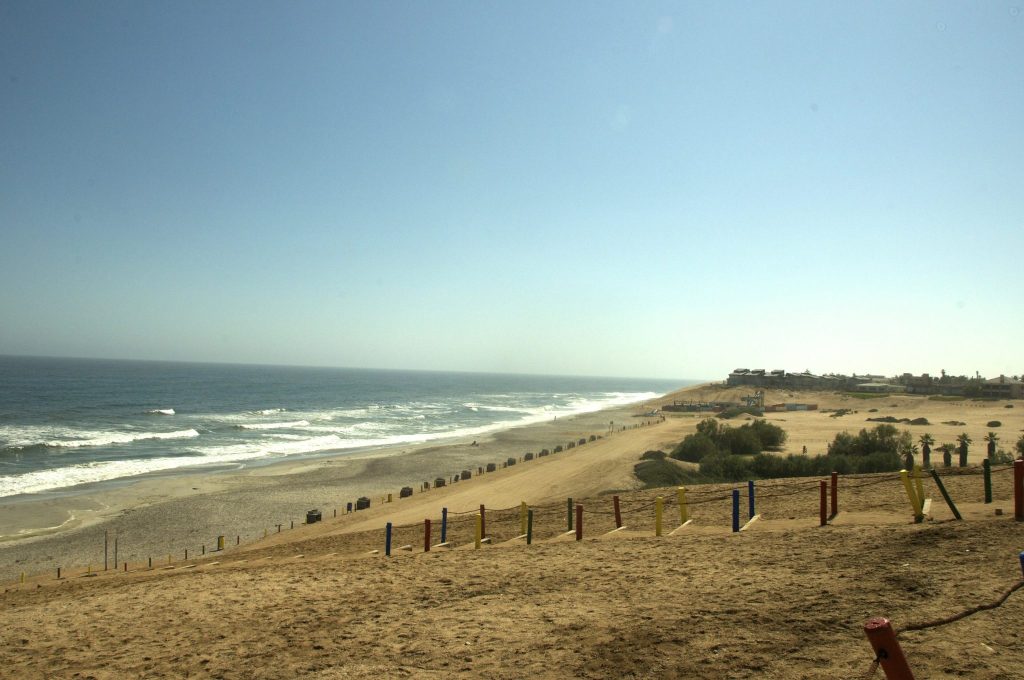
Henties Bay exists because of fishing, a town of holiday houses and caravan pitches on the Skeleton Coast road north of Swakopmund, filling with anglers over the December holidays and quiet the rest of the year. It is the base for the best shore angling in southern Africa, and the police station issues the permits.
A Town Built Around a Fishery
Henties Bay is unusual among Namibian settlements in having a single obvious reason to exist.
The Benguela current runs north along this coast, with upwelling cells pulling cold nutrient rich water to the surface. That feeds plankton blooms, which feed sardines and anchovies, which feed everything larger.
The practical result for anglers is a shoreline holding serious fish within casting distance of an empty beach, with close to unlimited space to fish it.
The town grew as a holiday settlement serving that fishery, and its character reflects it: holiday houses, a caravan park, a strong club scene and competitions that fill the place over December.
Namibians and South Africans make up most of the anglers here, with international visitors a small minority, which is part of what makes it good.
Outside the holiday season it is quiet to the point of feeling empty, which suits some travellers and unsettles others.
Get your fishing permit at the Henties Bay police station, which issues them alongside the Ministry of Fisheries offices in Swakopmund, Walvis Bay and Lüderitz. That is a useful thing to know if you have driven north without one, and it is the only permit point on this stretch of coast. Turning up at a beach two hours further north without one leaves you either not fishing or fishing illegally.
The Fishing
Kabeljou is what people come for and the rest fills out around it.
Kabeljou, also called kob, is the prized species, with steenbras and galjoen the other two in the top three.
Sharks are the other draw and they run large. Copper sharks, cow sharks, spotted gully sharks and bronze whalers are caught from the beach, with the bigger specimens a serious proposition on shore tackle. Most operations run catch and release for sharks.
Blacktail, west coast steenbras and a range of smaller species round out the list.
Equipment is heavy: long rods for distance casting, sturdy reels and strong line. Bringing your own works and hiring locally is simpler.
Local guides are worth more than the tackle. On a shoreline this long, knowing which stretch is producing matters more than what you cast with, and operators from Henties Bay and Swakopmund supply rods, bait and that knowledge.
The Rules
Namibian coastal angling regulations are more specific than most visitors expect and they are enforced.
A permit is required for all recreational fishing, available from Ministry of Fisheries offices in Windhoek, Swakopmund, Walvis Bay and Lüderitz, and from the Henties Bay police station.
Angling is permitted from the Ugab River to Walvis Bay within Dorob National Park, which covers the whole Henties Bay stretch, along with sections further north and south.
Bait rules exist and matter. Worms may not be used, and only red bait that has washed ashore may be collected rather than prised off rocks.
Angling is prohibited entirely inside the Cape Cross Seal Reserve, which surprises anglers used to fishing freely along this coast.
Bag limits and size limits apply by species and change, so check with the Ministry or a local operator rather than assuming.
Where Henties Bay Sits
The town is inside Dorob National Park, which most visitors never realise.
Dorob runs along the coast from the Kuiseb River to the Ugab, taking in Swakopmund, Walvis Bay, Henties Bay, Cape Cross and the salt road. Unusually for a national park it contains towns, and no permit is needed for the main routes.
Henties Bay sits around 70 kilometres north of Swakopmund on the C34 salt road, which is built from salt and gypsum and drives like tar when properly maintained.
Cape Cross is roughly 50 kilometres further north, holding one of the largest Cape fur seal breeding colonies in the world.
The Zeila shipwreck sits about 14 kilometres south of the town, close inshore and reachable on a short walk from a parking area with no permit needed.
North of the Ugab gate, Skeleton Coast National Park begins and a permit becomes necessary.
What Else Is There
The town itself is modest and the surroundings carry it.
Wlotzkasbaken, between Swakopmund and Henties Bay, is a scatter of holiday cottages on the open coast, each with its own water tank, and is among the odder settlements in Namibia.
The lichen fields on the gravel plains north of Wlotzkasbaken are the accessible ones on this coast. They are living organisms surviving entirely on fog, and pouring water on a dry patch makes it unfurl and change colour within minutes.
Those lichen fields are also why off road driving is restricted throughout Dorob, since a single set of tyre tracks stays visible for decades.
The Messum Crater, an eroded volcanic caldera inland from Cape Cross, is a remote 4×4 destination requiring care and preferably a guide.
Birdlife along the coast is strong, and the endangered Damara tern breeds on the gravel flats, which is the second reason for the vehicle restrictions.
The Coast North of Town
What lies north of Henties Bay shapes how far most travellers go.
Cape Cross sits around 50 kilometres up the C34, holding one of the largest Cape fur seal breeding colonies in the world, viewed from boardwalks. It is inside Dorob rather than Skeleton Coast, so no special permit is needed.
Diogo Cão landed there in 1486 and erected a stone cross, which gives the place its name, and replicas stand at the site.
Black backed jackal work the colony fringes taking pups, and brown hyena occur along this coast feeding almost entirely on seals, which is ecologically unique for the species.
Beyond Cape Cross the salt road continues to the Ugab gate, where Skeleton Coast National Park begins and a permit becomes necessary. Day permits are available at the gate, overnight stays only with a lodge booking, and self drivers can go no further north than Terrace Bay.
Everything north of Terrace Bay is concession wilderness reachable only through licensed fly in operators.
That makes Henties Bay the last comfortable base before the coast becomes genuinely restricted.
Wlotzkasbaken
The scatter of cottages between Swakopmund and Henties Bay is one of the odder settlements in Namibia and worth slowing for.
Wlotzkasbaken sits directly on the open coast, a collection of holiday houses with no municipal water supply, each with its own tank standing beside it.
The houses are painted in bright colours against a landscape of grey gravel and fog, which is what makes the place photograph well.
It began as a fishing settlement and remains one, occupied mainly over the December holidays and largely empty the rest of the year.
The lichen fields on the gravel plains just north of it are the accessible ones on this coast, and they are the reason off road driving is restricted throughout Dorob National Park.
There are no services beyond the houses themselves, so it is a stop rather than a base.
Practicalities
Accommodation. Holiday houses, guesthouses, a caravan park and campsites. Book well ahead for December and January, when Namibian and South African families fill the town.
Services. Fuel, shops and a police station that issues fishing permits. Swakopmund 70 kilometres south has everything else.
Roads. The C34 salt road runs north from Swakopmund and drives like tar when maintained. Do not treat it as tar; it softens when genuinely wet.
Weather. Coastal, at roughly 15 to 25 degrees year round, with morning fog and afternoon wind. A jacket is needed most evenings whatever the season.
Best Time to Visit
The fishing works year round and the character of the town changes completely by season.
December and January bring competitions and crowds, with Namibian and South African families filling the holiday houses and caravan park. Book far ahead if you want to be part of that, and avoid those months if you do not.
May to September is quieter with more settled weather, and is when most international travellers pass through.
Fog is the daily variable in any season, common in the morning and usually lifting by late morning, with wind building through the afternoon.
The seal breeding peak at Cape Cross in November and December brings the highest numbers there, along with pups and the jackals working the colony.
The coast stays mild throughout, which makes this a reasonable summer destination when the interior is above 40 degrees.
Henties Bay Questions
Why do people go to Henties Bay?
Fishing. The Benguela current makes this one of the more productive shorelines anywhere, holding serious fish within casting distance of an empty beach. The town grew as a holiday settlement serving that fishery, with holiday houses, a caravan park, a strong club scene and competitions filling the place over December. Namibians and South Africans make up most of the anglers.
Where do I get a fishing permit?
The Henties Bay police station issues them, alongside Ministry of Fisheries offices in Windhoek, Swakopmund, Walvis Bay and Lüderitz. It is the only permit point on this stretch of coast, which is useful to know if you have driven north without one. A permit is required for all recreational fishing on the Namibian coast.
What can I catch?
Kabeljou is the prized species, with steenbras and galjoen the other two in the top three. Sharks are the other draw and run large, including copper, cow, spotted gully and bronze whaler caught from the beach, usually on catch and release. Blacktail and west coast steenbras fill out the list. Equipment is heavy: long rods for distance casting and strong line.
What are the fishing rules?
Angling is permitted from the Ugab River to Walvis Bay within Dorob National Park, covering the Henties Bay stretch. Worms may not be used as bait, and only red bait washed ashore may be collected rather than prised off rocks. Angling is prohibited entirely inside the Cape Cross Seal Reserve. Bag and size limits apply by species and change.
How far is it from Swakopmund?
Around 70 kilometres north on the C34 salt road, which is built from salt and gypsum and drives like tar when properly maintained, though it softens when genuinely wet so should not be treated as tar. Cape Cross is roughly 50 kilometres further north, and the Zeila shipwreck sits about 14 kilometres south of the town.
Is Henties Bay inside a national park?
Yes, Dorob National Park, which most visitors never realise. Dorob runs along the coast from the Kuiseb River to the Ugab and unusually contains towns including Swakopmund, Walvis Bay and Henties Bay. No permit is needed for the main routes. That changes north of the Ugab gate where Skeleton Coast National Park begins.
When should I go?
May to September for quiet and settled weather. December and January bring competitions and crowds as Namibian and South African families fill the town, so book far ahead if that appeals and avoid those months if it does not. Fog is common in the morning and lifts by late morning, with wind building through the afternoon in any season.
Booking Your Namibia Trip
The safari companies and tour operators listed on this website put trips like this together for a living and know which camps, guides and routes actually deliver. We are an independent guide to Namibia; we do not book or sell tours ourselves.
When you are ready, arrange your safari, tour or holiday with one of the recognised operators listed here. Tell them your dates and what matters most, and a real person, not a form, will handle the itinerary, park bookings and logistics for you.