Best Scenic Drives in Namibia
The best scenic drives in Namibia are destinations rather than transfers, and several of them are worth routing a trip around. Spreetshoogte Pass, the C14 over the Gaub and Kuiseb passes, and the D707 along the Namib edge are the three most travellers rate highest. Most are gravel, and the country’s road fatality rate is high enough that speed discipline matters.
Spreetshoogte Pass on the Windhoek to Sossusvlei Drive
This is the one people talk about afterwards. The D1275 climbs to around 1,800 metres and then drops roughly a kilometre in altitude down the Great Escarpment onto the Namib plain, with gradients reaching 14 percent, which makes it the steepest road in the country.
Stop at the top before you start down. The viewpoint has parking and seating, and the outlook across the desert below is the single best roadside view in Namibia by most accounts. The descent is a sequence of switchbacks and hairpins with an unforgiving drop on the outer edge.
Take it slowly and use a low gear rather than the brakes. Towing anything down here is a bad idea, and heavy vehicles have come to grief on it. The steeper sections are tarred, which helps, and an ordinary car in good condition manages the pass without difficulty.
It sits on the Windhoek to Sesriem run and adds time compared with the direct route. Take it anyway.
The C14 Through the Gaub and Kuiseb Passes
The C14 between Solitaire and Walvis Bay is the route most travellers drive without realising it is one of the best roads in the country. It crosses two canyons in quick succession, Gaub about half an hour north of Solitaire and Kuiseb another half hour beyond, both with viewpoints and picnic spots.
The geology changes completely on either side of each pass, and drivers regularly describe the middle section as looking like another planet. After the Kuiseb the country flattens into the gravel plains of the Namib section, which is its own kind of emptiness for the run down to the coast.
The surface is gravel and often rough, and this is a road where a higher clearance vehicle earns its cost. There is a quiver tree picnic spot along the way and the Kuiseb River viewpoints are worth the stop.
On the scenic gravel routes, the corrugations are worst in the wheel tracks and smoother slightly off them. Drop your tyre pressure by ten to twenty percent for a long gravel day and it transforms the ride, but reflate before you rejoin tar, since low pressure at highway speed builds heat and causes blowouts.
The D707 Along the Namtib Desert Edge
Ask Namibian road trip regulars for their favourite drive and the D707 comes up more than anything else. It runs through the Namtib Desert in the south, threading between the Tiras Mountains on one side and the red dunes of the Namib on the other, with the two colliding along the whole length of it.
The surface is gravel and sand and the terrain changes constantly, from dune fields to rocky mountains to open plain. Traffic is close to nonexistent, which is much of the appeal.
It sits between Aus and the Sesriem area, so it fits naturally into any route linking the far south with Sossusvlei. That leg is long enough to want breaking anyway, and the guest farms along this road are a good reason to do it here.
The Aus to Lüderitz Road Across the Sperrgebiet
The B4 west of Aus crosses the restricted diamond zone to the coast, and it is tarred the whole way, which makes it unusual among Namibia’s memorable drives. What it offers is emptiness of a specific kind: flat gravel plain running to the horizon, sand drifting across the tar in ribbons, and almost nothing else for over a hundred kilometres.
The wild horses are the reason to slow down. Around 20 kilometres west of Aus a gravel turning leads to the Garub waterhole and a viewing hide, and horses are frequently visible from the roadside along this stretch too. Signs warn about them crossing, and they are not decorative.
Sand on the tar is the practical hazard, particularly after wind, and it catches drivers who assume tar means normal conditions. Koichab Pan lies along the route and adds to the sense of desolation that makes this road worth driving rather than enduring.
The Skeleton Coast Salt Road North of Swakopmund
The C34 runs north from Swakopmund along the Atlantic, built from salt rather than gravel, and it is one of the strangest surfaces you will drive in Africa. Compacted salt sets hard and drives beautifully when dry.
The scenery is austere rather than pretty: grey ocean on one side, gravel and dune on the other, fog most mornings, and a scatter of fishing shacks at Wlotzkasbaken. The Zeila shipwreck sits beside the road near Henties Bay and is the most photographed wreck on the coast.
Fog is the hazard here, because salt roads become genuinely slippery when damp and visibility drops fast. Slow down and use lights. North of the Ugab gate the road continues into Skeleton Coast National Park, which needs a permit and has strict gate timings.

Van Zyl’s Pass and the Kaokoland 4×4 Routes
Van Zyl’s Pass is the hardest drivable route in Namibia and it is not a scenic drive in the ordinary sense. Hand built in the sixties, it descends into the Marienfluss valley over rock steps and gradients that require spotting, winching and often several attempts.
It is one way, west and downhill only. There is no mobile reception, no recovery service and no realistic way out if a vehicle is damaged, so convoy travel with at least two properly equipped 4x4s is the norm and hire companies commonly prohibit it outright in their terms.
For most travellers the point of mentioning it is to say clearly that it is not for a standard rental. The Kaokoland tracks around Opuwo and up to Epupa Falls are demanding without being extreme, and they deliver much of the same remoteness with far less risk.
The Sesriem to Sossusvlei Dune Road
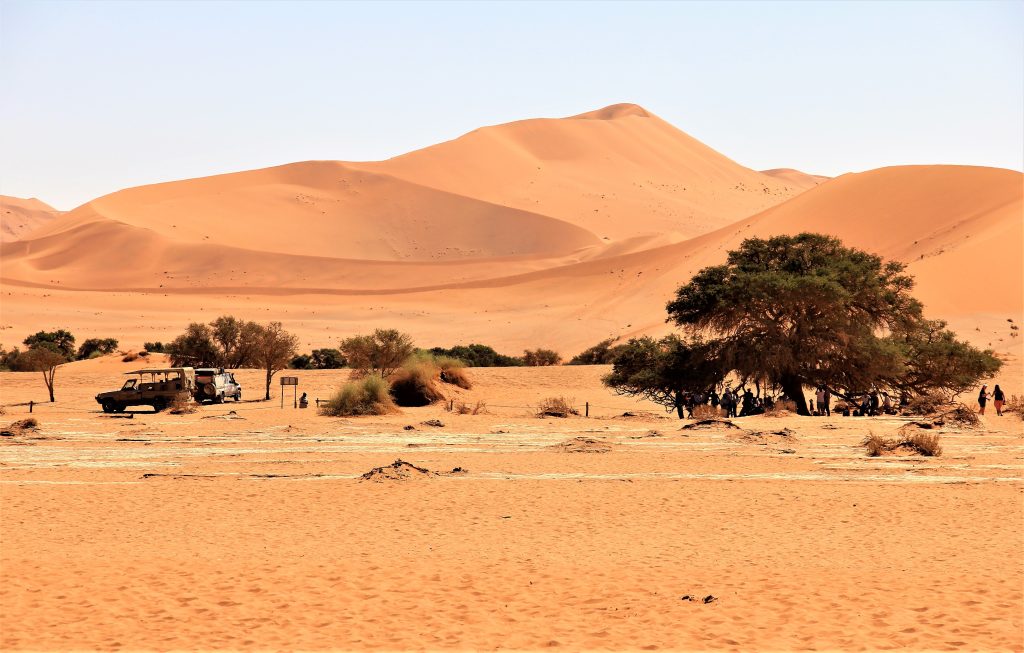
Sixty kilometres of tar running from the inner gate at Sesriem into the dune sea, following the dry Tsauchab riverbed with star dunes rising on both sides. In the first light after the gate opens it is among the most striking stretches of road anywhere.
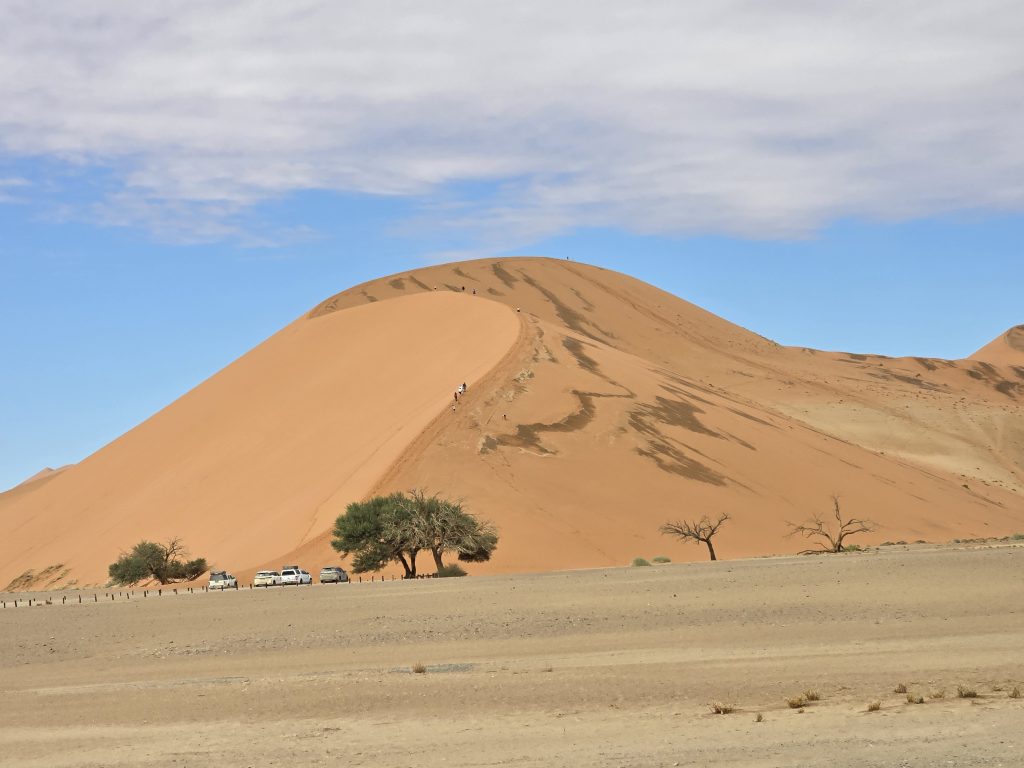
It is also the most controlled. The gate opening times dictate when you can be on it, and the first ninety minutes after sunrise are when the light works and everyone else is on it too. Dune 45 sits beside the road at the 45 kilometre mark.
The tar ends at the 2WD car park, and the final five kilometres to the pans is deep sand needing a real 4×4 or the shuttle. That short stretch is where more visitors get stuck than anywhere else in Namibia.
Tsaris Pass and the Roads into the Southern Namib
Tsaris Pass on the C19 climbs to around 1,670 metres and is among the highest roads in the country, linking the Sesriem area with the interior to the southeast. It is less dramatic than Spreetshoogte and considerably quieter, with long views over the plains from the top.
The wider network of gravel roads through this part of the south, running past the Tiras Mountains and NamibRand, is worth exploring without a fixed destination. Distances between fuel stops are long and settlements are few, so plan tank capacity around it.
These roads see a fraction of the traffic on the main routes. That is the appeal, and it is also the reason to tell someone where you are going.
Driving Safely on Namibia’s Scenic Gravel Roads
The roads that make these drives worth doing are the same ones that cause most visitor accidents. Gravel looks firm and invites speed, and loose stone over a hard base gives far less grip than the surface suggests. Rollovers from excessive speed or a sudden steering input are the most common serious accident involving travellers here.
Keep to 80 kilometres an hour at most and well below on bends, crests and descents. Both hands on the wheel. If the back steps out, ease off rather than braking. Stay on the graded surface when you pull over, because the edge is often a drop into soft sand.
Never drive these roads after dark. Kudu, oryx, warthog and unfenced livestock make night driving the single most avoidable risk on a Namibian road trip, and the scenery you came for is invisible anyway.
Best Time for Scenic Driving in Namibia
May to October gives predictable gravel, dry river crossings and clear air, which is what these drives need. Winter light is also lower and longer, which suits the passes and viewpoints.
The rains from November to April make gravel slippery and can wash out sections in the north, though the storm skies over the southern desert roads in October and November are worth photographing. Early morning and late afternoon are when any of these drives look their best, so build the day around the road rather than treating it as the gap between two lodges.
Vehicle Choice for Namibia’s Scenic Routes
An ordinary car handles Spreetshoogte, the Aus to Lüderitz road and the Sesriem dune road without difficulty in dry conditions. The C14 passes, the D707 and the salt road are all manageable in a two wheel drive and considerably more comfortable with higher clearance.
A proper 4×4 with low range is needed for the sandy stretch at Sossusvlei, the Kaokoland tracks and anything approaching Van Zyl’s Pass, which most rental agreements exclude anyway. Whatever you drive, hire a second spare tyre and take the tyre and windscreen waiver, since both are the items Namibian gravel damages most.
Namibia Scenic Driving Questions
What is the most scenic drive in Namibia?
Spreetshoogte Pass draws the strongest reactions, largely for the viewpoint at the top before the descent onto the Namib plain, and many travellers call it the best roadside view in the country. The D707 through the Namtib Desert is the favourite among people who have driven Namibia repeatedly, because it is constantly changing and almost empty. The C14 over the Gaub and Kuiseb passes is the one most visitors drive without planning to.
Do I need a 4×4 for Namibia’s scenic drives?
Not for most of them. Spreetshoogte, the B4 to Lüderitz and the tarred dune road at Sesriem are fine in any car, and the C14, the D707 and the salt road are all drivable in a two wheel drive in dry conditions. Higher clearance makes the gravel routes far more comfortable. A genuine 4×4 with low range is only required for the sand at Sossusvlei, Kaokoland tracks and extreme routes like Van Zyl’s Pass.
Is Spreetshoogte Pass dangerous?
Demanding rather than dangerous for a careful driver in a sound vehicle. Gradients reach 14 percent, the descent is a series of switchbacks and the drop on the outer edge is unforgiving. Use a low gear rather than riding the brakes, take it slowly and stop at the viewpoint rather than sightseeing while driving. Towing is not recommended, and heavy vehicles have had accidents here.
How fast should I drive on Namibian gravel?
The legal limit is 80 kilometres an hour on gravel and most experienced drivers here stay at 60 to 70. Loose stone over a hard base gives much less grip than the surface looks like it has, and rollovers from speed or sudden steering are the most common serious accident involving visitors. Slow further for bends, blind crests and descents, and treat a dust plume ahead as an oncoming vehicle.
Can I drive the salt roads on the coast in an ordinary car?
Yes when they are dry, and compacted salt drives very well. The problem is fog, which is a near daily occurrence on this coast and makes the surface genuinely slippery while cutting visibility. Slow down, use headlights and leave more distance. Inside Skeleton Coast National Park you also need a permit and must respect the gate times, which are stricter than most Namibian parks.
Which scenic drive should I add if I only have time for one?
Spreetshoogte Pass, because it sits directly on the Windhoek to Sossusvlei run that nearly every itinerary includes, so it costs you an hour or two rather than a day. The D707 needs a southern route to justify it and the salt road needs a coastal one. Spreetshoogte is the one you can add without redesigning the trip.
Are Namibia’s roads safe to drive?
The roads themselves are well maintained and quiet by international standards, and crime against drivers is uncommon. The accident rate is high though, and it is driven almost entirely by speed on gravel, by animals on unfenced roads after dark, and by fatigue on long empty stretches. Those three are all within the driver’s control, which is why careful visitors have straightforward trips.
Booking Your Namibia Trip
The safari companies and tour operators listed on this website put trips like this together for a living and know which camps, guides and routes actually deliver. We are an independent guide to Namibia; we do not book or sell tours ourselves.
When you are ready, arrange your safari, tour or holiday with one of the recognised operators listed here. Tell them your dates and what matters most, and a real person, not a form, will handle the itinerary, park bookings and logistics for you.