Warthog in Namibia
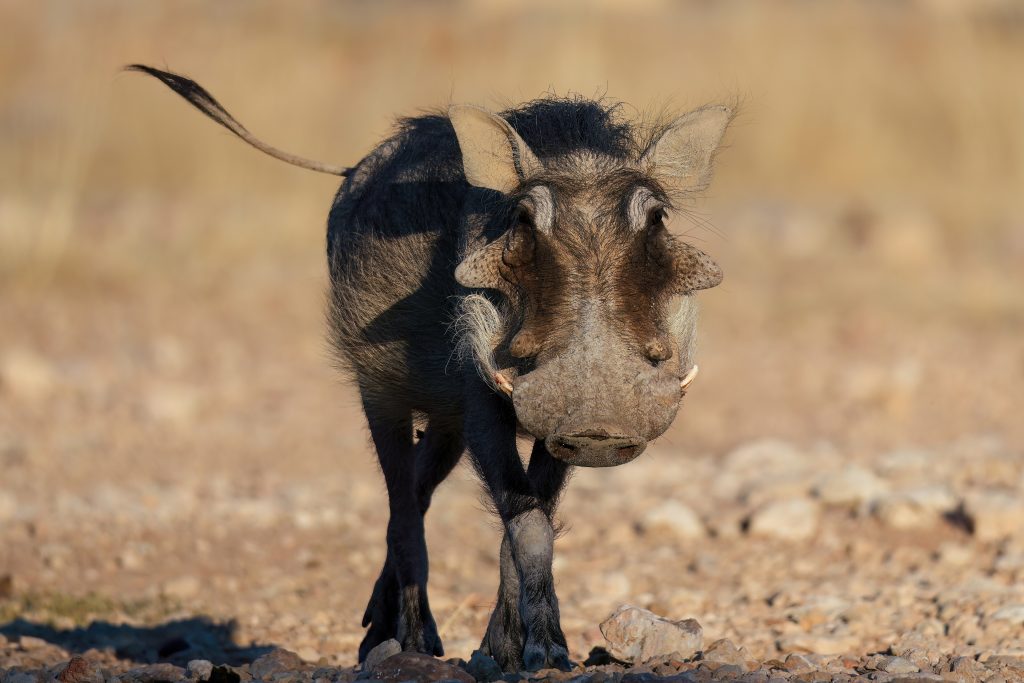
Warthogs are among the most frequently seen animals in Etosha and among the least photographed, which is a mistake. Namibia holds the southern subspecies of the common warthog, which kneels on padded wrists to graze, reverses into burrows so its tusks face the entrance, and runs at up to 50 kilometres an hour with its tail held vertical.
Which Warthog Lives in Namibia
This needs clearing up because published sources get it wrong.
Namibia holds the common warthog, Phacochoerus africanus, and in particular the southern subspecies found across South Africa, Botswana, Zimbabwe and Namibia. It is well adapted to both savanna and woodland and is the animal you will see throughout Etosha and the north.
The desert warthog, Phacochoerus aethiopicus, is a separate species confined to the Horn of Africa in Somalia, Ethiopia and parts of Kenya. It does not occur in Namibia. At least one widely circulated article captions a Namibian photograph as a desert warthog, which is incorrect and worth knowing if you are checking a sighting against what you have read.
Adults measure 0.9 to 1.5 metres head to body, stand 63 to 85 centimetres at the shoulder and weigh between 55 and 150 kilograms, with boars considerably larger than sows.
Kneeling to Graze
The behaviour visitors notice first is a warthog eating on its knees, and there is a good reason for it.
Warthogs have short necks and relatively long legs, which makes reaching short grass awkward. Rather than splaying, they drop onto their front wrists, which carry thick protective pads, and shuffle forward while grazing. Those pads develop early and are a genuine anatomical adaptation rather than a habit.
They also dig, using a tough disc on the snout to loosen soil with head swings and turn up roots, bulbs, rhizomes and tubers. In hard conditions they will use the tusks for the same job.
Diet is mostly grass, supplemented by roots and bulbs, and extended when necessary to fruit, berries, insects, eggs, carrion and even bones and dung for minerals. They are not fussy, and that flexibility is part of why they do well in country as dry as Namibia.
Burrows and Reversing In
Warthogs rarely dig their own burrows. They take over abandoned aardvark holes and natural cavities, and a home range usually contains several.
The burrow does two jobs. It shelters them from temperature extremes, which matters in a place where midday can be well over 35 degrees and the same night can drop close to freezing, and it is where sows raise piglets.
The famous part is how they enter. A warthog goes into a burrow backwards, tail first, so that its head and tusks face the entrance. Anything following it down the hole meets four tusks in a narrow tunnel, which is a considerable deterrent.
Watching a family disappear into a hole in reverse order, at speed, is one of the more entertaining sights in Etosha, and it happens the moment they decide something is wrong.
Wait at a burrow entrance in the early morning rather than driving on. Warthogs emerge at a rush, often at speed and in single file, and the sequence of animals bursting out of a hole in the ground makes better photographs than anything you will get of them grazing. They are creatures of habit and use the same holes repeatedly.
Sounders, Boars and Social Life
Female warthogs are sociable and live in matriarchal groups called sounders, usually one or two adult sows with their young. Sounders occupy home ranges near water but do not defend territory.
Young males form loose bachelor groups, and on reaching adulthood they mostly go their own way and live solitary lives, joining sounders only during the rut.
They are noisy. Grunts, snorts, squeals and growls carry between animals constantly, and a group at a waterhole is rarely quiet.
Breeding is seasonal, with rutting beginning in the late rainy or early dry season and births timed near the start of the following rains. Gestation runs around 170 to 175 days. Sows can suckle up to eight piglets though two to four is the usual number raised, and the young are born and kept in burrows.
Boars use two strategies during the rut: staying with and defending particular sows, or roaming in search of females in oestrus. Dominant boars displace rivals and will wait outside a burrow for a sow to emerge.
Tusks, Warts and Defence
The four tusks are enlarged canines rather than anything exotic, with the upper pair curving outwards and the lower pair shorter and considerably sharper, sharpened against the uppers every time the animal chews.
The lower tusks are the dangerous ones. Boars carry larger tusks than sows, and both use them in defence and in fights.
The warts are protective pads of thickened skin on the face, and males carry more of them than females. Their function is thought to be shielding the face during fights between boars, which involve head to head shoving rather than slashing.
Faced with danger, a warthog would rather run than fight. They reach up to 50 kilometres an hour and run in a zigzag, with the tail held straight up like a flag so that group members can follow one another through grass. Cornered or protecting piglets, they will use the tusks, and a boar is genuinely capable of injuring a predator.
Predators and the Ecosystem
Warthogs are a key prey species across their range and in Namibia they feature in the diet of lion, leopard, cheetah and spotted hyena, with piglets taken by smaller predators and raptors.
Their eyes sit high on the head, which lets them watch for danger while the snout is down in the grass, and their hearing and sense of smell are both excellent. Eyesight is comparatively poor, which is why a warthog will sometimes trot right up to a stationary vehicle before registering it.
Their digging has effects beyond feeding. Turning soil constantly aerates ground and creates small hollows that collect rainwater, which supports plant growth and other species in dry country. Along with aardvark, they are among the more consequential soil engineers in the Namibian bush.
Warthogs and Wallowing
Warthogs have very little hair and no meaningful layer of subcutaneous fat, which leaves them poorly insulated against both heat and cold. Much of their daily behaviour follows from that.
Wallowing is the main response to heat. They find mud, roll in it thoroughly, and let it dry, which cools the skin as it evaporates and forms a crust that deters biting flies and ticks. Afterwards they rub against a tree trunk or termite mound to scrape it off, taking parasites with it. Rubbing posts get heavy use and are often polished smooth at warthog height.
The burrow answers the opposite problem. Namibian nights in winter drop close to freezing and a hairless animal loses heat fast, so warthogs go underground before dark and stay there. Piglets in particular depend on it.
Oxpeckers work over warthogs regularly, taking ticks from the skin, and a warthog will stand still and let them get on with it. Both red billed and yellow billed oxpecker occur in Namibia.
Where to See Warthogs in Namibia
Etosha. Common throughout, particularly around waterholes and the pan edges where the open terrain makes them easy to spot. Often the first mammal visitors see.
Rest camps and lodges. Warthogs graze freely inside fenced camps at Okaukuejo, Halali and Namutoni, often on the lawns, entirely untroubled by people.
Zambezi Region. Present through Bwabwata, Mudumu and Nkasa Rupara in wetter country with more cover than the north central parks.
Private reserves and farms. Widespread across the central highlands, on guest farms and reserves, where they are among the most visible resident species.
Best Time to See Warthogs
Warthogs are diurnal, which makes them one of the easier animals to see in Namibia. They are active through the day and return to burrows before dark, so no night drive is needed.
Early morning is the best window, both because they emerge from burrows at a rush and because they come to water early. Mid morning finds them grazing on their knees in the open, which is the classic image.
Through the dry season from May to October they concentrate near water like everything else, and mud wallows become focal points, since warthogs wallow to cool down and reduce biting insects before rubbing the mud off against a tree or termite mound.
Warthog Questions
Why do warthogs kneel to eat?
Because their necks are short and their legs relatively long, which makes reaching short grass awkward. They drop onto their front wrists, which carry thick protective pads that develop early and are a genuine anatomical adaptation, then shuffle forward while grazing. They kneel to dig for roots and bulbs too, using a tough disc on the snout to loosen soil.
Why do warthogs go into burrows backwards?
So their tusks face the entrance. A warthog reversing into a hole tail first ends up with its head and four tusks pointed at anything that follows, which in a narrow tunnel is a serious deterrent. They rarely dig their own burrows, instead using abandoned aardvark holes, and a home range usually contains several that the group uses repeatedly.
Are there desert warthogs in Namibia?
No. Namibia holds the common warthog, southern subspecies. The desert warthog is a separate species confined to the Horn of Africa in Somalia, Ethiopia and parts of Kenya. At least one widely circulated article captions a Namibian photograph as a desert warthog, which is incorrect. If you photograph a warthog in Namibia, it is a common warthog.
Are warthogs dangerous?
They prefer to run and will reach up to 50 kilometres an hour in a zigzag rather than confront anything. Cornered, or with piglets to protect, a boar can injure a predator or a person with the lower tusks, which are shorter and considerably sharper than the upper pair. In camps where they graze freely on lawns they are relaxed around people, and the sensible response is still to give them space.
What are the warts on a warthog?
Protective pads of thickened skin on the face rather than growths in any medical sense. Males carry more than females, and the function is thought to be shielding the face during fights between boars, which involve head to head shoving rather than slashing with the tusks. Along with the tusks they are what distinguishes warthogs from bushpigs.
Why does a warthog run with its tail up?
The vertical tail acts as a flag so that group members can track one another while running through grass, which matters for a sounder of sows and piglets escaping together at speed. Piglets cluster tightly and follow the adults during a rapid escape, and the raised tails give them something to follow when visibility at ground level is poor.
Where are warthogs easiest to see in Namibia?
Etosha, where open terrain and waterhole concentrations make them one of the most frequently seen animals in the park. They also graze freely inside the fenced rest camps at Okaukuejo, Halali and Namutoni, often on the lawns and quite untroubled by people. Being diurnal, they need no night drive, which is unusual among the animals covered in this series.
Booking Your Namibia Trip
The safari companies and tour operators listed on this website put trips like this together for a living and know which camps, guides and routes actually deliver. We are an independent guide to Namibia; we do not book or sell tours ourselves.
When you are ready, arrange your safari, tour or holiday with one of the recognised operators listed here. Tell them your dates and what matters most, and a real person, not a form, will handle the itinerary, park bookings and logistics for you.