Omaruru
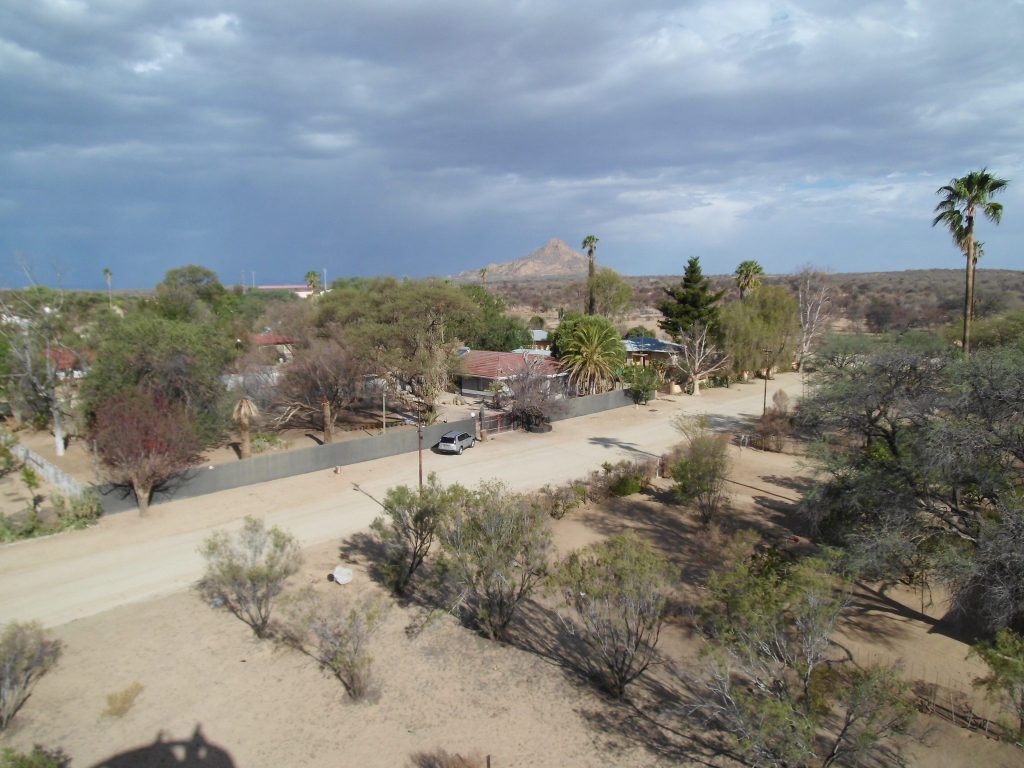
Omaruru is Namibia’s arts town and the site of its first winery, a settlement of around 14,000 people strung along a usually dry riverbed lined with camel thorns, halfway between Swakopmund and Etosha. Kristall Kellerei began operating in 1990, the year of independence, and took its first harvest in 1995. The name means bitter milk.
Why It Is Worth Stopping
Omaruru is one of the few Namibian towns that rewards a night rather than a fuel stop, and the reason is what has grown there.
It started as a mission station, founded by Gottlieb Viehe in 1872, and has reinvented itself as the country’s small town arts capital: galleries, studios, craft workshops and a food and drink scene that no other Namibian town of this size approaches.
Root wood carving, wine, chocolate and cheese are all produced locally, which is an unlikely combination in a place this dry.
Its position helps. Omaruru sits between Swakopmund and Otjiwarongo, on the route from the coast towards Etosha, and close to the Erongo Mountains.
The name comes from Otjiherero and is usually translated as bitter milk, a reference to the taste of milk after cattle had eaten the bitter bush that comes up quickly after rain.
Give Omaruru an overnight rather than an hour. It is the only Namibian town where you can spend an afternoon on a winery veranda with a cheese platter, watch woodcarvers working, buy locally made chocolate and eat somewhere genuinely good, all within a few kilometres. Travellers who treat it as a fuel stop between the coast and Etosha miss the point of the place entirely.
Kristall Kellerei
Namibia’s first winery sits about four kilometres east of town on the D2328 and it is a genuinely odd thing to find here.
The founders decided in 1989 to experiment with Colombard, a French white grape still grown in southwestern France, and operations began in 1990 with the first harvest in 1995.
The conditions are unlike any European wine region: a desert climate with around 330 days of sunshine a year. The Colombard copes with it, retaining acidity even with the high sugar content that constant sunlight brings, and recent editions have reached alcohol levels of 15 to 17 percent, which surprises most wine people.
The estate has run around four hectares under vine across two varieties, Colombard and Ruby Cabernet, and produces a red blend alongside the white.
It also makes brandy, schnapps, gin and liqueurs, with some distilling now done at Naute Dam in the south.
A tavern opened in 2000. Tastings, cheese and cold meat platters and tours of the cellar and garden are available, and lunch on the veranda is the standard way to spend a midday here.
A Note on Namibian Wine
This is worth clarifying because published descriptions conflict.
Older sources describe Kristall Kellerei as the only wine cellar in Namibia while more recent ones call it one of very few. A small Namibian wine industry also operates near Naute Dam in the south.
The estate’s focus has shifted over time, with more recent accounts describing it as concentrating on gin and liqueurs distilled at Naute Dam alongside the wine.
Drought has affected production. A long dry spell hit the wineries and the vegetable growing Omaruru was known for, and the Omaruru River flowed properly for the first time in eight years after good summer rains, recharging the underground aquifer.
The practical point for a visitor is that this is a small operation subject to real conditions, so check what is available rather than assuming a fixed range.
Products can be bought at the winery, at a warehouse in Omaruru and in Windhoek.
The Arts and Crafts
The carving is what Omaruru is known for and it is visible from the moment you arrive.
A tall wooden giraffe marks the entrance to town, part of the Tikoloshe carvings. Tikoloshe Afrika is a gallery and workshop where award winning woodcarvers work in the root wood of the mopane tree, and visitors can watch.
Root carving is distinct from the woodwork of the Kavango region, using the twisted underground forms of the tree rather than straight timber.
Galleries and studios are strung along the main street, and the town runs annual arts and crafts events worth timing a visit for.
The Dörgeloh chocolate factory produces locally made chocolate, which is another improbable thing to find in this country.
Sand Dragon on the main street is the café that anchors the town socially, supporting local artists and selling regional products alongside its food.
Franke Tower and the History
The tower is the town’s monument and it commemorates a colonial military action.
Franke Tower was built in 1908 in honour of relief troops led by Hauptmann Franke, sent to defend the town during the fighting between Herero forces and German colonial troops in the early nineteen hundreds.
It is a national monument and can be climbed for a view over the town and riverbed.
Like the fort at Sesfontein and the buildings of Swakopmund and Lüderitz, it sits inside the history of German colonial rule and the genocide that followed the 1904 rising, rather than beside it.
The Omaruru museum tells the town’s story, and its curator is described as passionate about doing so.
An unexpected strand of that history: Swedes were the leading traders and largest foreign group in the territory during the town’s early recorded period in the late eighteen eighties, though little trace of that remains today.
Around the Town
Several things within short driving distance justify the overnight.
The Erongo Mountains sit close by, holding rock art including the White Elephant at Phillip’s Cave, granite formations, dinosaur tracks and some of the richest ecology in Namibia. Lodges west of Omaruru sit within the conservancy.
Dinosaur footprints at Otjihenamaparero are among the local attractions and are reachable on a day trip.
Waldfrieden, a Benedictine monastery, sits just outside town.
Guest farms and lodges in the surrounding country offer game drives, walks and rock art visits, and this is game and hunting farm country.
The Erongo Mountain Nature Conservancy, formed by around 30 landowners dropping their fences across roughly 2,000 square kilometres, is the wider conservation context.
Food and Produce
For a town of 14,000 in dry country, the food is the surprise.
Cheese is made locally, and platters at the winery pair it with cold meats, pickles, chutneys and home made breads, with the manageress able to say which farm each cheese came from and who made it.
The Dörgeloh chocolate factory produces chocolate in a country where almost nobody does, and it is sold in town.
Sand Dragon on the main street is the café that holds the town together socially, supporting local artists and selling regional products alongside its food, and it is the gathering place for families and the artist community both.
Omaruru was known for vegetable production before a long drought hit it, alongside the wineries. Good summer rains recently put water back in the river for the first time in eight years, recharging the aquifer that the growing depends on.
Between the wine, the cheese, the chocolate and the carving, Omaruru produces more than any comparable Namibian town, which is the thing that makes it worth an overnight.

The Erongo on the Doorstep
Omaruru is one of two natural bases for the Erongo massif, alongside Usakos to the south, and the mountains are the reason to stay more than one night.
The Erongo is the eroded remains of a volcano that collapsed in on itself between roughly 110 and 130 million years ago, leaving a granite core standing after the softer rock eroded away. The boulder fields and domed hills are what remain.
Rock art is the draw. Phillip’s Cave on the farm Ameib holds the White Elephant, a large white figure with a red antelope superimposed across it, and stone tools found there date to around 3500 BC.
Bull’s Party and Elephant’s Head, clusters of enormous rounded granite boulders, sit nearby and photograph best in early or late light.
Birding is strong, with between 200 and 260 species recorded and several of Namibia’s near-endemics present including Hartlaub’s spurfowl, the rockrunner, Carp’s tit and Monteiro’s hornbill.
Lodges west of Omaruru sit inside the conservancy and run guided walks to painting sites, which is the practical way to see the art.
Practical Omaruru
Position. Around 2.5 hours northwest of Windhoek on tar, roughly halfway between Swakopmund and Etosha, and close to the Erongo Mountains.
Services. Fuel, shops, banks and restaurants. A working town rather than a tourist one, with the practical things a self drive trip needs.
Accommodation. Guest farms and lodges in the surrounding country, plus options in town. Erongo conservancy properties are within easy reach.
Best for. A first or last night of a Namibian trip, or a break on the run between the coast and the north.
Best Time to Visit
Omaruru works year round and the season is dictated by the wider trip rather than the town.
May to September gives comfortable days for walking in the Erongo and cool evenings, with nights genuinely cold in winter.
Summer from October to March brings heat, and the granite of the Erongo radiates it well into the evening, so walking should be early.
The rains green the country considerably and, in a good year, put water in the Omaruru River, which is a rare enough event to be worth seeing.
Annual arts and crafts events are worth checking dates for if the town’s creative side is the draw.
Omaruru Questions
Is there really a winery in Namibia?
Yes. Kristall Kellerei, four kilometres east of Omaruru on the D2328, began operating in 1990 and took its first harvest in 1995, growing Colombard and Ruby Cabernet under a desert climate with around 330 days of sunshine. Recent editions have reached 15 to 17 percent alcohol. It also produces brandy, schnapps, gin and liqueurs, with tastings and platters on the veranda.
What does Omaruru mean?
Bitter milk, in Otjiherero, referring to the taste of milk after cattle had eaten the bitter bush that comes up quickly following rain. The town began as a mission station founded by Gottlieb Viehe in 1872 and now holds around 14,000 people, strung along a usually dry riverbed lined with camel thorn trees.
What is Omaruru known for?
Arts and crafts, particularly root wood carving in mopane. Tikoloshe Afrika is a gallery and workshop where award winning carvers work and visitors can watch, and a tall wooden giraffe marks the entrance to town. Beyond that, Namibia’s first winery, locally made chocolate, cheese, galleries and studios along the main street, and annual arts events.
What is Franke Tower?
A national monument built in 1908 honouring relief troops led by Hauptmann Franke, sent to defend the town during fighting between Herero forces and German colonial troops. It can be climbed for a view over the town and riverbed. Like other German colonial buildings in Namibia, it sits inside the history of the 1904 rising and the genocide that followed.
How long should I stay?
An overnight rather than an hour. It is the only Namibian town where you can spend an afternoon on a winery veranda, watch woodcarvers working, buy locally made chocolate and eat somewhere genuinely good, all within a few kilometres. Travellers treating it as a fuel stop between the coast and Etosha miss the point of the place.
What is near Omaruru?
The Erongo Mountains, holding rock art including the White Elephant at Phillip’s Cave, granite formations and dinosaur tracks, with lodges in the surrounding conservancy of around 2,000 square kilometres formed by 30 landowners dropping their fences. Dinosaur footprints at Otjihenamaparero, and the Benedictine monastery at Waldfrieden just outside town.
Where does it fit on a route?
Around 2.5 hours northwest of Windhoek on tar, roughly halfway between Swakopmund and Etosha, which makes it a natural break on that run or a first or last night of a Namibian trip. It is close enough to the capital to reach easily and far enough out to feel like the trip has started.
Booking Your Namibia Trip
The safari companies and tour operators listed on this website put trips like this together for a living and know which camps, guides and routes actually deliver. We are an independent guide to Namibia; we do not book or sell tours ourselves.
When you are ready, arrange your safari, tour or holiday with one of the recognised operators listed here. Tell them your dates and what matters most, and a real person, not a form, will handle the itinerary, park bookings and logistics for you.