Namibia Travel FAQ

The five things that catch travellers out in Namibia are the visa, the driving times, the cold nights, the single vehicle accident clause and the Sesriem gate. Everything else is manageable with ordinary planning. This page answers the questions that come up repeatedly and points to the detail elsewhere.
The Five Things Most People Get Wrong
If you read nothing else, read this.
The visa. Namibia introduced a reciprocal visa regime from 1 April 2025, affecting nationals of 32 countries that previously entered visa free, including most of Europe, the UK, the US, Canada and Australia. It costs N$1,600, roughly 90 US dollars. A great deal of published advice still says Namibia is visa free.
Driving times. Plan at 100 kilometres an hour on tar and 50 to 60 on gravel, not the speeds a map implies. Itineraries built on optimistic figures produce arrivals after dark, which is the single largest risk here.
Cold nights. Desert and Etosha temperatures drop close to freezing between May and August, and visitors packing for Africa arrive without a jacket. The floodlit waterhole platforms are outdoors and unheated.
Insurance. Basic rental cover frequently excludes single vehicle accidents, meaning rolling on gravel or swerving to avoid a kudu, which is how Namibian accidents happen. Standard excess is commonly N$40,000.
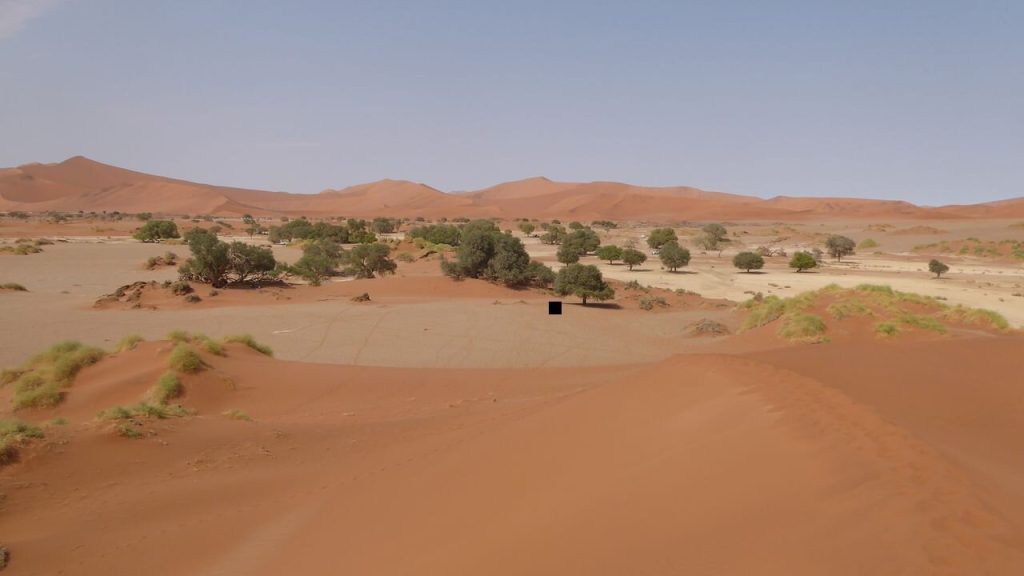
The Sesriem gate. Four properties sit inside it and the inner gate opens an hour before the outer one, which decides whether you photograph Deadvlei in shadow or in flat light behind a queue.
Book two things first and build the trip around them: accommodation inside the Sesriem gate, and rest camps inside Etosha. Both give you access nobody outside can buy, both book out six months ahead for peak season, and both are available at camping rates. Everything else in a Namibian itinerary can be arranged later.
Getting There and In
Hosea Kutako International, about 40 kilometres east of Windhoek, handles nearly all international arrivals, with most routings connecting through Johannesburg, Frankfurt or Addis Ababa.
Visas can be obtained online in advance through the Ministry of Home Affairs portal, with processing running three to ten working days, or on arrival at main entry points. The cost is the same and the queue is not.
You need a passport valid six months beyond departure with blank pages, proof of accommodation, a return ticket, insurance and proof of funds.
Children need a full unabridged birth certificate showing both parents, plus a parental consent letter if travelling with one parent. Airlines enforce this at check in, so a family without it can be refused boarding at home.
Yellow fever vaccination is not required for Namibia itself, only if arriving from or transiting more than 12 hours through a risk country.
Money
Namibia uses the Namibian dollar, pegged one to one with the South African rand, and both circulate freely here.
The asymmetry catches people: rand works in Namibia, Namibian dollars do not work in South Africa. Spend or exchange your Namibian change before leaving, since doing it inside Namibia is commission free.
Cards work in Windhoek, Swakopmund and larger towns. Outside them, cash is frequently the only option, including at community campsites, village fuel stations and several park sites. Twyfelfontein is cash only.
ATMs are plentiful in towns and scarce outside them. Withdraw in the last substantial town before Damaraland, Kaokoland, the northeast or the far south.
Tipping is customary: around ten percent in restaurants, a few Namibian dollars for petrol attendants and car guards, and more substantially for guides.
Health
Malaria risk is regional rather than national. High risk exists year round along the Kunene, Zambezi and Okavango rivers. Seasonal risk exists in the northern regions from about November to June. The coast, Namib, south and central plateau including Windhoek are close to risk free.
Etosha sits in a low risk zone considered lowest in winter, and guidance differs between authorities, so take your specific route and dates to a travel clinic.
The realistic health issues for most visitors are sun and dehydration rather than anything exotic. Carry four to five litres per person per day on active days.
Medical facilities are adequate in Windhoek and larger towns and thin elsewhere. Comprehensive insurance including evacuation is not optional.
Tap water in towns is treated and safe. In rural areas and remote parks it should be boiled or treated.
Driving
Namibia drives on the left. An international driving permit alongside your national licence is advisable.
A two wheel drive handles the main circuit in the dry season. A 4×4 is needed for the last five kilometres to the Sossusvlei pans, Sandwich Harbour, Kaokoland, Khaudum and the Zambezi park tracks.
Never drive after dark outside towns. Kudu jump into headlights, unfenced livestock wander onto tar, and most rental agreements prohibit it.
If an animal is in the road, brake in a straight line rather than swerving. Swerving turns a collision into a rollover, and a rollover is the single vehicle accident your insurance may not cover.
Fill at every town. Outjo before Etosha, Opuwo before the northwest, Grootfontein before the northeast, Aus before Lüderitz.
Download offline maps. Coverage is good in towns and on main routes and absent across large areas.
When to Come
May to October is the dry season and the main window, with July to September strongest for wildlife as water disappears and animals concentrate.
April, May, September and October sit between the extremes and are frequently the most pleasant: settled weather, comfortable temperatures, fewer people and lower rates.
November to April is the green season, bringing heat above 40 degrees inland, dramatic storm cloud, calving, migrant birds and considerably lower rates, against dispersed wildlife and a northeast that floods.
Birding peaks when game viewing is worst, which is the central tension for anyone wanting both.
The coast runs its own weather at 15 to 25 degrees year round, and is the refuge when the interior is unbearable.
How Long and Where
Four places anchor almost every itinerary: Sossusvlei, Swakopmund, Etosha and Damaraland.
Seven days means two anchors done properly. Ten days covers all four at two to three nights each, which is the standard trip. Fourteen adds the south or the northwest. Twenty one reaches the Zambezi Region, Kaokoland or a combination with Botswana.
Fewer places with more nights beats the reverse. Namibian driving days are long and arriving somewhere is not the same as seeing it.
Give each anchor three nights rather than two if choosing between adding places and adding time.
Most travellers self drive, which the country is set up for, with guided tours and fly in circuits the alternatives.
What to Pack
The packing problem in Namibia is a forty degree temperature swing in a single day, and almost nobody arrives prepared for it.
Warm layers are what visitors most often lack. A fleece or down jacket, windproof shell, long trousers and a warm hat are needed from May to September, and the Etosha waterhole platforms are outdoors and unheated.
Sun protection is needed in every month. Namibia gets around 300 days of sun a year, the dry air means you do not notice sweating, and glare comes off sand and gravel from below and above. A wide brimmed hat beats a cap.
Closed walking shoes with grip, since Namibian terrain is rock, gravel, thorn and sand, and sandals are inadequate everywhere except the beach.
Neutral coloured clothing rather than bright, which matters on walking safaris and hides dust better. Avoid camouflage patterns, which are frowned upon across the region.
A soft duffel rather than a hard case if any leg involves a light aircraft, where limits are commonly around 20 kilograms including hand luggage.
Type D and M plug adapters, the large round pin South African style, running on 220 to 240 volts. Travellers arriving with only European or UK adapters cannot charge anything.
Common Misconceptions
Namibia is visa free. Not since April 2025 for nationals of 32 countries including most of Europe, the UK, US, Canada and Australia. Older articles have not caught up.
You can see the Big Five at Etosha. Four of them. Buffalo are excluded entirely on veterinary grounds and occur only in the Zambezi Region.
Namibia is the cheap option. It costs about the same as South Africa. It is considerably cheaper than Botswana, and camping makes it cheaper still.
Africa is hot. Winter nights in the desert and at Etosha drop close to freezing, and the coast sits at 15 to 25 degrees year round.
Things Nobody Tells You
A short list of specifics that come up repeatedly.
Kolmanskop permits must be bought the day before at the tourist office in Lüderitz, not at the gate, and photography permits allow earlier access than the standard tour.
The Welwitschia Drive needs a permit obtained beforehand from Ministry offices, since there is no gate to pay at.
Guides at Twyfelfontein are compulsory and tips are their only income.
Day visitors cannot descend into Fish River Canyon at all; the trail runs 1 May to 15 September with a permit, medical certificate and minimum party of three.
Khaudum requires two 4x4s in convoy, three days of food per person and 100 litres of water per vehicle.
Ballooning at Sossusvlei closes from 15 January to 15 February.
Switch geotagging off before photographing rhino, since Namibia’s black rhino live on unfenced land with no perimeter.
Namibia Travel Questions
Do I need a visa for Namibia?
Almost certainly, if you hold a European, British, American, Canadian or Australian passport. Namibia introduced a reciprocal visa regime from 1 April 2025 affecting nationals of 32 countries that previously entered visa free. It costs N$1,600, roughly 90 US dollars, the same whether obtained online in advance or on arrival, with children under six exempt from the fee.
Is Namibia safe?
Relatively, and safer than most African countries. The realistic risks are driving, sun and dehydration rather than crime or wildlife. Urban crime in Windhoek, Swakopmund and Walvis Bay is mostly opportunistic. Outside the towns crime is rarely an issue and the risks become mechanical and environmental instead, which is why breakdown preparation matters more than personal security.
How long do I need?
Ten days for the four anchors of Sossusvlei, Swakopmund, Etosha and Damaraland at two to three nights each, which is the standard trip. Seven days means choosing two and doing them properly. Fourteen adds the south or the northwest comfortably. Fewer places with more nights beats the reverse, since Namibian driving days are long.
Do I need a 4×4?
Not for the main circuit in the dry season, where a two wheel drive handles Windhoek, Sesriem, Swakopmund, Damaraland’s main roads and Etosha at lower rental and fuel cost. A 4×4 is needed for the last five kilometres to the Sossusvlei pans, where a shuttle runs from the 2WD car park, and for Sandwich Harbour, Kaokoland, Khaudum and the Zambezi park tracks.
What is the biggest planning mistake?
Optimistic driving times. Plan at 100 kilometres an hour on tar and 50 to 60 on gravel, then add stops. Itineraries built on map speeds produce arrivals after dark, which is the single largest risk in Namibian travel given kudu, unfenced livestock and the fact that most rental agreements prohibit night driving.
What should I book first?
Accommodation inside the Sesriem gate and rest camps inside Etosha. Both give access nobody outside can buy: an hour’s head start to Deadvlei, and floodlit waterholes producing black rhino most nights. Both book out six months ahead for peak season, and both are available at camping rates. Everything else can be arranged later.
Can I drink the tap water?
In towns, yes, since it is treated and most travellers drink it without problems, which removes the bottled water line entirely. In rural areas, campsites and remote parks it may come from boreholes or springs and should be boiled or treated, with some parks including Khaudum stating this explicitly. Carry far more drinking water than you think regardless.
Booking Your Namibia Trip
The safari companies and tour operators listed on this website put trips like this together for a living and know which camps, guides and routes actually deliver. We are an independent guide to Namibia; we do not book or sell tours ourselves.
When you are ready, arrange your safari, tour or holiday with one of the recognised operators listed here. Tell them your dates and what matters most, and a real person, not a form, will handle the itinerary, park bookings and logistics for you.